Canon Announces the Canon RF 14mm f/1.4L VCM

Lenzbuddy has custom front lens caps, from 43 to 95mm, prices from $13 to $ 20, depending on the amount of information you want on the cap.

I’m not commenting on those particular caps, but, I did once buy a replacement from cap on eBay and it turned out to have raised lettering on the inner face of the cap. I didn’t notice at the time but the real caps have indented lettering.

I have a habit of straightening the cap orientation after attaching it, which ended up rubbing the coating off the front lens element. Right in the centre of the lens. I only noticed during a trip to Namibia, where it caused ghosting and flair in my pictures. Cost me £180 to have the front element replaced. I’ve been wary of replacement caps since.
 
Upvote 0
ND is pretty much the only thing one would use in a rear gel holder these days (since color correction and effects are handled in post processing with digital).

I still have most of a sheet of 10-stop, enough to cut out another 3-4 pieces.

View attachment 227905

Canon has a downloadable template to cut the filter for the holder:

Not sure if $125 is ‘huge cost’ for you (it’s similar to a 77mm round filter and you can cut several rear filters from one piece). B&H has several densities in stock (1, 2, 3, 6.6 and 10 stop). Here’s the 10-stop that I have:
They’re not available here in the UK (at least I couldn’t find any). Once I added delivery $20, and taxes, 20%. It got expensive.

I’ve bought some clip in ND filters that will work with any lens. Not the magnetic ones.
 
Upvote 0
I’ve bought some clip in ND filters that will work with any lens. Not the magnetic ones.
I have a set of the Kolari magnetic NDs (3-, 6- and 10-stop) that I use with my R8 (had to install the metal mount plate in it) and the R1 (no plate needed). That's why I have not bothered cutting another piece out of the 10-stop gel filter (I did cut a piece from it for the rear slot of the Ef 11-24/4L).
 
  • Like
Reactions: 1 users
Upvote 0
The size of the entrance pupil of a 35mm at f1.4 is much larger (25mm) than the size of the entrance pupil of a 14mm at f1.4 (10mm). The larger entrance pupil collects more light.

Clarkvision has an explanation with examples.
No it does not. Look at Clarkvision's equation 1: light collection ∝ t * sensor_area / (f_ratio)2
The amount of light collected is proportional to the exposure time, the sensor area, and the inverse of the fstop squared. It is not proportional to the size of the entrance pupil or the focal length. Rather, it is proportional to the exposure settings (fstop, exposure time) as I pointed out in my original post.

Think of it this way. Suppose you point your camera at the stars, and suppose we have an evenly distributed star field. With a 14 mm lens, there are many more stars beaming light at your lens than there are if you had the 35 mm lens mounted. So even though the 14 mm lens has a smaller entrance pupil, it captures the same amount of light as a 35 mm lens with a larger opening does.

Now, we are talking total amount of light. On the other hand, if we have a subject with a limited size (moon, stars) then it does come down to entrance pupil size. With a longer focal length, a larger area of the sensor needs to be illuminated, which requires more light. This is the old pixels-per-duck argument.
For subjects of limited size, Clarkvision has the following equation:

The light collected from an object covering angular area Omega, Ω, e.g. the Moon, a star,a bird in a tree, a person's face, or any other object is

Light Collected = EtST ∝ A * Ω(object) * T * SE (equation 4)

where
EtST = Etendue (Et) times System efficiency (S) times exposure Time (T),
Etendue = A * Ω, also called the A Omega product,
A = lens aperture area (more precisely, the lens entrance pupil area),
A = pi * D2 /4. where D = Lens diameter (entrance pupil diameter),
D = aperture diameter = focal length / f-ratio,
pi = 3.14159,
Ω (Omega) is the solid angle of the object,
T is the exposure time, and
SE= system efficiency = optics transmission * fill factor * quantum efficiency.
So for objects of limited size, the light collected is proportional to the entrance pupil size.
 
Upvote 0
No it does not. Look at Clarkvision's equation 1: light collection ∝ t * sensor_area / (f_ratio)2
The amount of light collected is proportional to the exposure time, the sensor area, and the inverse of the fstop squared. It is not proportional to the size of the entrance pupil or the focal length. Rather, it is proportional to the exposure settings (fstop, exposure time) as I pointed out in my original post.

Think of it this way. Suppose you point your camera at the stars, and suppose we have an evenly distributed star field. With a 14 mm lens, there are many more stars beaming light at your lens than there are if you had the 35 mm lens mounted. So even though the 14 mm lens has a smaller entrance pupil, it captures the same amount of light as a 35 mm lens with a larger opening does.

Now, we are talking total amount of light. On the other hand, if we have a subject with a limited size (moon, stars) then it does come down to entrance pupil size. With a longer focal length, a larger area of the sensor needs to be illuminated, which requires more light. This is the old pixels-per-duck argument.
For subjects of limited size, Clarkvision has the following equation:


So for objects of limited size, the light collected is proportional to the entrance pupil size.
You have not read the complete text, it states “Clearly equation 1 fails”.
 
  • Like
Reactions: 1 user
Upvote 0
No it does not. Look at Clarkvision's equation 1: light collection ∝ t * sensor_area / (f_ratio)2
Did you read the words immediately before that equation?

Another method of calculating light collection advocated by another "internet expert" is…

Clearly, the use of “internet expert” in quotes is a clue to the validity (i.e., lack thereof) of the equation that follows, despite which you dutifully reposted that equation here. Does that mean you’re also an “internet expert”? Hint: it’s not a flattering appellation.
 
  • Like
Reactions: 1 user
Upvote 0
Did you read the words immediately before that equation?


Clearly, the use of “internet expert” in quotes is a clue to the validity (i.e., lack thereof) of the equation that follows, which you dutifully reposted here. Does that mean you’re also an “internet expert”? Hint: it’s not a flattering appellation.
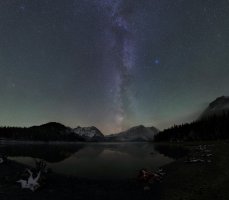
Clark starts with equation 1, says that it falls apart for unevenly lit scenes or subjects of limited size, and then works his way to equation 4 which takes into account subjects of a limited angular size.
Am I an internet expert? I dunno. I just like to shoot stars every so often. When I do, I shoot a grid and use a stitcher. In my experience, when optimizing control points, the errors get larger with closer subjects, which is due to parallax.

KanUpperLakeStereographic.jpg
 
  • Like
Reactions: 3 users
Upvote 0
Clark starts with equation 1, says that it falls apart for unevenly lit scenes or subjects of limited size, and then works his way to equation 4 which takes into account subjects of a limited angular size.
Fair, but of course starscapes (even fields of stars) are unevenly lit scenes.

I just like to shoot stars every so often.
Excellent shot!
 
Upvote 0
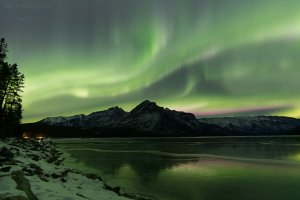
Here is some aurora, which I shot a few weeks ago (Jan 20). I used my 16/2.8, single frame. Would I have liked a 14/1.4? Heck yea. But suppose you already have a 24/1.4, then you can get pretty close by shooting two adjacent frames and stitching. You have to be quick in reframing, though. A friend of mine does this with excellent results. He was shooting beside me that evening and I have seen his composite images. You can't tell they're stitched.

The other bit about stitching is that it's easy to vary the projection (e.g. cylindrical, stereographic). One downside about rectilinear lenses is the area distortion. Sometimes straight lines are not needed.

6305MinnewankaSwirl.jpg
 
  • Like
Reactions: 2 users
Upvote 0
Hi!

Your pictures are nice, but for the theory you should check Clark again. I haven't found anything better and I like his old style web pages somehow. They aren't polished as the modern stuff, but full of very good information, based on physics!

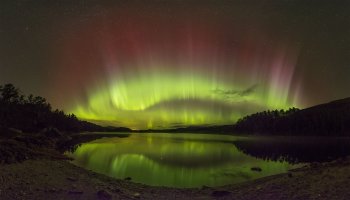
Concerning stitching of aurora pictures: Usually that works for me pretty well, but I found a better solution by shooting several cameras simultaneously. See the image below with the reflections fitting perfectly to the aurora.

Concerning parallax error: Yipp, there is a parallax error in the foreground, but without straight lines it's easy to hide in the darkness.

Concerning projections: Yes, I really love the different projections in PTGui!

9.jpg
 
  • Like
Reactions: 3 users
Upvote 0
The first two versions of the EF 16-35mm f2.8 were not very good, the third version was very good, even on my 5DsR.
Lensrentals has done testing and comparisons: https://www.lensrentals.com/blog/2016/10/canon-16-35mm-f2-8l-mark-iii-optical-bench-tests/
And https://www.lensrentals.com/blog/2016/12/real-world-testing-of-the-new-canon-16-35mm-f2-8l-iii/
I used a the EF 16-35 IIL a lot...weddings, landscapes etc. It was my goto UWA lens of choice for well over 15 years. It was a top tier performer when it was launched, it far eclisped the competition in terms of it's build and image quality. However....that was then, back when 12mp was considered "excessive" or "legendary". The EF 16-35IIL was small, light, convieniet and delivered a lot of great images for me. Stopped down, it was as sharp as the camera sensors it was attched too....however pop this old lens onto a R5 and shoot wide open and it is dissapointing in comparison.

The lens dos not have a flat film plane, so the corners are always slightly soft unless the lens is stopped down. It also suffers from really bad CA, correctable in post but still one of the worst lenses in this regard. It also suffered from a internal reflection if the incoming light hits the front element in a certain direction.
BUT, it's still got the best suns stars of any lens I've ever used and once stopped down to f8...it's sharp enough across the frame.

I've personally found that there is no "one" UWA lens, I've always had to have several options depending on the shooting situation. My typical landscape bag woud have my EF 16-35IIL as my goto, my EF 8-15mm fisheye (defished it's really good) and my trusty old TS-e 17L (movement swings and stunning IQ and straight line compositions).

These day's I have a EF 11-24L as my main UWA, but it's super heavy and cumbersome. But it's performance is superlative. I miss the convienince of the EF 16-35IIL. I'm still using my EF 8-15mm Fisheye too. But I really need a more versatile general UAW zoom. The RF10-20L is very tempting, small and light with amazing focal coverage.
 
Upvote 0
Unfortunately I only own the EF version. The 14mm 1.4 VCM will only be my 3rd RF lens. I haven't tried the EF version for astro.
Please, don't use the Canon EF 14/1.4 for astro! That lens has a horrible 'coma' which is well known. I started in the 'EF-era' with astro and got really frustrated by the poor image quality of the EF wide-angle lenses. But after around 2010 more and more suitable 3rd party lenses became available for astro photography. I only use the Canon EF 35/1.4 II for tracked, stacked and stitched panoramas nowadays and that lens is really good, but it's also a relatively modern lens (from 2015).

Concerning the 14mm VCM lens: I'm a bit skeptical because of the heavy 'vignette' of 4 EV for astro as I would use that lens for panoramas. I already get sometimes 'colorful' corners after removing the vignette with my recent lenses and they have usually a vignette of max. 3 EV in the corners (and I'm using modern cameras with a large DR: R8 and R6)

The optical quality (coma!) is looking good, but I'm not sure if this 'stretching' might give problems (e.g. when stacking).

In total: The RF 14/1.4 is a nice lens, but there are alternatives - for astro - now (and each of these 14mm lenses has pros and cons).
 
  • Like
Reactions: 1 user
Upvote 0
Concerning the 14mm VCM lens: I'm a bit skeptical because of the heavy 'vignette' of 4 EV for astro as I would use that lens for panoramas. I already get sometimes 'colorful' corners after removing the vignette with my recent lenses and they have usually a vignette of max. 3 EV in the corners (and I'm using modern cameras with a large DR: R8 and R6)

The optical quality (coma!) is looking good, but I'm not sure if this 'stretching' might give problems (e.g. when stacking).

In total: The RF 14/1.4 is a nice lens, but there are alternatives - for astro - now (and each of these 14mm lenses has pros and cons).
If you are stitching (eg 1/3rd overlap) then the corners won't be included bar the side/top edges of the final image. If you stitch sufficient panels then these areas can be cropped out as well. Hopefully any severe vignetting will not be as bad as expected post-stitched.
There isn't a solution for single panels unless you do a 2 or 3 vertical pano instead.

The other option is to stop down to f1.8 or f2 and track which should reduce the vignetting a lot.
You might ask 'what is the point of f1.4 then' which is a good question but performance doesn't always have to be when shooting completely wide open but it gives you options. I would love to try aurora video using it rather than timelapse but I am dreaming a little :)
 
  • Like
Reactions: 1 users
Upvote 0
I have a set of the Kolari magnetic NDs (3-, 6- and 10-stop) that I use with my R8 (had to install the metal mount plate in it) and the R1 (no plate needed). That's why I have not bothered cutting another piece out of the 10-stop gel filter (I did cut a piece from it for the rear slot of the Ef 11-24/4L).
Mine are the Kase clip in for the R5. I saw some repoports of the magnetics scratching, which made me think where are the shavings going? Have you seen any marking?
 
Upvote 0
The RF 15-35mm F2.8 is an absolutely great lens!!! The iq is outstanding and the lens is sharp across all focal lengths. I agree, it is perfect for landscapes, city travels and @35mm F2.8 fairly good for environmental portraits or group shots. I used it for nearly two years and only sold it because the RF 14-35mm is significantly lighter and I have more lenses with a 77mm filter thread. Other than that, I never would have sold the lens. Still, I´d image Canon might one day release a lighter mkii version...
Even I would prefer a lighter lens, but, after having tried 2 versions of the 14-35, I decided to keep the 15-35. I found it to be better at the 35mm setting (my most used one). What I also like about the 15-35 is that it is built like a little tank, so, mechanically and optically a remarkable lens.
 
Upvote 0
If you are stitching (eg 1/3rd overlap) then the corners won't be included bar the side/top edges of the final image. If you stitch sufficient panels then these areas can be cropped out as well. Hopefully any severe vignetting will not be as bad as expected post-stitched.
There isn't a solution for single panels unless you do a 2 or 3 vertical pano instead.

The other option is to stop down to f1.8 or f2 and track which should reduce the vignetting a lot.
You might ask 'what is the point of f1.4 then' which is a good question but performance doesn't always have to be when shooting completely wide open but it gives you options. I would love to try aurora video using it rather than timelapse but I am dreaming a little :)
Hi!

The overlap for panos helps a bit (I still need 50% of the overlap for the image), but I also try to minimize the overlap (around 25%) so that I can capture the aurora faster. That's always a compromise between aurora movement, exposure time, aperture, overlap and ISO. A bright aurora also requires a certain under-exposure to prevent the bright green patches from clipping and than it's getting tricky with 4EV vignette plus 1-2EV pushing for the general under-exposure.

And yipp, stopping down to f/2.0 should reduce the vignette to 3EV (based on a review) which is similar to the other 14mm lenses which I use. The Sigma A 14/1.8 also has a low coma at around f/2.2 (is more heavy, has no f/1.4 and is cheaper).

Yes, the VCM 14/1.4 isn't a bad lens and coma is looking low, even at f/1.4 ! My personal question is simply 'if it is good enough' to justify the steep price. So I will wait at the moment.

I'm not doing video, but this would definitely be an interesting lens for it as you need a fast aperture! Also think of the pulsating auroras which I see sometimes (61 deg N). They pulsate at around 0.5 Hz.
 
Upvote 0