

I guess you must take pictures in a really small field.I still have yet to see a soul use an extender out in the field.


Upvote
0
I guess you must take pictures in a really small field.I still have yet to see a soul use an extender out in the field.

The EF 200-400mm is anything but light and easy to lug around. But then I have only rented a 600mm once for a specific event (Red Bull Diving Cup) a couple of years ago.The sweet spot for integrated teleconverters is the 400mm f2.8. With a 1.4 it's close to a 600/f4 and with a 2x it's a 800/f5.6. You get a small lens package, that is light and easly to lug about (compared with the 600/4) and the 400/2.8 has a much closer MFD which some times helps.
But the 400 is collecting light from a narrower field of view. So for a uniform field illumination the f- number works: the 100/2.8 is collecting light over a larger angle.(for example, a 400/2.8 is letting in a lot more light than a 100/2.8 because it has a much larger entrance pupil, but with both lenses set to f/2.8 the exposure will be the same).
Yes, that was the point.But the 400 is collecting light from a narrower field of view. So for a uniform field illumination the f- number works: the 100/2.8 is collecting light over a larger angle.
This is the patent diagram aligned with the EF 300/2.8 block diagram at the front element, with the front element diameters matched.My original point seems to have been missed. While the lens patent is for 295 mm or so, the optics of the lens are crammed into a length of 184 mm, with the exception of what appears to be the insertable filter. That is very compact. Those hunks of glass still need to be 70 mm or so from the image plane but that is what makes the insertable tele converter possible. It seems to me to make the lens optics that compact will take some special optical trickery, like diffractive optics. If you go to the actual patent you will see other 300/2.8 lens designs which are much more like the EF 300/2.8 ii. The glass in those designs is spread out much more the length of the lens. But an insertable tele converter would not be possible.
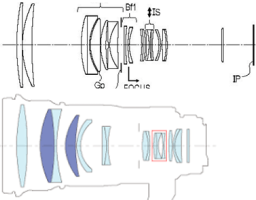


Neuro, great you matched the front element diameters. Had that thought but too many other things on the agenda. To my eye there is more curvature to the EF lens front cell, but there is one more element, 8 vs. 7, in the patent lens. The section behind the diaphragm is interesting with more, 10 vs 8, elements but thinner, lighter looking elements. Also, seems to be less curvature to the patent lens elements. And, lastly, my estimate of distance of filter to image plane is a wee bit over 37 mm, which I believe is enough to allow use of the present tele converters.
I am enjoying the Astrhori 6/2.8 at the momenti personally think the nikkor 7.5mm is the coolest lens ever.
but i digress.


Not sure why you're talking about Zooms "The problem with 400-600mm zoom designs" as I never mentioned any.The sweet spot for integrated teleconverters is the 400mm f2.8. With a 1.4 it's close to a 600/f4 and with a 2x it's a 800/f5.6. You get a small lens package, that is light and easly to lug about (compared with the 600/4) and the 400/2.8 has a much closer MFD which some times helps. Also the brighter optics help if you can move closer to your subject.
Where the 600/f4 kicks it's butt is when you put a 2x on the 600/4 and get a 1200mm f8 (which is well beyond the reach of a 400/2.8) and with a 1.4x to get a similar 800/f5.6 but with less stressed optics, AF and IS.
The problem with 400-600mm zoom designs is that you basically have a 600mm f4 that can go wider, it's not a 400/2.8 that can go longer. So you get the size and heft of the 600mm f4 and not the benefits that a 400/2.8 has. What would be cool is a 400mm f2.8 with an integrated 1.5x TC for a 600mm. The you could pop another 1.4x TC on for more reach and still ahve a small(ish) and more portable rig.
It was a 300mm f/1.8 https://petapixel.com/2017/04/27/canon-300mm-f1-8-yes-monster-lens-exists/Canon has made a 300 f2 in very limited numbers and almost exclusively for the horse racing industry. It is monstrously heavy.

Image quality of a RF300 mm f2 lens + 2 times extender would not be a match for a ‘bare’ 600mm f 4 lens. Same for AF speed and accuracy. Stacking teleconverters will make both even worse.Not sure why you're talking about Zooms "The problem with 400-600mm zoom designs" as I never mentioned any.
My ideas for these Primes with builtin T.C.s is that they would replace the current 600mm f/4 with a 300mm f/2.0 with 1.4x and 2x builtin T.C.s and
the 400mm f/2.8 with a 200mm f/.4 with 1.4x and 2x builtin T.C.s.
This means you'd still have the option of adding external T.C.s as well i.e:
the 200mm f/1.4 (with internal 1.4x and 2x) gives these options
and w. externals:
- 200mm f/1.4
- 280mm f/2
- 400mm f/2.8
And the 300mm f/2.0 (with internal 1.4x and 2x):
- 560mm f/4
- 800mm f/5.6
w. externals:
- 300mm f/2.0
- 420mm f/2.8
- 600mm f/4
- 840mm f/5.6
- 1200mm f/8
A 0x teleconverter is a lens cap.Ideally they would release a version of the 0x, 1.4x, 2x teleconverter,
It's better than you think. I used to shoot the RF 300mm f/2.8 II with the 2xTCIII and found it excellent. It stands up well, even on Craig's dishonourable 5DSR vs the RF 600mm f4 on the R5. I'm jealous of the Sony 300/2.8 as it gives a very sharp and light 600/5.6.Image quality of a RF300 mm f2 lens + 2 times extender would not be a match for a ‘bare’ 600mm f 4 lens. Same for AF speed and accuracy. Stacking teleconverters will make both even worse.
In 1981, Nikon made a few 300mm F2.0 lenses. Manual focus of course. I have seen pictures of these beasts, I think weighing in at over 15 pounds.
I had this lens. It cost $4000 at the time. It weighed about the same as the 600 f4 of the time. It was not as long as the Nikon and Canon 400 2.8s but fatter and heavier. It had a nice screw out hood and an additional hood. Tack sharp as you’d expect. Also, had its own TC-1.4C which retained great image quality. What photographers. today will never will realize about these big tele primes is how incredibly skilled you needed to be to focus them. The depth of field on the 300 f2.0, 400 2.8, and 600 4.0 are nearly the same at most equivalent shooting distance. Very shallow.In 1981, Nikon made a few 300mm F2.0 lenses. Manual focus of course. I have seen pictures of these beasts, I think weighing in at over 15 pounds.


