

Re: Deep Sky Astrophotography
Good start. The trick is stacking. Your single frame here is dim and noisy, as a single frame. Now, if you take about 100 of these 1 second shots, then align and stack them, you can greatly reduce the noise, and "fill in the blanks" and improve detail. Once you have a stacked image with lower noise and more detail, you will have MUCH more freedom to push the exposure around in ACR/LR or Photoshop. The grainy, poorly saturated example here could become a pretty amazing photo of the Orion nebula.
Another tip. If you live in or near a city, head out of town by about 50 miles (preferably at least the same distance from any other city). That should get you much darker skies. Darker skies mean more nebula detail, less noise, and even better results after stacking.
For stacking software, I recommend starting out with DeepSkyStacker. It's pretty easy...the trickiest part is "stretching" the exposure after DSS is done doing it's thing. The curves editor in DSS is pretty quirky, and not the easiest thing to use. Play with it for a couple of hours, though, and you'll start to get the hang of it.
Trust me, though...with that lens and the 5D III, you can get MUCH, MUCH better results...just takes a little more effort.
Mr Bean said:Some really beaut pics in this thread. Unfortunately, I don't have a tracking mount, and I wondered what was possible with a 5D3 + 300mm f4. While it's nothing flash, I was impressed what could be recorded in a 1 second exposure @ 3,200 ISO
Orion Nebula.

Good start. The trick is stacking. Your single frame here is dim and noisy, as a single frame. Now, if you take about 100 of these 1 second shots, then align and stack them, you can greatly reduce the noise, and "fill in the blanks" and improve detail. Once you have a stacked image with lower noise and more detail, you will have MUCH more freedom to push the exposure around in ACR/LR or Photoshop. The grainy, poorly saturated example here could become a pretty amazing photo of the Orion nebula.
Another tip. If you live in or near a city, head out of town by about 50 miles (preferably at least the same distance from any other city). That should get you much darker skies. Darker skies mean more nebula detail, less noise, and even better results after stacking.
For stacking software, I recommend starting out with DeepSkyStacker. It's pretty easy...the trickiest part is "stretching" the exposure after DSS is done doing it's thing. The curves editor in DSS is pretty quirky, and not the easiest thing to use. Play with it for a couple of hours, though, and you'll start to get the hang of it.
Trust me, though...with that lens and the 5D III, you can get MUCH, MUCH better results...just takes a little more effort.
Upvote
0

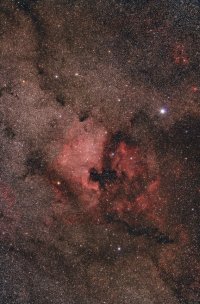
 When things do work out, I get about 6-8 opportunities a year during the New Moon window.
