Deep Sky Astrophotography (Gear Discussion)

Re: Deep Sky Astrophotography

Mr Bean said:
Some really beaut pics in this thread. Unfortunately, I don't have a tracking mount, and I wondered what was possible with a 5D3 + 300mm f4. While it's nothing flash, I was impressed what could be recorded in a 1 second exposure @ 3,200 ISO :)

Orion Nebula.
378A9604_Orion_Nebula.jpg

Good start. The trick is stacking. Your single frame here is dim and noisy, as a single frame. Now, if you take about 100 of these 1 second shots, then align and stack them, you can greatly reduce the noise, and "fill in the blanks" and improve detail. Once you have a stacked image with lower noise and more detail, you will have MUCH more freedom to push the exposure around in ACR/LR or Photoshop. The grainy, poorly saturated example here could become a pretty amazing photo of the Orion nebula. :)

Another tip. If you live in or near a city, head out of town by about 50 miles (preferably at least the same distance from any other city). That should get you much darker skies. Darker skies mean more nebula detail, less noise, and even better results after stacking.

For stacking software, I recommend starting out with DeepSkyStacker. It's pretty easy...the trickiest part is "stretching" the exposure after DSS is done doing it's thing. The curves editor in DSS is pretty quirky, and not the easiest thing to use. Play with it for a couple of hours, though, and you'll start to get the hang of it.

Trust me, though...with that lens and the 5D III, you can get MUCH, MUCH better results...just takes a little more effort.
 
Upvote 0
Re: Deep Sky Astrophotography

wearle said:
To all,

Here's a wide-field image of the Galactic Dark Horse Nebula. Numerous dark nebula come together to form a horse if rotate clock-wise 90 degrees. This was taken with a modified Canon 5D2 and a Canon 200mm f/2.0L stopped down to f/4.0. It is an integration of 25 four-minute exposures. It was calibrated using six dark frames, twenty biases, and twenty flats. All calibration and processing was done in PixInsight.

Thanks for looking,

Wade

Wonderful! It just blows me away how many stars there are near and in the galactic core. The density is stunning!

So, with a modified 5D2, I assume that means the UV/IR cutoff filter (and maybe low pass filter) were removed?
 
Upvote 0
Re: Deep Sky Astrophotography

emag said:
Last night was one of the rare nights this winter I've been able to use the scope, and only for about 3 hours at that, the seeing went to crap by 9PM. A shot of M81 (bottom) and M82 (top). The bright star in M82 is a supernova that became visible in January. About 12 million light years away.....I may be front focusing a few million miles. Taken with a 6D through an 8 inch scope, 1260mm effective focal length, f/6.3. Stack of 10 shots, each 30 seconds. I had some (operator) issues with my mount so there's a bit of trailing in the image.

Not bad! Kind of cool to capture a supernova in a distant galaxy. I always watch this blog for updates on interesting phenomena like that:

http://remanzacco.blogspot.com

They have a lot of info on solar system object, comets and asteroids and whatnot, but they also track extra-solar system events as well.
 
Upvote 0
Re: Deep Sky Astrophotography

jrista said:
Mr Bean said:
Some really beaut pics in this thread. Unfortunately, I don't have a tracking mount, and I wondered what was possible with a 5D3 + 300mm f4. While it's nothing flash, I was impressed what could be recorded in a 1 second exposure @ 3,200 ISO :)

Orion Nebula.
378A9604_Orion_Nebula.jpg
Good start. The trick is stacking. Your single frame here is dim and noisy, as a single frame. Now, if you take about 100 of these 1 second shots, then align and stack them, you can greatly reduce the noise, and "fill in the blanks" and improve detail. Once you have a stacked image with lower noise and more detail, you will have MUCH more freedom to push the exposure around in ACR/LR or Photoshop. The grainy, poorly saturated example here could become a pretty amazing photo of the Orion nebula. :)

Another tip. If you live in or near a city, head out of town by about 50 miles (preferably at least the same distance from any other city). That should get you much darker skies. Darker skies mean more nebula detail, less noise, and even better results after stacking.

For stacking software, I recommend starting out with DeepSkyStacker. It's pretty easy...the trickiest part is "stretching" the exposure after DSS is done doing it's thing. The curves editor in DSS is pretty quirky, and not the easiest thing to use. Play with it for a couple of hours, though, and you'll start to get the hang of it.

Trust me, though...with that lens and the 5D III, you can get MUCH, MUCH better results...just takes a little more effort.
Thanks for the tips jrista. I might give it a go tonight :)

The last time I did any "real" astrophotography was back with Halleys Comet using Fuji gas hypered film, standing in the middle of a paddock all night, keeping the scope on track ;)

Oh, and I live on the outskirts of Melbourne, where the skies are pretty dark. This one was taken from my house.
 
Upvote 0
Re: Deep Sky Astrophotography

Mr Bean said:
Oh, and I live on the outskirts of Melbourne, where the skies are pretty dark. This one was taken from my house.

Check how your light pollution is with this map:

https://mywebspace.wisc.edu/dlorenz/web/astronomy/lp2006/overlay/dark.html

Yellow and up are bad. Green is ok. You really want to be in blue or gray areas, where the skies are really dark. Trust me, I've experimented very recently with how much light pollution affects results. I live in a brighter yellow area bordering on an orange area in Denver, Colorado. LP is pretty bad over my house, even though it doesn't seem as much to my bare eyes. Green areas improve quite a bit. Blue areas are amazing, the number of stars increases considerably, and astrophotography gets much better.

Gray areas are just phenomenal. The two lighter regions of gray conform to Bortle Scale level between 2 and 1...very dark skies or "truly dark skies". You can see an unbelievable amount of stars, everything is crisp and clear, you might even get a glimpse of airglow. The milky way is brilliant, and at the right times of the year, you can see the zodiacal light (provided it isn't obscured by LP bubbles on the horizon. Blue and gray areas of the map above are really where you want to be for AP. Think of it like stops on a camera...Blue is about a stop worse than gray, green is about a stop worse than blue, yellow a stop worse than green, etc. Each time you get closer to the main source of light pollution, you lose about half your ability to deeply image the night sky.

You can expose for almost twice as long and all that as well (i.e. you can expose for maybe 10 minutes in a green region, but 20 minutes or longer in blue and gray regions) as you move out to darker regions. BTW, there are three levels of gray. The darkest gray are what they call "Exceptionally Dark Skies", and has a Bortle Scale level of 1. There are actually relatively few regions of civilized Earth that are still this dark. Australia appears to have more than normal. Canada also has large regions of exceptionally dark skies. There are small pockets of exceptionally dark skies in the US and Europe. Excptionally dark skies are where they put the big scientific observatories, especially when they are on mountaintops. If you have the opportunity to visit an exceptionally dark sky, it'll just blow your mind how clear and bright the night sky really is. It's a thing of wonder, and most people in the "civilized" world rarely ever see it. The milky way is so relatively so bright it will actually cast shadows, the zodiacal light (which I've never seen under these conditions) is apparently "annoyingly bright" (which came from an astrophotographer, so take that in context!), and the number of deep sky objects that you can see with your naked eye maxes out...magnitude 8 stellar objects are visible to the naked eye (which is really amazing, given that most people on earth are only able to see magnitude 6 and larger stars, a whole two orders of magnitude difference, and in cities magnitude four and larger is the limiting magnitude. If you live in a metropolitan heart, where LP is at its highest, you can only see things magnitude 0 and brighter, so mostly planets, the brightest stars, the moon....no milky way at all, no deep sky objects, you can't make out most constellations because there simply aren't enough stars visible. Light pollution is kind of a terrible thing really, a travesty against the natural state of night...massive waste of energy to light so much of the earths surface up like that when most of it is suburban regions full of sleeping families...they could all turn off their lights, turn of the street lights, etc.)

I have not had a chance to photograph in the night sky under exceptionally dark skies. I'm hoping to get up to the top of the continental divide in one of the couple spots where you have exceptionally dark skies and image the milky way and zodiacal light when the latter rolls around again this spring.

Anyway...if your on the outskirts of Melbourne, but are still under green, yellow, orange or red, try heading out to darker skies. The difference is worth it.
 
Upvote 0
Re: Deep Sky Astrophotography

jrista said:
Mr Bean said:
Oh, and I live on the outskirts of Melbourne, where the skies are pretty dark. This one was taken from my house.

Check how your light pollution is with this map:

https://mywebspace.wisc.edu/dlorenz/web/astronomy/lp2006/overlay/dark.html

Yellow and up are bad. Green is ok. You really want to be in blue or gray areas, where the skies are really dark. Trust me, I've experimented very recently with how much light pollution affects results. I live in a brighter yellow area bordering on an orange area in Denver, Colorado. LP is pretty bad over my house, even though it doesn't seem as much to my bare eyes. Green areas improve quite a bit. Blue areas are amazing, the number of stars increases considerably, and astrophotography gets much better.
Thanks for the link, that's really neat. Looks like I'm pale yellow, moving into green. It's not bad, considering I'm an hours drive from the City. Last October I went to Tasmania for a week. The areas around Cradle Mountain were stunning for clear night skies. I'll have to head back later this year :)

I've just downloaded DeepSkyStacker. I'll go out and try again, now that Orion is up :)
 
Upvote 0
Re: Deep Sky Astrophotography

Mr Bean said:
jrista said:
Mr Bean said:
Oh, and I live on the outskirts of Melbourne, where the skies are pretty dark. This one was taken from my house.

Check how your light pollution is with this map:

https://mywebspace.wisc.edu/dlorenz/web/astronomy/lp2006/overlay/dark.html

Yellow and up are bad. Green is ok. You really want to be in blue or gray areas, where the skies are really dark. Trust me, I've experimented very recently with how much light pollution affects results. I live in a brighter yellow area bordering on an orange area in Denver, Colorado. LP is pretty bad over my house, even though it doesn't seem as much to my bare eyes. Green areas improve quite a bit. Blue areas are amazing, the number of stars increases considerably, and astrophotography gets much better.
Thanks for the link, that's really neat. Looks like I'm pale yellow, moving into green. It's not bad, considering I'm an hours drive from the City. Last October I went to Tasmania for a week. The areas around Cradle Mountain were stunning for clear night skies. I'll have to head back later this year :)

I've just downloaded DeepSkyStacker. I'll go out and try again, now that Orion is up :)

Ah, that is really funny. Orion just set maybe an hour ago here. My favorite constellation...I don't have much time left to image it. I'm trying to find a good equatorial mount, an autoguider, and get some custom telescope rings built for my 600mm lens so I can use it as an apochromatic refracting telescope. I don't know if I'll find what I need before Orion sets for good...it is up near zenith by 8pm now....and directly overhead before 10pm...it's fading fast...
 
Upvote 0
Re: Deep Sky Astrophotography

jrista said:
Wonderful! It just blows me away how many stars there are near and in the galactic core. The density is stunning!

So, with a modified 5D2, I assume that means the UV/IR cutoff filter (and maybe low pass filter) were removed?
Thanks!

You should check out the link to the higher resolution version I just posted.

I purchased the camera from Astro Hutech with Option T. It includes a more astro-friendly bandpass filter. It works very well for astrophotography. You can still use it as a regular camera too if you create a custom white balance.

Wade
 
Upvote 0
Upvote 0
Re: Deep Sky Astrophotography

CarlTN said:
Thanks very much, that is mind-blowing!! Do you mind if I print one for myself?

Thanks, there is definitely enough stars in the image to be mind-blowing. :)

I would prefer you not to make a print from my image. If you would like a print, I can make you one at a very reasonable cost, and it would look a lot better than what could be achieved with the jpeg version. You can contact me privately if you like.

Wade
 
Upvote 0
Re: Deep Sky Astrophotography

wearle said:
CarlTN said:
Thanks very much, that is mind-blowing!! Do you mind if I print one for myself?

Thanks, there is definitely enough stars in the image to be mind-blowing. :)

I would prefer you not to make a print from my image. If you would like a print, I can make you one at a very reasonable cost, and it would look a lot better than what could be achieved with the jpeg version. You can contact me privately if you like.

Wade

Thanks Wade, I will contact you.
 
Upvote 0
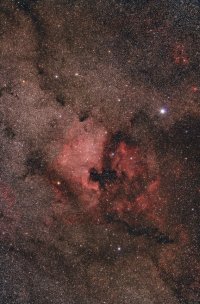
Re: Deep Sky Astrophotography

To all,

Here's a wide-field image of the North America Nebula. This was taken with a modified Canon 5D2 and a Canon 200mm f/2.0L stopped down to f/4.0. It is an integration of 24 four-minute exposures. It was calibrated using six dark frames, twenty biases, and twenty flats. All calibration and processing was done in PixInsight.

Thanks for looking,

Wade
 

Attachments

  • north_america_region_dslr_200mm.jpg
    north_america_region_dslr_200mm.jpg
    229.2 KB · Views: 1,263
Upvote 0
Re: Deep Sky Astrophotography

wearle said:
To all,

Here's a wide-field image of the North America Nebula. This was taken with a modified Canon 5D2 and a Canon 200mm f/2.0L stopped down to f/4.0. It is an integration of 24 four-minute exposures. It was calibrated using six dark frames, twenty biases, and twenty flats. All calibration and processing was done in PixInsight.

Thanks for looking,

Wade

How do you like PixInsight? I'm getting into deep sky AP now, and am in the process of buying a mount and software. I was planning to use something like Nebulosity or maybe BackyardEOS for control software, PHD for guiding, and Photoshop for processing. But Pixinsight seems pretty popular these days.
 
Upvote 0
Re: Deep Sky Astrophotography

wearle said:
To all,

Here's a wide-field image of the North America Nebula. This was taken with a modified Canon 5D2 and a Canon 200mm f/2.0L stopped down to f/4.0. It is an integration of 24 four-minute exposures. It was calibrated using six dark frames, twenty biases, and twenty flats. All calibration and processing was done in PixInsight.

Thanks for looking,

Wade

Amazing. Do you have a website? I'd love to see more of your work. TFS.
 
Upvote 0
Re: Deep Sky Astrophotography

jrista said:
How do you like PixInsight? I'm getting into deep sky AP now, and am in the process of buying a mount and software. I was planning to use something like Nebulosity or maybe BackyardEOS for control software, PHD for guiding, and Photoshop for processing. But Pixinsight seems pretty popular these days.
I believe PixInsight is one of the best astrophotography processing software packages out there. I've been using it since the PixInsight LE days. There is a steep learning curve; however, the PixInsight Forum is an awesome place to learn it and support is second to none.

Wade
 
Upvote 0
Re: Deep Sky Astrophotography

Canon1 said:
Amazing. Do you have a website? I'd love to see more of your work. TFS.
Thanks!

I have two websites. One is old, and I haven't updated it in a long time; however, it does allow viewing of higher resolution versions of my astrophotography images.

http://www.northwest-landscapes.com/

My new site has the most up-to-date images and includes the older material, but you can't view any images higher than 960 pixels in the long dimension.

http://thomaswearlephotography.smugmug.com/

Wade
 
Upvote 0
Re: Deep Sky Astrophotography

wearle said:
jrista said:
How do you like PixInsight? I'm getting into deep sky AP now, and am in the process of buying a mount and software. I was planning to use something like Nebulosity or maybe BackyardEOS for control software, PHD for guiding, and Photoshop for processing. But Pixinsight seems pretty popular these days.
I believe PixInsight is one of the best astrophotography processing software packages out there. I've been using it since the PixInsight LE days. There is a steep learning curve; however, the PixInsight Forum is an awesome place to learn it and support is second to none.

Wade

Yeah, I've heard it's a bit of an odd piece of software, but it seems it's becoming almost ubiquitous amongst astrophotographers for processing. Once I get a telescope, I'll give it a whirl.
 
Upvote 0
Re: Deep Sky Astrophotography

wearle said:
To all,

Here's a wide-field image of the North America Nebula. This was taken with a modified Canon 5D2 and a Canon 200mm f/2.0L stopped down to f/4.0. It is an integration of 24 four-minute exposures. It was calibrated using six dark frames, twenty biases, and twenty flats. All calibration and processing was done in PixInsight.

Thanks for looking,

Wade

Very impressive. I've been looking to get that lens myself for this purpose (among others). From your description, I'm guessing it's a pretty dark site?
 
Upvote 0
Re: Deep Sky Astrophotography

scyrene said:
Very impressive. I've been looking to get that lens myself for this purpose (among others). From your description, I'm guessing it's a pretty dark site?

Thanks!

It's a very dark site. I measured it last Summer, and it was approaching 22.0 visual magnitudes per square arc-second. The only problem is eastern Oregon. It's rarely clear in the Winter. The Summer is generally clear, but then your contending with smoke-filled skies from wildfires. :( When things do work out, I get about 6-8 opportunities a year during the New Moon window.

Wade
 
Upvote 0