
You are using an out of date browser. It may not display this or other websites correctly.
You should upgrade or use an alternative browser.
You should upgrade or use an alternative browser.
DPAF's Underlying Tech the Villain? (When all else ruled out)
- Thread starter YuengLinger
- Start date

Re: DPAF the Villain? (When all else ruled out)
As I noted earlier, it is possible that dual pixel technology could be the cause of a issue, but so many cameras are out there with no one waving a red flag, that it seems a remote possibility.
There is a lot of complexity in the dual pixels and their processing.
You might clarify if you were using DPP or some other software as well.
You implied that the issue appears in your 80D as well, but it does not have the option to record each half of the pixel separately as far as I know.
I'd suggest locking this this and start a new thread with the correct title and question? As you know, many posters only read the title and then start posting, or maybe just read a part of the conversation. Do not USE DPAF in the title, use "Dual Pixel Sensor" so as not to trigger automatic assumption that you are discussing Dual Pixel Autofocus (DPAF)YuengLinger said:Ok, Neuro, here is what Canon CPS says. They agree with you about DPAF being used only during LiveView or video, and they also agree that the article is poorly worded. Actually pledged to correct the article.
So I was wrong to use the term "DPAF" to discuss the issue that is popping up, but the CPS tech says that the dual photodiodes COULD hypothetically be involved in occasional problems, but hasn't seen complaints or reports about it.
Note that the 5DIV has one important extra feature not found on the 80D, the ability to choose DP Raw, essentially keeping both images recorded by the dual-photodiodes in a single file. (From what I understand, software exists which allows access to both images independently.)
He said the 5DIV captures with two photodiodes, creating two actual images that are then synced back together in-camera.
Which makes me believe that my original question is valid and relevant, though I should not have confused DPAF focusing with the dual-photodiode CMOS. If things don't go perfectly right with the processing which syncs the two images back together, then, hypothetically, if all other errors are eliminated, the new tech lumped under the name "DPAF" might be involved.
CPS wants me to email RAW files where I've noticed the problem, as well as RAWs captured in the same session where there is no problem.
As I noted earlier, it is possible that dual pixel technology could be the cause of a issue, but so many cameras are out there with no one waving a red flag, that it seems a remote possibility.
There is a lot of complexity in the dual pixels and their processing.
You might clarify if you were using DPP or some other software as well.
You implied that the issue appears in your 80D as well, but it does not have the option to record each half of the pixel separately as far as I know.
Upvote
0

Re: DPAF the Villain? (When all else ruled out)
You have a point, Mt. Spokane, but I don't want to lock the thread--I tweaked the title!
First, though many people do skip the original post, I went back to my opening and clarified.
Second, I think this thread shows exactly the benefits of asking questions, jargon issues aside. By using the term "DPAF" which Canon itself has conflated with the dual-photodiode CMOS tech now on several bodies, I daresay that not only I have learned something.
So, yes, "DPAF" as an umbrella term which includes capturing two images and merging them, as well as a new method of AF for LiveView, is confusing. I hope I'm not the only one who has a better understanding after working through this. Neuro's logic was solid, but I was basing my understanding on a badly written Canon Learning article on the Canon USA website.
Now, if somebody with a DPAF body is facing the same frustration I've had, as at least two other members have already shared, I think reading through the thread will be a big help.
I hope that any others who might be scratching their heads about problems with the 5DIV, 80D, or 7DII will chime in and also contact Canon about sending RAW files in for evaluation, along with relevant questions.
Maybe my "issue" is based on technique or other user error; I'm way far from perfect. But isn't it fair to ask, if a photographer can find no other explanation, can the new tech which captures two images and then merges them into one in a fraction of a second OCCASIONALLY result in some degraded IQ? When it happens to what would have other been a great keeper, it is frustrating.
Consider that the 5DIV does offer a way to "tweak" the twin images. Why? Why would the engineers think the option worth including? Has Canon been anything other than vague about the usefulness?
The CPS tech I spoke with said that the diodes are angled slightly to the left and right of each other. Not sure what this means optically, but it sure seems as if considerable, precise processing must be involved to align the two resulting images in-camera.
I'm gathering the RAW files that seem to demonstrate the issue and sending them to CPS.
You have a point, Mt. Spokane, but I don't want to lock the thread--I tweaked the title!
First, though many people do skip the original post, I went back to my opening and clarified.
Second, I think this thread shows exactly the benefits of asking questions, jargon issues aside. By using the term "DPAF" which Canon itself has conflated with the dual-photodiode CMOS tech now on several bodies, I daresay that not only I have learned something.
So, yes, "DPAF" as an umbrella term which includes capturing two images and merging them, as well as a new method of AF for LiveView, is confusing. I hope I'm not the only one who has a better understanding after working through this. Neuro's logic was solid, but I was basing my understanding on a badly written Canon Learning article on the Canon USA website.
Now, if somebody with a DPAF body is facing the same frustration I've had, as at least two other members have already shared, I think reading through the thread will be a big help.
I hope that any others who might be scratching their heads about problems with the 5DIV, 80D, or 7DII will chime in and also contact Canon about sending RAW files in for evaluation, along with relevant questions.
Maybe my "issue" is based on technique or other user error; I'm way far from perfect. But isn't it fair to ask, if a photographer can find no other explanation, can the new tech which captures two images and then merges them into one in a fraction of a second OCCASIONALLY result in some degraded IQ? When it happens to what would have other been a great keeper, it is frustrating.
Consider that the 5DIV does offer a way to "tweak" the twin images. Why? Why would the engineers think the option worth including? Has Canon been anything other than vague about the usefulness?
The CPS tech I spoke with said that the diodes are angled slightly to the left and right of each other. Not sure what this means optically, but it sure seems as if considerable, precise processing must be involved to align the two resulting images in-camera.
I'm gathering the RAW files that seem to demonstrate the issue and sending them to CPS.
Upvote
0
This is what I've found out reading up on how the Dual Pixel RAW files are generated in the 5DmkIV:
The camera reads the left half of each pixel into a 14 bit image buffer that we can call A.
The camera reads the right half of each pixel into a different 14 bit image buffer that we can call B (possibly interleaved reading, though the readout sequence has to my knowledge never been mentioned by Canon)
Each value in the B buffer is added to the corresponding position in A.
Each buffer is compressed separately (A+B and B) using lossless JPEG and stored as two subimages in the same TIFF structure that is the CR2 file.
So the only merging done is a simple addition. If you don't save a dual pixel raw (such as is always the case with the 70D, 7DmkII, 80D, 1DXmkII), only the A+B buffer is saved. If there is an issue with image quality from the dual pixel sensor, I highly doubt it is related to this addition. If anything, there might be a loss of some centrally originating rays due to the small gap necessary between the two pixel halves' photo diodes.
More technical reading on the CR2 format for those interested; http://lclevy.free.fr/cr2/
http://lclevy.free.fr/cr2
The camera reads the left half of each pixel into a 14 bit image buffer that we can call A.
The camera reads the right half of each pixel into a different 14 bit image buffer that we can call B (possibly interleaved reading, though the readout sequence has to my knowledge never been mentioned by Canon)
Each value in the B buffer is added to the corresponding position in A.
Each buffer is compressed separately (A+B and B) using lossless JPEG and stored as two subimages in the same TIFF structure that is the CR2 file.
So the only merging done is a simple addition. If you don't save a dual pixel raw (such as is always the case with the 70D, 7DmkII, 80D, 1DXmkII), only the A+B buffer is saved. If there is an issue with image quality from the dual pixel sensor, I highly doubt it is related to this addition. If anything, there might be a loss of some centrally originating rays due to the small gap necessary between the two pixel halves' photo diodes.
More technical reading on the CR2 format for those interested; http://lclevy.free.fr/cr2/
http://lclevy.free.fr/cr2
Upvote
0

SecureGSM said:it almost sounds like that the somewhat stronger AA filter on 5D Mark IV is to blame. it could be as simple as that.
So, is there a 5DIV IQ issue? Is it consistent or intermittent? Has everything else been ruled out? What kind of sharpening settings seem to be best for the 5DIV?
Upvote
0
YuengLinger, I've read through the whole thread, but I don't see any clear explanation of what this supposed IQ problem looks like or why you believe it is related to dual pixel architecture. You've written that you've ruled out camera shake, but how have you ruled that out? The fact that you see the problem mostly with specific shutter speeds would seem to imply a camera shake issue more than anything related to dual pixel architecture. Can you post some examples, and provide more information on how you have ruled out other causes? And have you done auto-focus microadjust?
Upvote
0

AlanF said:I have a problem with the 400mm DO II and 5DIV at 1/200-400s. There is a slight mirror slap in the vertical direction. It's worse when the 1.4xTC is on. It doesn't occur with the 100-400mm II.
That's something that might be tracked down. Does the 5D IV use the newer mirror motorized design? http://www.diyphotography.net/a-look-inside-canons-redesigned-mirror-mechanism/
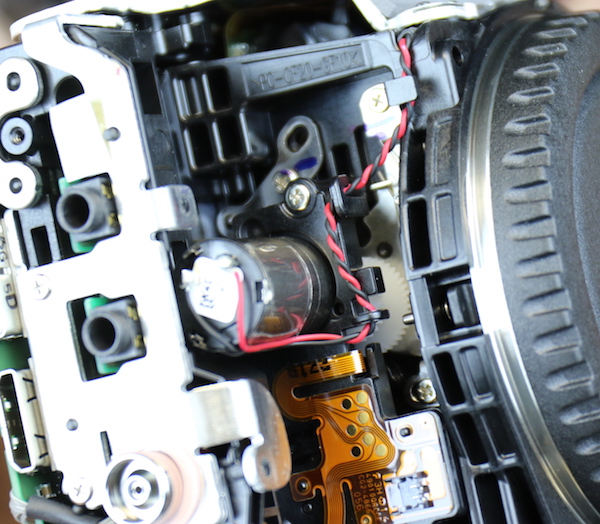
A resonance in the motor or some hangup in the shutter assembly could be responsible. That type of issue could be design, firmware, or a batch of out of tolerance parts. Its hard to imagine a resonance between a relatively heavy lens and the camera body when a different lens does not do it.
Did you use the laser pointer test to determine mirror slap vibration? If so, can you tell us how you set it up so others can replicate the same test?
Upvote
0
L
Loswr
Guest
AlanF said:I have a problem with the 400mm DO II and 5DIV at 1/200-400s. There is a slight mirror slap in the vertical direction. It's worse when the 1.4xTC is on. It doesn't occur with the 100-400mm II.
Out of curiousity, is this handheld or on a tripod, and if the latter, is IS turned on?
Upvote
0
gruhl28 said:YuengLinger, I've read through the whole thread, but I don't see any clear explanation of what this supposed IQ problem looks like or why you believe it is related to dual pixel architecture. You've written that you've ruled out camera shake, but how have you ruled that out? The fact that you see the problem mostly with specific shutter speeds would seem to imply a camera shake issue more than anything related to dual pixel architecture. Can you post some examples, and provide more information on how you have ruled out other causes? And have you done auto-focus microadjust?
Hi, gruhl, regarding the camera shake, that's based on years of looking 100% at images and recognizing the telltale slight blur of pixels. I might not get it right 100% of the time, but I know it when I see it, and this is not camera shake. It's a gritty yet slightly cloudy image which I can see in DPP and LR CC. The images are not back or front focused either. Not from temperature issues fogging the lens. Not from anything on the front or rear elements, and I've been taking the UV filters off, just in case.
As for posting images, there would be an infinite number of wild guesses and assumptions about what is causing the issue, and, without dozens of other examples from the same camera and lenses, very little baseline. If I sent a 100% cropped section, there'd be no context, and I don't want to link to RAWs, which would still be open to guessing.
As said, Canon wants RAWs, and I'm going to be sending them at least by the weekend. (I have to go back through the ones culled out, which I tend to save for six months.) The CPS tech I spoke to was genuinely interested in the issue. Whatever they tell me--user error, cannot-be-determined, or we are kicking this upstairs--I'll report back.
AlanF--I definitely notice a much harder mirror slap than on the 5DIII, and yes I've been disappointed with my 1.4x on the 100-400mm II. I was thinking the fully extended zoom barrel of the lens seems to amplify any kind of vibration. I get fewer issues handheld compared to tripod! (And then of course everybody chimes in about IS on or off. I've tried both. This combo just seems to be vibration prone.) And then throw in the issue which prompted the thread.
Thanks, Mt Spokane, for your thoughts. A laser pointer test sounds very interesting, especially to compare the 5DIV to other bodies!
Upvote
0

BillB said:SecureGSM said:it almost sounds like that the somewhat stronger AA filter on 5D Mark IV is to blame. it could be as simple as that.
So, is there a 5DIV IQ issue? Is it consistent or intermittent? Has everything else been ruled out? What kind of sharpening settings seem to be best for the 5DIV?
I have the same problem with my 80D. Does it have a stronger AA filter also? Manually focused, there is no problem. AF, through the viewfinder, this effect is there very consistently.
Upvote
0
YuengLinger said:gruhl28 said:YuengLinger, I've read through the whole thread, but I don't see any clear explanation of what this supposed IQ problem looks like or why you believe it is related to dual pixel architecture. You've written that you've ruled out camera shake, but how have you ruled that out? The fact that you see the problem mostly with specific shutter speeds would seem to imply a camera shake issue more than anything related to dual pixel architecture. Can you post some examples, and provide more information on how you have ruled out other causes? And have you done auto-focus microadjust?
Hi, gruhl, regarding the camera shake, that's based on years of looking 100% at images and recognizing the telltale slight blur of pixels. I might not get it right 100% of the time, but I know it when I see it, and this is not camera shake. It's a gritty yet slightly cloudy image which I can see in DPP and LR CC. The images are not back or front focused either. Not from temperature issues fogging the lens. Not from anything on the front or rear elements, and I've been taking the UV filters off, just in case.
As for posting images, there would be an infinite number of wild guesses and assumptions about what is causing the issue, and, without dozens of other examples from the same camera and lenses, very little baseline. If I sent a 100% cropped section, there'd be no context, and I don't want to link to RAWs, which would still be open to guessing.
As said, Canon wants RAWs, and I'm going to be sending them at least by the weekend. (I have to go back through the ones culled out, which I tend to save for six months.) The CPS tech I spoke to was genuinely interested in the issue. Whatever they tell me--user error, cannot-be-determined, or we are kicking this upstairs--I'll report back.
AlanF--I definitely notice a much harder mirror slap than on the 5DIII, and yes I've been disappointed with my 1.4x on the 100-400mm II. I was thinking the fully extended zoom barrel of the lens seems to amplify any kind of vibration. I get fewer issues handheld compared to tripod! (And then of course everybody chimes in about IS on or off. I've tried both. This combo just seems to be vibration prone.) And then throw in the issue which prompted the thread.
Thanks, Mt Spokane, for your thoughts. A laser pointer test sounds very interesting, especially to compare the 5DIV to other bodies!
The 5DIV has a 30mp sensor vs the 5DIII's 22mp. The 80D's 24mp is equivalent to 62mp FF. Are these differences going to have an effect if you are looking at everything at 100%? What does it look like at the same output size?
Upvote
0
BillB said:The 5DIV has a 30mp sensor vs the 5DIII's 22mp. The 80D's 24mp is equivalent to 62mp FF. Are these differences going to have an effect if you are looking at everything at 100%? What does it look like at the same output size?
I am sorry for the limited feedback, but there is a huge difference in AF through the viewfinder versus MF live view. Huge - the AF shots are completely unacceptable. Again, 80D only for me.
Upvote
0
L
Loswr
Guest
chrysoberyl said:BillB said:The 5DIV has a 30mp sensor vs the 5DIII's 22mp. The 80D's 24mp is equivalent to 62mp FF. Are these differences going to have an effect if you are looking at everything at 100%? What does it look like at the same output size?
I am sorry for the limited feedback, but there is a huge difference in AF through the viewfinder versus MF live view. Huge - the AF shots are completely unacceptable. Again, 80D only for me.
Tried AFMA?
Upvote
0
neuroanatomist said:chrysoberyl said:BillB said:The 5DIV has a 30mp sensor vs the 5DIII's 22mp. The 80D's 24mp is equivalent to 62mp FF. Are these differences going to have an effect if you are looking at everything at 100%? What does it look like at the same output size?
I am sorry for the limited feedback, but there is a huge difference in AF through the viewfinder versus MF live view. Huge - the AF shots are completely unacceptable. Again, 80D only for me.
Tried AFMA?
I did - no improvement. It's like drinking too much - you can get closer or farther away, and still nothing is in good focus. At least with the 80D you don't wake up with someone horrible next to you... But seriously, the same shots taken with the much-maligned 6D and the same lens (70-200L) look fine.
Upvote
0
neuroanatomist said:AlanF said:I have a problem with the 400mm DO II and 5DIV at 1/200-400s. There is a slight mirror slap in the vertical direction. It's worse when the 1.4xTC is on. It doesn't occur with the 100-400mm II.
Out of curiousity, is this handheld or on a tripod, and if the latter, is IS turned on?
Good question. On a tripod with IS on. Turn off IS and shake is just random.
Upvote
0
L
Loswr
Guest
AlanF said:neuroanatomist said:AlanF said:I have a problem with the 400mm DO II and 5DIV at 1/200-400s. There is a slight mirror slap in the vertical direction. It's worse when the 1.4xTC is on. It doesn't occur with the 100-400mm II.
Out of curiousity, is this handheld or on a tripod, and if the latter, is IS turned on?
Good question. On a tripod with IS on. Turn off IS and shake is just random.
Interesting. I know the red-ring supertele lenses specifically use IS to damp mirror/shutter vibrations at certain shutter speeds. I assume the 400 DO does the same, but perhaps not, or not as effectively.
Upvote
0
Similar threads

- Replies
- 71
- Views
- 37K
- Replies
- 27
- Views
- 21K