Lee Jay said:
neuroanatomist said:
Lee Jay said:
There's a spec on the accuracy of a focus point. It used to be 1/3 of the DOF. So, if a point is good to 1/3 of the DOF at f/5.6, it should be good to 1 DOF at f/1.8.
Sorry, but that's two wrongs for the price of one.
In fact, the spec is that the high-precision AF points (generally the f/2.8 ones) are precise within 1/3 the DoF at the lens' max aperture (whatever lens is attached), whereas the standard precision AF points (generally the f/5.6 ones) are precise within 1 DoF of the attached lens at max aperture.
It's also important to distinguish precision from accuracy. Canon specifies the former (as described above), but apparently not the latter (I've had an email exchange with Chuck Westfall on this). Accuracy is determined by the 'baseline' of the AF point, and the wider baseline of an f/2.8 line (easy to see on an image of an actual AF sensor) makes it more accurate than an f/5.6 line.
I'd be wary of anything Chuck Westfall says technically, since he once claimed that purple fringing was caused by birefringence of the stuff in front of the sensor (I forget if it was the microlenses, the AA filter or the IR filter). Regardless, that isn't the cause of purple fringing, axial CA in the lens is.
Since neither the baseline nor the pixel density of the sensor changes with lens wide open f-stop, I don't understand how a single line sensor could be more accurate on a lens that's faster than its baseline than on one that is equal to its baseline, but that's what it would have to be if what you wrote above is correct. It's seeing f/2.8 even on an f/1.4 lens but the DOF is half on the later so to retain 1/3 DOF performance, it would have to be twice as good on an f/1.4 lens as it is on an f/2.8 lens.
The point regarding Westfall was that I asked him if Canon specified AF accuracy in addition to AF precision, and he was not aware of such a specification (which presumably, he could find if there was one).
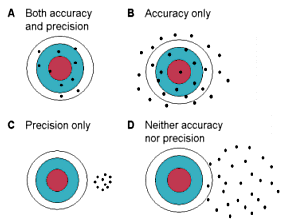
In our exchange, Westfall confused precision and accuracy, and it appears you are doing the same. Precision is not the same as accuracy. Precision is repeatability, how tightly a series of repeated measurements cluster together. Accuracy is how close the average of a repeated series of measurements, or even a single measurement for that matter, is to the true value.
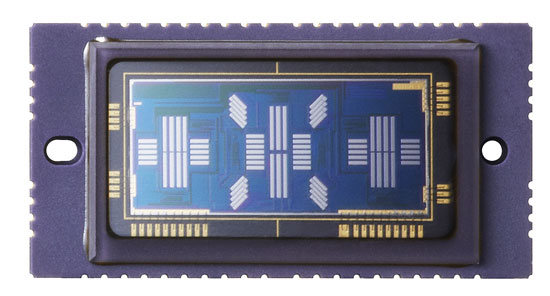
An f/2.8 AF point has a physically wider separation between the halves of the AF line, easy to see (the sets of five diagonal lines are the f/2.8 crosses):
That wider separation requires a faster lens to deliver a wide enough light cone, and that wider baseline makes the line more
accurate than the narrower baseline of an f/5.6 point. So, an f/2.8 AF point used with an f/2.8 or faster lens will be more accurate than an f/5.6 AF point used with the same lens. That was the point that I believe GraFax was making. In general, those f/2.8 points are also high-precision points, meaning a steeper distribution curve (but while Canon specifies 1/3 of the depth of focus, they don't provide a full description of the precision, e.g. xx% of shots will fall within that depth of focus, because I'm sure it's not 100%).
Because the precision of the system is specified in terms of depth of focus, whether or not you notice any differences depends a lot on your typical subject distance. As subject distance increases, DoF increases but depth of focus doesn't change significantly. So, you gain apparent precision as your subject distance increases.