How to differentiate crop vs. FF

Hillsilly said:
Perhaps I should read all of the prior six pages (and even some 7Dii reviews), but I suspect we're only having this discussion because Canon crop sensors are lagging a bit.

::)

No, they're not. Not in actual resolved detail as opposed to MP count. And not in high ISO, at least not for crop. Indeed it looks like the 7D2 has the best high ISO to date. (Still waiting on Samsung samples to appear.)

It also looks like the 7D2 may have dealt with banding issues. (Can't know for sure until it ships and/or RAWs are made available which allow one to explicitly test this.) Though it also looks like Sony still holds the crown for recovered shadow detail at base ISO.
 
Upvote 0
I've been hearing some positive murmurings about the 7Dii sensor, which is why I prefaced my comments accordingly. But,until DxO officially ranks the sensor any comments about about the 7Dii are just wild, unsubstantiated speculation and lack credibility. :)
 
Upvote 0
Jackson_Bill said:
docsmith said:
I have the simple answer to this one. Hand me a FF camera (6D, 5DIII, 1DX) and tell me that I can never shoot crop again and I will be ok with that. Give me a crop camera, even one as capable as the 7D/7DII, and take away my 5DIII and tell me I can never shoot FF again and I will beat your %$#^@ *&%$#. That is the difference. How many here feel differently?

Granted, they're both cropped heavily but tell me what I'm doing wrong with my new 5Diii, please, 'cause I'm not seeing that much difference.

Well, in addition to comparing two heavily cropped images, the 5DIII shot at 1/800 f/7.1, ISO 800 (+1) and the 7D at 1/640, f/5.6, ISO 400 (+0.7). The images you are comparing should be the situation where the 7D beats the 5DIII because you used the same lens, are "reach limited," and you gave the 7D an extra stop of ISO (1.3 with the push). And yet, you are "not seeing that much difference." The different DoF could have also be a factor.

This is almost exactly what I found, even at the same ISO setting. In real world cases where the 7D should be beating the 5DIII, they were very comparable. I did actually create a few conditions where I thought the 7D was slightly better. But, when I took all the different types of conditions that I shoot, the 5DIII really pulled away for me. The obvious example is high ISO conditions. Compare shots from ISO 800 on up and tell me which you prefer? Even in your example, I like the colors from the 5DIII image a bit better. Granted that can be adjusted in post. Speaking of post, have you seen how much better the 5DIII files respond to PP compared to the 7D files? It isn't even so much that you can push the files further (although you can), it is that I like the response of the file better.

Honestly, I do not want to prefer the 5DIII. It is more expensive and, except for photography, I tend to prefer "value" items. So, I'd prefer to still be using the 7D. But, I shot ~35,000 shots through the 7D. It is a great camera. But I do prefer the 5DIII.

If I were to line up the reasons it would go something like this (comparing the 5DIII to 7D):
  • Comparing similar images in the shooting conditions I typically shoot, preferred the 5DIII or found them to be even in the vast majority
  • 5DIII files can both be pushed further in post and respond better to adjustments made
  • While both can use Canon's lens lineup, the majority of L lenses are better suited to a FF sensor (possible exception of the super telephotos)
  • AF is better, especially in low light
  • I prefer the bokeh from the 5DIII under similar conditions
  • I prefer the colors of the 5DIII
  • I prefer the noise of the 5DIII, it is a finer grain that is easier to treat in post
  • and, of course, I have found the 5DIII has better high ISO performance

Of course, some of that is because the 5DIII was released 3 years after the 7D and had newer technology, etc. I have been watching the 7DII closely and while I am still waiting for reviews of RAW files form production copies of the camera, it seems that it has narrowed the gap in several of the above areas. Considering I am now invested in FF, all that likely means to me is that I am looking forward to similar improvements in the 5DIV.

But, as you have both cameras, if you could only have one, which would you take? For me, it is FF and the 5DIII. Lee Jay picked two 7DIIs.

None of this is meant as a put down of cropped sensor cameras. They are incredibly capable. I continue to see great pictures taken with them and, depending on what you shoot, may be all anyone needs. But, I find the FF sensor to be incrementally better. I am sure MF is incrementally better above that, and crop is incrementally better than 1" sensors and so on. It really gets down to which incremental (or ne.gli.gi.ble) improvement do you want before your needs/wants are satisfied. While I posted to this thread a couple of times, this is not a topic I get worked up about.

 
Upvote 0
There are several ways to look at the "reach" benefit. The way I look at it is the number of pixel defining any particular subject. I've always heard that the human eye can differentiate 75-150 pixels per inch at normal viewing distances and that magazines require/prefer a minimum of 300 ppi. So, say you want a minimum of 75 ppi to define every inch of your frame, with the FF sensor and that 500 mm lens of yours, you have a range of 85 ft with the 5DIII but 130 ft with the 7D.

This fits my general experience. In this example, less than 85 ft, FF would be better, in this middle range (85-130 ft) the 7D would be better and then greater than 130 ft, neither is providing the desired resolving power but are likely "comparable." Of course, those are absolute numbers and in the real world it is more minor shades of gray. But in my tests (which were not robust, more of me shooting trees at different distances with the same lens and different bodies), I was able to convince myself that there was a "middle range" where crop was better than FF (EDIT--I should stress, this was at a pixel peeping level and is likely the definition of neg.li.gi.ble). Granted, that was mostly regarding having adequate resolving power. The DR/Noise/Color sensitivity/etc do not stop being beneficial, but you do need adequate resolution.

As for the files. You have both cameras. Take a few pictures and play with them. Try adjusting highlights/shadows/color saturation/sharpness/etc. I still use a crop sensor body (EOS-M) and can tell the difference in PP. For example, in a similar shot, I tend to limit myself to lifting shadows +25 on crop, but +50-60 on the 5DIII. Above that, in some shots, is where I start to not like the effect.

If you are always shooting wildlife far enough away that you are reach limited on crop, I don't blame you for preferring crop. That is only <20 percent of what I shoot. I am usually not reach limited. Which is why I likely find the "L" glass better suited to FF. 24-x on crop isn't very wide. A 16-35 lens is a 26-56 FF equivalent. Which isn't much of a zoom range. The EFS 10-22 (which I had), 17-55 and 15-85 (what I used on my 7D) are optically great, but not up to the standards of the 24-70 II and do not have the build quality of the "L" lenses.
 
Upvote 0
Jackson_Bill said:
docsmith said:
And yet, you are "not seeing that much difference."
The discussions in many of the FF vs APS-C threads could lead one to believe that the FF is always superior so I'm thinking "not much difference" is pretty good.

The general response is that in focal length-limited scenarios, the crop sensor is better. It can be, if you're FL-limited and at low ISO and printing larger than 16x24"/A2. Unless all of those are part of the scenario, when FL-limited there's no real advantage to the smaller sensor.

Many people state the 'reach advantage' as the reason they choose crop bodies, but I doubt that most of them actually obtain any actual advantage based on 'reach'. There are other benefits to crop bodies, and as I've stated previously, the main one is lower cost.
 
Upvote 0
neuroanatomist said:
Jackson_Bill said:
docsmith said:
And yet, you are "not seeing that much difference."
The discussions in many of the FF vs APS-C threads could lead one to believe that the FF is always superior so I'm thinking "not much difference" is pretty good.

The general response is that in focal length-limited scenarios, the crop sensor is better. It can be, if you're FL-limited and at low ISO and printing larger than 16x24"/A2.

Or cropping heavily. Some of my final shots were shot on crop bodies with 400mm lenses and are cropped to 1:1 in the final. I often find that I don't have enough pixels left after cropping my 20D. That's why the full-frame options don't interest me for this - none of them would give me more pixels left on the target than my 20D does, and some like the 1Dx would give me fewer pixels. The 7D II will give me 2.5 times more pixels left than my 20D does for the same cropping.
 
Upvote 0
Yes, as stated, endless debating. A point worth reasserting is this. Crop vs. FF is not unlike teleconverter vs. bare. It is a significant advantage when reach limited to have the smaller region of spot focus to avoid AF locking onto undesirable objects. This is a major reason why I almost always head out with 300 2.8 II X 2 III when I'm anticipating shooting smaller birds even though I'm aware of the slight decrease in IQ. The X1.4 could have been left in the store in my case. Of course I don't love the loss in F stop but with the 6D that hasn't been much of an issue.

My issue is, I'm ready for a second body and was contemplating 7D2 but now I'm hedging against a FF update. I also don't like the extra size but more so the weight the 1DX would bring for hiking, having bought a 1D2 cheap just to see if I'd adjust in that department. :(

Jack
 
Upvote 0
Lee Jay said:
neuroanatomist said:
Jackson_Bill said:
docsmith said:
And yet, you are "not seeing that much difference."
The discussions in many of the FF vs APS-C threads could lead one to believe that the FF is always superior so I'm thinking "not much difference" is pretty good.

The general response is that in focal length-limited scenarios, the crop sensor is better. It can be, if you're FL-limited and at low ISO and printing larger than 16x24"/A2.

Or cropping heavily. Some of my final shots were shot on crop bodies with 400mm lenses and are cropped to 1:1 in the final. I often find that I don't have enough pixels left after cropping my 20D. That's why the full-frame options don't interest me for this - none of them would give me more pixels left on the target than my 20D does, and some like the 1Dx would give me fewer pixels. The 7D II will give me 2.5 times more pixels left than my 20D does for the same cropping.

agreed!

Using the same lens, an individual FF pixel is of better quality than an individual crop pixel, but in focal length limited scenarios there are more crop pixels on target. The quality difference between the two sizes also depends heavily on the lens used. On a very sharp lens, the difference is lower, but on a poor lens the difference per pixel can be striking...

My tests earlier between a 60D and a 5D2 showed that with a poor lens (Sigma 120-400) that there was no reach advantage for crop, yet when used with a 70-200 or a 100L there was definitely an improvement in reach.

Which one is better depends on your needs and your glass.... there is no universal answer.
 
Upvote 0
Don Haines said:
Lee Jay said:
neuroanatomist said:
Jackson_Bill said:
docsmith said:
And yet, you are "not seeing that much difference."
The discussions in many of the FF vs APS-C threads could lead one to believe that the FF is always superior so I'm thinking "not much difference" is pretty good.

The general response is that in focal length-limited scenarios, the crop sensor is better. It can be, if you're FL-limited and at low ISO and printing larger than 16x24"/A2.

Or cropping heavily. Some of my final shots were shot on crop bodies with 400mm lenses and are cropped to 1:1 in the final. I often find that I don't have enough pixels left after cropping my 20D. That's why the full-frame options don't interest me for this - none of them would give me more pixels left on the target than my 20D does, and some like the 1Dx would give me fewer pixels. The 7D II will give me 2.5 times more pixels left than my 20D does for the same cropping.

agreed!

Using the same lens, an individual FF pixel is of better quality than an individual crop pixel, but in focal length limited scenarios there are more crop pixels on target. The quality difference between the two sizes also depends heavily on the lens used. On a very sharp lens, the difference is lower, but on a poor lens the difference per pixel can be striking...

My tests earlier between a 60D and a 5D2 showed that with a poor lens (Sigma 120-400) that there was no reach advantage for crop, yet when used with a 70-200 or a 100L there was definitely an improvement in reach.

Which one is better depends on your needs and your glass.... there is no universal answer.

My crops are upressed to the same size and shot with one of the sharpest lenses Canon make at an optimal aperture. Over 50% of the pixels in the FF crop are 'made up', yet they still give very little away to the crop cameras native pixels.

Hey, at least we are talking about the sales pitch now rather than just buying into it............
 
Upvote 0
it´s been fun to follow the discussion. As I stated in the opening, I thought I had the pros and cons pretty clear, but realized that there was a bit more to it.

After about page 3 I thought I´d try to sum up the opinions so far, but I don´t think I´m the right guy for that. But it would be interesting if someone could try to make the comprehensive and objective list of pros and cons FF and crop.

Personally I have ordered the 7DII to be an addition to my 1DX for long reach, where I crop a bit too much today and where I also believe the AF will benefit from the 1.6x factor. I also see that it will be a very potent coupling with the 200-400mm f4L IS 1.4x lens. I do not use this lens for birding today, but I expect to do so with the 7DII. I´m also motivated by the AF and fps performance in such a small and light body, for long hikes, where size and weight are important issues.

But again, If someone could take on the challenge of making the ultimate objective guide to crop vs. FF ... Thank you in advance :)
 
Upvote 0
neuroanatomist said:
Lee Jay said:
Or cropping heavily. Some of my final shots were shot on crop bodies with 400mm lenses and are cropped to 1:1 in the final.

If I need to crop that severely, I don't consider the shot a keeper.

Well, if I'm in a situation that cannot be repeated, which is nearly everything I shoot, I get what I can get.

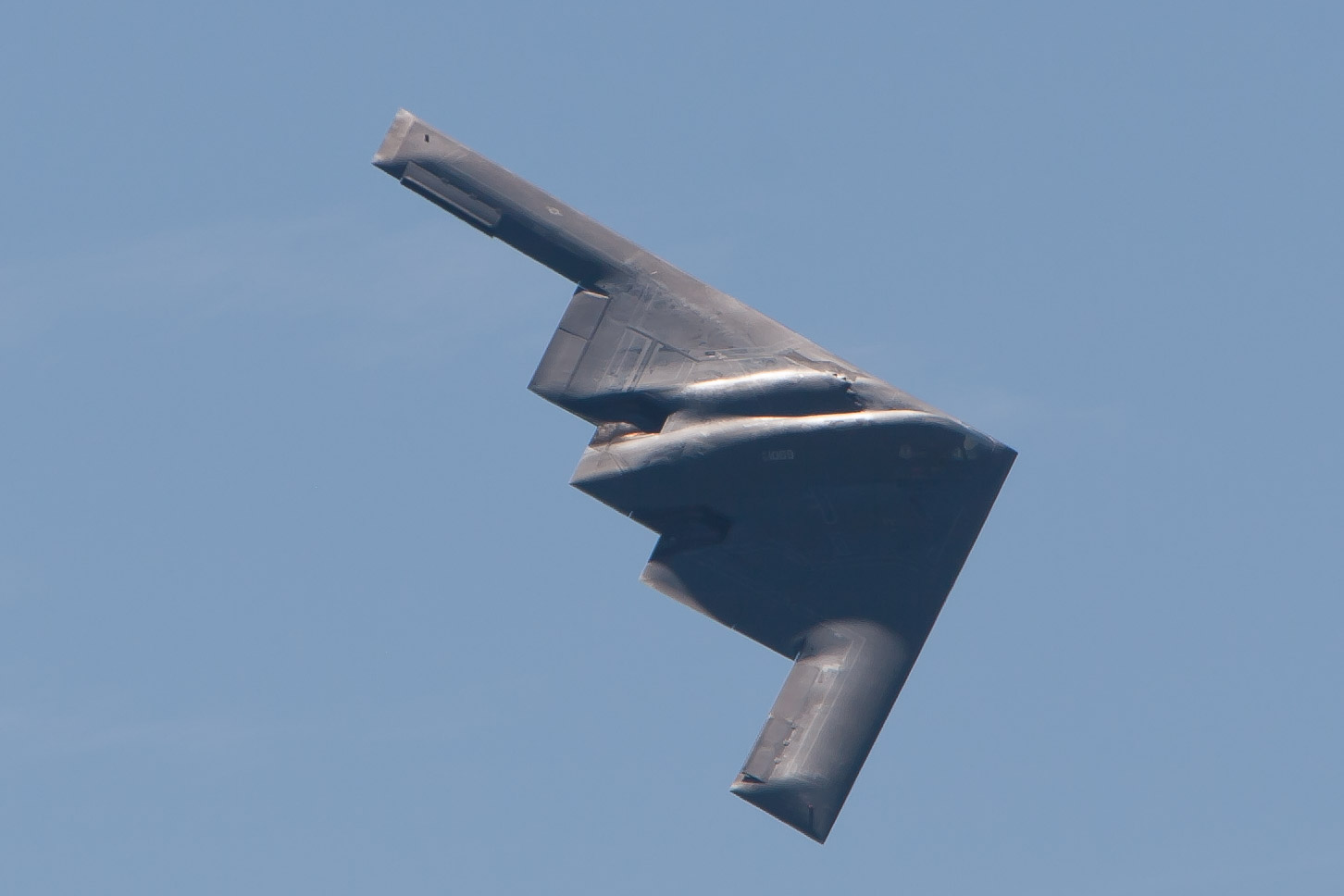
A B2 happened to fly by near my house. I grabbed my camera and shot what I could. This is a 100% crop from the 20D image shot at 400mm.

20D44394.jpg


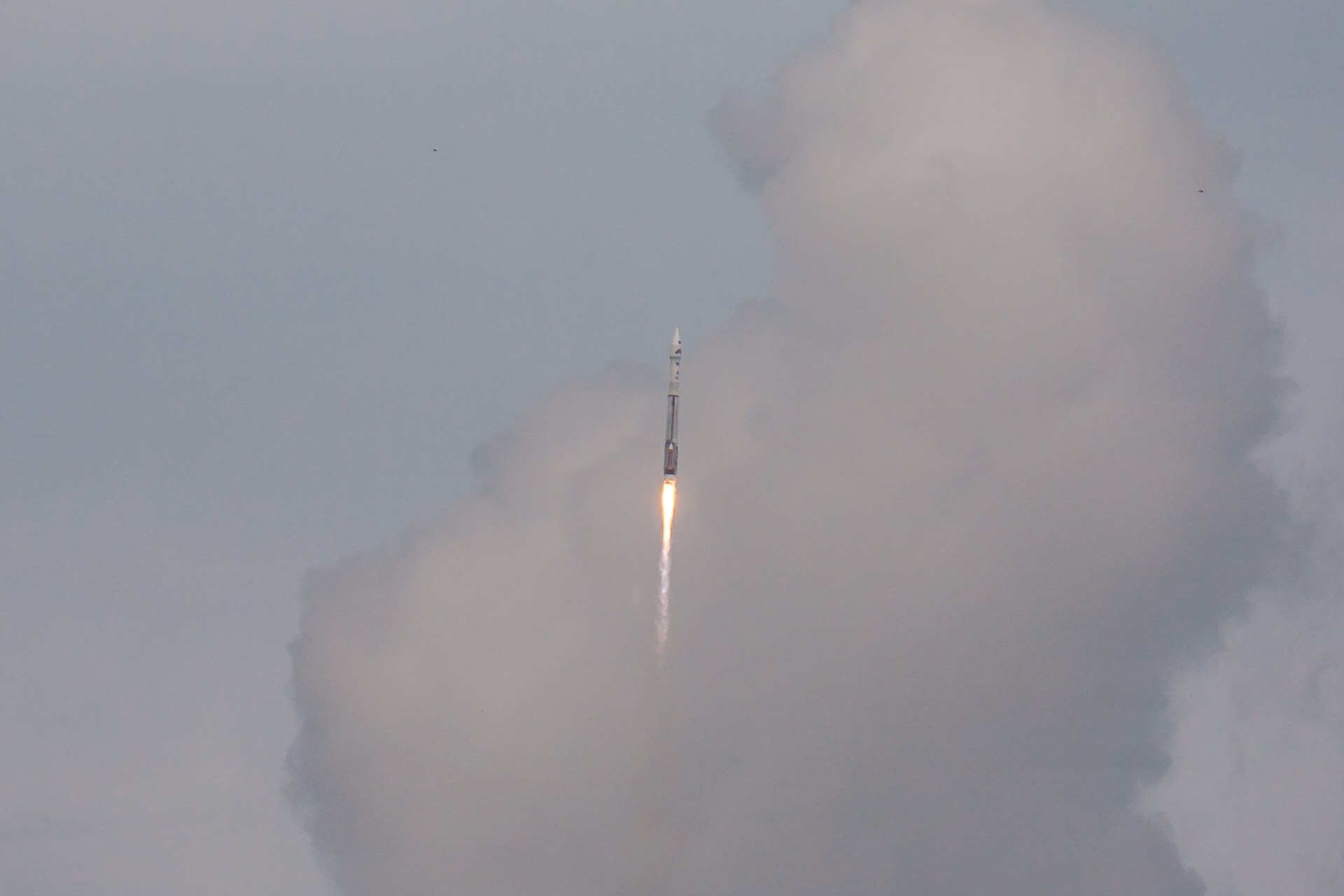
We were in Orlando on vacation and got a chance to go to KSC to visit and possibly to see an Atlas V launch. We were lucky and MAVEN (the probe that just went into orbit around Mars) launched right on time. I shot it with the longest lens I had (400mm) on the only camera I had (5D). We were as close as we could get (Visitor's Center) and this is the resultant 100% crop.

5D_46755.jpg
 
Upvote 0
privatebydesign said:
Bob Howland said:
Anyway, unlike some, I find the extra "reach" to be real and advantageous.

Got any comparison images to back that up Bob?
I have both the 7D and 1D4, and they are same generation sensors.
I have done several tests between these body's, and in my opinion the reach advantage for 7D is quite clear.
Especially using sharp lenses.
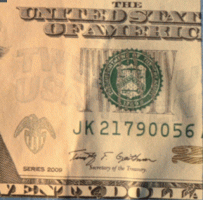
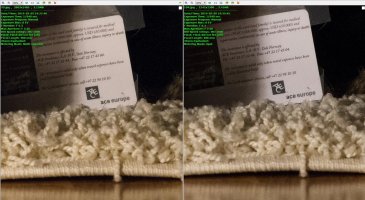
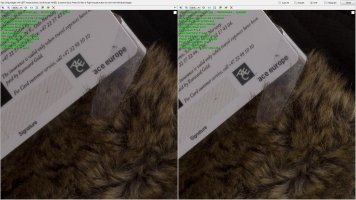
Here is 100% Crop from 7D vs upscaled Crop from 1D4, both iso 800:
 

Attachments

  • 7Dvs1D4.jpg
    7Dvs1D4.jpg
    1.4 MB · Views: 226
Upvote 0
Pit123 said:
privatebydesign said:
Bob Howland said:
Anyway, unlike some, I find the extra "reach" to be real and advantageous.

Got any comparison images to back that up Bob?
I have both the 7D and 1D4, and they are same generation sensors.
I have done several tests between these body's, and in my opinion the reach advantage for 7D is quite clear.
Especially using sharp lenses.
Here is 100% Crop from 7D vs upscaled Crop from 1D4, both iso 800:

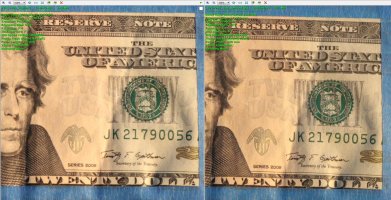
So you would have no problems picking out which of these two frames in the gif of your two images came from which camera?

All I did was apply a curves layer to even up the lighting a bit, no sharpening or other forms of optimisation.

I think your evidence actually supports the other side of the argument, if you didn'y know the colour and contrast of each frame, ie they were shot better, I doubt anybody could tell the difference, and these are at 100% and >100%, at normal reproduction sizes I doubt if ever.
 

Attachments

  • index.gif
    index.gif
    412.4 KB · Views: 734
Upvote 0
privatebydesign said:
Pit123 said:
privatebydesign said:
Bob Howland said:
Anyway, unlike some, I find the extra "reach" to be real and advantageous.

Got any comparison images to back that up Bob?
I have both the 7D and 1D4, and they are same generation sensors.
I have done several tests between these body's, and in my opinion the reach advantage for 7D is quite clear.
Especially using sharp lenses.
Here is 100% Crop from 7D vs upscaled Crop from 1D4, both iso 800:

So you would have no problems picking out which of these two frames in the gif of your two images came from which camera?

All I did was apply a curves layer to even up the lighting a bit, no sharpening or other forms of optimisation.

I think your evidence actually supports the other side of the argument, if you didn'y know the colour and contrast of each frame, ie they were shot better, I doubt anybody could tell the difference, and these are at 100% and >100%, at normal reproduction sizes I doubt if ever.
Your copies look very soft to me, compared to mine. Do the curve layer makes the images soft?
Comparing soft images makes no sense to me...
 
Upvote 0
privatebydesign said:
Pit123 said:
privatebydesign said:
Bob Howland said:
Anyway, unlike some, I find the extra "reach" to be real and advantageous.

Got any comparison images to back that up Bob?
I have both the 7D and 1D4, and they are same generation sensors.
I have done several tests between these body's, and in my opinion the reach advantage for 7D is quite clear.
Especially using sharp lenses.
Here is 100% Crop from 7D vs upscaled Crop from 1D4, both iso 800:

So you would have no problems picking out which of these two frames in the gif of your two images came from which camera?

All I did was apply a curves layer to even up the lighting a bit, no sharpening or other forms of optimisation.

I think your evidence actually supports the other side of the argument, if you didn'y know the colour and contrast of each frame, ie they were shot better, I doubt anybody could tell the difference, and these are at 100% and >100%, at normal reproduction sizes I doubt if ever.
And here is another comparison: 1600 iso. Now 7D image is downscaled to 1D4 size. And guess what: Less noise and more details on 7D image, except in black areas where hot pixels are bad.
 

Attachments

  • 7Dvs1D4_1600iso.jpg
    7Dvs1D4_1600iso.jpg
    493.8 KB · Views: 239
Upvote 0
Pit123 said:
privatebydesign said:
Pit123 said:
privatebydesign said:
Bob Howland said:
Anyway, unlike some, I find the extra "reach" to be real and advantageous.

Got any comparison images to back that up Bob?
I have both the 7D and 1D4, and they are same generation sensors.
I have done several tests between these body's, and in my opinion the reach advantage for 7D is quite clear.
Especially using sharp lenses.
Here is 100% Crop from 7D vs upscaled Crop from 1D4, both iso 800:

So you would have no problems picking out which of these two frames in the gif of your two images came from which camera?

All I did was apply a curves layer to even up the lighting a bit, no sharpening or other forms of optimisation.

I think your evidence actually supports the other side of the argument, if you didn'y know the colour and contrast of each frame, ie they were shot better, I doubt anybody could tell the difference, and these are at 100% and >100%, at normal reproduction sizes I doubt if ever.
And here is another comparison: 1600 iso. Now 7D image is downscaled to 1D4 size. I guess what: Less noise and more on 7D image, except from dark areas where hot pixels are bad.

Another interesting comaprison:
1d4+500mm+2x vs 7d+500mm+1.4x (100%crops). Both wide open With same shutter. Which one would you choose? And you still say there is no crop advantage?
 

Attachments

  • 1d4 vs 7D low iso.jpg
    1d4 vs 7D low iso.jpg
    358.3 KB · Views: 239
Upvote 0
Pit123 said:
Your copies look very soft to me, compared to mine. Do the curve layer makes the images soft?
Comparing soft images makes no sense to me...

That is because I resized the gif, here it is unresized, I guarantee nobody would get it right now without guessing even at 100% and above.

P.S. The 'sharper' one is the 1D MkIV with a fraction of sharpening.......
 

Attachments

  • index2.gif
    index2.gif
    124.3 KB · Views: 678
Upvote 0
I'm not seeing any real difference in any of the pairs. Doesn't that kind of support the other side ???

Again I'll say if you're cropping in so much that you're left with like 3 MP from the FF file...and you have to make a larger print...crop wins. You simply run out of pixels otherwise. But that's rare.

The flip side is that the same thing happens when you honestly compare FF vs. crop, same FoV and print size and all of their pixels, at low to mid ISO. A landscape photo with an 11mm on crop and a 17mm on FF. OOC you can see a difference, but after post processing...good luck telling them apart, even at 36". In fairness, in difficult situations FF files can take harder processing, but you can push a crop 14-bit RAW pretty hard as well.

Even high ISO at smaller print sizes is becoming more difficult to discern, though ISOs like 6400 and 12800 still clearly show off FF's light gathering advantage. But if Scott Kelby's samples are any indication...a crop 7D mark II will be usable at 16,000 for an 8x10. FF would look better even at 8x10 at that ISO, but how much better? It's ridiculous how good we have it.

We are far too concerned with minutia at a time when equipment is...by a wide margin...the best it has ever been.
 
Upvote 0
dtaylor said:
I'm not seeing any real difference in any of the pairs.

The 1000mm versus 700mm pair is the best one - the 700mm lens on the 7D won because it has 60% more linear pixel density and the 1D only had a 41% focal length advantage. Do that same test with the same focal lengths and the gap would be even bigger.
 
Upvote 0