In-Depth Review: Tamron 150-600 f/5-6.3 VC

Plainsman said:
With all due respect Don testing a 600 lens at 20 feet is a bit ridiculous - IMO!

I agree.

I intended to test it at about 100 feet, but it was -26C and windy outside... I am going to retry the test the next nice day that I am home.... I was thinking of a bird-sized target at 100 feet and then another target at around 300 feet, plus trying some additional F-stops....
 
Upvote 0
Don Haines said:
Plainsman said:
With all due respect Don testing a 600 lens at 20 feet is a bit ridiculous - IMO!

I agree.

I intended to test it at about 100 feet, but it was -26C and windy outside... I am going to retry the test the next nice day that I am home.... I was thinking of a bird-sized target at 100 feet and then another target at around 300 feet, plus trying some additional F-stops....

Don, take heart :) People love to criticize without much consideration for reality. Doing long range tests in Canada in January/February are difficult at best. You have an indoor limitation of how much space you have. Going outdoors introduces a lot of other factors. I appreciate seeing these results, and I seriously doubt that such a lens is optimized for short distance. FoCal recommends doing AFMA at 12meters for 600mm, and have a pretty scientific explanation for that.

I'm interested in seeing your further tests, but I reject the notion that your current test has no value.
 
Upvote 0
TWI by Dustin Abbott said:
Don Haines said:
Plainsman said:
With all due respect Don testing a 600 lens at 20 feet is a bit ridiculous - IMO!

I agree.

I intended to test it at about 100 feet, but it was -26C and windy outside... I am going to retry the test the next nice day that I am home.... I was thinking of a bird-sized target at 100 feet and then another target at around 300 feet, plus trying some additional F-stops....

Don, take heart :) People love to criticize without much consideration for reality. Doing long range tests in Canada in January/February are difficult at best. You have an indoor limitation of how much space you have. Going outdoors introduces a lot of other factors. I appreciate seeing these results, and I seriously doubt that such a lens is optimized for short distance. FoCal recommends doing AFMA at 12meters for 600mm, and have a pretty scientific explanation for that.

I'm interested in seeing your further tests, but I reject the notion that your current test has no value.

My hunting blind in the back yard is about 25 feet away from the bird feeders.... for me the test has great value...

But I also want to see what happens at medium and longer distances too :) I learned from that first test that I need to check more F stops...
 
Upvote 0
I'm still very much interested in this. But have yet to find the time to my local camera store to chat to an assistant about it and the price.

When some of you mention about needing time to learn how to use a 600mm lens. Are you mainly referring to the desire/need for a tripod or monopod? The difficulty of handholding? Up to now the longest lens I have used has been 300mm. Just curious as to what I would be in for if I pull the trigger and buy it.
 
Upvote 0
dhr90 said:
I'm still very much interested in this. But have yet to find the time to my local camera store to chat to an assistant about it and the price.

When some of you mention about needing time to learn how to use a 600mm lens. Are you mainly referring to the desire/need for a tripod or monopod? The difficulty of handholding? Up to now the longest lens I have used has been 300mm. Just curious as to what I would be in for if I pull the trigger and buy it.

There are few challenges. Motion blur is much more of an issue at 600mm than it is at 300mm, so despite the great image stabilization you have to learn to get your shutter speed up higher. Framing and tracking at that length requires a bit of retraining of the way you visualize.

There are other factors, but those are the biggies in my mind.
 
Upvote 0
dhr90 said:
When some of you mention about needing time to learn how to use a 600mm lens. Are you mainly referring to the desire/need for a tripod or monopod? The difficulty of handholding? Up to now the longest lens I have used has been 300mm. Just curious as to what I would be in for if I pull the trigger and buy it.

The angle of view is quite narrow at 600mm…it takes a bit of practice just to find the subject in the viewfinder. The zoom capability will help, but it takes time to zoom out and zoom in.
 
Upvote 0
dhr90 said:
When some of you mention about needing time to learn how to use a 600mm lens. Are you mainly referring to the desire/need for a tripod or monopod? The difficulty of handholding? Up to now the longest lens I have used has been 300mm. Just curious as to what I would be in for if I pull the trigger and buy it.
I have been using an old 800mm, manual focus, no IS lens on my 5Diii and at a long distance a tiny vibration can cause the target to bounce around your viewfinder. Without autofocus or IS getting a sharp shot at a distant target is more akin to shooting a rifle at a distant target. This should be much less of an issue with the 150-600's auto focus and IS. Nevertheless, you see the guys with the modern 600mm and 800mm lenses being very methodical in maintaining a steady support for their lens even though they have advanced IS and can shoot at high shutter speed. Many of the reviews on the 150-600 which complain about some blurry shots appear to be written by those who don't appear to have a great deal of experience with long lenses. Therefore, I have a hard time discerning how much faith to put into these reports. It appeared to me that those who had more long lens experience were getting better results with the 150-600 than those with less experience with long lenses. The bottom line for me is that it sounded like a fun toy, so I recently bought the 150-600. I wanted something that I could carry around with me that would give me some reach. Having IS and autofocus will also be a luxury. Unfortunately, I have yet to really give it a go as it has been raining or dark by the time I can get free.

I would not worry too much about what you will be in for if you buy. When I first bought the 800mm, I googled what appears to be the term of art, "long lens technique," and found many articles that were of assistance.

I plan on keeping the 800mm not only for its extra reach, but because while it is challenging to use, it is also really satisfying when you are on a roll and even on moving targets get your keepers much higher than your discards. Hopefully, the 150-600 will be a great addition as well as being more hiking and air travel friendly than the 800mm.
 
Upvote 0
Don Haines said:
TWI by Dustin Abbott said:
Don Haines said:
Plainsman said:
With all due respect Don testing a 600 lens at 20 feet is a bit ridiculous - IMO!

I agree.

I intended to test it at about 100 feet, but it was -26C and windy outside... I am going to retry the test the next nice day that I am home.... I was thinking of a bird-sized target at 100 feet and then another target at around 300 feet, plus trying some additional F-stops....

Don, take heart :) People love to criticize without much consideration for reality. Doing long range tests in Canada in January/February are difficult at best. You have an indoor limitation of how much space you have. Going outdoors introduces a lot of other factors. I appreciate seeing these results, and I seriously doubt that such a lens is optimized for short distance. FoCal recommends doing AFMA at 12meters for 600mm, and have a pretty scientific explanation for that.

I'm interested in seeing your further tests, but I reject the notion that your current test has no value.

My hunting blind in the back yard is about 25 feet away from the bird feeders.... for me the test has great value...

But I also want to see what happens at medium and longer distances too :) I learned from that first test that I need to check more F stops...

There's nothing ridiculous at all about your 20' test. As you point out, the 600mm is often used at 20 or so feet for small birds. And, in any case relative sharpness at different apertures won't change much with distance. Diffraction effects start coming in at about f/6.3 with your 60D compared with about f/11 on the new 5 and 1Ds, and so the sharpness should be better at f/11 and f/16 on them.
 
Upvote 0
I was able to get out for a few minutes after work with my 150-600. I took a series of photos of a lighthouse across the lake from me using a monopod at several f stops. I need to get used to using the lens on this monopod as I was having issues controlling a sideways twisting motion. I posted the shots at http://www.pbase.com/lebthree/tamron_150600mm_test&page=all. All the lighthouse and tower shots have no sharpening or noise reduction applied. For each of these shots I have the full frame 600mm original shot and a heavily cropped version. The last two photos in the series will give you an idea of the distances involved. I don't know how much faith I would put in these shots as the variation between them could just as well be due to lens movement on my monopod and fading light.
 
Upvote 0
Don Haines said:
A quick sharpness test....

The goal is to see what effect the F stop has on sharpness with the 150-600 when used at 600mm

All shot with a 60D from a distance of 20 feet and processed in lightroom. All images are with the Tamron 150-600 profile enabled and with chromatic aberration correction enabled.

The target is the fine print on the back of the packaging of a laser pointer... it was the smallest size printing that I could find lying around the house.

The first image has the colour balanced, sharpness slider at 0, noise reduction slider at 0

The second image has the sharpening slider at 80, noise reduction slider at 50, and blacks level at -50. There is a typo on the picture description.... The first bar is F6.3, not F5.6.

Obviously F8 or F11 is far sharper than F6.3 and it falls of by F16. With sharpening enabled, F11 appears slightly better than F8. When you consider that I could not see the pattern around the "danger" symbol when it was inches from my face, yet the lens could pick that up from across the house, this lens is great bang for the buck!....

Very nice comparison, but I wonder just how sharp it is at 100 or 200 feet distance? In my experience with telephoto prime and zoom lenses, both the lens itself becomes less sharp at longer distances...but also the AF accuracy diminishes at those distances that are either at, or close to, infinity. Why? Because the focusing elements need only move a micron or two to take things from being "tack sharp", to "soft"...even when focusing manually in live view.

I'm not even talking about atmospherics with the above, either...they enter in (especially in warmer weather), but they are easier to see than just some slight softness. They're "wavy"...

I don't shoot most of my bird images, and especially not any other wildlife at such a close distance (20 feet).

 
Upvote 0
TWI by Dustin Abbott said:
I can't speak for everyone, but I own multiple teleconverters and frankly I kind of hate using them. In the field or at an event, I often don't bother with changing it out because of the environment, the amount of time for the switch, or the risk of getting gunk in my body during the change. The 135L takes a 1.4x quite well, and I do use that combination, but let's be realistic; it is only 189mm, and an unstabilized 189mm at that.

The 70-200L II takes teles very well well, too, but even on it with a 2x there is quite a degrading of image quality, and it is a 400mm f/5.6 by that point.

If you want reach, the Tamron is the best bargain option on the market. I'll certainly be adding one to my kit. And for those saying it is only good up to 400mm - they haven't used it. I thought I was taking this wide open, but it is actually f/7.1 (stopped down 1/3rd a stop). But it is 600mm, handheld, and ISO 2000. How exactly is this not usable?

I suppose it's usable for this amount of cropping.
 
Upvote 0
CarlTN said:
Don Haines said:
A quick sharpness test....

The goal is to see what effect the F stop has on sharpness with the 150-600 when used at 600mm

All shot with a 60D from a distance of 20 feet and processed in lightroom. All images are with the Tamron 150-600 profile enabled and with chromatic aberration correction enabled.

The target is the fine print on the back of the packaging of a laser pointer... it was the smallest size printing that I could find lying around the house.

The first image has the colour balanced, sharpness slider at 0, noise reduction slider at 0

The second image has the sharpening slider at 80, noise reduction slider at 50, and blacks level at -50. There is a typo on the picture description.... The first bar is F6.3, not F5.6.

Obviously F8 or F11 is far sharper than F6.3 and it falls of by F16. With sharpening enabled, F11 appears slightly better than F8. When you consider that I could not see the pattern around the "danger" symbol when it was inches from my face, yet the lens could pick that up from across the house, this lens is great bang for the buck!....

Very nice comparison, but I wonder just how sharp it is at 100 or 200 feet distance? In my experience with telephoto prime and zoom lenses, both the lens itself becomes less sharp at longer distances...but also the AF accuracy diminishes at those distances that are either at, or close to, infinity. Why? Because the focusing elements need only move a micron or two to take things from being "tack sharp", to "soft"...even when focusing manually in live view.

I'm not even talking about atmospherics with the above, either...they enter in (especially in warmer weather), but they are easier to see than just some slight softness. They're "wavy"...

I don't shoot most of my bird images, and especially not any other wildlife at such a close distance (20 feet).
Agreed!

I've done the "hunting blind" test and I'd like to see what it looks like at "in the wild" distances... I probably won't get to try it today... it is snowing....
 
Upvote 0
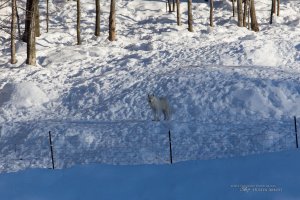
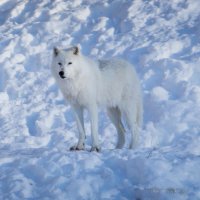
For those wanting to see resolving at distance, here's an example of Arctic wolves. I want to preface this post by saying that I don't believe this represents optimum conditions for sharpness. I was shooting from a vehicle, with a serious temperature variation, and my shutter speed is only 1/250th here. The lighting situation was pretty challenging with the subject in shadow. Still, I think it demonstrates that focus was good (although this shot was stopped down to f/11). I was at least 150-200 feet away when shooting:
 

Attachments

  • 08 At Distance.jpg
    08 At Distance.jpg
    2.7 MB · Views: 1,375
Upvote 0
If you are having autofocus problems on the 150-600, your problem might be camera configuration.

If you go into the camera setup menus, under Autofocus/Drive, there is an option for Lens drive when AF impossible... You can set it to "Continue focus search" or to "Stop focus search". If you set it to "Stop focus search" the lens will give up very easily and AF will not work well, particularly when going between near and distant focus. If you set it to "Continue focus search" it works far better.

(At least it does on a 60D)
 
Upvote 0
Mine arrived yesterday and my initial impression is that It's well worth the money. It handles well and fits nicely on the 70d. Really big lenses dont match well with a smaller body like that but this one seems just right.The IQ is what I expected, really good to 400 and good to 600 same thing for the af. I think the sigma 120-300 with the canon tc's is still better but this lens is 1/2 the weight and less than 1/3rd the price (1/4th if you add the cost of the converters) if you are looking for a packable high quality long zoom with an attractive price then I don't see how you could do much better, I am very pleased so far.
 
Upvote 0