L Lenses for crop bodies

candc said:
well i will start with the first lens in the list the sigma 8-16, its wider than anything except the sigma 12-24 for ff i think and the 8-16 on an aps-c body gives better results sraight up head to head than the 12-24 on a ff so thats one reason to go with a crop

I owned the Sigma 8-16 when I owned a Pentax K-5 and it was a good lens (though for reasons that aren't entirely clear, more than a few of the photos I took with it are completely soft on one side), far better than the closest Tamron equivalent. But does it give better results than the 12-24 on FF? This doesn't suggest so:

http://www.the-digital-picture.com/Reviews/ISO-12233-Sample-Crops.aspx?Lens=710&Camera=474&Sample=0&FLI=0&API=3&LensComp=369&CameraComp=453&SampleComp=0&FLIComp=0&APIComp=3

Maybe there are real world comparisons out there which support your conclusion (or vice versa); I don't know.

But assuming the crop version is better, you could take your approach an end up elsewhere. If the extra couple of mm at the wide end don't matter much, the Nikon 14-whateveritis is better; so that's one reason to go FF Nikon. The 4/3 Olympus 7-14 and M4/3 Panasonic 7-14 perform better than the Sigma too, which is one reason to get the new OMD for the former or a Panasonic M43 for the latter (for some reason the Panasonic has purple flare issues on all Olympus bodies). So if wide angle matters, but 14 will do instead of 12 (in ff terms), one shouldn't bother with Canon at all....
 
Upvote 0
candc said:
you think the squirrel shot is soft? it was iso 1600 300mm + 2xii on a crop body from about 50 yards away and its plenty sharp enough to see the individual hairs on the tail.

If I can barge into your exchange with Pi, I'm afraid I agree with him. The image looks just fine at the small size it appears at in this forum (not surprising), but not the image you provided for download. Yes, you can see some individual hairs on the tail, but the fur on the body looks almost splotchy - whether because of processing or some other reason I can't say, of course, but other things being equal it doesn't look as though the camera does all that well at ISO 1600 (if you think the 6D's RAW files would look the same at ISO 1600...). Maybe the original looks better and something was lost in your downsizing. Otherwise, while I've never used the lens you used for that photo, so I can't say for sure, I would expect that a good copy (there seems to be some variation out there; the good ones are remarkably sharp) of the Panasonic 100-300 at 300 on a recent m4/3 body would do a better job than this particular combination did, and that my Sigma 50-500 on my 5DIII or 6D would do a better job too. (Maybe someone out there has done a suitable comparison that's more useful than my speculation.)
 
Upvote 0
sdsr said:
candc said:
well i will start with the first lens in the list the sigma 8-16, its wider than anything except the sigma 12-24 for ff i think and the 8-16 on an aps-c body gives better results sraight up head to head than the 12-24 on a ff so thats one reason to go with a crop

I owned the Sigma 8-16 when I owned a Pentax K-5 and it was a good lens (though for reasons that aren't entirely clear, more than a few of the photos I took with it are completely soft on one side), far better than the closest Tamron equivalent. But does it give better results than the 12-24 on FF? This doesn't suggest so:

http://www.the-digital-picture.com/Reviews/ISO-12233-Sample-Crops.aspx?Lens=710&Camera=474&Sample=0&FLI=0&API=3&LensComp=369&CameraComp=453&SampleComp=0&FLIComp=0&APIComp=3

Maybe there are real world comparisons out there which support your conclusion (or vice versa); I don't know.

But assuming the crop version is better, you could take your approach an end up elsewhere. If the extra couple of mm at the wide end don't matter much, the Nikon 14-whateveritis is better; so that's one reason to go FF Nikon. The 4/3 Olympus 7-14 and M4/3 Panasonic 7-14 perform better than the Sigma too, which is one reason to get the new OMD for the former or a Panasonic M43 for the latter (for some reason the Panasonic has purple flare issues on all Olympus bodies). So if wide angle matters, but 14 will do instead of 12 (in ff terms), one shouldn't bother with Canon at all....

http://www.juzaphoto.com/article.php?l=en&article=31

thats a comparison article of the 2. at the time i bought the lens the consensus i found from online samples and reviews was that the 8-16 gave better results than the 12-24
 
Upvote 0
sdsr said:
candc said:
you think the squirrel shot is soft? it was iso 1600 300mm + 2xii on a crop body from about 50 yards away and its plenty sharp enough to see the individual hairs on the tail.

If I can barge into your exchange with Pi, I'm afraid I agree with him. The image looks just fine at the small size it appears at in this forum (not surprising), but not the image you provided for download. Yes, you can see some individual hairs on the tail, but the fur on the body looks almost splotchy - whether because of processing or some other reason I can't say, of course, but other things being equal it doesn't look as though the camera does all that well at ISO 1600 (if you think the 6D's RAW files would look the same at ISO 1600...). Maybe the original looks better and something was lost in your downsizing. Otherwise, while I've never used the lens you used for that photo, so I can't say for sure, I would expect that a good copy (there seems to be some variation out there; the good ones are remarkably sharp) of the Panasonic 100-300 at 300 on a recent m4/3 body would do a better job than this particular combination did, and that my Sigma 50-500 on my 5DIII or 6D would do a better job too. (Maybe someone out there has done a suitable comparison that's more useful than my speculation.)

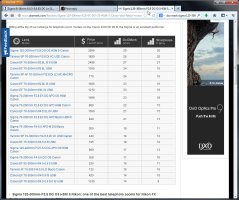
if you wanted to compare the 120-300 on a crop body to the 50-500 on a ff body then it would be without the 2x converter on the 120-300. i have a sigma 80-400 which i think is as good or better optically than the bigma but the bigma has hsm the 80-400 has a garage door opener for a focus motor. the 120-300 is far better than either from what i have seen. dxo now lists it as the top performing tele zoom on a 5diii body and the bare lens is really good on a crop body too
 

Attachments

  • dxo list.jpg
    dxo list.jpg
    148.6 KB · Views: 551
Upvote 0
candc said:
the 120-300 is far better than either from what i have seen. dxo now lists it as the top performing tele zoom on a 5diii body and the bare lens is really good on a crop body too

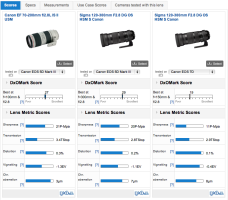
You've got those rankings sorted based on DxOMark's Biased Scores (aka BS). Those Scores are based on how a lens performs in lighting found in a dimly lit warehouse (150 lux). Both the Sigma 120-300/2.8 OS and the Canon 70-200/2.8L IS II are f/2.8 lenses, but the Sigma has a higher transmission (T-stop), therefore is gets a higher score despite not being quite as sharp.

As for the 120-300/2.8 being 'really good on a crop body too', on the 22 MP FF sensor of the 5DIII, it delivers 20 P-Mpix, on the 20 MP sensor of the 6D, it delivers 18 MP. So, you're right that the lens is good, on FF…almost as sharp as the Canon 70-200 II, only costing the system resolution 2 MP, a drop of ~10%. However, on the 18 MP APS-C sensor of the 7D, it delivers only 11 P-Mpix…a drop of nearly 40%, far less sharpness than the same lens on FF.
 

Attachments

  • 70-200 120-300.png
    70-200 120-300.png
    81.1 KB · Views: 502
Upvote 0
candc said:
you think the squirrel shot is soft? it was iso 1600 300mm + 2xii on a crop body from about 50 yards away and its plenty sharp enough to see the individual hairs on the tail.

I wouldn't call it soft, but a cropped image from a FF camera would be sharper, and have less noise.
 
Upvote 0
neuroanatomist said:
candc said:
the 120-300 is far better than either from what i have seen. dxo now lists it as the top performing tele zoom on a 5diii body and the bare lens is really good on a crop body too

You've got those rankings sorted based on DxOMark's Biased Scores (aka BS). Those Scores are based on how a lens performs in lighting found in a dimly lit warehouse (150 lux). Both the Sigma 120-300/2.8 OS and the Canon 70-200/2.8L IS II are f/2.8 lenses, but the Sigma has a higher transmission (T-stop), therefore is gets a higher score despite not being quite as sharp.

As for the 120-300/2.8 being 'really good on a crop body too', on the 22 MP FF sensor of the 5DIII, it delivers 20 P-Mpix, on the 20 MP sensor of the 6D, it delivers 18 MP. So, you're right that the lens is good, on FF…almost as sharp as the Canon 70-200 II, only costing the system resolution 2 MP, a drop of ~10%. However, on the 18 MP APS-C sensor of the 7D, it delivers only 11 P-Mpix…a drop of nearly 40%, far less sharpness than the same lens on FF.

an excerpt from the review linked.

Sharpness
The Sigma 120-300mm ƒ/2.8 Sports lens is very good optically, producing very sharp images on both full-frame and sub-frame cameras. The graphs at right show very slightly sharper results on the sub-frame body than the full-frame one, but the amount of difference is less than or equal to 0.2 of our arbitrary blur units, an amount that's well within the error margin of our tests, and a level that's completely indiscernible.

http://slrgear.com/reviews/showproduct.php/product/1559/cat/all

they claim its sharper on a crop body?

i am not sure what to make of all that but what i do know is that the bare lens will give you the best i have seen on a crop body in its range. and i have experimented with different teleconverters and found the canons to work the best. this lens has a reputation for being bad with tc's . on a crop body it gives you pretty good reach without a tc, and its 2.8 which you need on a crop body, that's why i like it. i have gotten better than i expected results with the canon 2xiii, the canon and kenko 1.4x are better i dont seem to use them much.
 
Upvote 0
It's my contention that L is just a set of expectations, red paint and marketing. There is no one single consistent feature that defines L.

There are great lenses that don't don't have red rings, and great lenses by third parties.

I wouldn't get too hung up on the marketing, read the reviews, try things out and see what works for you.

I think the Tokina 11-16 is a work of genius. Would canon sell enough to APS-C users to justify R&D etc? Probably not. But Tokina obviously are able to sell enough to Canon, Sony Nikon etc users to justify it.

This is sometimes where the third party guys can come up trumps.

APS-C users are particularly lucky in some regards, they have a massive choice of lenses that often behave better than on FF thanks to the crop.

My Tokina isn't an L? I don't care.
 
Upvote 0
candc said:
an excerpt from the review linked.

Sharpness
The Sigma 120-300mm ƒ/2.8 Sports lens is very good optically, producing very sharp images on both full-frame and sub-frame cameras. The graphs at right show very slightly sharper results on the sub-frame body than the full-frame one, but the amount of difference is less than or equal to 0.2 of our arbitrary blur units, an amount that's well within the error margin of our tests, and a level that's completely indiscernible.

http://slrgear.com/reviews/showproduct.php/product/1559/cat/all

they claim its sharper on a crop body?

Relative sharpness. What you're seeing is just the 'sweet spot' effect - lenses are sharper in the center, and when a FF lens is used on a crop body, only the central portion of the image circle is used.
 
Upvote 0
neuroanatomist said:
candc said:
an excerpt from the review linked.

Sharpness
The Sigma 120-300mm ƒ/2.8 Sports lens is very good optically, producing very sharp images on both full-frame and sub-frame cameras. The graphs at right show very slightly sharper results on the sub-frame body than the full-frame one, but the amount of difference is less than or equal to 0.2 of our arbitrary blur units, an amount that's well within the error margin of our tests, and a level that's completely indiscernible.

http://slrgear.com/reviews/showproduct.php/product/1559/cat/all

they claim its sharper on a crop body?

Relative sharpness. What you're seeing is just the 'sweet spot' effect - lenses are sharper in the center, and when a FF lens is used on a crop body, only the central portion of the image circle is used.

did you read the entire review? they account for that.

true or not that is a benefit of aps-c. you are using the best part of the lens
 
Upvote 0
candc said:
they claim its sharper on a crop body?

They use different units for different sensors, like miles for FF and km for crop. They basically say that the use DXO software but they have no idea what it reports, and they rescale it so that the same lens would produce the same blur index in the center at the best aperture regardless of the sensor.

Because of the relative nature of the DxO blur measurements, you can't directly equate results obtained on different camera platforms. By careful choice of the camera settings and the assignment of a relative scaling factor, we've brought the blur numbers for the different camera platforms we use into reasonably close agreement. We have no adequate way to precisely calibrate the BxU numbers between platforms though.

We arrived at the multipliers by looking at best-case performance with the same lens on the different camera platforms. The scaling factors were set to make this best-case performance roughly the same between the cameras in question.


Bottom line- you cannot compare lenses on different sensors with their data.

http://www.the-digital-picture.com/Reviews/ISO-12233-Sample-Crops.aspx?Lens=738&Camera=453&FLI=0&API=0&LensComp=738&Sample=0&SampleComp=0&CameraComp=736&FLIComp=0&APIComp=0
 
Upvote 0
candc said:
did you read the entire review? they account for that.

true or not that is a benefit of aps-c. you are using the best part of the lens

Yes, I read the review…and yes, they mention the slightly softer edges on FF, but no, they don't account for the fact that they are measuring relative sharpness, not absolute sharpness.

When comparing the same lens on APS-C and FF, the FF result will be sharper. There's not a TDP comparison for the Sigma 120-300, but check out one of the sharpest lenses available, the 300/2.8L IS II, on the 1DsIII (FF) vs. the 60D (APS-C). Comparing lenses that cost 20% of the 300 II (300/4, 400/5.6, 100-400) on FF with the 300 II on APS-C, the sharpness is pretty similar. So you can spend $2000 more on the body or $5500 more on the lens to get to the same place.

The 70D is a good camera, but APS-C just isn't going to deliver the IQ of a FF camera, period. An image from a 200/2.8L II on the 6D, cropped to the FoV of APS-C, would be sharper than the 120-300/2.8 on the 70D. Cheaper, too.

I've been there...I loved my 7D, it delivered sharp images. Then I got a 5DII and compared them - 5DII + 135L ($1K lens) was better than 7D + 85L II ($2K lens). With the same lens, no competition. 1.5 stops more usable ISO on FF. I kept the 7D because the AF and frame rate were better. With the 1D X, the 7D has no advantages, I sold it. Would have done the same with a 5DIII.
 
Upvote 0
On a broader note anyone notice how conveniently people switch between a dependence on the lens vs dependence on the body?

If talking about reach, people are gladly happy to say the image projected by the lens remains the same thus it is nothing more than faux reach via an optical crop and there is no real extra reach. True and I agree with that, even though yes reach is about pixel densities rather than optical reach per se.

If talking about sharpness, suddenly it's all on the body; despite the fact it's the same thing where the image projected by the lens has not changed thus absolute sharpness from the image also does not change.

I don't deny in an absolute final image sense the image is better, but the candy being sold is a little disingenuous. Similar to saying FF gives shallower DoF, which is misleading when explaining to newbies because the shallower DoF is from the consequence of changing the composition (FL and/or focus distance).
 
Upvote 0
dufflover said:
I don't deny in an absolute final image sense the image is better, but the candy being sold is a little disingenuous. Similar to saying FF gives shallower DoF, which is misleading when explaining to newbies because the shallower DoF is from the consequence of changing the composition (FL and/or focus distance).

All very shrewd, your last point, quoted is a belter.

I actually prefer shooting aps-c with fast lenses. Especially for video where I'm focusing manually. In terms of depth of field I think 135 format sensors come into their own in allowing smaller apertures before diffraction becomes intrusive. This also gives you more exposure control, potentially.
 
Upvote 0
dufflover said:
Similar to saying FF gives shallower DoF, which is misleading when explaining to newbies because the shallower DoF is from the consequence of changing the composition (FL and/or focus distance).
Without changing the elements that make up the scene, composition is purely a combination of camera placement and field of view. To keep the composition the same, those two elements have to stay the same. Which means if you switch sensor size, the focal length has to change accordingly to maintain the composition.
 
Upvote 0
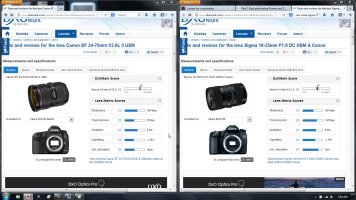
the 2nd lens on the list: sigma 18-35

you can see that the overall scores are pretty close on the 2 combos, the ff combo is sharper but both combos are plenty sharp and will give you good results with similar dof.

the ff combo is $5700 the aps-c combo is $2100
 

Attachments

  • comparison.jpg
    comparison.jpg
    219.8 KB · Views: 510
Upvote 0
rs said:
Without changing the elements that make up the scene, composition is purely a combination of camera placement and field of view. To keep the composition the same, those two elements have to stay the same. Which means if you switch sensor size, the focal length has to change accordingly to maintain the composition.

No. When you change ONLY the focal length, only the field of view changes. The perspective is unaltered. Perspective is a spatial relationship between objects and the camera. By changing lenses or body you may change the crop of the scene, but you won't affect composition at all.
 
Upvote 0
paul13walnut5 said:
rs said:
Without changing the elements that make up the scene, composition is purely a combination of camera placement and field of view. To keep the composition the same, those two elements have to stay the same. Which means if you switch sensor size, the focal length has to change accordingly to maintain the composition.

No. When you change ONLY the focal length, only the field of view changes. The perspective is unaltered. Perspective is a spatial relationship between objects and the camera. By changing lenses or body you may change the crop of the scene, but you won't affect composition at all.
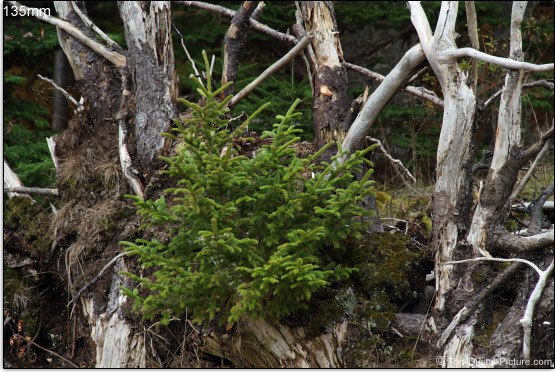
So are you saying these two images have the same composition?

18mm.jpg


135mm.jpg


source: http://www.the-digital-picture.com/Reviews/Canon-EF-S-18-135mm-f-3.5-5.6-IS-Lens-Review.aspx
 
Upvote 0