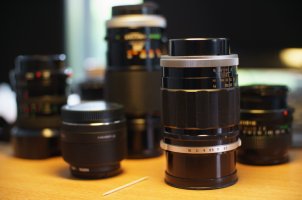
Nice sample images mrs! I just got my FD 50mm 1.2L and the results with the Speedbooster and the Fuji X-T1 are quite interesting:
focus: the focus peaking function from the X-T1 makes it very easy to nail the manual focus nine times out of ten. Having started photography in the film days I'm rediscovering the joy of manually setting the lens without compromising the keeper rate
 handhold-ability
: I repeated the same test as that detailed in a previous post and I made the comparison with my 6D and EF 50mm 1.2L keeping the FoV and DoF constant:
- Fuji X-T1+speedbooster+FD50L at 36mm (53mm equivalent in 135 format), f/1.2, 1/30s = 8/10 clean shots
- Canon 6D + EF50L at 50mm, f/1.2, 1/50s = 6/10 clean shots
Again, same conclusion as before, I got more keepers with the APS-C system and the focal reduction from the speedbooster enables a significant decrease in minimum shutter speed at no cost on the keeper rate.
Image quality and properties: In the first tests I found that I get significantly shaper in-focus images with the FD50/1.2L+Speedbooster on the X-T1 than with the EF50/1.2L on the 6D, but there's still some strong spherochromatic aberrations at f/1.2 as expected with such a fast lens. In terms of bokeh, I can hardly see any significant differences between the two set-ups although the APS-C combination deliver a shallower DoF at the same subject distance and lens apperture than the EF50/1.2L+6D (!) which I did not see coming, especially in view of the next observations.
Light-gathering ability: I had hoped that the FD50/1.2L+Speedbooster would deliver a 1 stop advantage in terms of light-gathering ability over the EF50/1.2L due to the reduction in the projected image circle. However, in my ISO and shutter speed tests I found that the two optical systems delivered the exact same image brightness at the sensor, which is caused by the fact that the FD50/1.2L has an optical transmission 1 Tstop slower than the EF50/1.2L. When I dug into this puzzling result I realized that the FD50 has smaller front and back lenses than the EF50, and the reduced T-stop is just a result of the different generations of optical formula. So, in this particular case there is no low-light advantage and the speedbooster just brings the older lens up to the same light transmission level of the newer EF lens.
Since the combination of the FD50/1.2L and the Speedbooster delivers an optical formula of 36mm and f/0.9, the light-gathering properties of the sensor become important factors impacting on the final shutter speed / ISO settings when the lens is used wide open. In my tests I found that below the f/1.4 setting at the lens (f/1.0 for the system) the collected image intensity by the sensor no longer increased linearly with the apperture area. This is clearly caused by light falling beyond the acceptance cone of each individual sensor pixel. The limit of Fuji's X-trans APS-C sensor seems to be around f/1.0 and this is also why I was surprised to find a slightly shallower DoF with this camera and the FD50+Speedbooster than with my EF50/1.2L+6D.
All in all, I am very pleased with the new APS-C combination. The X-T1+Speedbooster+FD50/1.2L delivers improved image outputs (shallower DoF and sharper in-focus images) compared to the FF system, all in a significantly smaller and lighter package. The manual focusing on the mirrorless systems is a far more pleasant and accurate process than on my 6D provided with the EG-S screen! However, the full-frame system retains its ~1stop low light advantage, but since this is not a critical factor for me I think I'll eventually ditch this system if my experience with the X-T1 in next couple of months remains as positive as it its now.
I don't have many interesting images taken with the FD50 yet as in the past couple days I just did some technical tests to assess the value of the APS-C set-up. I'll get proper portraits and other in the-field pictures as time progress. Anyway, out of interest I post some of the first technical samples below. All images are straight OOC and reduced in size under photoshop with some color point tweak done in the process. The first two pictures were taken at f/0.9 under fluorescent light (top right position) and some additional daylight (very weak due to poor weather, at left side of the subjects):
LED bicycle lamp, ISO 200, 1/180s, 1800x1200 image
here
Metal halide lamp, ISO 200, 1/90s, 1800x1200 image
here
and below, stopped down to f/4.0 under weak halogen light (top of the subject):
HID projection headlight module, ISO 1250, 1/40s, 1800x1200 image
here
now, I'm waiting for the FD 15/2.8 fisheye and the FD 135/2 with great expectations ;D

primes that I may use with it, and I'm thinking of picking up a Sigma 21-35 zoom.