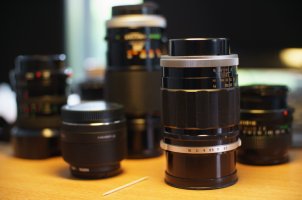
Long shot - Anyone tried using FD lenses on an EOS body?

mrsfotografie said:
I'm considering getting one of these; I assume you mean the Mitakon Canon FD - Sony E-mount Lens Turbo? Is it any good? I have a bunch of consumer level FL and FD(n) primes that I may use with it, and I'm thinking of picking up a Sigma 21-35 zoom.

That's what I meant. I've never tried one myself, but I use a few old Minolta lenses on a Fuji X-E1 and often think about picking one up. (For those curious, there is also the original Metabones Speed Booster, too).

I'm surprised that Canon haven't released anything similar for the EOS-M for both FD and EF lenses.
 
Upvote 0
mrsfotografie said:
I'm considering getting one of these; I assume you mean the Mitakon Canon FD - Sony E-mount Lens Turbo? Is it any good? I have a bunch of consumer level FL and FD(n) primes that I may use with it, and I'm thinking of picking up a Sigma 21-35 zoom.

If you want to get the best image quality possible, I would then advise you to consider the Metabones Speedbooster over the LensTurbo. Of course, the last option is much cheaper but in optical design like in anything else in life there is no such a thing as a free lunch: http://admiringlight.com/blog/review-metabones-speed-booster-canon-fd-to-fuji-x/2/
I just got myself a FD-to-X speedbooster adapter for my fuji X-T1 and a FD 135/2 is underway. I'll certainly be back in this thread to share my experience, but from what I have already seen from various discussions on mirorrless forums and sites, there is little risk that the results will be disappointing.
 
Upvote 0
Max ☢ said:
mrsfotografie said:
I'm considering getting one of these; I assume you mean the Mitakon Canon FD - Sony E-mount Lens Turbo? Is it any good? I have a bunch of consumer level FL and FD(n) primes that I may use with it, and I'm thinking of picking up a Sigma 21-35 zoom.

If you want to get the best image quality possible, I would then advise you to consider the Metabones Speedbooster over the LensTurbo. Of course, the last option is much cheaper but in optical design like in anything else in life there is no such a thing as a free lunch: http://admiringlight.com/blog/review-metabones-speed-booster-canon-fd-to-fuji-x/2/
I just got myself a FD-to-X speedbooster adapter for my fuji X-T1 and a FD 135/2 is underway. I'll certainly be back in this thread to share my experience, but from what I have already seen from various discussions on mirorrless forums and sites, there is little risk that the results will be disappointing.

Thanks, I have coincidentally found that review a few days ago and I came to the same conclusion. I intend to order the Metabones adapter, also because I want to expand my FD(n) set with a 35mm f/2 when I can find one and from what I've read that lens is a poor combination with the Lens Turbo. The only other alternative tot the Metabones adapter is a Sony Alpha 7 but that's a bridge too far I'm affraid.
 
Upvote 0
Using the Alpha 7 would surely save you the cost of the speedbooster, but that's a system you'd have to commit to, so I understand its a bit too much.

There is also another aspect which I have not seen being commented on with regard to the benefit of the FF lens + Speedbooster combination: handhold-ability. If I use the 135/2 on a full frame camera, normally I should apply the 1/focallength rule for the minimum shutter time (thus 1/135s) in order to prevent image blur when I hand-hold the camera. Adapting the Speedbooster to this lens reduces its effective focal length to 96mm, while at the same time I gain 1 stop of light-gathering capability (f/1.4). This means that I can decrease the ISO setting on my APS-C camera and increase the minimum shutter time to 1/100s (+35%!) and I'll still get sharp images (i.e. free of hand-induced blur that is).
If this is indeed correct, then that's a very interesting advantage! You get nearly the same DoF as with a FF camera body, you can use a lower ISO setting and slower shutter time, and you get all that in a smaller and lighter package...
 
Upvote 0
Max ☢ said:
Using the Alpha 7 would surely save you the cost of the speedbooster, but that's a system you'd have to commit to, so I understand its a bit too much.

There is also another aspect which I have not seen being commented on with regard to the benefit of the FF lens + Speedbooster combination: handhold-ability. If I use the 135/2 on a full frame camera, normally I should apply the 1/focallength rule for the minimum shutter time (thus 1/135s) in order to prevent image blur when I hand-hold the camera. Adapting the Speedbooster to this lens reduces its effective focal length to 96mm, while at the same time I gain 1 stop of light-gathering capability (f/1.4). This means that I can decrease the ISO setting on my APS-C camera and increase the minimum shutter time to 1/100s (+35%!) and I'll still get sharp images (i.e. free of hand-induced blur that is).
If this is indeed correct, then that's a very interesting advantage! You get nearly the same DoF as with a FF camera body, you can use a lower ISO setting and slower shutter time, and you get all that in a smaller and lighter package...

The main problem with the A7 is that it'll show the flaws in any lens as surely as the full frame Canon camera's which means it is likely to draw me into buying better glass for the mirrorless system (the FD lenses are only so good), or adapting my EF lenses which means I would be back to square one (I might as well use them on a 5D series body!).

If I consider my FD lenses as something to just play around with for interest and creativity (and compacteness!) sake, then the Speed Booster makes sense, at least that's how I look at it.

I'm not sure if your focal length comparison works in the way you say, because after all that 135 mm is reduced from an effective 203mm to 135 in the first place, not 96mm. I agree that you will gain extra light but it depends on the aperture of the lens to begin with and that f/2 is pretty bright to begin with, so you may run into the 'pixel shading' limit, see: http://admiringlight.com/blog/review-metabones-speed-booster-canon-fd-to-fuji-x/2/

Whatever the way one looks at it, the Speed Booster does give a lot of creative leverage. On a side note: I just rebuilt a Sigma 21-35 f/3.5-4 due to a stuck aperture, but the first test results at 1.5x crop aren't all that exciting. Maybe the Speed Booster will help to increase the MTF, because after all it's a reversed magnifying glass!
 
Upvote 0
You raise some good points indeed. For an equal number of pixels the FD+Spedbooster combination should deliver about the same (or very slightly worse) image quality as if the FD lenses were used on a FF body. The only advantages I can see of using the Speedbooster with an APS-C body are 1/ compactness (any FD lens is also smaller and ligher than its equivalent EF lens) and 2/ one stop gain in shutter time. If you consider that any APS-C sensor signal-to-noise ratio vs. ISO specs is shifted by 1 stop compared to the performance of FF sensors, then the latter point is cancelled (from the point of view of image noise that is) and only point 1/ remains. In my opinion this is still a very interesting value proposition given the much lower cost price of FD lenses compared to their EF equivalent while the image quality is only slightly lower with the older generation of canon prime glass.

As for the question of the 1/focallength rule with regard to handhold-ability of FF vs. APS-C cameras, it is true that this is only a guideline and that the crop factor may play a role in the risk of image blur at a given shutter speed and focal length.
As I could not find any clear cut answer to this question, I did some tests to compare the results with my Canon 6D and some EF (L and non L) primes and my Fuji X-T1 and some XF lenses. I stood in the upright position, properly hand-helding the cameras using no support whatsoever. The subject had a properly strong contrast and was positioned at a fixed distance of 4 meters. For each case I took ten shots after refocusing the lens using the in-camera AF system (center point, servo mode for the 6D and single, non high-performance mode for the Fuji). In all cases I used the camera OVF or EVF for maximum stability and I used my usual techniques to ensure a high stability (elbows close together against the chest and breathing control). Finally, in all cases I disabled the IS function on lenses provided with this feature. Below the results are given in terms of number of clean shots (i.e. tack sharp subject at the point of focus) out of the total number of shots:

¤ case 1 - same equivalent FoV but different DoF
- Fuji X-T1+XF10-24 at 24mm (36mm equivalent in 135 format), f/4, 1/24s = 9/10 clean shots
- Canon 6D + EF35IS at 35mm, f/4, 1/40s = 7/10 clean shots
→ advantage: APS-C. I applied the 1/focallength rule for the actual focal length of each lenses and I got more keepers with the Fuji

¤ case 2 - same focal length and apperture of lens (different FoV and DoF)
- Fuji X-T1+XF56 at 56mm (84mm equivalent in 135 format), f/1.2, 1/50s = 8/10 clean shots
- Canon 6D + EF50L at 50mm, f/1.2, 1/50s = 6/10 clean shots
→ advantage: APS-C. Although I applied a slower shutter time with the XF 56mm than required by the 1/focallength rule, I got slightly more keepers than with the 6D+50L. The images were also a lot sharper and contained far less spherochromatic aberrations...

¤ case 3 - same FoV but different DoF
- Fuji X-T1+XF56 at 56mm (84mm equivalent in 135 format), f/1.2, 1/50s = 8/10 clean shots
- Canon 6D + EF85LII at 85mm, f/1.2, 1/80s = 6/10 clean shots
→ advantage: APS-C. I got the same keeper rate with the 6D+85LII than with 50L, which is still lower than the keeper rate with the Fuji. Also, as for the 50L, the shots looked cleaner (sharper and less aberrations) with the XF56 than with the EF85LII (while the 85LII clearly outperforms the 50L).

¤ case 4 - same FoV and same DoF
- Fuji X-T1+XF56 at 56mm (84mm equivalent in 135 format), f/1.2, 1/50s = 8/10 clean shots
- Canon 6D + EF85LII at 85mm, f/1.8, 1/80s = 6/10 clean shots
→ advantage: APS-C. Same case as before, the keeper rate with the canon 6D+85LII remains the same at the smaller apperture.

I found that in all cases I got more hand-held keepers using the APS-C system from Fuji than with the Full-Frame Canon while applying the 1/focallength rule to the shutter time and using the actual focal length value of the attached lens. Thus, the crop factor of the APS-C system does not appear to affect the 1/focallength rule, and the actual focal length of the lens matters in this case while the dimensions of the sensor has not impact. This means that using the metabones Speedbooster with the FD 135mm will not only give nearly the same FoV and DoF on the APS-C camera as if the lens was used on a FF body, but this will in principle enable its use at 1/100s (+35% gain) while maintaining a high keeper rate. I'll definitely test this when I receive the FD, and if I can confirm that, then I'll get the FD50/1.2L and FD85/1.2L much sooner that I planned.

Now, the question remains as to why I consistently got a lower keeper rate with the 6D and EF lenses. The reason might be in the fact that the FF camera+lens combo is much heaver and bulkier, and thus more difficult to stabilize while taking hand-held shots.
 
Upvote 0
rs said:
The FD mount has a shorter flange distance than EF - 42mm vs 44mm - so by the time you've added physical mount adapter to the 44mm, you end up with a total lens flange to sensor distance much greater than 42mm. Either you lose infinity focus, or there are optical elements (much like a mild TC) which further degrade the image quality of these old lenses.

In short, nothing works, bar one ingenious solution made by Ed Mika (who is also a member on this forum)

http://www.edmika.com/
http://www.canonrumors.com/tech-articles/fd-fl-lenses-on-your-ef-body/

His solution is custom made for each lens. Not all lenses can be adapted, and the cost makes it pointless on a cheap lens. Good L FD lenses are worth converting.
ditto this

I have his adapter on my 600 f4.5 FD lens and its pretty damn good but heavy!
 
Upvote 0
Max ☢ said:
Now, the question remains as to why I consistently got a lower keeper rate with the 6D and EF lenses. The reason might be in the fact that the FF camera+lens combo is much heaver and bulkier, and thus more difficult to stabilize while taking hand-held shots.

I love your extensive analysis, and think you have made some valuable observations. However, that heavier and bigger body should aid stability. What you haven't taken into account, scientifically speaking, is the effect that mirror slap will have on the sharpness of the images at the shutter speeds you mentioned. That, and the overall ergonomics (shutter response/sensitivity, button placement, relative length of lenses, camera comfort), may affect your results. Not to say you should re-test. (!!!)

Note that the speed booster advantage of compactness is relative because it is also available for use with EF lenses! However, FD lenses are more compact, lighter and cheaper as you mentioned so therein lies the real advantage - keeping that mirrorless system 'compact' and being able to expand your usable lens collection at a fair price.

Now where's that 35mm FDn? I can't seem to find one (let alone an FD 'L' lens which I don't think is worth it from a size/cost point of view).

Edit: The Speed Booster may be (almost) the perfect sensor protector; change lenses without exposing the sensor! ;)
 
Upvote 0
Hi - I'm not entirely convinced that a heavier camera set-up intrinsically leads to a more stable hand-held situation, there's the problem of muscle fatique which at the end of the day will certainly result in more shaking. As for the ergonomy, I think the Canon DSLR is better than the smaller mirrorless system, so it should have affected the test outcome in favor of the 6D. What's left is indeed the vibrations induced by the slapping mirror; I think you are right, this has certainly played strongly against the hand-held performance of the DSLR!

mrsphotografie said:
Ok I just mail ordered the Metabones Speedbooster (Sony Nex body - Canon FD). A new photography adventure in the making?...

I don't think you will regred this purchase. I already got mine and I'm very pleased with its built quality, I'm just waiting for my FDns to arrive. In the mean time I bought a FD 50/1.2 L and I'm really looking forward to see how the 36mm f/0.9 combination will perform on the X-T1.

I agree with you that the Speedbooster has the further advantage of providing a protection barrier between the sensor and the outside world. Seeing the sensor being exposed to the elements makes me nervous everytime I change the lens on my CSC, the mirror box in the DSLR camera provides at least some sort of protection. I have an EF 8-15/4 fisheye lens which I want to use on my X-T1 with an adapter, but until now I have refrained from doing this adaptation because I fear that this zoom lens will "breath" some air (and particles that go with it) directly onto the sensor. I plan to adapt a transparent filter (with AR coating of course) inside an EF-to-X mount adapter in order to provide a physical barrier between the lens and the sensor but I'm afraid this will degrade the MTF properties of the lens...
 
Upvote 0
I haven't bothered with the FD lenses because of the specialty adapters required to use them. I found it much easier to get some old Nikon AIS lenses and use those. It's more difficult to get the focus just right, but it was a cheaper way to get high quality glass in focal ranges I could afford. I regularly carry around my Nikon 300mm f/2.8 lens in spite of the weight, and when I do nail the focus just right, I get superb photos. Back in those days, the Nikon glass was higher quality than the comparable Canon lenses.

The biggest problem I have with these old lenses is the purple fringing. They say it's not a big deal because it's easy to remove in post processing, but photos look even better if there weren't any fringing to begin with. Still, I love my Nikon glass, and you'll have to pry it from my dead, cold hands if you want it :)
 
Upvote 0
Max ☢ said:
I agree with you that the Speedbooster has the further advantage of providing a protection barrier between the sensor and the outside world. Seeing the sensor being exposed to the elements makes me nervous everytime I change the lens on my CSC, the mirror box in the DSLR camera provides at least some sort of protection. I have an EF 8-15/4 fisheye lens which I want to use on my X-T1 with an adapter, but until now I have refrained from doing this adaptation because I fear that this zoom lens will "breath" some air (and particles that go with it) directly onto the sensor. I plan to adapt a transparent filter (with AR coating of course) inside an EF-to-X mount adapter in order to provide a physical barrier between the lens and the sensor but I'm afraid this will degrade the MTF properties of the lens...

Don't be too paranoid about protecting the sensor. I discovered dust on my NEX sensor the other day and was able to easily blow it away with a hurricane blower. One speck remained that I then picked up with an electrostatic sensor brush. At least that mirrorless sensor is easy to reach if you do need to give it a clean.
 
Upvote 0
Max ☢ said:
you're probably right, I'll concentrate more on how to properly clean the sensor. I have no experience in this field, do you have some equipment and methods to recommend?

Well first of all- don't get it dirty! Keep the body facing down when changing lenses, be quick about changing them and do it in a suitable environment. I find it helps to check that rear elements of lenses are clean before I mount them on camera; at least if there is time I will give it a quick check and a puff of air to dislodge any dust if necessary.

As for sensor cleaning - just use a dust blower as a first resort. No compressed air mind you! Keep the lens mount facing downward as much as possible to help the dust come out and no new dust to fall in.

I have a sensor brush too - it's given an electrostatic charge by blowing air through the hair with the blower, and then you can lift the dust that won't come off the sensor simply by blowing. Try to avoid physical contact of the cleaning tool with the sensor surface unless absolutely necessary.

For more stubborn spots you may need to do a wet clean which requires the correct fluid (extremely important to check fluid compatibility to avoid damaging the sensor) and the correct size sensor swabs. Whatever you use to clean the sensor, keep it clinically clean and don't touch it with your fingers. For a wet clean you can use the sensor swab but only once, then use a new one for each new cleaning attempt. I have so far wet cleaned my 5DMkII about 2 or 3 times. A 400D I bought second hand required a more thorough clean and it took me three cleaning actions (three swabs) in one go to get it clean.

Always use a dust blower first to remove any dry particles! If any sand (sand is made of quartz, and that's a very hard material) gets into the body and onto the sensor, you may scratch the sensor when using a sensor swab.

My Nex only required the sensor brush for one speck of dust. The nice thing about not having a mirror assembly is that there's no lubricant that might find its way to the sensor. Some Nikons are notorious in getting oil from the mirror assembly onto the sensor.

Oh and only clean the sensor when specs of dust become apparent in your photo's. As long as you can't see it, it wont hurt your pictures.

To check for dus after a clean I stop down to about f/10 and then make a few shots of the sky while moving the camera. On a computer screen you can check for any dark spots that don't move between the different pictures.

There's a lot of info on the net about cleaning your camera. It sounds scary but is actually not to bad to do if you have the right tools and take your time to follow the correct procedures.

Edit:

I just received and unpacked the Metabones Speed Booster - it really looks like a quality product! I instantly regret not having any 'L' lenses to go with it. When I get around to it, I'll try it out this weekend ;)
 
Upvote 0
Thanks a lot for the extensive reply, this is very helpful! I see that I already have the good habit of changing the lenses with the body facing downward. I'll check the internet further for more details on sensor cleaning methods and products.

As for the SpeedBooster, mine arrived also very quickly, which surprised me given that it travelled all the way from England to the Netherlands. My experience with the British post has not been stellar, except for the Metabones adapter. Now you have to find your FDn 35/2 to test it, I'm still waiting for my two FDns and the postage delay is killing me ;D
 
Upvote 0
I've converted a couple of FD lenses with EdMika conversion kits, using them on my Canon 6D.

So far I converted seven lenses: FDn 20/2.8, FDn 28/2, 55/1.2 SSC Aspherical, 85/1.2 SSC Aspherical, FDn 100/2, FDn 135/2 and my only zoom lens, the FDn 35-105/3.5. My converted manual focusing lenses even outnumber my AF lenses, having 'only' three of them (15/2.8, 24/1.4 II and my 200/2.8 II).

The lenses have all excellent image quality, some of them on a level with their EF/EOS counterparts as far as I can tell. The resolution of the pictures I take is fabulous. At f/1.2 the 55mm and 85mm are really sharp. It happens that I miss the focus when shooting moving targets, but I think this mostly depends on your manual focusing skills. The more I practice the more I have a feeling for the focusing ring of the lens, and how fast I have to turn it to catch the target in focus.

The only downside for me is the missing aperture information in the EXIF metadata, but I can live with that.

If you are interested you can check a couple of shots here:
85mm: https://secure.flickr.com/photos/10272067@N00/sets/72157633991245766/ here: https://secure.flickr.com/photos/10272067@N00/sets/72157633510326447/ and one single picture here: https://secure.flickr.com/photos/10272067@N00/8578943736/in/set-72157633052759823
55mm: https://secure.flickr.com/photos/10272067@N00/sets/72157633991142682/
135mm: https://secure.flickr.com/photos/10272067@N00/sets/72157634007480678/
 
Upvote 0
criza said:
I've converted a couple of FD lenses with EdMika conversion kits, using them on my Canon 6D.

So far I converted seven lenses: FDn 20/2.8, FDn 28/2, 55/1.2 SSC Aspherical, 85/1.2 SSC Aspherical, FDn 100/2, FDn 135/2 and my only zoom lens, the FDn 35-105/3.5. My converted manual focusing lenses even outnumber my AF lenses, having 'only' three of them (15/2.8, 24/1.4 II and my 200/2.8 II).

The lenses have all excellent image quality, some of them on a level with their EF/EOS counterparts as far as I can tell. The resolution of the pictures I take is fabulous. At f/1.2 the 55mm and 85mm are really sharp. It happens that I miss the focus when shooting moving targets, but I think this mostly depends on your manual focusing skills. The more I practice the more I have a feeling for the focusing ring of the lens, and how fast I have to turn it to catch the target in focus.

The only downside for me is the missing aperture information in the EXIF metadata, but I can live with that.

If you are interested you can check a couple of shots here:
85mm: https://secure.flickr.com/photos/10272067@N00/sets/72157633991245766/ here: https://secure.flickr.com/photos/10272067@N00/sets/72157633510326447/ and one single picture here: https://secure.flickr.com/photos/10272067@N00/8578943736/in/set-72157633052759823
55mm: https://secure.flickr.com/photos/10272067@N00/sets/72157633991142682/
135mm: https://secure.flickr.com/photos/10272067@N00/sets/72157634007480678/

Thanks for sharing! Some FD lenses are totally excellent ;)

Here's two shots from my NEX-6 + Metabones Speed Booster. The first is a snapshot portrait of my girlfriend, at 1/400 f/2.5 with an FL 135mm f/2.5, a really interesting lens I may add!

The second is of same lens with a bunch of other kit. This shot was taken with the 50mm FDn f/1.4 at f/2.8 and the Speed Booster. I'm very happy with th 50mm + Speed Booster, even though there is a lot of Bokeh fringing (purple halos in front and green halos beyond the focus point)... this is caused by the lens, not the booster.

I'm also stoked to find the Sigma FDn 70-210mm 3.5-4.5 APO (rare lens) I bought on a whim the other day turns out to be a stellar performer, even at maximum aperture, both with and without the Speed Booster (third shot). It also has excellent ergonomics (it's a one-touch push/pull that gets longer as the focal length increases, and when you use the screw in hood to hold the long end of the lens, it's easy to keep it very steady). This zoom makes my FD 200mm f/4 SSC instantly obsolete... This shot of my cat was at f/5.6, 210mm.
 

Attachments

  • 2014_07_05_0090.jpg
    2014_07_05_0090.jpg
    149.5 KB · Views: 684
  • 2014_07_05_0111.jpg
    2014_07_05_0111.jpg
    167.2 KB · Views: 690
  • 2014_07_05_0166.jpg
    2014_07_05_0166.jpg
    179.8 KB · Views: 697
Upvote 0
Nice sample images mrs! I just got my FD 50mm 1.2L and the results with the Speedbooster and the Fuji X-T1 are quite interesting:

focus: the focus peaking function from the X-T1 makes it very easy to nail the manual focus nine times out of ten. Having started photography in the film days I'm rediscovering the joy of manually setting the lens without compromising the keeper rate :)

handhold-ability: I repeated the same test as that detailed in a previous post and I made the comparison with my 6D and EF 50mm 1.2L keeping the FoV and DoF constant:
- Fuji X-T1+speedbooster+FD50L at 36mm (53mm equivalent in 135 format), f/1.2, 1/30s = 8/10 clean shots
- Canon 6D + EF50L at 50mm, f/1.2, 1/50s = 6/10 clean shots
Again, same conclusion as before, I got more keepers with the APS-C system and the focal reduction from the speedbooster enables a significant decrease in minimum shutter speed at no cost on the keeper rate.

Image quality and properties: In the first tests I found that I get significantly shaper in-focus images with the FD50/1.2L+Speedbooster on the X-T1 than with the EF50/1.2L on the 6D, but there's still some strong spherochromatic aberrations at f/1.2 as expected with such a fast lens. In terms of bokeh, I can hardly see any significant differences between the two set-ups although the APS-C combination deliver a shallower DoF at the same subject distance and lens apperture than the EF50/1.2L+6D (!) which I did not see coming, especially in view of the next observations.

Light-gathering ability: I had hoped that the FD50/1.2L+Speedbooster would deliver a 1 stop advantage in terms of light-gathering ability over the EF50/1.2L due to the reduction in the projected image circle. However, in my ISO and shutter speed tests I found that the two optical systems delivered the exact same image brightness at the sensor, which is caused by the fact that the FD50/1.2L has an optical transmission 1 Tstop slower than the EF50/1.2L. When I dug into this puzzling result I realized that the FD50 has smaller front and back lenses than the EF50, and the reduced T-stop is just a result of the different generations of optical formula. So, in this particular case there is no low-light advantage and the speedbooster just brings the older lens up to the same light transmission level of the newer EF lens.

Since the combination of the FD50/1.2L and the Speedbooster delivers an optical formula of 36mm and f/0.9, the light-gathering properties of the sensor become important factors impacting on the final shutter speed / ISO settings when the lens is used wide open. In my tests I found that below the f/1.4 setting at the lens (f/1.0 for the system) the collected image intensity by the sensor no longer increased linearly with the apperture area. This is clearly caused by light falling beyond the acceptance cone of each individual sensor pixel. The limit of Fuji's X-trans APS-C sensor seems to be around f/1.0 and this is also why I was surprised to find a slightly shallower DoF with this camera and the FD50+Speedbooster than with my EF50/1.2L+6D.

All in all, I am very pleased with the new APS-C combination. The X-T1+Speedbooster+FD50/1.2L delivers improved image outputs (shallower DoF and sharper in-focus images) compared to the FF system, all in a significantly smaller and lighter package. The manual focusing on the mirrorless systems is a far more pleasant and accurate process than on my 6D provided with the EG-S screen! However, the full-frame system retains its ~1stop low light advantage, but since this is not a critical factor for me I think I'll eventually ditch this system if my experience with the X-T1 in next couple of months remains as positive as it its now.

I don't have many interesting images taken with the FD50 yet as in the past couple days I just did some technical tests to assess the value of the APS-C set-up. I'll get proper portraits and other in the-field pictures as time progress. Anyway, out of interest I post some of the first technical samples below. All images are straight OOC and reduced in size under photoshop with some color point tweak done in the process. The first two pictures were taken at f/0.9 under fluorescent light (top right position) and some additional daylight (very weak due to poor weather, at left side of the subjects):

IMGF0940m.jpg

LED bicycle lamp, ISO 200, 1/180s, 1800x1200 image here

IMGF0937m.jpg

Metal halide lamp, ISO 200, 1/90s, 1800x1200 image here

and below, stopped down to f/4.0 under weak halogen light (top of the subject):

IMGF0948m.jpg

HID projection headlight module, ISO 1250, 1/40s, 1800x1200 image here

now, I'm waiting for the FD 15/2.8 fisheye and the FD 135/2 with great expectations ;D

 
Upvote 0
Max ☢ said:
...

now, I'm waiting for the FD 15/2.8 fisheye and the FD 135/2 with great expectations ;D

Great results! I agree that manual focusing on the mirrorless systems is a far more pleasant and accurate process, but that is also due to the MF lenses being designed exactly for that purpose. Focus peaking is also a great help but I've found it can be mislead for instance if you have a low contrast foreground and sharply defined background; the focus peaking will draw on the background, indicating it is sharp while it is not really in focus. Best is to magnify and check. So it's a great system for static/still life photography, but other than developing a good pre-focusing technique, it's not that great for dynamic subjects.

The speed booster really is magical; an aps-c camera suddenly really gives that FF feel and it has completely changed the way I look at my NEX-6.

Regarding wide apertures: I've found that wide open, contrast is reduced and there is some ghosting with the FDn 50mm 1.4, but when I checked that lens with a regular adapter (no glass) it turns out to be caused by the lens, not the speed booster.

Keep me posted regarding the results with wide angle lenses. The speed booster performs really nicely with my FDn 28mm f/2.8, but the Sigma 21-35 results were pretty much unusable - worse than without the speed booster. This is likely caused by the lens though as I have rebuilt that one due to a sticky aperture and I may have done a poor job reassembling and/or cleaning it. I don't really have a way to calibrate that lens anyhow so it's trial and error if I try to adjust that lens and get better contrast and sharpness. Still the results without the speed booster are better with this lens so I wonder how the speed booster plays with wide angle (wider than 28mm).
 
Upvote 0
I think the Speedbooster is fully compatible with wide-angle lenses as indicated in Metabones' white paper, especially pp13-14:
Ultra-Wide Lenses: As mentioned in Section 6 above, the Speed Booster can be combined with ultra-wide lenses such as the 8-16mm Sigma zoom lens to produce a record-breaking 5.6–11.2mm ultra-wide zoom for Micro Four Thirds (but see note below).
So, unless your Sigma 21-35 is really optically compromized, you should not have any problem with its combination with the Speedbooster. In any cases I'll be back here with feedbacks on how the FD15mm performs with my set-up. I am not worried about the quality of the resulting images, but I really hope the lens has a decent Tstop value at f/2.8 so I can shoot hand-held in low light conditions...

On the subject of manual focusing lenses, I agree that mirrorless systems are intrinsically better designed than DSLRs for this purpose, and it certainly doesn't hurt if the attached lens is also optimized for this function. However, this is for sure not the best set-up for people into sport/action photography, but the AF function in mirrorless cameras (provided with the proper lenses that is) are getting better at each product iteration and I don't think we will have to wait very long before we can enjoy DSLR-like performances with CSCs.

As far as manual focusing with ultrafast lenses goes, you are indeed correct that the focus-peeking function can be misleading with subjects which are not properly contrasted. I go easily around this problem by using both the zoomed-in view and the focus-peeking functions which are bundled automatically in a single image in the EVF of my Fuji - that's indeed very convenient to make sure the subject is sharp and well in focus.
 
Upvote 0