Major IQ advantage of FF?

Marsu42 said:
* ff has more leverage for postprocessing, this is what matters the most to me. If you try to raise one color channel on a gradient (say lessen or intensify blue on a partly cloudy sky) the crop shot will immediately fall apart while the bigger ff pixels allow for more postprocessing creativity or fixing.

This is true but an exaggeration. Crop images do not 'immediately fall apart.' You have to push to see the difference.

Also the ff has less problems on the red color channel on plain surfaces, a known issue with Canon sensors, try shooting a red mushroom if you don't know what I'm talking about.

This is true at anything other then the lowest ISOs. But it's true for most (all?) crop sensors, and even the FF ones as the ISOs climb. You just have more ISOs where red doesn't suck on FF.

In reality, I find the ff has a 2-3 stop advantage over crop because with crop iso800 is the highest "safe" setting while with the 6d it's iso6400, and truth to be told I'd still prefer the latter if the dr is low.

The crop sensors are fine to about 3200, though I agree that Canon's FF sensors are 2+ stops better at high ISO.

* Viewfinder: Not directly sensor-iq related and last, but not least - the more expensive crop cameras have an somewhat ok vf, but with ff you see more of what you're shooting due to the larger mirror which is a reason for ff on its own as in "iq for your eye".

I don't notice a significant difference vs. the 7D, though what you say is true for the other crop models.

and of course for tele shots with 300mm * 1.6x crop factor which makes a decisive difference for wildlife.

It's hard to beat a "built in" 1.6x teleconverter :)
 
Upvote 0
The "major" IQ advantage of FF is in high ISO noise. There is an improvement of ~2 stops. Which is to say, you get similar levels of noise at ISO 6400 on a current generation FF sensor as ISO 1600 on a current generation crop sensor.

This past year I went from a 7D to a 5DIII. I happily shot for years with the 7D. It is a great camera. I took many pictures that I proudly posted on the web and enlarged to 16x20 in prints. People still come into my office and stop and stare at some of the pictures before they talk with me. Crop sensors are very capable.

I upgraded for a couple of reasons. First, the higher ISO performance. I didn't want to use a flash as often as I was. But I have also seen improvements, IMO, in color rendition, fine detail, highlight performance, and out-of focus blur (bokeh) using the same or similar lenses. Regarding detail, I sometimes get shots that are so sharp, I could print them at 100% and they'd look good. That was almost never true on the 7D.

So, P&S camera sensors are better than camera phones, crop sensors are much better than P&S cameras (2/3 sensors), FF is better than cropped sensors, and medium format gives even better images than FF. So, phone>P&S>APS-C>FF>MF.

You just need to pick where in that range your budget allows and you want to be...
 
Upvote 0
Nishi Drew said:
sanj said:
Of course full frame is better.

Why would you not shoot full frame? If you do not go overboard and limit yourself to say a 6D and a decent lens what would be the cost difference between this and crop? Not enough to matter in the long run.

However, better lenses are required, though shooting F/2 on APS-C is close to shooting F/2.8 on FF, which means the stopped down performance advantage with equal DOF is there with FF, but lenses tend to perform better on APS-C in regards to taking the good center IQ of a lens. I've compared shots with my 5DII + Sigma 35mm and a friend's X100, the images come so close to performance with image quality and ISO performance, my lens was sharper wide open and of course, I could go twice as shallow, but the colors and overall picture the X100 can put out with plain Jpegs are just marvelous, this made me reconsider the relevance of full frame for a while...
But, I'm comparing an FF from 2008 and a crop from 2010, so, smaller sensor cameras will outperform older larger sensor cameras, but in terms of latest tech the bigger sensor will outperform the smaller in ISO performance, color depth, DR etc. but it's all an eventual catch up game I believe

"All things being equal" implies we compare same manufactures, current sensors, lenses etc. Bottom line: Full frame is better.
 
Upvote 0
Unless you are FL (and cash) limited, FF provides much better IQ. Some people would not care, and that is OK. But if you do, you immediately notice:

[list type=decimal]
[*]Much richer colors. This is a Canon thing. To be competitive in benchmark tests, they put weaker color filters in the crop cameras.
[*]Much better base ISO files. Again, on small monitors and/or for people who do not care, base ISO is the same. But once you start pp your file, you will notice better tonality, more "elastic" RAWs, etc. This is related to the better color separation and the lower noise at base ISO.
[*]Much better resolution at equivalent apertures at large apertures (low f-numbers), and still better resolution at f/11 or so.
[*]DOF, but you knew that.
[*]A lot of excellent lenses designed for FF.
[*]AF is generally better at equivalent apertures.
[/list]

Here is a graph with DXO data: the Canon 50/1.4 on the 7D (green) vs. the Canon 85/1.8 on the 5D2 (red), in equivalent apertures, center:
graph1.png


You see that the advantage is more noticeable near wide open, where the weakest resolution is. BTW, I was sloppy, and did not make the effort to draw better interpolated curves. The peaks of both curves are flattened.

Another comparison: the 135L on the 5DII vs. the 85L (twice the price!) on the 50D, in the center, using photozone.de data. The 70D would perform better, of course but not so much wide open - the limiting factor is the lens here. Again, equivalent apertures. The shorter green curve is the 85/1.8 on the 50D.
graph2.png


And here: http://www.the-digital-picture.com/Reviews/ISO-12233-Sample-Crops.aspx?Lens=397&Camera=736&Sample=0&FLI=0&API=0&LensComp=108&CameraComp=0&FLIComp=0&APIComp=0 is a visual evidence (crop camera: 60D). This picture is much more telling since you see the effect of the LoCA as well.

BTW, I used to have crop cameras, so I am speaking of experience, as well. You can follow the link in my profile for some 50D/5D2 comparisons (cameras of the same generation). You can see there some equivalent comparisons, and also how the 35L compares wide open on both (not equivalent shots, of course).

BTW, the theory that crop cameras use the better part of the lens is a myth, mostly. They do but they penalize you everywhere by the extra enlargement needed. That penalty is compensated a bit but the higher pixel density but this factor is not enough, most of the time. EF lenses do offer more uniform performance on crop than EF-S lenses but at the expense of some resolution.
 
Upvote 0
Cory said:
I know that you get a more shallow DOF and better high ISO performance with a full frame over a crop, but with good lenses on either is there really much of an IQ difference all other things being equal. I do get great results with my T1i, but I do see some ultra-great results out there that my camera just isn't capable of. The sensible option is to remain with my crop-inspired lenses and maybe go to a 70D or the next Rebel, but the 6D seems pretty cool.
I agonize over this stuff because I'm the opposite of a gear-hound. I'm a minimalist who tries to do the most with the least so it's quality over quantity. Thank you in advance for your wisdom.

In most cases, you will get better quality for full frame, but there are cases crop is better too.

If you are trying to frame something really far away and it fails to fill the frame of your full frame camera due to lack of reach, the crop camera will likely have better quality on said target as its reach will be better due to the crop factor & more pixels on the far away item.

Crop is also better in terms of lightness and cost, meaning you may not always want to take something as heavy and costly as full frame with you everywhere.

But, for most other situations full frame will produce a significantly better picture. Consider though that for full frame its not just the cost of a 6D, but also the replacement zoom lenses that run $1000+ for quality ones, and $2000+ for really high quality ones. So whether the improved picture is personally worth it will only likely be found with experimentation.

Personally, I'd advocate having both a full frame and a crop camera and using them for different scenarios.
 
Upvote 0
dtaylor said:
Marsu42 said:
* ff has more leverage for postprocessing, this is what matters the most to me. If you try to raise one color channel on a gradient (say lessen or intensify blue on a partly cloudy sky) the crop shot will immediately fall apart while the bigger ff pixels allow for more postprocessing creativity or fixing.
This is true but an exaggeration. Crop images do not 'immediately fall apart.' You have to push to see the difference.

Not to be misunderstood: The "immediately" is concerning color channel operation like pushing or reducing blue sky or green grass - otherwise of course you can do a lot of pp with crop shots unless you're drowning in iso noise.

dtaylor said:
In reality, I find the ff has a 2-3 stop advantage over crop because with crop iso800 is the highest "safe" setting while with the 6d it's iso6400, and truth to be told I'd still prefer the latter if the dr is low.
The crop sensors are fine to about 3200

This has been discussed to death, so no need to re-open pandora's box :-p but to clarify: I find iso800 the max. setting which doesn't make that much of a difference @100% crop if properly exposed, otherwise it's up to the specific subject, print/display size and subjective feeling when nr+sharpening results in too much of a plastic look.
 
Upvote 0
Ok, I know we're talking APS-C here, but have you ever shot at ISO 3200 and ISO 6400 with the 1D Mark IV? Completely useable, if not underexposed. I think this more speaks to Canon's flagship line manufacturing though, vs. the general category of APS-H sensors. I have a lot of night football game shots at ISO 3200 with that camera that are probably not much different than the 1Dx shots at that ISO, same situation. This is where I think a 1D4 with 300 f/2.8 might be a better choice than a 1Dx 300 f/2.8 but with cropping in post. I could be wrong.
 
Upvote 0
Pi said:
  • A lot of excellent lenses designed for FF.

This is especially apparent if you want to shoot at the shorter end of the focal length range. You have better options available to you if shooting full frame than crop. That said, I have still shot some decent landscapes with the 7D.

One good example is the 24-105 f/4 - being a full frame lens, it delivers best in terms of its overall flexibility on a full frame body. On crop, you effectively lose out on the wide end, and you cannot shoot exposures as long hand-held as on full frame. I have successfully shot 0.3s exposures with the 5DII and 24-105 f/4L IS USM hand-held. I would not like my chances of achieving the same with the 7D.
If you were to move to the 17-55 f/2.8 IS USM on crop, you would lose the long end and the weather sealing.

Currently, if I want to shoot something quickly, I just pull the 7D out of the cupboard. If I want to put more care into the shot, I reach for the 5DII or 5DIII.

Maybe on the weekend I can convince my son or daughter to pose and let me shoot with the 5DIII and 7D in the same light, using the same lens. That would be a more valid comparison. It would probably need to be in studio to guarantee the same lighting.
 
Upvote 0
Thanks again. I think my options are:
- 70D with my current set of 17-55, 100 2.0 and 200 2.8II or
- 6D (or used 5D Mk II) with (sell my 17-55 for) 35 2.0 IS, 100 2.0 and 200 2.8II
My main duty is indoor volleyball, but I also do a lot of street, landscape, travel, family, nature, etc.

:-*
 
Upvote 0
Cory said:
I know that you get a more shallow DOF and better high ISO performance with a full frame over a crop, but with good lenses on either is there really much of an IQ difference all other things being equal. I do get great results with my T1i, but I do see some ultra-great results out there that my camera just isn't capable of. The sensible option is to remain with my crop-inspired lenses and maybe go to a 70D or the next Rebel, but the 6D seems pretty cool.
I agonize over this stuff because I'm the opposite of a gear-hound. I'm a minimalist who tries to do the most with the least so it's quality over quantity. Thank you in advance for your wisdom.

All else being equal, a photosite is a photosite. A FF camera has a larger area, BUT...

Costs more
Has shallower depth of field (NOT always a good thing, ESPECIALLY with long lenses)
Wide angle lenses are WAY more expensive (there are superb crop lenses Tokin 11-16 for example)
lenses are not as long...
Heavier
Bulkier camera
Bulkier lenses

There are a lot of people jumping on the Micro four thirds bandwagon. check out Natureandphotography.com
The author there has ditched FF for smaller, far more usable gear. A camera is useless which is too bulky to use. If you ever feel like not picking up your camera because it is too heavy, consider the true price of FF...
 
Upvote 0
Cory said:
I know that you get a more shallow DOF and better high ISO performance with a full frame over a crop, but with good lenses on either is there really much of an IQ difference all other things being equal.

I'm a minimalist who tries to do the most with the least so it's quality over quantity. Thank you in advance for your wisdom.

Shallow DOF and better high ISO performance improves IQ. Unless you hold to the thought that lens sharpness is the test of IQ. Both of these reasons are big positives to go with a FF body.

With equally framed identical FOV pictures with the same lens the IQ will be better out of the FF. The FF will put more pixels and larger pixels on the target than a crop body will. Larger pixels will take a larger sampling of available light. You will be closer to the subject in this situation and that will improve your IQ as well.

Only in those situations where you focal length limited would the crop body have an advantage. An example would be shooting distant objects with the longest lens you own.

So quality over quantity IMO would be to own a 6D with a 24-70mm f/2.8 II, instead of owning a t4i and a half dozen average lenses.
 
Upvote 0
To be honest I've always been skeptical about the difference, but today after editing some of the pictures from a 6D I borrowed from someone, the IQ difference is amazing! I used the same lens for 6D and 550D, and I must say the sharpness, crisp, dynamic range, colour and "wow" effect is something I've never seen in my 550D. Given that it might be a skill thing, I am convinced now that the sensors do matter, and IQ will be the same if the same sensor is used in APS-C and FF cameras (I guess?), but the issue is that FF generally uses a different sensor, hence the difference.
 
Upvote 0
Pi said:
AprilForever said:
A FF camera has a larger area, BUT...
[...]
Has shallower depth of field (NOT always a good thing, ESPECIALLY with long lenses)

This is a misconception. FF does not have shallower DOF. It only has the option for less DOF when needed.

Sure it has shallower depth of field 50mm at f4 on a 7D is roughly equivalent to 30mm f2.5 on a 5D. Same framing, shallower depth of field. When shooting birds in flight, I need usually f8 on a 7D to get the bird at least mostly in focus. On full frame? That's f13. To maintain shutter speed, that means ever rising ISO's.

Yes. The Hi ISO advantage disappears.
 
Upvote 0
AprilForever said:
Pi said:
This is a misconception. FF does not have shallower DOF. It only has the option for less DOF when needed.
When shooting birds in flight, I need usually f8 on a 7D to get the bird at least mostly in focus. On full frame? That's f13. To maintain shutter speed, that means ever rising ISO's.

Yes. The Hi ISO advantage disappears.

And the "shallow DOF disadvantage" disappears, too. There is a reason those are called equivalent settings.
 
Upvote 0
AprilForever said:
Pi said:
AprilForever said:
A FF camera has a larger area, BUT...
[...]
Has shallower depth of field (NOT always a good thing, ESPECIALLY with long lenses)

This is a misconception. FF does not have shallower DOF. It only has the option for less DOF when needed.

Sure it has shallower depth of field 50mm at f4 on a 7D is roughly equivalent to 30mm f2.5 on a 5D. Same framing, shallower depth of field. When shooting birds in flight, I need usually f8 on a 7D to get the bird at least mostly in focus. On full frame? That's f13. To maintain shutter speed, that means ever rising ISO's.

Yes. The Hi ISO advantage disappears.

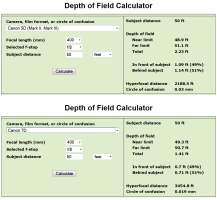
And that is just plain BS you are talking. Assuming that you are taking a photograph of a bird with a 400mm lens 50 feet away. Let's see how the DOF works out at f/8 with the 5D3 and the 7D -

7D: Total DOF is 1.41 feet
5D3: Total DOF is 2.23 feet
 

Attachments

  • DOF.png
    DOF.png
    65.6 KB · Views: 688
Upvote 0
I enter monthly club photo competitions. When you view the entries, you have no idea what type of camera was used, the settings, the lens etc. Yet I know that other photos are taken with a mixture of FF and APS-C cameras. There's even the occasional film camera and P & S. But usually its almost impossible to tell what type of camera was used. And in 100% of cases, from a viewer's perspective, it is irrelevant, because you are only interested in the final result. You're more concerned with impact, emotion, etc.

But from the photographers perspective, choice of camera is very relevant. If your final result relates to an image in low light, fast action, taken in the rain, needs particular lenses, etc then things are so much easier if you are using the right tool for the job. Given that FF cameras have traditionally been more feature packed, apart from IQ, there are a lot of other reasons why they might be the best choice for someone. Just as in many situations, a crop camera is the best choice.

In summary - when viewing the final result, nobody cares what camera you used. But choosing the right camera makes it easier to get the best final result.
 
Upvote 0
J.R. said:
AprilForever said:
Pi said:
AprilForever said:
A FF camera has a larger area, BUT...
[...]
Has shallower depth of field (NOT always a good thing, ESPECIALLY with long lenses)

This is a misconception. FF does not have shallower DOF. It only has the option for less DOF when needed.

Sure it has shallower depth of field 50mm at f4 on a 7D is roughly equivalent to 30mm f2.5 on a 5D. Same framing, shallower depth of field. When shooting birds in flight, I need usually f8 on a 7D to get the bird at least mostly in focus. On full frame? That's f13. To maintain shutter speed, that means ever rising ISO's.

Yes. The Hi ISO advantage disappears.

And that is just plain BS you are talking. Assuming that you are taking a photograph of a bird with a 400mm lens 50 feet away. Let's see how the DOF works out at f/8 with the 5D3 and the 7D -

7D: Total DOF is 1.41 feet
5D3: Total DOF is 2.23 feet

I think that there are circles of confusion here! It seems pretty obvious that if you have the same lens it gives the same size image on crop and FF sensors, and if the two images are viewed at the same size on a screen or print they will have exactly the same depth of field. If they are not enlarged, but the FF is viewed at a smaller size, it will only appear to have a greater depth of field.

The arithmetic from the DOF calculator proves that the images have the same depth of field when viewed at the same size. The depth of field is calculated from the size of the circle of confusion. For the 5DIII it is 0.03 mm, for the 1.6x crop 7D it is 0.019. And 0.03/0.019 = 1.6. So, when you enlarge the FF image 1.6x to get the same size image as the crop, you exactly compensate for the difference in circles of confusion.

Similarly, look at the ratios of total DOF of the 5D3 to 7D. It equals 2.23/1.41 = 1.6. The image from FF has to be enlarged 1.6x to give the same size print as the crop, and in doing so you multiply the out of focus regions 1.6x and so reduce the depth of field 1.6x.

Edit: to avoid confusion - what I am talking about is taking. say, a photo of a bird in flight, and cropping the bird in flight on the FF to be the same size as that taken directly on the crop. Then, they should have the same depth of field.
 
Upvote 0
J.R. said:
And that is just plain BS you are talking. Assuming that you are taking a photograph of a bird with a 400mm lens 50 feet away. Let's see how the DOF works out at f/8 with the 5D3 and the 7D -

7D: Total DOF is 1.41 feet
5D3: Total DOF is 2.23 feet

Yes (as someone else probably already mentioned), you should count in crop factor of x1.6 and compare "Focal length (mm): 400 mm" on cropped 7D with "Focal length (mm): ~ 640 mm" on FF 5Ds.

After that you will see that to get "equivalent" DOF, you need to stop 5D down to f/13...
 
Upvote 0