candc said:
if you take a photo with a lens on ff and crop out a square or put it on a crop body, it is the same.
Not quite the same - given that current FF sensors generally have lower pixel density than current APS-C sensors, your cropped FF image will have lower MP than the APS-C image. For example, a 5DIII image cropped to APS-C framing will have 8.6 MP. If that lower resolution is sufficient for your output purposes, there's no difference. But also consider a focal length limited situation in which even the APS-C sensor doesn't provide sufficiently close framing, and you need to crop the APS-C image to 50% of it's original size. The corresponding crop of the FF image will not have sufficient resolution for 100% display on some current montitors.
Marsu42 said:
Edit: One more note: High iso on ff is *NOT* equivalent to low iso on crop because the higher iso always has less dynamic range - so the advantage not only disappears, but a disadvantage appears :-o
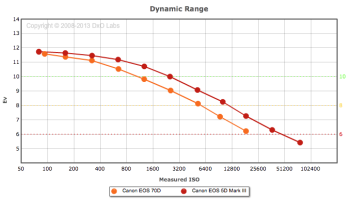
You seem to be assuming the DR at equal ISO settings is the same on both FF and APS-C, but it's not. Yes, raising the ISO reduces DR, but the DR of FF is higher to begin with (see below), which mitigates the 'disadvantage that appears'. For example, at ISO settings above 800, the 5DIII has ~1 stop more DR than the 70D, so when you raise the ISO to compensate for the narrower aperture, you're not incurring a significant reduction in DR (<0.3 EV).
The upshot is that if you can frame the subject identically, FF has a substantial advantage in terms of IQ. If you need to crop to APS-C framing because you're focal length limited, there's no significant difference at low ISOs (up to ~800), and at higher ISOs the FF has a progressively bigger advantage, provided the cropped image has sufficient resolution to meet your output needs.



 Or take more away (in a tight room?) to simulate the DOF of APS-C I want. ???