+1 I'm having a good feeling that Canon won't let us down with the 7D MkII! ;Dtomscott said:Really exciting at this point anything is a bonus! I will be glad to see Canon innovating again!
Upvote
0
+1 I'm having a good feeling that Canon won't let us down with the 7D MkII! ;Dtomscott said:Really exciting at this point anything is a bonus! I will be glad to see Canon innovating again!
Delish said:Lee Jay said:Putting a few things together into PURE speculation...
It was mentioned before that the viewfinder would be pretty big - as big as the 5DIII. I pointed out that would make it pretty dim.
What if the "revolutionary sensor technology" is quad-pixel, for a cross-type AF sensor under every pixel, and that it works so well with a new processor that there's no need for a separate PDAF module in the bottom of the mirror box? That would enable the main mirror to be "fully silvered" instead of "partially silvered" which would mean a brighter viewfinder even at the same size.
I kind of doubt it, but it's a bit fun to speculate.
Would that not require the mirror to be up to AF? gogo EVF

wockawocka said:Part of me wouldn't be surprised if this is the high MP body.
Lee Jay said:Assuming it's a Bayer sensor with multiple pixels under each microlens (like the 70D), there's not a lot they can do to improve sensor performance that's outside the realm of read noise. There are several ways to attack that one, and some of them involve doing clever things with the multiple pixels per microlens, such as reading out each one at a different ISO and then combining them, sort of like what Magic Lantern has done to increase DR.

Canon Rumors said:This may be one of Canon’s best kept secrets as it’s apparently going to be more than an “evolutionary” technology.
 )... which is a certainly nice, but it's all the same general sensor generation for a long time.
x-vision said:Lee Jay said:Assuming it's a Bayer sensor with multiple pixels under each microlens (like the 70D), there's not a lot they can do to improve sensor performance that's outside the realm of read noise. There are several ways to attack that one, and some of them involve doing clever things with the multiple pixels per microlens, such as reading out each one at a different ISO and then combining them, sort of like what Magic Lantern has done to increase DR.
Either that - or, it might not be a Bayer sensor in the first place.
By the look of things, the so called dual-pixel tech is actually quad-pixel already.
See my previous post on the topic here.
With a quad-pixel design, rather than having a single color filter per pixel, it's theoretically possible to have individual color filters for each of the four sub-pixels.
These color filters don't need to be monochromatic R/G/B filters anymore.
Instead, these could be a combination of di/poly-chromatic filters, from which the full color of a pixel can be derived.
That's better than a Bayer sensor, where two of the pixel colors need to be interpolated from neighboring pixels.
Yes ;D.Lee Jay said:Wouldn't you be worried about that approach messing up the phase detection?

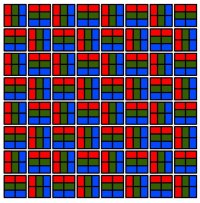
Don Haines said:I have wondered for a long time why the bayer filter has survived. Instead of breaking up a pixel into 4 squares, G-G-R-B, why can't it be made into 3 rectangles of R-G-B where the colours no go from 25 percent of the area to 33 percent of the area and you gain about a third of a stop?
Now imagine each pixel made up of 6 subpixels, 3DPAF pairs, and alternate the orientation of adjacent pixels so you can do DPAF in both the vertical and the horizontal plane.
that would certainly be a logical growth from what is in the 70D....
x-vision said:Either that - or, it might not be a Bayer sensor in the first place.
By the look of things, the so called dual-pixel tech is actually quad-pixel already.
See my previous post on the topic here.
Lee Jay said:Don Haines said:I have wondered for a long time why the bayer filter has survived. Instead of breaking up a pixel into 4 squares, G-G-R-B, why can't it be made into 3 rectangles of R-G-B where the colours no go from 25 percent of the area to 33 percent of the area and you gain about a third of a stop?
Now imagine each pixel made up of 6 subpixels, 3DPAF pairs, and alternate the orientation of adjacent pixels so you can do DPAF in both the vertical and the horizontal plane.
that would certainly be a logical growth from what is in the 70D....
I think if you have quad, each pixel can do horizontal, vertical and diagonal in each direction phase measurements. So, no need for six.
The thing about this arrangement is that it uses single-color (monochromatic) filters.Don Haines said:I did a quick drawing of the idea....
It's all a matter of interpretation, I guess 8).neuroanatomist said:You mean your previous post that was bogus and immediately discredited, because your conclusion was based on erroneous interpretation? :
Lee Jay said:Putting a few things together into PURE speculation...
It was mentioned before that the viewfinder would be pretty big - as big as the 5DIII. I pointed out that would make it pretty dim.
interesting.... so you think that it could be done with the more transmissive filters? the combination (if it works) could get to only throwing away 1/3 of the light, as opposed to the current bayer which throws away 3/4 of the light.....x-vision said:The thing about this arrangement is that it uses single-color (monochromatic) filters.Don Haines said:I did a quick drawing of the idea....
So, you are still 'throwing away' 2/3rds of the incident light.
The trick would be to use more transmissive filters (say R+G, R+B, G+B) and thus throw away less than 2/3rds of light.
Your arrangement does improve resolution, though.