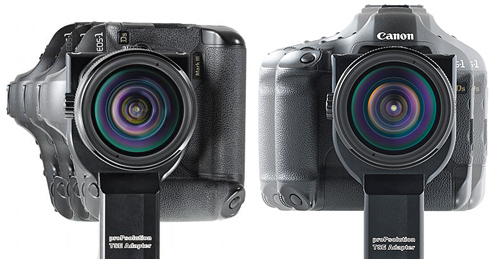
New TS-E Lenses for Photokina [CR2]

dafrank said:
And as to whether having a super-telephoto-like lens mount adapter on a TS-E lens would make multiple exposure panorama-making easier, by not affecting the perspective of the multiple shifted exposures, the answer is: I think so. One TS-E's shifted lens view's perspective will not exactly match the perspective of a view from an image shifted along the same axis by the same lens, unless an appropriate image plane shift could mitigate it. To do this properly, it would work best if only the camera-sensor back itself were shifted through the image plane, and, when the lens itself is immobile on a tripod, the lens movements themselves actually serve to move only the camera body through the immobile image plane. If this does not seem practical for the owners of existing TS-E lenses to achieve, it is good to know that it is not always necessary, given the "fudge factors" available in post-processing, and that it is still possible to achieve with some extra effort and cost, via various adapters and rails.
David, thank you for the informative reply, and in regards to the last point, here's a simple way to eliminate parallax with the TS-E lenses from Outback Photo: Workflow Technique #058: Avoiding Parallax while Stitching with Shift Lenses. Solution #2 in the article is particularly easy.
 
Upvote 0
mackguyver said:
dafrank said:
And as to whether having a super-telephoto-like lens mount adapter on a TS-E lens would make multiple exposure panorama-making easier, by not affecting the perspective of the multiple shifted exposures, the answer is: I think so. One TS-E's shifted lens view's perspective will not exactly match the perspective of a view from an image shifted along the same axis by the same lens, unless an appropriate image plane shift could mitigate it. To do this properly, it would work best if only the camera-sensor back itself were shifted through the image plane, and, when the lens itself is immobile on a tripod, the lens movements themselves actually serve to move only the camera body through the immobile image plane. If this does not seem practical for the owners of existing TS-E lenses to achieve, it is good to know that it is not always necessary, given the "fudge factors" available in post-processing, and that it is still possible to achieve with some extra effort and cost, via various adapters and rails.
David, thank you for the informative reply, and in regards to the last point, here's a simple way to eliminate parallax with the TS-E lenses from Outback Photo: Workflow Technique #058: Avoiding Parallax while Stitching with Shift Lenses. Solution #2 in the article is particularly easy.

I linked to that article in the other thread I linked as well!

And that works fine but for a couple of very useful stitch techniques. It doesn't work quite so well vertically unless you are using the screw macro style adapter, but more persuasively for me, if you do a four image stitch with the lens/body at 10, 8, 4, and 2 O'clock the technique fails completely unless you have a geared center column on your tripod. However the lens mount if done as I suggested, between the tilt and shift mechanics, would make a parallax free four rotated and shifted image stitch very easy.

Trouble is, how many people shoot like that? How often is parallax an issue? How often do we need 90 MP images etc etc. Fun to talk about, not much in the way of actual practical problem solving though.

As for David's comments re the different kinds of tilt you can get by changing the tilt axis line, that was my point about these Canon lenses never being replacements for view cameras, however, if shift and rise, and swing and tilt, are specialised, the variations on tilt are even more so, and are really the realm of very specialised perspective distortion work. But, the elephant in the room for the short Canon/Nikon/et al T/S-P/C lenses, and I'd expect the 45 at least to have similar issues, is the retrofocus design that throws even solid understanding of the different types of tilt and swing out the window, the entry points are not where they are supposed to be and they are not where they would be with equivalent view camera fov setups so tilt will never work the same way.
 
Upvote 0
Superimposing grid-lines on Live view sounds awesome. With that and focus peaking, I'll know exactly where the wedge of focus lies, and how it broadens/tapers across the scene. Very handy for the odd occasion when I shoot off-tripod.

I was addicted the moment I touched the TS-E 24mm f/3.5L II. Can't wait for these longer TS-E models. I definitely will be getting one of them.
 
Upvote 0
I have owned the 45mm TS previously, and sold it to actually get the 24 V2, which I love. But I do miss the 45.

All I can think of with this post is that the lens will come with an L price tag as well, and wondering if I should go pick up a current 45mm while I can. They are priced pretty well atm, and I found my previous one to be quite sharp.
 
Upvote 0
StudentOfLight said:
Superimposing grid-lines on Live view sounds awesome. With that and focus peaking, I'll know exactly where the wedge of focus lies, and how it broadens/tapers across the scene. Very handy for the odd occasion when I shoot off-tripod.

I was addicted the moment I touched the TS-E 24mm f/3.5L II. Can't wait for these longer TS-E models. I definitely will be getting one of them.

It would be nice to have, but wouldn’t the camera have to make a 3D scan of the scene and its own 3D position in it?
Being one foot above street level is not the same as being five foot above it when you want to apply tilt.
Keith Cooper has some informative articles on his website, the link below is about the using tilt
http://www.northlight-images.co.uk/article_pages/using_tilt.html
 
Upvote 0
2xProPsolutionsCanon.jpg

Photo Credit, hotlinked from hartblei.de
 
Upvote 0
privatebydesign said:
And next to pointless..............

I read all your replies in this topic and can believe what you type. ???

I shoot buildings and the parallax is a real problem when doing shifts with the lens rather than the chip. So much so I bought the 17mm TS-E so I could avoid having to do them. While the amount of error is not massive it is still there and a mount like the ProPsolution linked to above or a possible integrated foot in the new lenses would eradicate this completely.

This very week I ran into the same issue and I had to make adjustments in PS to all the images........... I hate PS and much prefer getting the image right in camera than spending hours staring at a computer screen. There were 21 shots but that then equated to 63 shots to correct as they were 3 image stitches. Time wasted prating about in PS could have been time spent having a life or working on another project.
 
Upvote 0
Zagga,
"privatebydesign" calls all such lens collars for the Canon TS-E lenses pointless. I guess he has no own experience with any of them....
I use the Zörk lens collar with the TS-E 17mm and TS-E 24mm II, so I can write about my own experiences with it. But I don't speculate about the usefullness of sich collars without having used them. IMHO it is true that an integrated collar would probably be the better solution. The Zörk lens collars works pretty well but it is obvious that the lens barrel of the TS-E 17mm and TS-E 24mm II were not designed for this purpose.

Kind regards, Robert
 
Upvote 0
RobertG. said:
Zagga,
"privatebydesign" calls all such lens collars for the Canon TS-E lenses pointless. I guess he has no own experience with any of them....
I use the Zörk lens collar with the TS-E 17mm and TS-E 24mm II, so I can write about my own experiences with it. But I don't speculate about the usefullness of sich collars without having used them. IMHO it is true that an integrated collar would probably be the better solution. The Zörk lens collars works pretty well but it is obvious that the lens barrel of the TS-E 17mm and TS-E 24mm II were not designed for this purpose.

Kind regards, Robert
Robert - just to chime in, FYI, I know private owns a TS-E 17 (and maybe others?) and given that you do have the collar, I'd like to hear about how you use them. I understand how they work and what they're for, but I haven't read about how people actually use them and why they are so useful. As a TS-E 24 II owner who recently picked up a 17 as well, I'm interested in learning more about the real-world use of the collars.
 
Upvote 0
RobertG. said:
Zagga,
"privatebydesign" calls all such lens collars for the Canon TS-E lenses pointless. I guess he has no own experience with any of them....
I use the Zörk lens collar with the TS-E 17mm and TS-E 24mm II, so I can write about my own experiences with it. But I don't speculate about the usefullness of sich collars without having used them. IMHO it is true that an integrated collar would probably be the better solution. The Zörk lens collars works pretty well but it is obvious that the lens barrel of the TS-E 17mm and TS-E 24mm II were not designed for this purpose.

Kind regards, Robert

And also, RobertG"To say the truth I seldom use the Zörk adapter nowadays." http://www.canonrumors.com/forum/index.php?topic=3055.msg376997#msg376997

Which begs the question, if it is so invaluable, and you paid such a hefty price for it, why do you find its use so unnecessary?

Alternatively, you could advise people on how great it is so they could get one, they can then find it is practically unnecessary and also choose to not use it, sounds like a great way to spend a few hundred dollars.
 
Upvote 0
zagga said:
privatebydesign said:
And next to pointless..............

I read all your replies in this topic and can believe what you type. ???

I shoot buildings and the parallax is a real problem when doing shifts with the lens rather than the chip. So much so I bought the 17mm TS-E so I could avoid having to do them. While the amount of error is not massive it is still there and a mount like the ProPsolution linked to above or a possible integrated foot in the new lenses would eradicate this completely.

This very week I ran into the same issue and I had to make adjustments in PS to all the images........... I hate PS and much prefer getting the image right in camera than spending hours staring at a computer screen. There were 21 shots but that then equated to 63 shots to correct as they were 3 image stitches. Time wasted prating about in PS could have been time spent having a life or working on another project.

Would you mind posting example images of the "real problem". I have shot thousands of images with the TS-E's and have yet to create a "problem" PS doesn't fix entirely automatically under the hood.
 
Upvote 0
With such a lens collar like the Zörk one or an integrated lens collar in the right position, you can create a panorama by shifting to the left, no shift, shifting to the right without any parallax error. Even full tilt can be used at the same time. If you shift the lens instead of the camera body, there is a parallax error. That's what my own tests have shown. Modern software like PS or Kolor Autopano Giga does correct the parallax error very well but there are sometimes applications (e.g. in interior photography) when such software can't be used. In such a particular case the photos need to be stitched manually and here parallax plays a big role.

As I said before, I do shot mainly landscapes with my TS-E lenses and use software to stitch my photos, so the parallax error is no issue for me anymore. But in case it does become an issue, I do have at least a solution at hand.

About the hefty price: in November 2011 I paid €180 + €6 shipping + 19% VAT = €221,34 . That's OK for me, especially considering that's there is no cheaper alternative. If you consider the price of the material and the time to manufacture it, it is actually quite cheap. No wonder the price increased. The Hartblei "Canon TSE Tripod Collar" costs more than twice as much. That's what I would call a hefty price. But both lens collars can't be compared to each other because they do not offer exactly the same functionality.

"privatebydesign", if PS is such a great software, why bother to use a TS-E lens at all? (It is a rethorical question and no answer is expected.)

Tilt-shift lenses are highly specialized gear and the same can be said about lens collars for them. For some shots these tools are needed and sometimes a smartphone will do.
 
Upvote 0