Patent for Moving Sensor Switch?

Not to mention the practical limitations in ensuring that the sensor alignment is absolutely exactly the same every shot.

There is no way that this is going to be a practical competitive camera. If you want a mirrorless camera then use a mirrorless camera. Instead of moving from one moving part to no moving parts, we are expected to think that three moving parts is an improvement. If you think microadjustment of focus is a pain with current DSLRs, this thing is going to be way way worse than that, and what is more that microadjustment will change with every shot.

Why would anyone want such a complicated arrangement?
 
Upvote 0
Tugela said:
Not to mention the practical limitations in ensuring that the sensor alignment is absolutely exactly the same every shot.

There is no way that this is going to be a practical competitive camera. If you want a mirrorless camera then use a mirrorless camera. Instead of moving from one moving part to no moving parts, we are expected to think that three moving parts is an improvement. If you think microadjustment of focus is a pain with current DSLRs, this thing is going to be way way worse than that, and what is more that microadjustment will change with every shot.

Why would anyone want such a complicated arrangement?
Would have to agree that its very risky to have two sensors that move you want the distance between the mount & sensor to be exact having worked in the film industry for too many years to mention moving parts eventually wear and attaining the accuracy required to get the maximum out of lenses or the sensor your just asking for trouble employing moving parts.
 
Upvote 0
Tugela said:
neuroanatomist said:
Tugela said:
Not practical, since it would significantly change the optical path length. You would need completely different lenses for each mode.

In current dSLRs, the optical path length to the eyepiece is significantly different from that to the image sensor, yet somehow I can still both look through the lens via the viewfinder and capture an image with the sensor, all with the same lens. Why?

camera-viewfinder.gif


Beacuse the the focusing screen is at the same relative location in the optical path as the sensor. That's also true in the animation that Keith at Northlight prepared (from the diagrams in the patent) to illustrate the concept.

The concept is perfectly valid, but your understanding of it and the relevant underlying principles seems to be lacking.

The only understanding lacking is yours.

Because the mirror has its own optics to correct for the changes in optical path lens. The sensor doesn't move, so for the purposes of taking a picture no additional correction is needed. If your sensor moves and changes the optical path lens, you will also have to flip in additional optics to correct for that, if you are using the same lens. That is not practical. Realistically you would need to use a completely different lens design.

This patent is for a DSLR to use mirrorless lenses. Either the focus screen is positioned at the focal plane of the short flange lens, or that is replaced with the sensor at this same position. One focal plane. If you want to use other lenses such as FD or EF, and adapter like the existing EF to EF-M would be needed.
 
Upvote 0
jeffa4444 said:
Tugela said:
Not to mention the practical limitations in ensuring that the sensor alignment is absolutely exactly the same every shot.

There is no way that this is going to be a practical competitive camera. If you want a mirrorless camera then use a mirrorless camera. Instead of moving from one moving part to no moving parts, we are expected to think that three moving parts is an improvement. If you think microadjustment of focus is a pain with current DSLRs, this thing is going to be way way worse than that, and what is more that microadjustment will change with every shot.

Why would anyone want such a complicated arrangement?
Would have to agree that its very risky to have two sensors that move you want the distance between the mount & sensor to be exact having worked in the film industry for too many years to mention moving parts eventually wear and attaining the accuracy required to get the maximum out of lenses or the sensor your just asking for trouble employing moving parts.

If the focusing is done on the imaging sensor then the distance between the sensor and the mount does not need to be exact. Each time you focus you compensate for the differences.
 
Upvote 0
OMG, Canon invents the Multi-Slapper

If this ever appears as a product, i will definitely buy it. Since i will be one of very few people to do so, and because i will not take a single shot with it, it will become an extremely rare collectors item. It will secure my old-age income, once i sell it "in perfectly mint condition" to some chinese, japanese or Russion gazillionaire collector.

Way to go, Canon!
 
Upvote 0
Tugela said:
neuroanatomist said:
Tugela said:
Not practical, since it would significantly change the optical path length. You would need completely different lenses for each mode.

In current dSLRs, the optical path length to the eyepiece is significantly different from that to the image sensor, yet somehow I can still both look through the lens via the viewfinder and capture an image with the sensor, all with the same lens. Why?

camera-viewfinder.gif


Beacuse the the focusing screen is at the same relative location in the optical path as the sensor. That's also true in the animation that Keith at Northlight prepared (from the diagrams in the patent) to illustrate the concept.

The concept is perfectly valid, but your understanding of it and the relevant underlying principles seems to be lacking.

The only understanding lacking is yours.

Because the mirror has its own optics to correct for the changes in optical path lens. The sensor doesn't move, so for the purposes of taking a picture no additional correction is needed. If your sensor moves and changes the optical path lens, you will also have to flip in additional optics to correct for that, if you are using the same lens. That is not practical. Realistically you would need to use a completely different lens design.

Lol. Yes, your understanding is as correct as your statement that any camera with Digic 7 will shoot 4K video. Please describe the 'optics in the mirror to correct for the optical path length'.

I agree that it's not a practical product, but not for the reason you suggest.
 
Upvote 0
Canon at its innovative best ...

Nikon launches 2 new, but still tired old mirrorslappers
Innovative Canon launches groundbreaking compact cams with the smallest sensors all around plus the world's first Full-HD video cam for vixen shootings and most importantly, patents the future of photography ... the multi-slapper!

I will have to call the EU commission and ask them to stop Canon before it is too late and they have wiped out all competitors in the entire imaging junk industry! :P ;D
 
Upvote 0
Steve_FR said:
I am in agreement that this patent looks at first glance like a ridiculous Rube Goldberg contraption, but it could also be one of the most exciting recent patents from Canon.

It appears to have an EF-M focal flange distance (18mm) That would allow a DSLR with this design to use all legacy Canon FD lenses with an adapter. As well as most other legacy glass. Potentially there could also be room for a full frame sensor, and built in sensor stabilization. That's a bit of a stretch, but...if the sensor is already moving, maybe it could compensation for hand-held vibration as well. Could be a really exciting camera. EF-M lenses could be used in "APS-C" mode, and this could open up the doors for full frame EF-M lenses without adding another lens mount type to the lineup.

I want some of what you're consuming.
 
Upvote 0
skp said:
As shown, it seems that in order to take a photo while in OVF mode, three things would have to move (....)

No.

In DSLR mode, just the mirror moves, like in any other DSLR.
In mirrorless mode nothing moves.

Only while switching modes, all three are moved and then locked.

This won't happen for every single shot.

It's like switching from TV to AV, if you get me.
 
Upvote 0
Quackator said:
skp said:
As shown, it seems that in order to take a photo while in OVF mode, three things would have to move (....)

No.

In DSLR mode, just the mirror moves, like in any other DSLR.
In mirrorless mode nothing moves.

Only while switching modes, all three are moved and then locked.

This won't happen for every single shot.

It's like switching from TV to AV, if you get me.

So you are saying that in the DSLR mode you would take the photo through the focusing screen? ::)
And you also would have to turn the mirror downwards to direct the light to the sensor so there would actually have be two mechanism in the mirror, to move it away of the way of the focusing screen and the sensor when they are moving and to pivot form the center to either to direct the light to the ovf or the sensor...
And then you would have a camera with two different lengths of optical paths :o
 
Upvote 0
3kramd5 said:
Seems like a neat way to get the worst of both worlds in one package!
Haha yes it does. Compromising both would not be very useful.

The only point I see is if Canon would before introduce a full frame mirrorless, go this way. The new mirrorless cameras would have the same mount, people could use their old dslr lenses, slowly integrate into the mirrorless until the dslr are rendered obsolete by the mirrorless.
 
Upvote 0
Quackator said:
skp said:
As shown, it seems that in order to take a photo while in OVF mode, three things would have to move (....)

No.

In DSLR mode, just the mirror moves, like in any other DSLR.
In mirrorless mode nothing moves.

Only while switching modes, all three are moved and then locked.

This won't happen for every single shot.

It's like switching from TV to AV, if you get me.

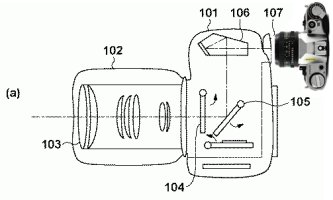
There is no such thing as a 'DSLR mode' and a 'mirrorless mode' in this patent.

There is a framing position designated as (a) in the patent (and called "preparation of photography" in the description) and a shooting position called as such and designated as (b).

index.php


In framing position (a):

- the image sensor 108 flips down to make way for both the focussing screen 104 and the mirror 105
- the focussing screen 104 (which, in the patent, is said to include a phase difference detection device) flips down to the same plane as the sensor 108 in shooting position (b)
- the mirror 105 flips forwards
- the image on the focussing screen 104 is reflected towards the prism 106 by the mirror 105.

In shooting position (b):

- the focussing screen 104 flips up, out of the optical path
- the mirror 105 flips backwards to make way for the image sensor 108
- the image sensor 108 flips up to the focal plane to take the picture (or use the live view).
 
Upvote 0
kphoto99 said:
jeffa4444 said:
Tugela said:
Not to mention the practical limitations in ensuring that the sensor alignment is absolutely exactly the same every shot.

There is no way that this is going to be a practical competitive camera. If you want a mirrorless camera then use a mirrorless camera. Instead of moving from one moving part to no moving parts, we are expected to think that three moving parts is an improvement. If you think microadjustment of focus is a pain with current DSLRs, this thing is going to be way way worse than that, and what is more that microadjustment will change with every shot.

Why would anyone want such a complicated arrangement?
Would have to agree that its very risky to have two sensors that move you want the distance between the mount & sensor to be exact having worked in the film industry for too many years to mention moving parts eventually wear and attaining the accuracy required to get the maximum out of lenses or the sensor your just asking for trouble employing moving parts.

If the focusing is done on the imaging sensor then the distance between the sensor and the mount does not need to be exact. Each time you focus you compensate for the differences.
This only works in stills not in video where you would also rely on focus marks on the lens so back focus from mount to sensor IS critical Ive only been doing it for 35 years.
 
Upvote 0
A Pro told me that Canon is doing research about a camera that takes digital and analog pictures. By moving the sensor away this would make room for exposing the film in the back. This is the only interpretation that makes sense when watching that patent: A mirrorless digital sensor camera with the ability to shoot film via the traditional mirror.
 
Upvote 0
Mistral75 said:
There is no such thing as a 'DSLR mode' and a 'mirrorless mode' in this patent.

There is a framing position designated as (a) in the patent (and called "preparation of photography" in the description) and a shooting position called as such and designated as (b).

Exactly. It seems several people failed to correctly understand the concept, in some cases inventing ridiculous explanations to support their misunderstanding.
 
Upvote 0
David said:
A Pro told me that Canon is doing research about a camera that takes digital and analog pictures. By moving the sensor away this would make room for exposing the film in the back. This is the only interpretation that makes sense when watching that patent: A mirrorless digital sensor camera with the ability to shoot film via the traditional mirror.
Interesting if true as Kodak will be launching a Super 8 camera in fall 2016.

http://www.kodak.com/ek/us/en/Consumer/Products/Super8/default.htm
 
Upvote 0
Isn't this just a way of having a reflex OVF with mirror-less flange distance and thinner body ? I think someone has designed this purely for the purpose of winding up the likes of AvTvM, and the rest of the "mirror-less is the future" brigade ! Although it doesn't show it very well in the diagram I guess that this design could have a body that is about the same thickness as a traditional 35mm film SLR.
 
Upvote 0
jeffa4444 said:
David said:
A Pro told me that Canon is doing research about a camera that takes digital and analog pictures. By moving the sensor away this would make room for exposing the film in the back. This is the only interpretation that makes sense when watching that patent: A mirrorless digital sensor camera with the ability to shoot film via the traditional mirror.
Interesting if true as Kodak will be launching a Super 8 camera in fall 2016.

It might be true that Canon is looking into a combined digital/analog camera, but that's not evident from this patent. The patent is all about adding TTL viewing capability to a mirrorless design, there's no provision for capturing images with anything other than the digital sensor. Although perhaps such a provision could be added... ;)
 

Attachments

  • Hybrid.jpg
    Hybrid.jpg
    89.5 KB · Views: 395
Upvote 0
Sporgon said:
Isn't this just a way of having a reflex OVF with mirror-less flange distance and thinner body ? I think someone has designed this purely for the purpose of winding up the likes of AvTvM, and the rest of the "mirror-less is the future" brigade ! Although it doesn't show it very well in the diagram I guess that this design could have a body that is about the same thickness as a traditional 35mm film SLR.

Yes for the reflex with OVF and mirrorless flange distance, not so sure for the thinner body: you still have a mirror and you add a focussing screen in front of it.

The advantage of such a device is to reconcile optical viewfinder and phase-detection autofocus on the one hand, lenses with a short-registered mount on the other hand, i.e. to only need one range of lenses for both mirrorless and reflex cameras. The price to pay is a huge mechanical complexity:

- three flipping devices that shall be perfectly synchronised,
- two flipping devices (sensor and focussing screen) that shall be perfectly adjusted to stop at the very same vertical position,
- a flipping sensor, the movements of which shall be perfectly damped.

Not to mention a phase detection device that shall be perfectly transparent since located on the focal plane...
 
Upvote 0
Mistral75 said:
The advantage of such a device is ... to only need one range of lenses for both mirrorless and reflex cameras.

Why can't you do that by just making a mirrorless body with the same flange distance as an SLR body?

With DPAF you don't even lose phase detect.
 
Upvote 0