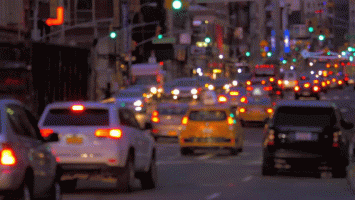
mb66energy said:privatebydesign said:mb66energy said:I think it is allowed to speculate about CFA + sensor sensitivity and DR. If the brake light has 100 000 times
the energy density on the sensor compared to the light reflected by the cars which is 100 times brighter than the shadows you need 20 stops of usable dynamic range at least and fold it into the display which has 15 stops of DR in the optimum case: A well made OLED display.
Sometimes I am fascinated how good our eye-brain-system is and how bad just the best photographic systems - on the other hand: A photograph is the easiest way to communicate visual impressions to others!
privatebydesign said:Getting 'accurate' colours can be difficult, but to speculate about CFA sensitivity when you are not addressing the herd of elephants in the room is farcical.
You can get very close to 'accurate' colours, certainly much closer to 'accurate' than with film, with any digital camera ever made. BUT YOU HAVE TO PROFILE IT.
Trying to talk about 'accurate' colours while not addressing the most important and first step, camera profiles, is moronic.
Maybe, years ago. Nowadays most digital sensors are within a stop or so of the DR even the very best that negative films can achieve, the Exmor sensors and many video orientated sensors beat it, some by several stops. All digital sensors resoundingly beat the DR available from transparency film from their first release.
DR is a red herring when talking about colour like this. Basically, if you are going to blow highlights on digital you are going to do the same on film.
For transparency film I agree with you. But B/W negative film has -- what I read and remember from my dark darkroom experiences (20 years ago) -- roughly 18 stops of DR and I know that hollywood switched from positive film to negative film for movie production ... to benefit from the higher DR.
One remark about color calibration: For the blown out areas this wouldn't help but on the other hand it would help for the surrounding halos which arent blown out -- so your idea of color profiling as first step is right for most of the image! I have forgotten to differentiate ...
B&W film DR is pretty irrelevant in a thread about accurate colour reproduction
 But if you look at the data sheet for Kodak TriX ( http://www.kodak.com/global/en/professional/support/techPubs/f4017/f4017.pdf ) you get a Log Exposure range of 3.3-3.6, or 11-12 stops.
As for negative film, again Eastman Kodak claim a Log Exposure range of 3.3-3.6, or 11-12 stops. And again is on the data sheet for the film http://www.kodak.com/global/en/professional/support/techPubs/e4050/e4050.pdf
Few modern digital cameras don't give 11 stops of DR, and many give over 12.
The film vs digital arguments died a long time ago, some of us just never heard the eulogy. Of course there are, and always will be, very good reason to shoot film instead of or with digital, but the technical differences are not particularly valid and as far as a colour reproduction argument go, are entirely false.
Think of it like this, how was the film image digitised? What profile was used, because there had to be one that somebody somewhere wrote and put in the scanning software.
Upvote
0