Red vs orange

mb66energy said:
privatebydesign said:
mb66energy said:
I think it is allowed to speculate about CFA + sensor sensitivity and DR. If the brake light has 100 000 times
the energy density on the sensor compared to the light reflected by the cars which is 100 times brighter than the shadows you need 20 stops of usable dynamic range at least and fold it into the display which has 15 stops of DR in the optimum case: A well made OLED display.

Sometimes I am fascinated how good our eye-brain-system is and how bad just the best photographic systems - on the other hand: A photograph is the easiest way to communicate visual impressions to others!


privatebydesign said:
Getting 'accurate' colours can be difficult, but to speculate about CFA sensitivity when you are not addressing the herd of elephants in the room is farcical.

You can get very close to 'accurate' colours, certainly much closer to 'accurate' than with film, with any digital camera ever made. BUT YOU HAVE TO PROFILE IT.

Trying to talk about 'accurate' colours while not addressing the most important and first step, camera profiles, is moronic.

Maybe, years ago. Nowadays most digital sensors are within a stop or so of the DR even the very best that negative films can achieve, the Exmor sensors and many video orientated sensors beat it, some by several stops. All digital sensors resoundingly beat the DR available from transparency film from their first release.

DR is a red herring when talking about colour like this. Basically, if you are going to blow highlights on digital you are going to do the same on film.

For transparency film I agree with you. But B/W negative film has -- what I read and remember from my dark darkroom experiences (20 years ago) -- roughly 18 stops of DR and I know that hollywood switched from positive film to negative film for movie production ... to benefit from the higher DR.

One remark about color calibration: For the blown out areas this wouldn't help but on the other hand it would help for the surrounding halos which arent blown out -- so your idea of color profiling as first step is right for most of the image! I have forgotten to differentiate ...

B&W film DR is pretty irrelevant in a thread about accurate colour reproduction ;) But if you look at the data sheet for Kodak TriX ( http://www.kodak.com/global/en/professional/support/techPubs/f4017/f4017.pdf ) you get a Log Exposure range of 3.3-3.6, or 11-12 stops.

As for negative film, again Eastman Kodak claim a Log Exposure range of 3.3-3.6, or 11-12 stops. And again is on the data sheet for the film http://www.kodak.com/global/en/professional/support/techPubs/e4050/e4050.pdf

Few modern digital cameras don't give 11 stops of DR, and many give over 12.

The film vs digital arguments died a long time ago, some of us just never heard the eulogy. Of course there are, and always will be, very good reason to shoot film instead of or with digital, but the technical differences are not particularly valid and as far as a colour reproduction argument go, are entirely false.

Think of it like this, how was the film image digitised? What profile was used, because there had to be one that somebody somewhere wrote and put in the scanning software.
 
Upvote 0
mb66energy said:
Simple shots of a cheapo RGB light source, a RGB LED from a light strip made with two cameras - EOS 5D classic (see file name) and EOS 600D under similar conditions and with the same settings / processing with DPP.

No they aren't. DPP has different profiles (different settings) for every single camera model, the differences are almost certainly just down to the different profiles for each camera, certainly if you made custom profiles for each you wouldn't see a noticeable difference.

All I am saying is the differences in profiles dwarf any differences inherent from different CFA's, and you can't hope to compare the differences in CFA's unless you truthfully normalise the RAW data. I think the only way you could do that effectively is to look at RAW files in something like DCRAW, but viewing RAW files without gamma corrections and heavy green bias is far from intuitive!

On a practical level I have done this 'getting everything the same' kind of thing, last year I shot a wedding with two other photographers, I used two 1DS MkIII's, another had a 5D MkIII and a 7D, and the third had two Nikons. After getting them to shoot color checkers a couple of times during the wedding I was able to normalise the output of all six cameras (and many lenses) to a level that, from a colour point of view, they were all the same.
 
Upvote 0
Ok, thank you for all your answers :)

-No, I haven't shot slide-film, only negative-film.

-I get what you say about the need for overlap between the 3 channels, to produce colors in between of the primaries.


I highly prefer the look of the film-image (of the 2 images I posted)
Its reds are clearly saturated (maxed out), but they remain much more cleanly red anyway.
It's possible the picture-profile is where this difference should be addressed. I'll see what I can do with Canon's profile-editor (I dread using that though, but I'll try :) )

I will also keep investigating for other solutions.

Maybe if digital processing would stop increasing the other channels when one is at its max-limit, then perhaps color-shifts could be avoided. Or if it blended the 2 other channels to the same value so the over-exposed channel would keep its color but just go towards white rather than a color-shift.
I don't know.

But if the lights went pink (red + white (if the G and B channel was equalized when the R channel was maxed out)) instead of orange I feel it would look a lot better, but of course that's a matter of taste :)


Anyway, thanks again for your inputs and suggestions.

Exposing for the lights is not a workable option, because in my experiments I had to lower exposure so much the image went black. The difference in brightness is just too large.

The digital image has some natural light still in it, while the film has a black night-sky. So technically I would assume the digital should have a better chance of keeping the car-lights within exposure-limits (since you need lower exposure when there's still natural light, than with a true night-scene)

Yet the film-image of the true night-scene keeps the reds red. It may be that the term 'color-accuracy' isn't really what I should have used here. What I meant is simply that I'd like the reds to stay red and not shift toward orange :)


I was asking this question because with Christmas coming these types of colored bright lights (from decorations and so on) is something I would like to be able to capture correctly :)
Past years my Christmas-images often end up with all the colors being mostly white blobs with colored halos, and I just would like to avoid a repeat of that this year.
In bright sun-light digital works just fine, but with night-time scenes I'm still having quite the fight with digital (and of course I'd like to use digital since it's much easier and quicker than film)


Thanks again everybody :)
 
Upvote 0
privatebydesign said:
JEL said:
What I meant is simply that I'd like the reds to stay red and not shift toward orange :)

All you need to do is profile your camera, and accept that both digital and film have dynamic range limitations that are within a hairs breath of each other.

I am quite prepared to be proved wrong here, but if you fully saturate a colour channel, how does it matter what camera profile you use?
 
Upvote 0
scyrene said:
privatebydesign said:
JEL said:
What I meant is simply that I'd like the reds to stay red and not shift toward orange :)

All you need to do is profile your camera, and accept that both digital and film have dynamic range limitations that are within a hairs breath of each other.

I am quite prepared to be proved wrong here, but if you fully saturate a colour channel, how does it matter what camera profile you use?

Once you exceed your capture mediums DR you are looking at white. Kodak specs agree that film has the same DR (or very close) as pretty much every digital camera available, blow the lights on one and you blew the highlights on the other.

The example images shown at the beginning of the thread don't have the same bulb intensity for the film and digital exposures so give the impression film doesn't blow the light bulbs, but in the same situation as digital, because they have very similar DR, it will.

So if we aren't talking about blown highlights, because we can't be because they have no colour, then a profile will make a difference.

Look at it like this, JEL says "I'd like the reds to stay red and not shift toward orange" so we are not talking about blown highlights (white) but orange. To get orange the pixel is getting three channels of colour info, orange needs red, blue and green levels and only red could be at 255. Even if the red is at that 255 level if you lower the green and blue levels you get your red back, that is a textbook profile issue not a DR issue.
 
Upvote 0
privatebydesign said:
JEL said:
What I meant is simply that I'd like the reds to stay red and not shift toward orange :)

All you need to do is profile your camera, and accept that both digital and film have dynamic range limitations that are within a hairs breath of each other.

+1 Hair's breath. I am an old timer who has shot on lots on film. I feel like saying digital has perhaps bettered film by now. (Ducks).
 
Upvote 0
sanj said:
privatebydesign said:
JEL said:
What I meant is simply that I'd like the reds to stay red and not shift toward orange :)

All you need to do is profile your camera, and accept that both digital and film have dynamic range limitations that are within a hairs breath of each other.

+1 Hair's breath. I am an old timer who has shot on lots on film. I feel like saying digital has perhaps bettered film by now. (Ducks).

Sanj,

You are a DP, in the video realm digital has comfortably bested every metric film has, iso, resolution, DR, colour, etc, there are still compelling reasons to shoot film if that is what the director wants, but it is an emotional decision now with a very nuanced and subtle difference/feel that few could distinguish.
 
Upvote 0
privatebydesign said:
sanj said:
privatebydesign said:
JEL said:
What I meant is simply that I'd like the reds to stay red and not shift toward orange :)

All you need to do is profile your camera, and accept that both digital and film have dynamic range limitations that are within a hairs breath of each other.

+1 Hair's breath. I am an old timer who has shot on lots on film. I feel like saying digital has perhaps bettered film by now. (Ducks).

Sanj,

You are a DP, in the video realm digital has comfortably bested every metric film has, iso, resolution, DR, colour, etc, there are still compelling reasons to shoot film if that is what the director wants, but it is an emotional decision now with a very nuanced and subtle difference/feel that few could distinguish.

Yes Private. I know what you are saying. But this is my OPINION on it: The emotion decision is mostly because many people, rightfully so, rejected digital when it started stating that film has 'a special something'. It did. Then. Not now. The advantages of shooting digital far best the film days. I think now it is more of an 'emotional/intellectual' thing. Strictly my opinion. And, if anyone needed the 'grain', it is a simple filter while doing grading. It is very easy to recreate the film look: Crushed blacks, grain etc.
 
Upvote 0
scyrene said:
privatebydesign said:
JEL said:
What I meant is simply that I'd like the reds to stay red and not shift toward orange :)

All you need to do is profile your camera, and accept that both digital and film have dynamic range limitations that are within a hairs breath of each other.

I am quite prepared to be proved wrong here, but if you fully saturate a colour channel, how does it matter what camera profile you use?

I would like to learn this too. I shoot RAW strictly. So does this 'profile' thing apply to me as well?
 
Upvote 0
A blown highlight does not immediately turn white. It goes from the true color to white along a color space slope defined by the ratio of the two remaining unsaturated channels. And, btw, I see white in the middle of at east one tail light.
If a color gradient is visible across a light emitting device, it is overexposed. Is there any accurate color in there? That's a good question, but it's also a very deep rabbit hole.
If the OP can't expose for the lights, then a variable power flash to boost the rest of the scene this holiday may be in order.
 
Upvote 0
This is the reason when I shoot at night I use a fixed 6000k colour balance, despite shooting RAW, then watch for blinkies in my highlights.

By doing the above the JPEG will see a blown red blue or green, if it adjusts the colour it can miss the blown single colour.

Additionally most surfaces reflect approx 10~20% total light (trees pavements walls etc.. I've done experiments for this myself), so with a diffuse or out of shot light source you want something close to the typical 18% of max exposure for typical illumination, white objects aren't blown, shadows have as much leeway left as possible.

If however you want to capture the true colour of say a setting sun, then you need ETTR exposure, which will always be a LOT darker, possibly 3 stops darker, than "evaluative".

The way I do it is to push my exposure to +2stops, then use the spot metering and meter on the brightest point, recompose and shoot... that gets me pretty close for most things other than really small bright sources.
 
Upvote 0
-Profiling on the to-do list.

-Using flash as fill may be the best option. I'll have to shoot some tests to see what settings and ratios will be optimal while still getting an image-tone that seems nice.

-Yes, I've used evaluative past years, but have already done a few tests with spot-metering. I can make that work fairly well on outside shots as long as it isn't completely dark/night (day and twilight is workable), but even then I often end up with shots so dark I can't really salvage it in post (I shoot the 5D3 currently and pushing shadows hasn't worked well for me. The sensor-noise patterns are very quickly showing themselves)

Why do you choose 6000K for night-shots? I've tended to use the preset 'daylight' setting, as my understanding is that that setting balances the red and blue channel equally (which I then use for histogram preview purposes during shooting)

Maybe I also need to re-think how I frame shots, to counter the short-comings of the camera (or at least to fit the camera-limits better to my limited skills :) )

I'm not denying it could be user-error (camera profiling etc), but I do find that film handles bright colored spot-lights much better than digital. It just seems to separate the 3 color-channels better (which is why I thought it could be somehow related to stronger/steeper color-filters in film rather than those on the digital sensor)

Well, live and learn :)
 
Upvote 0
rs said:
sanj said:
"Is it avoidable without under-exposing your images into near-total darkness?"

The lights are overexposed. The shot is not. You have to pick what part of the shot you want to reproduce 'properly exposed'.

Not wanting to start a debate but this is a good example of where DR comes into play. If you would have reduced exposure of this photo by 2 odd stops the lights would have been more manageable. Then you can open up blacks depending upon the sensor you used.

+1

Underexpose, and use a custom curve to regain some highlight tone. Or if you're happy sticking with Canon, try enabling Highlight Tone Priority. It does that for you, adding around 1 stop of headroom in the highlights at the expense of shadow noise. Possibly not enough headroom for this scenario, but worth a shot.
This is a situation where HDR photography is needed.

What you are doing is photographing light bulbs at night. You want the colour of the light bulbs to come through, but you also want the details in the rest of the picture to come through. If you expose for the light bulbs, the rest of the image is black... If you expose for the background, you run into the following problem: Coloured lights are usually done by placing a film or "tint" over the bulb. This tint is not monochrome. For example, the red bulbs might let 90 percent of the red light through, but they also let the other light through in lesser amounts. Your eye will still interpret this as red, but not so with the camera sensor.

Lets say you properly expose for the highlights (red bulbs)... the red pixels are receiving 100 percent of the light they can capture and are on the edge of clipping the signal. Since that light is not pure monochrome and is not exactly matched to your bayer filter, both the green pixels and the blue pixels will also be receiving light, let's say at 5 percent green and 2 1/2 percent blue. If you look at the image the colour seems to match what you saw.

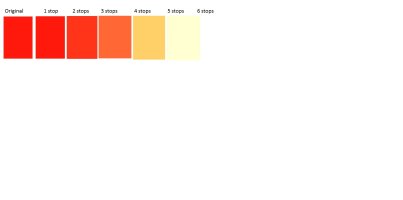
Now overexpose by three stops to get some of the detail in the shadows.... 3 stops means 8 times the light. The red pixels are now receiving 800 percent of the light they can capture, green at 40 percent, and blue at 20 percent. The sensor reports the levels at 100, 40, and 20 and we get a different colour.

The image below shows what you would see as a result, and yes, your red turns into orange.
 

Attachments

  • redorange.jpg
    redorange.jpg
    45.7 KB · Views: 189
Upvote 0
Don Haines said:
rs said:
sanj said:
"Is it avoidable without under-exposing your images into near-total darkness?"

The lights are overexposed. The shot is not. You have to pick what part of the shot you want to reproduce 'properly exposed'.

Not wanting to start a debate but this is a good example of where DR comes into play. If you would have reduced exposure of this photo by 2 odd stops the lights would have been more manageable. Then you can open up blacks depending upon the sensor you used.

+1

Underexpose, and use a custom curve to regain some highlight tone. Or if you're happy sticking with Canon, try enabling Highlight Tone Priority. It does that for you, adding around 1 stop of headroom in the highlights at the expense of shadow noise. Possibly not enough headroom for this scenario, but worth a shot.
This is a situation where HDR photography is needed.

What you are doing is photographing light bulbs at night. You want the colour of the light bulbs to come through, but you also want the details in the rest of the picture to come through. If you expose for the light bulbs, the rest of the image is black... If you expose for the background, you run into the following problem: Coloured lights are usually done by placing a film or "tint" over the bulb. This tint is not monochrome. For example, the red bulbs might let 90 percent of the red light through, but they also let the other light through in lesser amounts. Your eye will still interpret this as red, but not so with the camera sensor.

Lets say you properly expose for the highlights (red bulbs)... the red pixels are receiving 100 percent of the light they can capture and are on the edge of clipping the signal. Since that light is not pure monochrome and is not exactly matched to your bayer filter, both the green pixels and the blue pixels will also be receiving light, let's say at 5 percent green and 2 1/2 percent blue. If you look at the image the colour seems to match what you saw.

Now overexpose by three stops to get some of the detail in the shadows.... 3 stops means 8 times the light. The red pixels are now receiving 800 percent of the light they can capture, green at 40 percent, and blue at 20 percent. The sensor reports the levels at 100, 40, and 20 and we get a different colour.

The image below shows what you would see as a result, and yes, your red turns into orange.

Don, that's a very good explanation of a semi-technical 'light matter', really useful for the average 'enthusiast' photographer to understand.

Well done for writing it, and sharing helpful information that way.

Best wishes... really appreciate your posts on CR.

Paul
 
Upvote 0
Don Haines said:
rs said:
sanj said:
"Is it avoidable without under-exposing your images into near-total darkness?"

The lights are overexposed. The shot is not. You have to pick what part of the shot you want to reproduce 'properly exposed'.

Not wanting to start a debate but this is a good example of where DR comes into play. If you would have reduced exposure of this photo by 2 odd stops the lights would have been more manageable. Then you can open up blacks depending upon the sensor you used.

+1

Underexpose, and use a custom curve to regain some highlight tone. Or if you're happy sticking with Canon, try enabling Highlight Tone Priority. It does that for you, adding around 1 stop of headroom in the highlights at the expense of shadow noise. Possibly not enough headroom for this scenario, but worth a shot.
This is a situation where HDR photography is needed.

What you are doing is photographing light bulbs at night. You want the colour of the light bulbs to come through, but you also want the details in the rest of the picture to come through. If you expose for the light bulbs, the rest of the image is black... If you expose for the background, you run into the following problem: Coloured lights are usually done by placing a film or "tint" over the bulb. This tint is not monochrome. For example, the red bulbs might let 90 percent of the red light through, but they also let the other light through in lesser amounts. Your eye will still interpret this as red, but not so with the camera sensor.

Lets say you properly expose for the highlights (red bulbs)... the red pixels are receiving 100 percent of the light they can capture and are on the edge of clipping the signal. Since that light is not pure monochrome and is not exactly matched to your bayer filter, both the green pixels and the blue pixels will also be receiving light, let's say at 5 percent green and 2 1/2 percent blue. If you look at the image the colour seems to match what you saw.

Now overexpose by three stops to get some of the detail in the shadows.... 3 stops means 8 times the light. The red pixels are now receiving 800 percent of the light they can capture, green at 40 percent, and blue at 20 percent. The sensor reports the levels at 100, 40, and 20 and we get a different colour.

The image below shows what you would see as a result, and yes, your red turns into orange.
Thanks, Dom.
You got a few words, explain a phenomenon that requires a certain degree of abstraction to understand.

I still surprised when I see today's photographers complaining about the inability of today's cameras perform "miracles". Yes, the human eye is still superior to any means of image capture, when it comes to color reproduction and huge brightness variations in an image.
 
Upvote 0
There are two things we are talking about here, clipping channels, and maintaining truer reds instead of them being orange.

First, Don's explanation is spot on for clipping channels, but the red is only truly lost when the red channel and at least one other are both clipping, if it is only the red channel that is clipped and turning to orange due to over exposure, but not clipping, of a second channel, we can adjust for that.

On the other hand I was talking about the general feel of the reds in the OP's first digital shot when compared to his film shot. Notice in that film shot the reds (the bars at the side of the Dunes sign) are not over exposed and so hold a true red, however the lights of the actual letters of the Dunes sign are blown with orange and gold showing through the less exposed parts. On the other hand if you look at other images of the Oasis tree trunks they are very red, not orange as in the OP's shot, so exactly the same thing has happened to the reds of the Oasis tree trunks as has happened to the tail lights in the digital shot, the red channel is blown and the green and blue channels are too high. The film has ressponded in exactly the same way as the digital sensor has.

Now, with regards the general orangeness of the reds in the digital shot, that is just profiling.

You can't apply a proper camera profile to a jpeg, but you can emulate it, so I have.

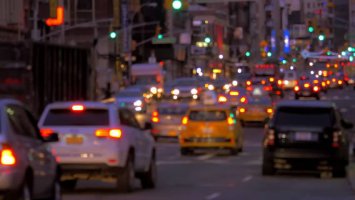
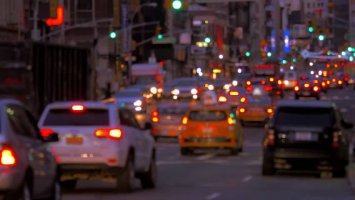
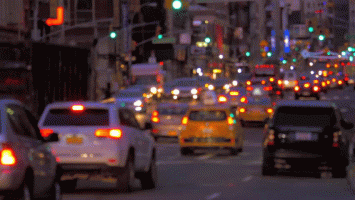
Here is the original digital shot, a version with a rough profile to address the red to orange shift and a gif of them both. I think you will agree the reds of the 'profiled' shot feel a lot closer to the film shot now.
 

Attachments

  • 1.jpg
    1.jpg
    75.1 KB · Views: 184
  • 2.jpg
    2.jpg
    81.1 KB · Views: 199
  • 1.gif
    1.gif
    413.7 KB · Views: 227
Upvote 0
Don Haines said:
Now overexpose by three stops to get some of the detail in the shadows.... 3 stops means 8 times the light. The red pixels are now receiving 800 percent of the light they can capture, green at 40 percent, and blue at 20 percent. The sensor reports the levels at 100, 40, and 20 and we get a different colour.

Thank you. Yes I agree with this :)

But isn't this directly related to the color-filter's bandwidth?

Say the RGB channels were much narrower, then they should block light that falls outside their band-pass range much more efficiently, correct?
And in such a case, you should be able to over-expose the red channel more before you would notice a significant rise in the green and blue channel, correct?
(I'm not saying narrower color-filters are a good thing for color-fidelity, since, as somebody else mentioned, it might hinder yellow, magenta and cyan from appearing, but I'm still wondering if perhaps modern color-filters allow too much yellow, magenta and cyan through, in the hunt for increased low-light sensitivity. I don't have any gel-filters I could use to test this though, so it's just pure speculation on my part :) )
 
Upvote 0
JEL said:
Don Haines said:
Now overexpose by three stops to get some of the detail in the shadows.... 3 stops means 8 times the light. The red pixels are now receiving 800 percent of the light they can capture, green at 40 percent, and blue at 20 percent. The sensor reports the levels at 100, 40, and 20 and we get a different colour.

Thank you. Yes I agree with this :)

But isn't this directly related to the color-filter's bandwidth?

Say the RGB channels were much narrower, then they should block light that falls outside their band-pass range much more efficiently, correct?
And in such a case, you should be able to over-expose the red channel more before you would notice a significant rise in the green and blue channel, correct?
(I'm not saying narrower color-filters are a good thing for color-fidelity, since, as somebody else mentioned, it might hinder yellow, magenta and cyan from appearing, but I'm still wondering if perhaps modern color-filters allow too much yellow, magenta and cyan through, in the hunt for increased low-light sensitivity. I don't have any gel-filters I could use to test this though, so it's just pure speculation on my part :) )

But is the red from the light source a pure colour which falls only under what is considered red, a wavelength of approximately 650 nm? If so, then having a CFA on the green and blue channels which is strong enough to block out 100% of 650 nm light would result in a red light, no matter how it is exposed. But if the red is not pure, no CFA would stop the green and blue seeing something.
 
Upvote 0
rs said:
JEL said:
Don Haines said:
Now overexpose by three stops to get some of the detail in the shadows.... 3 stops means 8 times the light. The red pixels are now receiving 800 percent of the light they can capture, green at 40 percent, and blue at 20 percent. The sensor reports the levels at 100, 40, and 20 and we get a different colour.

Thank you. Yes I agree with this :)

But isn't this directly related to the color-filter's bandwidth?

Say the RGB channels were much narrower, then they should block light that falls outside their band-pass range much more efficiently, correct?
And in such a case, you should be able to over-expose the red channel more before you would notice a significant rise in the green and blue channel, correct?
(I'm not saying narrower color-filters are a good thing for color-fidelity, since, as somebody else mentioned, it might hinder yellow, magenta and cyan from appearing, but I'm still wondering if perhaps modern color-filters allow too much yellow, magenta and cyan through, in the hunt for increased low-light sensitivity. I don't have any gel-filters I could use to test this though, so it's just pure speculation on my part :) )

But is the red from the light source a pure colour which falls only under what is considered red, a wavelength of approximately 650 nm? If so, then having a CFA on the green and blue channels which is strong enough to block out 100% of 650 nm light would result in a red light, no matter how it is exposed. But if the red is not pure, no CFA would stop the green and blue seeing something.
The red light will not be pure. Incandescent bulbs, and to a lesser degree fluorescent bulbs, output a fairly wide spectrum of light. The paint or tinting to colour the bulbs will primarily let red through, but there will be a significant component of other frequencies.
 
Upvote 0