Red vs orange

Red vs orange.

Will stronger color-filters on a digital camera make any difference when shooting bright colors, or will color-accuracy still be off?

Here's an example-image showing the in-accuracy of red turning orange:
7.jpg


Is it avoidable without under-exposing your images into near-total darkness?

Is it a by-product of trying to make cameras super-sensitive and low-light capable?

The funny thing, which is not really funny, is that on film these color-shifts does not seem to happen as easily. Is that because film is basically stronger in its color-filtration, or is it the bayer-sensor of digital that plays some part here, or what is going on?

Here's a film-image similar to the image above, where the much better (in my opinion) colors can be seen:
87045325_efa82476d4_b.jpg


I see these color-shifts on all digitals I've used and really want to know of a camera that doesn't have this 'flaw'.

Bright red lights turn orange.

Bright green lights turn cyan/teal (sometimes orange or yellow)

Bright blue light turns cyan (occasionally magenta)

Bayer-sensor issue or color-filter issue or something else related to digital?

And most importantly, short of going back to film; which digital cameras do not behave in this, to me, annoying way?

Thanks for any answers that can shed some (hopefully color-accurate) light on this
 
How are you shooting and processing?

Do you shoot RAW or rely on Canon jpegs? If RAW what are you using to process your files?

The truth is all you need to do to get accurate colours is make a custom camera profile, make a dual illuminante one and you can use it for most ligh sources. Making a profile takes about 15 seconds.

The accuracy, or not, you have at the moment is because you are relying on various software guesses as to what you want, tell it what you want and voila, the colours are good.

P.S. None of the cameras are flawed, your technique is.
 
Upvote 0
I shoot raw and the only way I can keep bright red lights from going orange is by under-exposing dramatically.

I don't have this problem when shooting film (at exact same exposure settings)

I use Canon's DPP mostly, but also have Adobe lightroom and RawTherapee. I see the same problem in all.

I've done tests where I shot the same images on both digital and film, with the exact same exposure-settings, and the difference with bright lights is always there.
On film they stay red or go slightly pink (as in red with added white). On digital they go orange.

It does seem like it's exposure-related, but I can't tell if it's the color-filters on film that keep the green channel more efficiently out of the red channel (since obviously orange is red plus green), or if it's simply that digital calculates over-exposure by adding green channel to the RGB pixel-value (or if it's something else that happens)

In short; on digital I always get what seems to be spill-over from one RGB color-channel into another, thus creating false colors (bright reds become orange rather than staying red or going pink. On film it's much more difficult to get those false colors, for me at least.)
 
Upvote 0
I do not think the problem is color accuracy so much as the red is overexposed. After all you are shooting into light sources (e.g., light bulbs) with red filters over them. If you are using Lightroom you could try to reduce the red luminance level which is located under HSL/Color/B&W in the develop module. Note that the green lights are also a bit overexposed. It is more difficult to overexpose color negative film.
 
Upvote 0
fish_shooter said:
I do not think the problem is color accuracy so much as the red is overexposed. After all you are shooting into light sources (e.g., light bulbs) with red filters over them. If you are using Lightroom you could try to reduce the red luminance level which is located under HSL/Color/B&W in the develop module. Note that the green lights are also a bit overexposed. It is more difficult to overexpose color negative film.

Do you think a steeper (more discriminate) color-filter would produce the same colors?

I'm thinking that the green channel pollutes the red channel because the color-filters are too weak (allowing too much of their neighboring color to be picked up in their own channel, which would perhaps also explain why the green goes cyan/teal, and the blue sometimes magenta and teal)

If I under-expose severely, the orange goes away and the color becomes pure. So there's definitely something happening when light rises over a certain intensity. My issue is just that with film it takes a lot to get these cross-colors (the orange where there should be only red), and I was just hoping somebody knew of a digital camera that behaved more like film in this regard.

As far as I understand, current digital is so close to the same dynamic range of film that over-exposure on its own should no longer really be an issue, but perhaps it isn't quite there yet :)

Could it be the bayer-sensor that allows color-spillage? Or perhaps rather the sensor, that allows electric current to excite neighbor sensels such that the digital processor 'thinks' there should be green signal where there should really only be read (because all the sensels are at the same plane, rather than on individual planes as on film). It only happens on overloads (over-exposure), so perhaps this could be a possible explanation? (if a sensel is 'excited' by overload in electrical current from neighbor sensels, then I assume it might register this current as light even though it doesn't come through its color-filter. I'm guessing that perhaps such pollution might bypass the color-filters that otherwise filter out current from building on a sensel, and thus basically be color-indifferent. I'm just speculating here of course, in looking for a solution :) )
 
Upvote 0
The tail lights are overexposed. They are incandescent bulbs with red filters, so the light is mostly red, but a full spectrum is coming through.
Overexposure of a pure white source will have all channels saturate at the same time. Overexposure of a colored source will have the dominant channel saturate first. More exposure will add to the other channels, but the dominant channel is still saturated. The color will seem to shift as a result. Each pixel is like a bucket collecting rain. When the red bucket is full, more rain just overflows. The blue and green buckets still have room for more. The color is the ratio between the three buckets, but the ratio is wrong because you were spilling red for much of the exposure time.
Duplicating shots with the same settings is a waste. The ISO standard for film and digital imaging allows for substantial range, one manufacturer's 64 can be another's 100. Far more importantly, the response curves of film, CCD, Canon CMOS, Sony CMOS, and whatever else comes along will never be identical. Especially when they saturate.
 
Upvote 0
"Is it avoidable without under-exposing your images into near-total darkness?"

The lights are overexposed. The shot is not. You have to pick what part of the shot you want to reproduce 'properly exposed'.

Not wanting to start a debate but this is a good example of where DR comes into play. If you would have reduced exposure of this photo by 2 odd stops the lights would have been more manageable. Then you can open up blacks depending upon the sensor you used.
 
Upvote 0
sanj said:
"Is it avoidable without under-exposing your images into near-total darkness?"

The lights are overexposed. The shot is not. You have to pick what part of the shot you want to reproduce 'properly exposed'.

Not wanting to start a debate but this is a good example of where DR comes into play. If you would have reduced exposure of this photo by 2 odd stops the lights would have been more manageable. Then you can open up blacks depending upon the sensor you used.

+1

Underexpose, and use a custom curve to regain some highlight tone. Or if you're happy sticking with Canon, try enabling Highlight Tone Priority. It does that for you, adding around 1 stop of headroom in the highlights at the expense of shadow noise. Possibly not enough headroom for this scenario, but worth a shot.
 
Upvote 0
JEL said:
[...]

[1] Do you think a steeper (more discriminate) color-filter would produce the same colors?

[2] I'm thinking that the green channel pollutes the red channel because the color-filters are too weak (allowing too much of their neighboring color to be picked up in their own channel, which would perhaps also explain why the green goes cyan/teal, and the blue sometimes magenta and teal)

[...]

I think your analysis is absolutely correct:
1: A very narrow red filter would give a r:255 value and leaves blue and red at zero. It would alter the color representation in the image.

2: A steeper filter for reds, greens and blues would help to give better "pure" primary colors.

Think about a filter array which separates the full spectrum into three intervals without any overlap: You will get a posterized image of red green and blue (EDIT:) __for light/colors of narrow spectral width__ -- not a useful representation of the scene!
You need the overlap to transform a pure orange of e.g. 600nm wavelength into a relative r-g-value - b should result in zero.
I read a lot about newer cameras with broader curves (=more overlap) for r, g and b to increase sensitivity. But by loosing color precision. I see better reds with my 5D classic which might have narrower (but necessarily still overlapping) filter curves compared to 600D or EOS M. Quantum efficiency is rated roughly half that of the newer cameras ...

While you need the overlap of the r, g and b spectra you can always run into the situation that the r channel is saturated while the overlapping part of the green channel is still acquiring photons/electrons and turning the resulting color into red.

About your examples: IMO they aren't comparable because the brake lights are much much much brighter than your film example with the "neons".

The only countermeasures are:
* much more really useable native DR (16EV +) of sensors (without downscaling) for each color channel
OR
* a sensor which has a spectrometer for each pixel and the pixel information is stored as (parametrized) optical spectrum. Resulting in ~100Bytes per pixel minimum ... 10MPixel (each pixel full color) = 1GByte raw data ... (good for card manufacturers etc.)

The latter idea is hypothetical but would result in extraordinary IQ because a spectral orange of 600nm wavelength is stored and not some mixture of red and green which maybe was produce by a mixed color (RGB LED).
 
Upvote 0
Does it matter? Direct light sources are often overexposed in the centre, but does the image suffer for it? Most people wouldn't even notice.

You could underexpose. If this really bugs you, you'd be better off with one of those cameras you can pull the shadows up massively. Expose for the lights.

For static scenes, you could use multiple exposures (HDR).

If film is better at this, fine. No doubt film has some technical advantages over digital sensors. But this is such a tiny niche case it's academic.

I'm not sure what colour profiles could do, if those light sources are truly overexposed/fully saturated, the data cannot be recovered.

I guess you could get that B&W Leica and use colour filters ;)
 
Upvote 0
I think it is allowed to speculate about CFA + sensor sensitivity and DR. If the brake light has 100 000 times
the energy density on the sensor compared to the light reflected by the cars which is 100 times brighter than the shadows you need 20 stops of usable dynamic range at least and fold it into the display which has 15 stops of DR in the optimum case: A well made OLED display.

Sometimes I am fascinated how good our eye-brain-system is and how bad just the best photographic systems - on the other hand: A photograph is the easiest way to communicate visual impressions to others!


privatebydesign said:
Getting 'accurate' colours can be difficult, but to speculate about CFA sensitivity when you are not addressing the herd of elephants in the room is farcical.

You can get very close to 'accurate' colours, certainly much closer to 'accurate' than with film, with any digital camera ever made. BUT YOU HAVE TO PROFILE IT.

Trying to talk about 'accurate' colours while not addressing the most important and first step, camera profiles, is moronic.
 
Upvote 0
JEL said:
fish_shooter said:
I do not think the problem is color accuracy so much as the red is overexposed. After all you are shooting into light sources (e.g., light bulbs) with red filters over them. If you are using Lightroom you could try to reduce the red luminance level which is located under HSL/Color/B&W in the develop module. Note that the green lights are also a bit overexposed. It is more difficult to overexpose color negative film.


As far as I understand, current digital is so close to the same dynamic range of film that over-exposure on its own should no longer really be an issue, but perhaps it isn't quite there yet :)

It was quite easy to overexpose transparency, i.e., slide film. One got a similar results, a shift towards white or the color of the film base.

On the internet people are discussing about how underexposure is fixed with the extended dynamic range of certain sensors. Overexposure, OTOH, is the kiss of death for images.
 
Upvote 0
JEL said:
jarrodeu said:
What film are you using?

I've run tests of Kodak, Fuji and Agfa.
All exhibit the same behavior.
They all seem quite a lot more resilient to these cross-channel color-changes than digital.

IMHO, film type is more important for your problem than film brand. Did you shoot any transparency/slide film in your test?
 
Upvote 0
mb66energy said:
I think it is allowed to speculate about CFA + sensor sensitivity and DR. If the brake light has 100 000 times
the energy density on the sensor compared to the light reflected by the cars which is 100 times brighter than the shadows you need 20 stops of usable dynamic range at least and fold it into the display which has 15 stops of DR in the optimum case: A well made OLED display.

Sometimes I am fascinated how good our eye-brain-system is and how bad just the best photographic systems - on the other hand: A photograph is the easiest way to communicate visual impressions to others!


privatebydesign said:
Getting 'accurate' colours can be difficult, but to speculate about CFA sensitivity when you are not addressing the herd of elephants in the room is farcical.

You can get very close to 'accurate' colours, certainly much closer to 'accurate' than with film, with any digital camera ever made. BUT YOU HAVE TO PROFILE IT.

Trying to talk about 'accurate' colours while not addressing the most important and first step, camera profiles, is moronic.

Maybe, years ago. Nowadays most digital sensors are within a stop or so of the DR even the very best that negative films can achieve, the Exmor sensors and many video orientated sensors beat it, some by several stops. All digital sensors resoundingly beat the DR available from transparency film from their first release.

DR is a red herring when talking about colour like this. Basically, if you are going to blow highlights on digital you are going to do the same on film.
 
Upvote 0
privatebydesign said:
mb66energy said:
I think it is allowed to speculate about CFA + sensor sensitivity and DR. If the brake light has 100 000 times
the energy density on the sensor compared to the light reflected by the cars which is 100 times brighter than the shadows you need 20 stops of usable dynamic range at least and fold it into the display which has 15 stops of DR in the optimum case: A well made OLED display.

Sometimes I am fascinated how good our eye-brain-system is and how bad just the best photographic systems - on the other hand: A photograph is the easiest way to communicate visual impressions to others!


privatebydesign said:
Getting 'accurate' colours can be difficult, but to speculate about CFA sensitivity when you are not addressing the herd of elephants in the room is farcical.

You can get very close to 'accurate' colours, certainly much closer to 'accurate' than with film, with any digital camera ever made. BUT YOU HAVE TO PROFILE IT.

Trying to talk about 'accurate' colours while not addressing the most important and first step, camera profiles, is moronic.

Maybe, years ago. Nowadays most digital sensors are within a stop or so of the DR even the very best that negative films can achieve, the Exmor sensors and many video orientated sensors beat it, some by several stops. All digital sensors resoundingly beat the DR available from transparency film from their first release.

DR is a red herring when talking about colour like this. Basically, if you are going to blow highlights on digital you are going to do the same on film.

For transparency film I agree with you. But B/W negative film has -- what I read and remember from my dark darkroom experiences (20 years ago) -- roughly 18 stops of DR and I know that hollywood switched from positive film to negative film for movie production ... to benefit from the higher DR.

One remark about color calibration: For the blown out areas this wouldn't help but on the other hand it would help for the surrounding halos which arent blown out -- so your idea of color profiling as first step is right for most of the image! I have forgotten to differentiate ...
 
Upvote 0
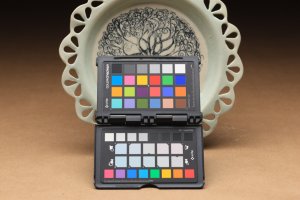
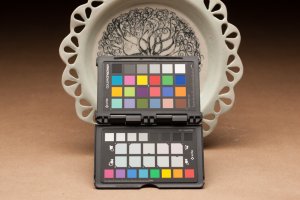
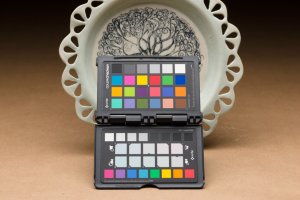
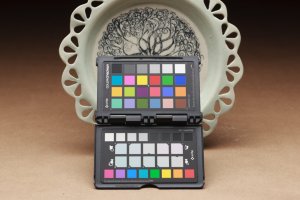
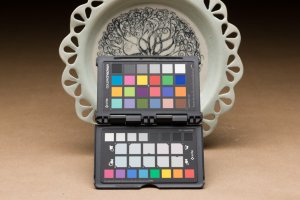
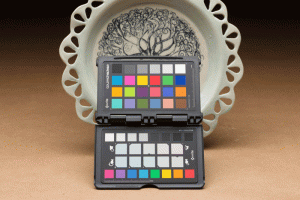
OK, which is 'accurate'?

One is as opened in LR so, by default, Adobe Standard, one is ACR4.4, one is custom profiled, one is Adobe Camera Portrait and one is Adobe Camera Landscape.

The point is they are all the exact same image file. If you shoot RAW you tell the rendering software what the colours should be, not the other way around, if you do that colours are 'accurate'.


EDIT: For those who struggle to see the differences, here are the five images layered as a gif. Just watch the red orange and yellow squares in the bottom right corner change, remember, these are all the same shot just using different camera profiles. The vast majority of the differences people talk about in various camera models 'colour reproduction' has nothing whatsoever to do with CFA filters, it is all down to software profiles.
 

Attachments

  • 1.jpg
    1.jpg
    156.2 KB · Views: 187
  • 4.jpg
    4.jpg
    157.3 KB · Views: 175
  • 5.jpg
    5.jpg
    155.8 KB · Views: 171
  • 2.jpg
    2.jpg
    155.4 KB · Views: 151
  • 3.jpg
    3.jpg
    153.8 KB · Views: 184
  • 1.gif
    1.gif
    687.3 KB · Views: 591
Upvote 0
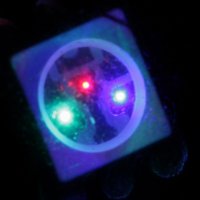
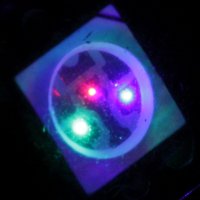
Simple shots of a cheapo RGB light source, a RGB LED from a light strip made with two cameras - EOS 5D classic (see file name) and EOS 600D under similar conditions and with the same settings / processing with DPP.

The blown out highlights from the LED crystals can be well observed while the (black) stripe shows virtually no structure.

The colors seem a little bit cleaner with the 5D classic but both cameras exhibit the violet halo around the blue LED ... I always wondered how a sensor would be which has IR and UV sensitive photosize to give better color information for deep reds and the violet color between blue and UV ...
But I am still impressed what can be done with just three color channels to fool our eyes and brains and I enjoy photography just with that old 5D!
 

Attachments

  • IMG_5d1_003585_reds_vs_orange.JPG
    IMG_5d1_003585_reds_vs_orange.JPG
    79.8 KB · Views: 598
  • IMG_600d_008043_reds_vs_orange.JPG
    IMG_600d_008043_reds_vs_orange.JPG
    85.5 KB · Views: 596
Upvote 0