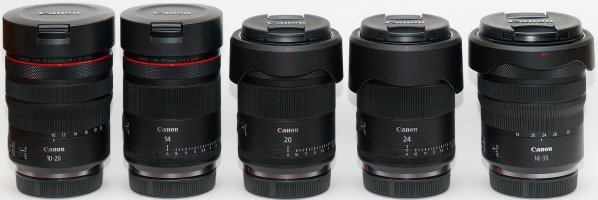
As is obvious from the above image, the RF 14mm f/1.4L VCM is very similar to its VCM siblings, and also something of a slimmer version of the RF 10-20mm f/4L STM lens. The build quality of all of them is similar, though the 14/1.4 feels a bit more dense.
One of the useful features of a fast, ultrawide lens is the ability to blur out a background with a very wide field of view. Given the 40 cm of snow on the ground in my area, getting close to an interesting feature of the landscape without putting on my snowshoes required something contrived like this. The fieldstone wall and planter on it are about 4 m from the leaf, but already strongly blurred.
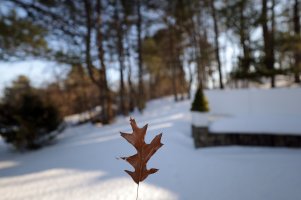
EOS R1, RF 14mm f/1.4
L VCM, 1/1600 s, f/1.4, ISO 100 (in-camera JPG)
Case in point, there's a cemetery nearby that I walked through for initial test shots with the 24-105/2.8L Z and the 20/1.4L VCM, but this time it would have been into knee-deep snow so I stayed in the car (and was fortunate that the Subaru X-Mode pulled me through the deep mud). With a 14mm lens, the mud splatter on the snow and the glow of my headlights (this was after sunset) are visible in lower right corner of the frame, illustrating the challenges of ultrawide compositions.
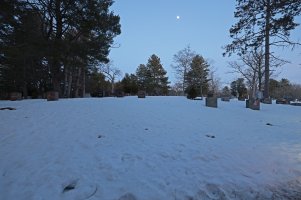
EOS R1, RF 14mm f/1.4
L VCM, 1/60 s, f/3.2, ISO 2500 (in-camera JPG)
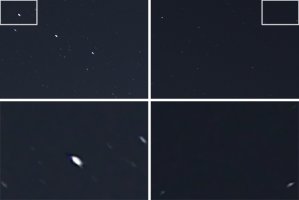
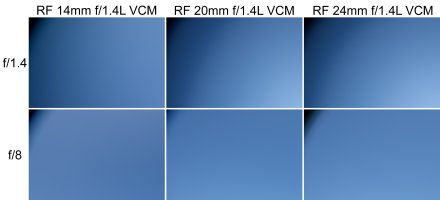
When I tested the 20/1.4, I was surprised to find that wide open mechanical vignetting was a bit less on the 20/1.4 than on the 24/1.4. Turns out that's a trend, since it's even less with the 14/1.4. It's still present after stopping down to f/8, somewhat reduced but not as much improvement as with the 20mm lens. The images in the composite below are the upper left corners of RAWs exported from DxO PhotoLab 9 with no corrections applied.
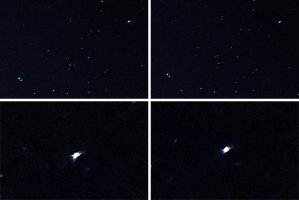
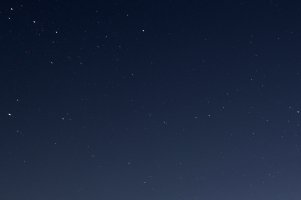
Obviously, starscapes are going to be a primary use case for this lens. The full moon in the shot of the cemetery above hints that it's not the best time of the month to shoot such images. and my usual test subject (Ursa Major) was very close to that moon. Instead, here is a 100% crop of the extreme upper left corner of the image, composed with Orion's Belt right next to that corner in the camera's LCD.
EOS R1, RF 14mm f/1.4
L VCM, 13 s, f/1.4, ISO 100 (in-camera JPG, 100% crop)
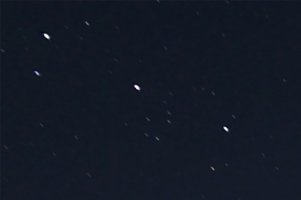
Coma is very well controlled in this lens, although there is some tangential astigmatism (with virtually no sagittal astigmatism). Here's just Orion's Belt at 400%:
I did take one shot with the full moon, and I see that the lens does exhibit some flare. I think this is the first time I've seen moon flare...
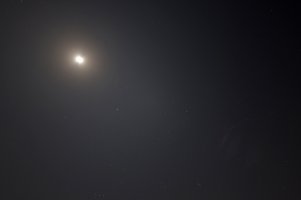
EOS R1, RF 14mm f/1.4
L VCM, 20 s, f/1.4, ISO 100 (in-camera JPG)
One other bit of trivia about this lens. For those into lens cap photography, this is not the lens for you...but the light leak with the cap in place is rather interesting.
EOS R1, RF 14mm f/1.4
L VCM, 1/4 s, f/1.4, ISO 51200 (NR in DxO)