
You are using an out of date browser. It may not display this or other websites correctly.
You should upgrade or use an alternative browser.
You should upgrade or use an alternative browser.
Show your Bird Portraits
- Thread starter 1982chris911
- Start date

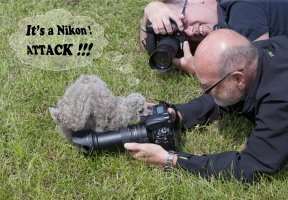

Don & bjd ... AWESOME!bjd said:Hi, I've managed it with Blue Tits, Great Tits, Thrushes and I'm now working on a Robin.Don Haines said:I had asked a while ago for advice on photographing Chickadees. I got lots of useful advice on setting up blinds, use of long lenses, remote triggers, etc. It turns out that what I needed was a pocket full of sunflower seeds.
Taken with a 60D, 100L macro lens, ISO320....while using the camera one handedThis is the full picture, no cropping.
For most birds Mealyworms are the way to go, obviously they must be insect eaters.
I get the birds to associate me with food and can call some with a whistle (through my lips).
Some even sit on the patio and call me if there is no other food out.
The best time is coming up when they are in feeding stress with their young, then they are easier
to "Persuade". Keep fairly quiet, provide a safe place for them to feed (where you sit) and try to give
them a reproducable situation at the start, makes them less nervous.
A good way to start is a white saucer with a few worms on it under/near the normal feeding spot,
they'll notice the movement pretty quickly. Then you move the saucer gradually in your direction.
Going onto my hand was a big step for most birds, but they would fairly quickly sit in the bush next
to me and take worms out of my hands, while still sat on a branch.
And in the end you keep hold of the worm, meaning it gets torn apart between your fingers, but keeping
the bird closer for a longer period.
Here's fluffy, been a around a while now.
Cheers
Upvote
0

Wow! Thanks for sharing. This is fantastic!bjd said:Hi, I've managed it with Blue Tits, Great Tits, Thrushes and I'm now working on a Robin.Don Haines said:I had asked a while ago for advice on photographing Chickadees. I got lots of useful advice on setting up blinds, use of long lenses, remote triggers, etc. It turns out that what I needed was a pocket full of sunflower seeds.
Taken with a 60D, 100L macro lens, ISO320....while using the camera one handed
For most birds Mealyworms are the way to go, obviously they must be insect eaters.
I get the birds to associate me with food and can call some with a whistle (through my lips).
Some even sit on the patio and call me if there is no other food out.
The best time is coming up when they are in feeding stress with their young, then they are easier
to "Persuade". Keep fairly quiet, provide a safe place for them to feed (where you sit) and try to give
them a reproducable situation at the start, makes them less nervous.
A good way to start is a white saucer with a few worms on it under/near the normal feeding spot,
they'll notice the movement pretty quickly. Then you move the saucer gradually in your direction.
Going onto my hand was a big step for most birds, but they would fairly quickly sit in the bush next
to me and take worms out of my hands, while still sat on a branch.
And in the end you keep hold of the worm, meaning it gets torn apart between your fingers, but keeping
the bird closer for a longer period.
Here's fluffy, been a around a while now.
Cheers
Upvote
0

House Wren - taken on 4-7-13

House Wren (7298) by Revup67, on Flickr
Pacific-throat Flycatcher taken on 4-7-13

Pacific-slope Flycatcher (7217) by Revup67, on Flickr
House Wren (7298) by Revup67, on Flickr
Pacific-throat Flycatcher taken on 4-7-13
Pacific-slope Flycatcher (7217) by Revup67, on Flickr
Upvote
0

John, that's a sweet image! Congratulations, you really nailed that one!CTJohn said:Osprey from the Everglades
Upvote
0
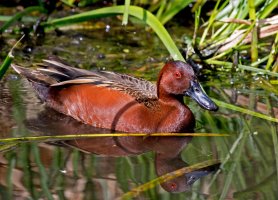
Steven, that's gorgeous! Were you using a better beamer or some on or off camera flash? Great Job!steven kessel said:Cinnamon Teal. Photographed this morning. 5D iii, 100-400 F4-5.6L IS, ISO 320.
Upvote
0
Strictly natural light for this photo. I took the picture about one hour after sunrise, the sun was still fairly low in the sky and was shining from my left to my right. There was a very light haze and the sunlight was somewhat diffused as a result. The light really highlighted the bird's eyes and brightened his feathers for me.
Upvote
0
I'd have to agree, the ambient shot the IQ on this one over the top! Great image!steven kessel said:Strictly natural light for this photo. I took the picture about one hour after sunrise, the sun was still fairly low in the sky and was shining from my left to my right. There was a very light haze and the sunlight was somewhat diffused as a result. The light really highlighted the bird's eyes and brightened his feathers for me.
Upvote
0
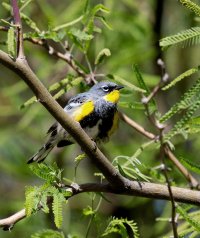
Steven about the yellow rumpled warbler, does it skitter in a tree and then make a short loop out into a clear area as if catching bugs. I've been seeing a bird like this in portland or, and having equal difficulty catching it. Later I'll see if I have any portable images, I was having trouble identifying it.
Regards
Regards
Upvote
0

American Coot at Duck Lake, City Park, Denver, Colorado:

Canon EOS 7D + EF 100-400mm f/4.5-5.6 L IS + Gitzo GT3532LS
Eurasian Collared Dove, My Backyard:

Visit my web site for more!
Canon EOS 7D + EF 100-400mm f/4.5-5.6 L IS + Gitzo GT3532LS
Eurasian Collared Dove, My Backyard:
Visit my web site for more!
Upvote
0

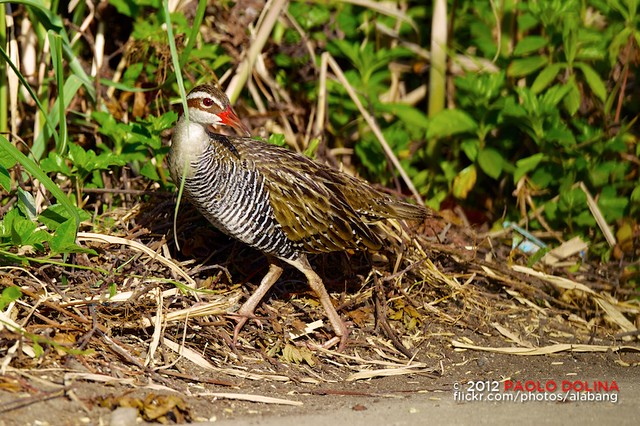
Buff-banded Rail (Gallirallus philippensis) by alabang, on Flickr
The Buff-banded Rail (Gallirallus philippensis) is a distinctively coloured, highly dispersive, medium-sized rail of the family Rallidae. This species comprises several subspecies found throughout much of Australasia and the south-west Pacific region, including the Philippines (where it is known as Tikling), New Guinea, Australia, New Zealand (where it is known as the Banded Rail or Moho-pereru in Māori),[2] and numerous smaller islands, covering a range of latitudes from the tropics to the Subantarctic.
It is a largely terrestrial bird the size of a small domestic chicken, with mainly brown upperparts, finely banded black and white underparts, a white eyebrow, chestnut band running from the bill round the nape, with a buff band on the breast. It utilises a range of moist or wetland habitats with low, dense vegetation for cover. It is usually quite shy but may become very tame and bold in some circumstances, such as in island resorts within the Great Barrier Reef region.[3]
The Buff-banded Rail is an omnivorous scavenger which feeds on a range of terrestrial invertebrates and small vertebrates, seeds, fallen fruit and other vegetable matter, as well as carrion and refuse. Its nest is usually situated in dense grassy or reedy vegetation close to water, with a clutch size of 3-4. Although some island populations may be threatened, or even exterminated, by introduced predators, the species as a whole appears to be safe and its conservation status is considered to be of Least Concern.
Source: http://en.wikipedia.org/wiki/Buff-banded_Rail
Taken: http://en.wikipedia.org/wiki/Los_Ba%C3%B1os,_Laguna
Settings: http://www.flickr.com/photos/alabang/8640215278/#meta/
Upvote
0

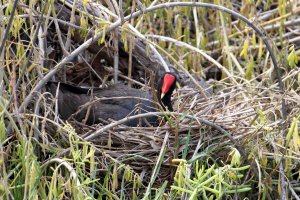

serendipidy said:Female Moorhen on her nest of eggs...taken today Apr 11 with 7D, 100-400mmL @400mm, AE priority, f/8, 1/500s, ISO 800, hand held. PP in DPP and cropped.
Really good control of contrast, smooth gradient all the way. Nice
Upvote
0


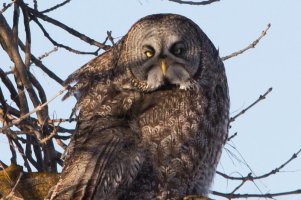
That's a GREAT Great Grey Owl picture....Harv said:Great Grey Owl
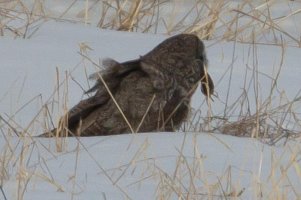
I had one hanging around for half of the winter but was rarely able to get near it. Apologies for the quality of the second picture, it was taken at quite a distance and is upsampled (worse than 100 percent crop).... but you can see the mouse hanging from the beak.... it swallowed it whole!
Attachments
Upvote
0
Similar threads
- Replies
- 118
- Views
- 99K
