Still waiting for high MP canon while Nikon is coming out with new 800

Sporgon said:
Despite the mighty exmor sensor and 36 mp Sony have failed to meet Canon ( and Nikon ) head on in DSLR sales, the DSLR still being by far the most versatile camera system, and this is rather irrefutable evidence that it takes more than a good sensor and high mp to make a winning system.

Or is it just that the sensor they are trying to compete against isn't that bad ?

there ya go, sounds like you're also saying Canon's "good enough"
were you trying to make a counter point to my argument?
the marketshare argument is more in support of the OP's topic
there's apparently room for other mfrs to fill the generous gaps left in the market by its leader
 
Upvote 0
Orangutan said:
What kind of photography do you do? You're obviously not unintelligent or completely ignorant, but you strike me as the kind of person who sees everything from his own perspective, as though your type of photography is the only kind that's important.

I have a friend who is a die-hard Nikon fanboi. He has a D800 and some nice glass. He mostly shoots portraits, and loves his D800, and made jokes about Canon products not keeping up. Then he shot a wedding using someone else's 5D3, and nearly switched to Canon.

If you shoot landscapes, or other slow-moving objects, you can get really great photos from Nikon, Sony, etc, especially using lens adapters and third-party (even Canon) glass. If your subject is moving, it doesn't matter how good the sensor if the rest of the camera can't give you a well-focused shot at the moment you want it.

Thanks for a civilized approach to a contentious topic. :)

I don't do events, sports or wildlife, so I don't often need great AF systems unless I'm after birds on occasion. My needs are primarily best possible IQ (highly maleable raw files) at lower ISO levels as most of my images are sunlit scenes with inherently wide dynamic range and processing those images into a useful print, the way I want to process them, means ABC cameras perform better in my workflow.

My gripe is less with Canon's products (they're making tons of profit with 'good-enough' products, why change) than with its fanbois who think that, "if only those complainers knew what they were doing then Canon products would do what they need." And as voiciferous as some of those fanbois are, that's just wrong. Canon has some inherent flaws that have been around a long time and some of us got tired of working around those problems and waiting for them to be fixed. We don't have to hobble ourselves if we used ABC cameras instead but you might notice the most evangelical Canonites here are the ones who likely haven't learned how to make good use of ABC cameras or, the compromises embodied by Canon products actually are well suited to their uses so, they think if their mainstream or niche application can be filled by Canon gear then all such endeavors can be similarly satiated. And I am happy to disagree with that sort of generalization. :)

..I would like some pressure on Canon to continue to improve. However, I don't want them to drop all their strong features just to be a hunk of metal with a great sensor.
I certainly do not advocate for them to introduce more compromises in order to add improved sensor performance! I'm interested in seeing them catch up to where everyone else is in sensor performance as I'd love a 7d2 with clean low iso shadow performance.
 
Upvote 0
neuroanatomist said:
When did low ISO DR suddenly become 'most metrics'? Oh, I see, you meant 'most important to Aglet and others who represent a minority of consumers'.
Geez Neuro, did you miss the part where the other major mfrs now also have hi ISO performance that rivals or exceeds Canon's last bastion of sensor performance? Even MFT with a smaller sensor is outperforming Canon sensors across most, if not ALL metrics as measured by DPR, IR and DxO.

A 'real explanation' from your personal, biased, 'I need to push images 4-5 stops in post' perspective. I think you should ask Sella174 to explain the concept of 'minority' to you...

And what you got against "minorities" anyway?... Do they get in the way of your corporate interests?
Do you think monopolies are good for anything?... Canon had a virtual monopoly, can we see how much innovation happened during that time?
Yes, for YOU it's all about the shareholders. ;) We don't all think that way.

And thanks to Sony's innovations, I CAN push 4 stops if I want to and I don't need to have great retouching skills to fix a mass of FPN that shows up if I try the same with a Canon file. ABC cameras save me a lot of time compared to Canon bodies for that kind of work and when you're old and prone to getting cranky, it's good to not waste time on irritating products. ;D

Canon makes a system of cameras, lenses, flashes, etc., that collectively meet the needs of the majority of photographers in the world. The sensor may only need to be be 'good enough' - recall that the 5DIII + Canon 24-70/2.8L II outresolves the D800 + Nikon 24-70/2.8G.

You just finished agreeing that Canon makes "good enough" products for the majority of users, which is what I said they did. Sure, they make a few decent lenses too. But good lenses don't make a system either.


Explain how mirrorless is moving ahead?
I'll take Sellas line here.
faster pace of technology and performance improvement from everybody but Canon lately.
Even Nikon's N1V3 can do some tricks their flagship flapper can't.
 
Upvote 0
unfocused said:
Why is it that people always give Nikon and Sony so much credit for being "leaders" when they both are now desperately trying to catch up to Canon by now offering lower megapixel, high ISO models.

So they can kick Canon's arse in another direction; hi-ISO, low-light, low-cost, video-capable bodies vs the other end they already own; Low-ISO, High-DR, High MP bodies. That leaves Canon with the big, fat, boring, middle-ground of "good enough" which makes them a pile of money which apparently makes Neuro happy. :D He must own Canon stock as a portfolio diversification to protect against a possible loss of income from a large corporate Drug-Co it sounds like he works for.... Cuz, you know, they don't already have enough government concessions and lobbyists to ensure their long-term viability. (sorry, was a good set up for a dig ;) I might just do stand-up comedy)
 
Upvote 0
eml58 said:
I think the issue Aglet in particular has is that he sees himself as not being like most of us, you know, the "Common Folk" those majority of "enthusiastic amateurs", the majority of those "Pros", the incredibly mentally challenged....Canon users, poor people, the misguided.
Well, you may be partly correct. Unlike you, perhaps, I'm not satisfied with Canon's product for all of my uses. Now if you also feel like adding a "mentally challenged" category to that group... if the shoe fits, slip your flash on it and strobe along. ;)

The point is, for those of use who are not satisfied with the cadre of mediocre Canon sensors that place limitations on otherwise good gear, we have other options to go to, thankfully.
 
Upvote 0
Sella174 said:
What is very interesting, however, is that FUJIFILM appears to be doing the same as Canon. This is really going to be interesting to watch.

oh, gawd, no! I like Fuji more than Canon. But Fuji believes in doing good for the consumer, even if to their detriment at times. It's a noble Japanese custom... Apparently not so much so for Canon... Well, Canon DID eventually release some updated firmware that unlocked hardware features that could have stayed hidden...
Yes, this might be interesting.

..and niche markets have a nasty tendency to become mass markets.

+1

Oh, did I mention my friend who is a wildlife photographer and recently switched from Canon to Pentax? Well, I am now. Yip, Pentax.

I'd like to know why. I have Pentax too. I like it but I tend to fall back to Nikon or Fuji more now.
 
Upvote 0
dilbert said:
But Canon are selling lots of camera, more than the others, so what Canon is doing must be ok, right?
Yup, it certainly works for Canon and all those users who are satisfied with the product.
Lets face it, Canon's sensors currently rate bottom of the rung so whilst Canon might be getting lots of people to buy their equipment, there is an increasing number of people that won't buy anything again (or recommend Canon) because there's just no incentive to upgrade for "better IQ."
Agreed.
Altho today's "bottom of the rung" is not all that bad, is disappointing Canon have not yet done better. The other mfrs have caught up or passed them, even with limitations imposed by physics causing a handicap for the MFT sensors.
I will only recommend Canon for users who like an easy to figure out camera and who aren't likely to exceed its limitations. That's still a lot of potentially satisfied users.

For me, and others of my ilk, Canon doesn't offer anything compelling enough to buy yet. The longer it takes for them to bring something better to market the less likely I am to keep waiting. I've already sold most of my high end Canon gear and will eventually sell the rest if I'm using it less and less.
I've only got one L lens left and have been waiting a long time for a 7D replacement to put it on. But it has to perform better than the current 70D to be useful. If not, I'll be going MFT and saving weight and money in the process while only losing out some low light AF ability which, frankly, I don't really need.
 
Upvote 0
Anyone who doesn't agree that Sony sensors are better at the moment than canon sensors are in denial. Let's face facts that it's true.

However, in most everything else, canon is better and what limitations are in the Canon sensor can be overcome by proper technique as photographers have done for decades.

Once canon releases the next Gen of sensors, we should have lenses and AF paired that will get every ounce of resolution from that sensor. Currently, those 36 MP can't be resolved by the majority of lenses and when canon drops there high MP sensor, we will have a new lens lineup to match it.
 
Upvote 0
RLPhoto said:
Anyone who doesn't agree that Sony sensors are better at the moment than canon sensors are in denial. Let's face facts that it's true.

When I go out to shoot birds, I'm usually in the f/8-11 range for sufficient DoF with my f/5.6 lens (600/4L IS II + 1.4xIII, so 'get a faster lens' isn't an option even if I didn't need the DoF). Flying birds mean shutter speeds of 1/1600 s or faster, and I'm almost always shooting with relatively poor light. That means I need to shoot in the ISO 1600-6400 range >80% of the time.

Can you please either educate me on the facts I should face that show how Sony sensors are better than Canon sensors for my needs, or explain how your definition of 'better' is more relevant for me than my own definition? I'd hate to remain in denial... ::)
 
Upvote 0
Aglet said:
But good lenses don't make a system either.

Correct, it is a pool of resources which make a system. On the subject of IQ, flashes and all that can generally be neglected since all that is strictly needed to produce a photograph are 1) a camera and 2) a lens.

Again, ignoring weirdly weighted scores, When comparing the huge volume of data accumulated over measuring 147 lenses, one very surprising result was revealed. The average sharpness scores of the Canon EOS 5D Mark III matched the Nikon D800 and if the results were based solely on the mean average, the Canon actually out-performed the Nikon.

When using specific lenses (such as the new Sigma 35mm f/1.4 DG HSM A) the Nikon can out resolve the Canon. However, taken as a whole, the statistics reveal the EOS 5D MK III is capable of similar sharpness and of achieving a close DxOMark camera/lens score to the Nikon D800. Moreover, that’s despite the latter camera’s 60% extra pixel count.


So, while the sensor Nikon sources for the D800/E/S is undeniably more capable than that Canon builds for the 5D3 (both cameras representing the highest resolution offering from both makes), the lenses for the Nikon are, on average, undeniably poorer performing than those for the Canon.

Within its system, Nikon doesn't yet offer a wide variety of lenses that are a match for its highest resolution body.

Within its system, Canon does offers a wide variety of lenses that are at least good enough for its highest resolution body. Whether they're good enough for a 50% pixel increase has yet to be determined. If and when Canon makes the business decision to enter the higher-res market (and I suspect their lens refresh is a milestone in that direction) we shall see.

Assuming canon releases a 35+ MP body and the lenses resolve that well, it will trounce the D800 in detail. Canon fans will trumpet. Nikon fans will likely say "yah but you need to spend $20,000 for a variety of series II lenses for it." I'll sit back with 23MP and be glad I don't need a metric ton of flash memory and a supercomputer to process it all.
 
Upvote 0
3kramd5 said:
Again, ignoring weirdly weighted scores, When comparing the huge volume of data accumulated over measuring 147 lenses, one very surprising result was revealed. The average sharpness scores of the Canon EOS 5D Mark III matched the Nikon D800 and if the results were based solely on the mean average, the Canon actually out-performed the Nikon.

When using specific lenses (such as the new Sigma 35mm f/1.4 DG HSM A) the Nikon can out resolve the Canon. However, taken as a whole, the statistics reveal the EOS 5D MK III is capable of similar sharpness and of achieving a close DxOMark camera/lens score to the Nikon D800. Moreover, that’s despite the latter camera’s 60% extra pixel count.


So, while the sensor Nikon sources for the D800/E/S is undeniably more capable than that Canon builds for the 5D3 (both cameras representing the highest resolution offering from both makes), the lenses for the Nikon are, on average, undeniably poorer performing than those for the Canon.

Within its system, Nikon doesn't yet offer a wide variety of lenses that are a match for its highest resolution body.

Within its system, Canon does offers a wide variety of lenses that are at least good enough for its highest resolution body. Whether they're good enough for a 50% pixel increase has yet to be determined. If and when Canon makes the business decision to enter the higher-res market (and I suspect their lens refresh is a milestone in that direction) we shall see.

Actually, anyone who really cares can determine this right now - it's easy to attach a Canon lens to a Sony mirrorless body (APS-C or FF), so those who take the right sort of measurements should be able to make the comparison, assuming they have any interest in doing so (for all I know this has already been done somewhere). I'm in no position to take such measurements, but my casual use of Canon lenses on my Sony A7r yields marvelous results in terms of resolution (and other ways too) - and the lenses I've tried probably aren't, for the most part, those which would score the highest (I've used 28mm IS, 40mm, 50mm 1.4, 85mm 1.8, 100L, 135L, 24-105L & 70-200 f4 IS L, as well as an old FD 55mm 1.2). My hunch is that Canon lens owners have absolutely nothing to be worried about (in this regard, anyway) when/if Canon releases a camera with a high MP sensor.

Roger Cicala has noted that the Tamron 24-70VR on a D800e outresolves the Canon 24-70 II on a 5DIII. It would be interesting to see how they compare on a Sony A7r, and not outlandish to expect that Canon/Sony combination to handily beat the Tamron/Nikon.
 
Upvote 0
Aglet said:
Sella174 said:
What is very interesting, however, is that FUJIFILM appears to be doing the same as Canon. This is really going to be interesting to watch.

oh, gawd, no! I like Fuji more than Canon. But Fuji believes in doing good for the consumer, even if to their detriment at times. It's a noble Japanese custom... Apparently not so much so for Canon... Well, Canon DID eventually release some updated firmware that unlocked hardware features that could have stayed hidden...
Yes, this might be interesting.

Just to clarify, I meant it in the context of product availability. It is now actually easier to purchase FUJIFILM X-lenses than Canon L-lenses ... over here, of course.

Aglet said:
Oh, did I mention my friend who is a wildlife photographer and recently switched from Canon to Pentax? Well, I am now. Yip, Pentax.

I'd like to know why. I have Pentax too. I like it but I tend to fall back to Nikon or Fuji more now.

He says it is the WR lenses and the Limited primes that did it. (Note that he isn't one of those people who wants to photograph the mites on the ticks on the rhino at 300 metres; he prefers to photograph the animals/tourists within the context of their environment.)
 
Upvote 0
neuroanatomist said:
RLPhoto said:
Anyone who doesn't agree that Sony sensors are better at the moment than canon sensors are in denial. Let's face facts that it's true.

When I go out to shoot birds, I'm usually in the f/8-11 range for sufficient DoF with my f/5.6 lens (600/4L IS II + 1.4xIII, so 'get a faster lens' isn't an option even if I didn't need the DoF). Flying birds mean shutter speeds of 1/1600 s or faster, and I'm almost always shooting with relatively poor light. That means I need to shoot in the ISO 1600-6400 range >80% of the time.

Can you please either educate me on the facts I should face that show how Sony sensors are better than Canon sensors for my needs, or explain how your definition of 'better' is more relevant for me than my own definition? I'd hate to remain in denial... ::)
Sony sensors do perform better at all ISO ranges. The new Exmor in the a7s will supposedly even raise it higher. To deny they don't perform better is sheer egotism. I'm on your side neuro, as we both know a camera is much more than a sensor.
 
Upvote 0
Sella174 said:
unfocused said:
Perhaps I'm being unfair. But, when people assert that a company is headed toward financial disaster because the specific product that they as an individual would like to see produced isn't available and when in reality that company's products consistently outsell their competitors' comparable models across the entire product line, the charitable assumption is that the person making the assertion doesn't quite grasp some fairly basic economic principles.

Let me try this again from MY understanding of basic economic principles. In order to succeed, most companies need at least two types of products, i.e. foundation products and mass products. The former (foundation products) are what you build your company reputation on and are also the products that support your company through any lean years, recessions and failures to predict the swing of the market. The latter (mass products) are the hugely popular products you sell to the masses at huge profits, i.e. the cash cows, and which support the growth and development of your company.

For Canon, IMO, the 1D-series and the 5D-series are foundation products, whereas the 6D and the "xxxD"-series with their kit lenses are the mass products.

Mass products come and go, but foundation products stay for the count. It is therefore vital for any company to always maintain this distinction within the company itself. Placing reliance on the revenue from the mass products for the financing of essential corporate functions is always a one-way ticket to insolvency.

But, due to the fickleness of the mass market consumers, a company must always be ready with the next big mass market "thing". IMO, in cameras, this is mirrorless.

Problem for Canon, IMO, is that not only do they not have any decent mirrorless cameras or a "high-MP" (portrait/architecture/landscape) camera waiting in the wings, they are also allowing their competitors to actually steal the early adopters of this "new trend" away from them. You snooze, you lose.

(I could go on, but I've probably lost everyone's attention by now.)

unfocused said:
There are certainly less charitable assessments that could be made – perhaps some people just enjoy being trolls and don't really believe what they write.

Or it could be research into the thought-patterns of the influential persons within the market. For example, what I've determined through my incessant ramblings/trolling/flaming is that (a) sales figures sell products, (b) a product sells simply because it is the best of what is offered and not because it is actually any good, and (c) extremes sell best.

unfocused said:
Yes...here in the U.S. Nikon and Sony offers their products to exclusive outlets like Walmart, Target and Best Buy.

Two things then ... obviously the "regional managers" of those brands have a better understanding of the importance of placing products on shelves; and perhaps we here in Africa could be a significant untapped market for those brands ... if they only tried.

I don't get one part of this. Sony has the only FF mirrorless body out there now - and it allows those in the canon system to buy it without having to do a complete switch (how many of you are there are using an a7 with canon lenses???). Mirrorless is new and may or may not take off - and if it does who knows what form it will take. Pro grade equipment or mass market equipment. so both Canon and Nikon are letting sony do the market research for them. Canon is actually in a good position considering with this - early adopters aren't selling off their gear to switch, most are keeping their canon gear and adding the sony...
 
Upvote 0
I fell for the grass is greener with a higher MP sensor so bought a Sony A7R and mounted my Canon lenses on it.

My experience so far is this.
the moire of the Sony A7R is better (less) than a 5D III
the 5D mark III produces sharp images, while the Sony on the same lens doesn't. EF 70-200 F4 (non IS) at 200mm because its shutter vibrates too much (known issue on Sony fanbois websites)
I can't use Manual focus lenses like the 24mm TSE because I have failed thus far to figure out how to get EVF zoom to work so focus here is poor. it may only work with Sony Lenses
I bricked the Sony doing a firmware upgrade so waiting for it to be repaired. (trying to fix problem above)
I cannot get a remote shutter trigger easily, to operate the camera from a Promote control or gigapan head so all in all its quite limited. having to make a shutter cable from bits.
The best recommended solution to the vibration issue I found is to use two tripods one for the body to dampen that and one to take the lens weight... did I think the sony was lighter

The A7R is a great concept and promises much, but its made me realise how good DSLR's are, they are heavy for a reason and there is no leap in IQ that made buying it worth while and I can only use it in very niche ways not as a light everyday camera.

Summary I suspect Canon will sort out the ADC noise issue they have and the IQ will leap as a consequence, just need to be patient, I have been reminded that Canon isn't so bad.
 
Upvote 0
RLPhoto said:
neuroanatomist said:
RLPhoto said:
Anyone who doesn't agree that Sony sensors are better at the moment than canon sensors are in denial. Let's face facts that it's true.

When I go out to shoot birds, I'm usually in the f/8-11 range for sufficient DoF with my f/5.6 lens (600/4L IS II + 1.4xIII, so 'get a faster lens' isn't an option even if I didn't need the DoF). Flying birds mean shutter speeds of 1/1600 s or faster, and I'm almost always shooting with relatively poor light. That means I need to shoot in the ISO 1600-6400 range >80% of the time.

Can you please either educate me on the facts I should face that show how Sony sensors are better than Canon sensors for my needs, or explain how your definition of 'better' is more relevant for me than my own definition? I'd hate to remain in denial... ::)
Sony sensors do perform better at all ISO ranges. The new Exmor in the a7s will supposedly even raise it higher. To deny they don't perform better is sheer egotism. I'm on your side neuro, as we both know a camera is much more than a sensor.

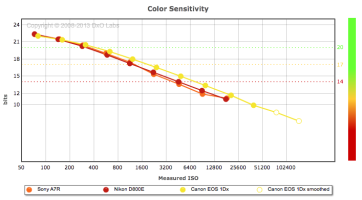
Well, thanks. That's good to know. Here I was, thinking that at high ISO the 1D X was better. Silly me. Those yellow lines for the 1D X that are above the red and orange lines for the Sony sensors in the D800E and a7R, such as for dynamic range at ISO 800 and higher…that's performing worse, right? More tonal range and color sensitivity - those are bad things? Higher SNR across the ISO range, that's worse too, right?

::) ::) ::)

Of course, a camera is more than just a sensor. But I'm still waiting for your facts showing how my Canon sensor is worse at higher ISOs...
 

Attachments

  • DR.png
    DR.png
    44.4 KB · Views: 1,068
  • Tonal Range.png
    Tonal Range.png
    43.3 KB · Views: 685
  • Color Sensitivity.png
    Color Sensitivity.png
    43.2 KB · Views: 710
  • SNR.png
    SNR.png
    45.1 KB · Views: 714
Upvote 0
neuroanatomist said:
RLPhoto said:
neuroanatomist said:
RLPhoto said:
Anyone who doesn't agree that Sony sensors are better at the moment than canon sensors are in denial. Let's face facts that it's true.

When I go out to shoot birds, I'm usually in the f/8-11 range for sufficient DoF with my f/5.6 lens (600/4L IS II + 1.4xIII, so 'get a faster lens' isn't an option even if I didn't need the DoF). Flying birds mean shutter speeds of 1/1600 s or faster, and I'm almost always shooting with relatively poor light. That means I need to shoot in the ISO 1600-6400 range >80% of the time.

Can you please either educate me on the facts I should face that show how Sony sensors are better than Canon sensors for my needs, or explain how your definition of 'better' is more relevant for me than my own definition? I'd hate to remain in denial... ::)
Sony sensors do perform better at all ISO ranges. The new Exmor in the a7s will supposedly even raise it higher. To deny they don't perform better is sheer egotism. I'm on your side neuro, as we both know a camera is much more than a sensor.

Well, thanks. That's good to know. Here I was, thinking that at high ISO the 1D X was better. Silly me. Those yellow lines for the 1D X that are above the red and orange lines for the Sony sensors in the D800E and a7R, such as for dynamic range at ISO 800 and higher…that's performing worse, right? More tonal range and color sensitivity - those are bad things? Higher SNR across the ISO range, that's worse too, right?

::) ::) ::)

Of course, a camera is more than just a sensor. But I'm still waiting for your facts showing how my Canon sensor is worse at higher ISOs...

Very ignorant of you. Please go see d4s. ;) It outperforms the 1dx period in sensor tech.
 
Upvote 0
neuroanatomist said:
Of course, a camera is more than just a sensor. But I'm still waiting for your facts showing how my Canon sensor is worse at higher ISOs...

Gee, Neuro. Would you write up the drug test studies with cherry-picked data too?

You know, I've heard that some DrugCo's double-blind placebo tests
used spiked placebos to make test subjects have more nasty side effects
using the "placebo" than they do when using the new wonder-drug? ;)

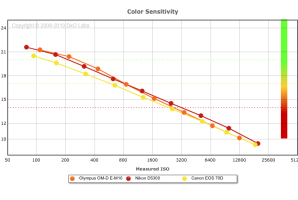
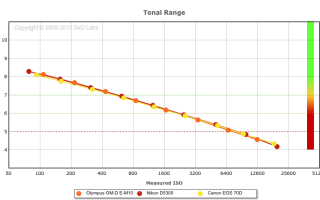
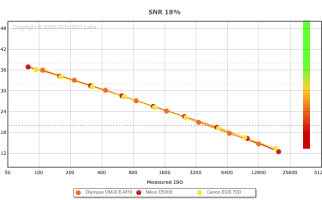
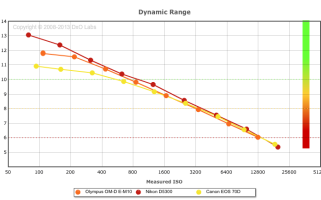
In the crop sensor and smaller world, the results are notably different.

And remember the MFT is outperforming Canon's latest crop sensor using with only about 60% of the surface area of an APSC... And the prices are similarly ratio'd.

These are all presented as SCREEN rather than PRINT data; don't want any of that funky downsampling math to make the differences even bigger.

And to make it more relevant to you, I think Canon probably sells more 70D bodies than 1DX bodies.
That's gotta count for something, eh?.. ;)

(Data provided by DxoMark)
 

Attachments

  • color.png
    color.png
    42.1 KB · Views: 642
  • tonal.png
    tonal.png
    35.3 KB · Views: 644
  • SNR.png
    SNR.png
    36.2 KB · Views: 599
  • DR.png
    DR.png
    40.4 KB · Views: 997
Upvote 0
RLPhoto said:
Very ignorant of you. Please go see d4s. ;) It outperforms the 1dx period in sensor tech.

The performance of the two is nearly identical above ISO 800, and the D4s has a DR advantage below ISO 800. Plus, I can't hand-hold Nikon's 600/4.

Also…

RLPhoto said:
Sony sensors do perform better at all ISO ranges.

AFAIK, Sony doesn't make the sensor in the D4s. Ignorance must be bliss for you…


Aglet said:
Gee, Neuro. Would you write up the drug test studies with cherry-picked data too?
In the crop sensor and smaller world, the results are notably different.

Would you believe the results of testing a drug for Alzheimer's disease in a population of 20 year olds with asthma? Note that I said my Canon sensor in the use case I described. The point was, people make assumptions about their own, personal definition of 'better' without regard for the fact that their needs don't define the needs of everyone else.

Come back when m4/3 is outperforming FF sensors, we'll talk.
 
Upvote 0
DOUBLE SMACKDOWN on Neuro

neuroanatomist said:
Would you believe the results of testing a drug for Alzheimer's disease in a population of 20 year olds with asthma?

coming from you, ya, it's not impossible

Note that I said my Canon sensor in the use case I described. The point was, people make assumptions about their own, personal definition of 'better' without regard for the fact that their needs don't define the needs of everyone else.

Come back when m4/3 is outperforming FF sensors, we'll talk.

sure, don't let facts you don't like get in the way
In case you forgot, the thread's about Canon tech, and when are we gonna see some improvements.

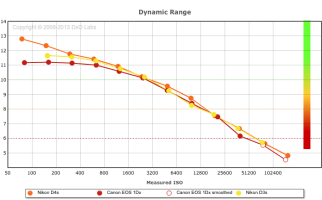
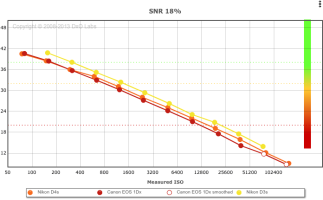
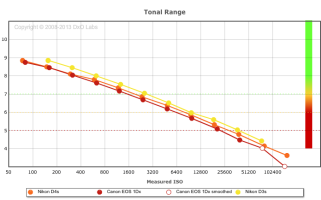
If you didn't like the previous smackdown try this one; using an old-tech D3s with the same kind of pixel-size-advantage BS you tried to pull off in your data comparison... tho even less of a size advantage for the Nikon this time.

Even the old D3s has the 1Dx beat pretty much across the board. Screen OR print normalized. (screen presented data from DxOmark)
FWIW, you can compare a D700 to the group too, it only loses on DR at higher ISO.

So pay attention, YOUR 1DX is the red line, note how IT'S MOSTLY AT THE BOTTOM of every chart.

put that in your syringe and poke it. ;)

DOUBLE-SMACKDOWN!
(tho likely to try BS his way out of it with more weasel-feces)

:P :P :P :P :P :P :P :P :P :P :P :P :P
 

Attachments

  • FFDR.png
    FFDR.png
    41.4 KB · Views: 976
  • FFSNR.png
    FFSNR.png
    43.6 KB · Views: 555
  • FFCS.png
    FFCS.png
    42.8 KB · Views: 546
  • FFTR.png
    FFTR.png
    42.1 KB · Views: 537
Upvote 0