• The Canon Rumors Forum has officially been shut down as of July 10, 2026.

    All data will be deleted on September 16, 2026.

    the ad free experience will return by July 17, 2026.

The Light Leak Issue

Are the new 5D Mark III's being recalled?


  • Total voters
    14
  • Poll closed .
Status
Not open for further replies.

Canon Rumors

Who Dey
Canon Rumors Premium
Jul 20, 2010
12,874
5,707
279,596
Canada
www.canonrumors.com
HTML:
<div name="googleone_share_1" style="position:relative;z-index:5;float: right; /*margin: 70px 0 0 0;*/ top:70px; right:120px; width:0;"><g:plusone size="tall" count="1" href="http://www.canonrumors.com/2012/04/the-light-leak-update/"></g:plusone></div><div id="fb_share_1" style="float: right; margin: 0 0px 0 10px;"><a name="fb_share" type="box_count" share_url="http://www.canonrumors.com/2012/04/the-light-leak-update/" href="http://www.facebook.com/sharer.php">Share</a></div><div><script src="http://static.ak.fbcdn.net/connect.php/js/FB.Share" type="text/javascript"></script></div><div class="tweetmeme_button" style="float: right; margin-left: 10px; margin-bottom: 70px;"><a class="tm_button" rel="&style=normal&b=2" href="http://www.canonrumors.com/2012/04/the-light-leak-update/"></a></div>
<strong>Tested a few cameras


</strong>I went into the office today and did some tests on all the Canon DSLRs I had in stock and discovered a few things.</p>
<p>The biggest discovery I found with most of the cameras and the sunlight test is that just placing your thumb over the viewfinder isn’t enough. Bright light passes through the thumb without much issue. I discovered this when I used a folded piece of black fabric and stuffed that over the viewfinder. Most of the Canon cameras no longer had a “light leak” issue.</p>
<p>I tested with both the lens mounted with a cap on and with just the body cap on.</p>
<p>These tests were done in direct bright sunlight.</p>
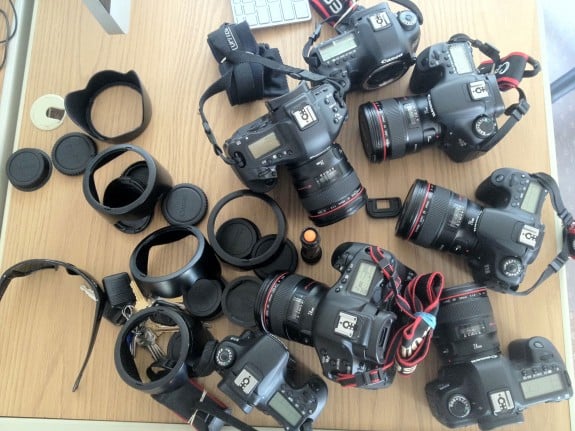
<div id="attachment_9466" class="wp-caption alignnone" style="width: 585px"><a href="http://www.canonrumors.com/wp-content/uploads/2012/04/lightleak.jpg"><img class="size-medium wp-image-9466" title="lightleak" src="http://www.canonrumors.com/wp-content/uploads/2012/04/lightleak-575x431.jpg" alt="" width="575" height="431" /></a><p class="wp-caption-text">The cameras I used for testing. I even mounted the same model lens on all the bodies, the 24 f/1.4L II.</p></div>
<p><strong>Canon EOS 60D


</strong>I tested 2 bodies and found no issue once I placed the folded black fabric over the viewfinder. No change with backlight on.</p>
<p><strong>Canon EOS 7D


</strong>I tested 2 bodies and found no issue once I placed the folded black fabric over the viewfinder.  No change with backlight on.</p>
<p><strong>Canon EOS 5D Mark II


</strong>I tested the one body I have in stock. This camera exhibited the same issue as the 5D Mark III in direct sunlight, however the backlight didn’t affect exposure. I also did the flashlight test that is mentioned below and nothing changed in exposure.</p>
<p><strong>Canon EOS-1D Mark IV – Body #1


</strong>There was an ever so slight shift in exposure with the viewfinder cover down.  10 seconds out of the sun, 8 seconds in the sun. I stuffed the viewfinder with the black fabric and there was no change. The variance in exposure went away if I wrapped the LCD with the black fabric and only left enough space to see the exposure number. No change with backlight on.</p>
<p><strong>Canon EOS-1D Mark IV – Body #2


</strong>This body exhibited no movement in exposure. No change with backlight on.</p>
<p><strong>Canon EOS 5D Mark III


</strong>I only have one body to test for the moment, however it exhibits the shift in exposure  with the backlight turned on.</p>
<p>Once I placed the black fabric over the viewfinder instead of my thumb, the variance in exposure decreased in direct sunlight. However it was still present. Out of direct sunlight, the camera metered 10 seconds, in the direct sunlight the camera metered 1 second.</p>
<p>The final test I did with the 5D Mark III was take the lens cap off and meter off a relatively neutral wall. I turned on the backlight and nothing changed. I then pressed a 130 lumen flashlight up against the top LCD and the exposure didn’t change. I also ran the flashlight around the camera body and absolutely nothing changed.</p>
<p><strong>So why do things change with the caps on?


</strong>I have no idea, none, ziltch!</p>
<p><strong>So is this an issue?


</strong>On the body I tested, it doesn’t appear to be. If the camera acts properly with the lens cap off, who cares how it acts with the caps on? So please don’t return your 5D Mark IIIs, or cancel preorders or overreact. This “issue” may have a simple explanation.</p>
<p>However, if Canon says something is wrong, I apologize…… it just doesn’t appear there is an issue to me.</p>
<p><strong><span style="color: #ff0000;">c</span>r</strong></p>
 
Canon Rumors said:
I have no idea, none, ziltch!

Thanks, Craig.

Well clearly there is a very slight light leak through the LCD and also from the LCD backlight LED to the metering sensors.

But the leaked light is very little; down in the nanowatt or less range. It only shows up when there is no TTL light to swamp it.

With all caps on, and light on the LCD, you get leaked light of say 1nW (GUESS, not real!!!) on the lighting sensors. In the absence of any other light, the sensors do detect this.

With the lens cap off, and say 1uW or likely more of TTL light hitting the metering sensors, you simply don't see the effect of the 1000 times smaller (or even smaller than that) leaked light.

I don't think the 5D3 would've made it through Beta if this had been a real issue with the lens uncapped.
 
Upvote 0
Thanks for the great effort. I believe not everyone would've been able to do the test you were able to..
As expected, i don't see why people are making such a big deal about that little light leak..It's like complaining about a stone in the tyre of a car you just bought…i was never bothered about this "leak" and after reading your test, i'm even less bothered about it.

BTW, that's a whole lot of 24L lenses there!
 
Upvote 0
I really don't get it. I really don't. Canon obviously tested the camera taking zillions of pictures in the field and they didn't notice anything that made the pictures crap.... so why the hell should I care? Even if the exposure is off 1/3 of a stop, hell, with the photos I take the exposure is NEVER exactly right. That's why we shoot RAW, isn't it?
 
Upvote 0
Hi guys I noticed this happens with my camera (5D mk iii), it does not happen with my original 5D. Honestly I don' see it as threat to my photography as soon as you have some light going through the lens the problem disappears and it meters accurately. I also noticed nothing records on the sensor, its just the meter that gets fooled 2/3 to 1 stop under test conditions. I'd still like to hear what canon has to say about it.
 
Upvote 0
So, just to make sure I've got this right:

The next time I'm photographing a black cat at the bottom of an unlit coal mine, if I want to use the camera's meter, I should make sure I don't also use the LCD backlight at the same time, or let any stray sunlight strike it either?

I think I can live with that....

b&
 
Upvote 0
Perhaps the reason that this shows up with the cap on is because the sensor is actually really really sensitive, more so than on older models, and that is why it seems to show up on the high end gear only.
IE: The same minor leaks as on all gear, but now the sensor can see it.

Boom.
 
Upvote 0
i believe this movement in exposure with the lenscap on is not triggered by a light leak. its the same as when pressing the shutter button in total darkness wherein the camera is trying to meter the available light for it to set the exposure, with the lens on this shall go with the hunting of the lens for focus. in this situation the camera metering is fooled and couldn't lock the focus and exposure therefor the shutter will not trigger unless you overide the cameras' computer by going to manual mode.
 
Upvote 0
neuroanatomist said:
Canon Rumors said:
... it just doesn’t appear there is an issue to me.

Wrong. It's a HUGE issue for anyone who's favorite photographic subject is the inside of a lens cap!!!

All sarcasm aside... does anyone not see how this could be a serious issue for astrophotographers?

If you are using a headlamp or the LCD backlight to set your exposure for a night sky capture, you could be in serious trouble. I'll be doing some tests tonight and will follow-up tomorrow.

I fear the 5D3 may not be suited for astrophotography at all if this problem affects nighttime exposures.
 
Upvote 0
msdarkroom said:
Perhaps the reason that this shows up with the cap on is because the sensor is actually really really sensitive, more so than on older models, and that is why it seems to show up on the high end gear only.
IE: The same minor leaks as on all gear, but now the sensor can see it.

Boom.

Actually, if anybody here is handy with math, it might be possible to do a calculation to see if that reasonable-sounding theory holds up.

What is the actual increase in illumination indicated by the change in meter readings, and how does that compare with the actual light levels at the (new) bottom of the 5DIII's sensitivity? If there's any overlap...

...though that still would only be of idle curiosity to the non-lenscap non-black-cat-in-coal-mine crowd....

b&
 
Upvote 0
Hi,

I test it and yes that happes to mine too but............

here is my real problem:

If I take a picture for example: Manual 4.0 / 1/200 / iso 800 & I compare the same but in P mode the manual picture is a bit darker like 2/3 also you can notice that if you check the histogram.

since I start to take picture with my 5d mark iii I notice the picture was a bit dark like 2/3 so if I want to take the picture right I have to set my meter to +2/3

anyone with this problem?
 
Upvote 0
justsomedude said:
neuroanatomist said:
Canon Rumors said:
... it just doesn’t appear there is an issue to me.

Wrong. It's a HUGE issue for anyone who's favorite photographic subject is the inside of a lens cap!!!

All sarcasm aside... does anyone not see how this could be a serious issue for astrophotographers?

If you are using a headlamp or the LCD backlight to set your exposure for a night sky capture, you could be in serious trouble. I'll be doing some tests tonight and will follow-up tomorrow.

I fear the 5D3 may not be suited for astrophotography at all if this problem affects nighttime exposures.

I've not done any astrophotography, but I was under the impression that the onboard meter is perfectly useless for such work. Or any meter, for that matter -- I thought the serious stuff was all done either from well-established exposure charts or by stacking multiple exposures....

b&
 
Upvote 0
could it be that they switched the amber backlight position from the right(7d) to the left next to the mirorbox?

when you look at the lcd at an angle you can make out the led.
i believe that one side of the lcd is mirrored off to reflect the backlight back.
the ledside isn't so sunlight can sliptrough and the ledlight itself will have a more profound effect when placed next to the mirror box

can someone check the position of the backlight led on the markIII?
 
Upvote 0
msdarkroom said:
Perhaps the reason that this shows up with the cap on is because the sensor is actually really really sensitive, more so than on older models, and that is why it seems to show up on the high end gear only.
IE: The same minor leaks as on all gear, but now the sensor can see it.

Boom.

Good one.
Already people are seeing more vignetting on there lenses, probably also due to the sensor.
I still have old stuff, lucky me.

very juicy picture btw.
lightleak-575x431.jpg
 
Upvote 0
justsomedude said:
neuroanatomist said:
Canon Rumors said:
... it just doesn’t appear there is an issue to me.

Wrong. It's a HUGE issue for anyone who's favorite photographic subject is the inside of a lens cap!!!
All sarcasm aside... does anyone not see how this could be a serious issue for astrophotographers?

If you are using a headlamp or the LCD backlight to set your exposure for a night sky capture, you could be in serious trouble. I'll be doing some tests tonight and will follow-up tomorrow.

I fear the 5D3 may not be suited for astrophotography at all if this problem affects nighttime exposures.

Erm, no.

Because you would NOT rely on the camera's idea of what is correct exposure when doing astrophotography. Because if you did, the camera would seek to make the picture's lightness similar to that for normal photography.

You simply don't use the camera's exposure system when photographing star fields, because the overwhelming majority of the field is near-black.

You go to manual, or bulb.

Unless you're doing high-magnification photos of the Moon or other frame-filling objects, in which case you're now doing daylight photography, and basically, the terrestrial sunlit "Sunny f/16" rule applies.

Also, you're unlikely to be using headlights or bright torches anyway when engaged in astrophotography, because doing so would destroy your night vision.

BUT, please do report back your findings, because it will be a useful data point.

The 5D3 is the most light-sensitive/noise-free DSLR that exists in a conventional-size (non-integrated-grip) body at the present time, AFAIK.

So it would seem, it's the best such DSLR for astrophotography. (Possibly barring the 60DA, but even then I suspect the 5d3 wins on low-light performance.)
 
Upvote 0
Status
Not open for further replies.