Upcoming Canon EF-S 35mm f/2.8 M IS STM Will Have Macro Illumination

scyrene said:
Talys said:
Objectively, based on lab scoring (not mine), the 5DMk4 has slightly more color depth and the same dynamic range as the 80D, and much better low light (higher ISO) performance. But, if you're only shooting ISO 100 in bright sunlight, the latter doesn't matter. If you drop it down a notch and compare 6D and 80D, the 80D has superior dynamic range; who knows what the 6DII will bring.

If you're able to do all your bird photography at ISO 100, you must live somewhere very bright! But anyhow, I'm glad you're enjoying your kit; however, the argument 'more pixels on bird with crop' is not as cut and dried as you suggest, or else everyone would be using fixed lens superzooms for bird photography. I've no doubt the 80D is a fine camera for this type of work if budget and weight are limiting factors. The 5D4 is nonetheless doubtless superior in most technical aspects.


You'll find no argument from me that a 5D4 is a superior camera in most aspects. If I were only allowed to have one camera and price weren't an issue it would be a 5D4, because birds at 50-70+ feet are not the only things I photograph.


Given the f6.3 constraint at 600mm of my lens, I find proper exposure at ISO 100 to be from 1/250-1600 shutter speeds on a bright, sunny day. Since I shoot stills with a tripod, the lower shutter speeds are ok. For birds in flight, the sun must be behind me anyways (otherwise, the bird comes out as a silhouette), so shutter speeds are well over 1/1000 -- sometimes as high as 1/3200.

My biggest complaint with the Sigma (yes, I realize it isn't a 600L for IQ) is that at f6.3, the 80D autofocus is not great for capturing birds in flight. I must often AF at a shorter FL (to get 45 point cross at 5.6), then zoom back in, when the AF system has less work to do. If there were a better lens alternative that didn't require me to spend a gazillion dollars, I'd do it, but the photographs are infinitely better than my 70-200L, and at least comparable or better to a borrowed 100-400L at the range I want to photograph at.
 
Upvote 0
Talys said:
Objectively, based on lab scoring (not mine), the 5DMk4 has slightly more color depth and the same dynamic range as the 80D, and much better low light (higher ISO) performance.

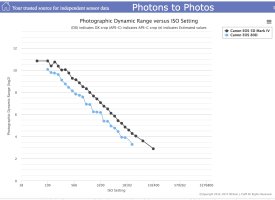
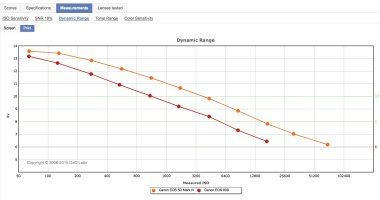
5DMk4 same dynamic range as 80D? That's not what I have seen from lab testing by Claff and DxOmark.
 

Attachments

  • DR_80DvsMkIV_Claff.jpg
    DR_80DvsMkIV_Claff.jpg
    264.3 KB · Views: 169
  • DR_80DvsMkIV_DxO.jpg
    DR_80DvsMkIV_DxO.jpg
    255.7 KB · Views: 167
Upvote 0
AlanF said:
Talys said:
Objectively, based on lab scoring (not mine), the 5DMk4 has slightly more color depth and the same dynamic range as the 80D, and much better low light (higher ISO) performance.

5DMk4 same dynamic range as 80D? That's not what I have seen from lab testing by Claff and DxOmark.

If you read my entire post instead of taking just one sentence out of it, the DXOMark numbers prove my point precisely. I said that in perfect lighting situations, where you can shoot at ISO 100 they have nearly identical performance. I also said that as ISO increased, the 5D4's definitely had an edge in image quality, if I could get close enough to the subject -- and that means better pictures of birds in flight if there's filtered light, because in such situations, to maintain high shutter speeds with crappy aperture, it's necessary to up the ISO to as high as 400.

Yes, the 5D4 scores very slightly higher dynamic range at 100. But it's a very small number, and if you weigh it against the number of megapixels that you lose -- I'll take the megapixels, thank you, because I can improve dynamic range in post, whereas if I don't have enough pixels of the subject, the photo is worthless.

My point was never that an 80D is a better camera body than a 5D4. It was that the 80D is a different tool, and in certain, specific circumstances -- specifically, when lighting isn't an issue, and you're at the limit of your focal range of the crop area and you'd be discarding the rest of the frame, or more, anyhow -- it can yield a superior (or usable) photograph.

Edit: it's also worth mentioning that when using imperfect optics -- which is the case with many at long telephoto lengths, because not a lot of amateurs can afford professional primes -- APS-C means that you're only using the center 63% of the lens, which will be the part of the lens with the least problems. That means you're squeezing 24 megapixels out of the center 63% of glass, rather than a 28 megapixels out of 100% of the glass.
 
Upvote 0
Talys said:
Edit: it's also worth mentioning that when using imperfect optics -- which is the case with many at long telephoto lengths, because not a lot of amateurs can afford professional primes -- APS-C means that you're only using the center 63% of the lens, which will be the part of the lens with the least problems. That means you're squeezing 24 megapixels out of the center 63% of glass, rather than a 28 megapixels out of 100% of the glass.

If you are using the same telephoto lens on an APS-C camera and a full frame at the same distance, then your image of your bird (or whatever) will occupy the same physical space on the crop and FF sensors and be subject to exactly the same optical defects of the lens. There will be fewer pixels from the FF after you have cropped the image to the same size as APS-C of course, but the cropped image will be unaffected by the poorer edge effects of the lens as you have cropped out the edges.
 
Upvote 0
scyrene said:
PeterT said:
Do you want to say that those lenses are impossible to produce? Do you want to say that I am alone with my needs and nobody else would buy those lenses? Just look around in this discussion thread, you will see that I am not alone...

Well the most sensible response is that Canon has assessed the market and decided it's not worth their while to produce the lenses you ask for. Just because a few people on forums are vocal on an issue, doesn't mean that represents a large enough constituency in the real world to make something profitable. Some people respond by claiming there must be a conspiracy, but that's as ridiculous as any other conspiracy theory...

I never say it's a conspiracy.
It's called marketing. An ugly (in my opinion) but common kind of marketing which ignores the needs of a group of (potential) customers (even if there are enough of them to make the product profitable) because of the fear that some other group of existing customers could be better (=cheaper) served by that product.
What else can the ignored group do in order to get their needs fulfilled than being vocal?
 
Upvote 0
PeterT said:
scyrene said:
PeterT said:
Do you want to say that those lenses are impossible to produce? Do you want to say that I am alone with my needs and nobody else would buy those lenses? Just look around in this discussion thread, you will see that I am not alone...

Well the most sensible response is that Canon has assessed the market and decided it's not worth their while to produce the lenses you ask for. Just because a few people on forums are vocal on an issue, doesn't mean that represents a large enough constituency in the real world to make something profitable. Some people respond by claiming there must be a conspiracy, but that's as ridiculous as any other conspiracy theory...

I never say it's a conspiracy.
It's called marketing. An ugly (in my opinion) but common kind of marketing which ignores the needs of a group of (potential) customers (even if there are enough of them to make the product profitable) because of the fear that some other group of existing customers could be better (=cheaper) served by that product.
What else can the ignored group do in order to get their needs fulfilled than being vocal?

I'm not sure that is the reason, but we don't have access to enough data - your assertion relies on the assumption that the group of people being poorly served by this policy (if it exists) is large enough to be worth Canon's while targeting with the products you desire. But there's no evidence of that. Be as vocal as you like, but don't assume that high volume (loudness) of complaints equals high volume (number) of dissatisfied customers.

They do what they think is best to maximise their profits. A lot of people seem personally affronted that this doesn't mean their personal needs and desires are met. I can only shrug my shoulders. No solution is perfect, unless perhaps it's bespoke. For most of us, compromise is just part of life.
 
Upvote 0
AlanF said:
Talys said:
Edit: it's also worth mentioning that when using imperfect optics -- which is the case with many at long telephoto lengths, because not a lot of amateurs can afford professional primes -- APS-C means that you're only using the center 63% of the lens, which will be the part of the lens with the least problems. That means you're squeezing 24 megapixels out of the center 63% of glass, rather than a 28 megapixels out of 100% of the glass.

If you are using the same telephoto lens on an APS-C camera and a full frame at the same distance, then your image of your bird (or whatever) will occupy the same physical space on the crop and FF sensors and be subject to exactly the same optical defects of the lens. There will be fewer pixels from the FF after you have cropped the image to the same size as APS-C of course, but the cropped image will be unaffected by the poorer edge effects of the lens as you have cropped out the edges.

You are absolutely correct. But in reality, that's not how it works. The same shot is often impossible from the same location, because on a FF, the subject would just be too small. It's actually the entire premise of what I've been trying to say; perhaps I've been inarticulate.

Let's just say for the sake of argument that you have a 300mm EF mount prime (no zoom). You mount that onto a crop sensor camera, and take a perfectly framed picture of your still subject at 50 yards; let's say, the subject takes 50% of the sensor height.

Now, you take the body off, and swap a full frame body, and take exactly the same picture. You're right: the light hitting the sensor occupies exactly the same sensor area. But the sensor area is 1.6x larger, meaning your subject, instead of being 50% of the sensor area, is only 31% of the sensor area. Your know that real pixel output would make this too small to use. It's not going to be perfectly framed anymore, because you wouldn't be happy with just taking a 62.5% crop area from the photo. So what do you do? Obviously, you move up closer to the subject. My earlier point was that with wildlife, often, getting closer to the subject is not an option, so you'd need a longer focal length piece of glass or a higher resolution FF sensor to accomplish the same number of pixels of subject.

If you compare most current generation full frame with current generation crop sensor cameras, the full frame cameras don't have 1.6x the number of megapixels (ie density). To fill your subject to the same number of pixels, you must move some distance closer, and which point, you are using more of the lens glass radius.

Of course, we can solve all this by simply using a FF camera with the same or greater sensor pixel density as the crop; but if you're comparing it against an 80D, that means going all the way to a 5DSR.

The best body for a lens would be the highest pixel density on the sensor that the glass supports built up to the size that the glass is designed for. Since life is full of compromises, you need to choose between pixel density and sensor size, with the exception of 5DSR.
 
Upvote 0
Talys said:
AlanF said:
Talys said:
Edit: it's also worth mentioning that when using imperfect optics -- which is the case with many at long telephoto lengths, because not a lot of amateurs can afford professional primes -- APS-C means that you're only using the center 63% of the lens, which will be the part of the lens with the least problems. That means you're squeezing 24 megapixels out of the center 63% of glass, rather than a 28 megapixels out of 100% of the glass.

If you are using the same telephoto lens on an APS-C camera and a full frame at the same distance, then your image of your bird (or whatever) will occupy the same physical space on the crop and FF sensors and be subject to exactly the same optical defects of the lens. There will be fewer pixels from the FF after you have cropped the image to the same size as APS-C of course, but the cropped image will be unaffected by the poorer edge effects of the lens as you have cropped out the edges.

You are absolutely correct. But in reality, that's not how it works. The same shot is often impossible from the same location, because on a FF, the subject would just be too small. It's actually the entire premise of what I've been trying to say; perhaps I've been inarticulate.

Let's just say for the sake of argument that you have a 300mm EF mount prime (no zoom). You mount that onto a crop sensor camera, and take a perfectly framed picture of your still subject at 50 yards; let's say, the subject takes 50% of the sensor height.

Now, you take the body off, and swap a full frame body, and take exactly the same picture. You're right: the light hitting the sensor occupies exactly the same sensor area. But the sensor area is 1.6x larger, meaning your subject, instead of being 50% of the sensor area, is only 31% of the sensor area. Your know that real pixel output would make this too small to use. It's not going to be perfectly framed anymore, because you wouldn't be happy with just taking a 62.5% crop area from the photo. So what do you do? Obviously, you move up closer to the subject. My earlier point was that with wildlife, often, getting closer to the subject is not an option, so you'd need a longer focal length piece of glass or a higher resolution FF sensor to accomplish the same number of pixels of subject.

If you compare most current generation full frame with current generation crop sensor cameras, the full frame cameras don't have 1.6x the number of megapixels (ie density). To fill your subject to the same number of pixels, you must move some distance closer, and which point, you are using more of the lens glass radius.

Of course, we can solve all this by simply using a FF camera with the same or greater sensor pixel density as the crop; but if you're comparing it against an 80D, that means going all the way to a 5DSR.

The best body for a lens would be the highest pixel density on the sensor that the glass supports built up to the size that the glass is designed for. Since life is full of compromises, you need to choose between pixel density and sensor size, with the exception of 5DSR.

I believe users of, e.g. the fairly low resolution (by current standards) 1Dx series tend to argue that you can crop more (as a percentage of the image) with that camera than lesser devices (with smaller sensors and/or smaller pixels). This is intuitively true - a 15MP phone camera image shows much poorer quality (in terms of noise, DR, etc) when cropped than a 15MP FF DSLR image. It's not just the quantity of the pixels that counts. I'm sure there are others here who can put this better. But the old chestnut 'crop gives more reach' has never been that simple, but obviously especially not now we have APSC and FF cameras with the same pixel density (e.g. 7D2-5Ds).
 
Upvote 0
scyrene said:
I believe users of, e.g. the fairly low resolution (by current standards) 1Dx series tend to argue that you can crop more (as a percentage of the image) with that camera than lesser devices (with smaller sensors and/or smaller pixels). This is intuitively true - a 15MP phone camera image shows much poorer quality (in terms of noise, DR, etc) when cropped than a 15MP FF DSLR image. It's not just the quantity of the pixels that counts. I'm sure there are others here who can put this better. But the old chestnut 'crop gives more reach' has never been that simple, but obviously especially not now we have APSC and FF cameras with the same pixel density (e.g. 7D2-5Ds).

I think that technically, this occurs as a result of noise, or a low signal to noise ratio. As sensors get smaller, they need more light to capture the same quality of image (because less light hits the sensor), and this becomes apparent especially in darker colors as you increase the ISO.

As you increase the ISO to 400 and 800, the differences between 5D4, 80D, and iPhone become vast. On the other hand -- I'm sure you've all seen it -- for family photos in the sun, the iPhone takes beautifully crisp photos.

When lighting isn't perfect, often, the noise isn't apparent at 25% magnification, but on actual pixels you see unacceptable noise. In a lot more photos, that doesn't happen on a top-of-the-line FF like the 5D4, making the higher magnification crop possible.

This is why when I shoot on an 80D, I almost always use ISO 100, and generally never go higher than ISO 250. I find that any higher gives me non-ideal photos that I'm going to discard anyways, and this is the principle reason that I want a FF camera. Even at 200-250, I find that pixel-level images are only marginally acceptable and require work in post to make me happy.
 
Upvote 0
Talys said:
scyrene said:
I believe users of, e.g. the fairly low resolution (by current standards) 1Dx series tend to argue that you can crop more (as a percentage of the image) with that camera than lesser devices (with smaller sensors and/or smaller pixels). This is intuitively true - a 15MP phone camera image shows much poorer quality (in terms of noise, DR, etc) when cropped than a 15MP FF DSLR image. It's not just the quantity of the pixels that counts. I'm sure there are others here who can put this better. But the old chestnut 'crop gives more reach' has never been that simple, but obviously especially not now we have APSC and FF cameras with the same pixel density (e.g. 7D2-5Ds).

I think that technically, this occurs as a result of noise, or a low signal to noise ratio. As sensors get smaller, they need more light to capture the same quality of image (because less light hits the sensor), and this becomes apparent especially in darker colors as you increase the ISO.

As you increase the ISO to 400 and 800, the differences between 5D4, 80D, and iPhone become vast. On the other hand -- I'm sure you've all seen it -- for family photos in the sun, the iPhone takes beautifully crisp photos.

When lighting isn't perfect, often, the noise isn't apparent at 25% magnification, but on actual pixels you see unacceptable noise. In a lot more photos, that doesn't happen on a top-of-the-line FF like the 5D4, making the higher magnification crop possible.

This is why when I shoot on an 80D, I almost always use ISO 100, and generally never go higher than ISO 250. I find that any higher gives me non-ideal photos that I'm going to discard anyways, and this is the principle reason that I want a FF camera. Even at 200-250, I find that pixel-level images are only marginally acceptable and require work in post to make me happy.

Sure, but wasn't the argument that a crop camera is better in some circumstances than FF because you get more pixels on target? Maybe someone else was saying that. The difference may be greater at higher ISOs, but it's there at base ISO too, surely? The whole thing is rather muddy, anyhow.

But I'm sure the 80D is an excellent camera. I considered it too, when it came out, as it had such a high pixel density (along with the 750/760D). I went the other route, and got the 5Ds, which allows the best of both worlds, but is obviously more expensive and has lower fps than the 80D. As for ISO 100, once again all I can say is: lucky you! I have shot almost no bird photos at base ISO, and even ISO 400 is low by my standards, but I live in a not-very-sunny place, and often shoot at f/10. Everyone's different :)
 
Upvote 0
+1
I too have never shot a bird photo at iso 100. As I invariably use iso 640 or higher, on FF, APS-C and 5DSr, all of my photos must be unacceptable to Talys. Using the sunny 16 rule for exposure, a fully illuminated bird on a bright sunny day at f/16 at iso 100 would require an exposure of 1/100s, or 1/400s at f/8. A top bird photographer like Ari Hazeghi uses exposures of 1/2500s or faster at f/8, which requires an iso of usually more than 800 (see eg http://arihazeghiphotography.com/blog/how-to-set-exposure-in-bird-photography/) and goes up to 3200 or so on FF in poorer light. His work must be unacceptable too.
 
Upvote 0
AlanF said:
+1
I too have never shot a bird photo at iso 100. As I invariably use iso 640 or higher, on FF, APS-C and 5DSr, all of my photos must be unacceptable to Talys. Using the sunny 16 rule for exposure, a fully illuminated bird on a bright sunny day at f/16 at iso 100 would require an exposure of 1/100s, or 1/400s at f/8. A top bird photographer like Ari Hazeghi uses exposures of 1/2500s or faster at f/8, which requires an iso of usually more than 800 (see eg http://arihazeghiphotography.com/blog/how-to-set-exposure-in-bird-photography/) and goes up to 3200 or so on FF in poorer light. His work must be unacceptable too.

In fairness to Talys, he said *on the 80D*. But even so, I would push a camera like that to 3200 with no qualms.
 
Upvote 0
scyrene said:
AlanF said:
+1
I too have never shot a bird photo at iso 100. As I invariably use iso 640 or higher, on FF, APS-C and 5DSr, all of my photos must be unacceptable to Talys. Using the sunny 16 rule for exposure, a fully illuminated bird on a bright sunny day at f/16 at iso 100 would require an exposure of 1/100s, or 1/400s at f/8. A top bird photographer like Ari Hazeghi uses exposures of 1/2500s or faster at f/8, which requires an iso of usually more than 800 (see eg http://arihazeghiphotography.com/blog/how-to-set-exposure-in-bird-photography/) and goes up to 3200 or so on FF in poorer light. His work must be unacceptable too.


In fairness to Talys, he said *on the 80D*. But even so, I would push a camera like that to 3200 with no qualms.

Which is why I wrote I use 640 or more on APS-C and 5DSr. You can use high iso if you know how to remove noise with the right software and settings. If I use DPP or PS with bulk standard settings for noise then my 7DII and M5 are noisy at 640 iso, but there is no obtrusive noise when processed properly. If I was restricted to iso 100 I would have to give up bird photography. Base DR has never worried me because i am rarely down there.
 
Upvote 0
scyrene said:
Sure, but wasn't the argument that a crop camera is better in some circumstances than FF because you get more pixels on target? Maybe someone else was saying that. The difference may be greater at higher ISOs, but it's there at base ISO too, surely? The whole thing is rather muddy, anyhow.

But I'm sure the 80D is an excellent camera. I considered it too, when it came out, as it had such a high pixel density (along with the 750/760D). I went the other route, and got the 5Ds, which allows the best of both worlds, but is obviously more expensive and has lower fps than the 80D. As for ISO 100, once again all I can say is: lucky you! I have shot almost no bird photos at base ISO, and even ISO 400 is low by my standards, but I live in a not-very-sunny place, and often shoot at f/10. Everyone's different :)

I was trying to say that if you have a focal range constraint -- and I was using 600mm as an example, because this is the biggest lens I own -- there are times when you just can't get enough pixels out of a 20-30 megapixel full frame camera. Because sensor is 1.6x larger, and the pixel density is only a little bit larger, there will be times when you get a gorgeous photo where a bird is just 600 pixels tall, and that's not a usable photo no matter how good those 600 pixels are.

Although I was using eagles as examples, those are pretty easy to photograph using shorter focal lengths and FF cameras because they're such big birds. There are plenty of birds that are much smaller, and often shy, and I just can't get close enough.

I live in the west coast of Canada, where it's often rainy. But birding is a hobby, not a job, so I only go photographing birds on clear days. Mostly, this evolved simply because I like taking hikes in sunshine, not in rain :) I also don't enjoy trekking in mud.

AlanF said:
+1
I too have never shot a bird photo at iso 100. As I invariably use iso 640 or higher, on FF, APS-C and 5DSr, all of my photos must be unacceptable to Talys. Using the sunny 16 rule for exposure, a fully illuminated bird on a bright sunny day at f/16 at iso 100 would require an exposure of 1/100s, or 1/400s at f/8. A top bird photographer like Ari Hazeghi uses exposures of 1/2500s or faster at f/8, which requires an iso of usually more than 800 (see eg http://arihazeghiphotography.com/blog/how-to-set-exposure-in-bird-photography/) and goes up to 3200 or so on FF in poorer light. His work must be unacceptable too.

I think ISO 600 photos on an 80D looks grainy, whereas ISO 600 photos from a 5D4 looks pretty good. I have never had the pleasure of using a 5DS, 5DSR, or 1D so I can't say with those. If you don't/can't shoot at low ISOs and you want pictures that are free of digital noise, I'd definitely recommend a full frame camera. If a bird is too far away to get a good picture because of resolution and focal range, c'est la vie -- be patient and pray it comes closer, sneak up if you can, or go and buy a ridiculously expensive longer lens or low aperture lens that you can throw a teleconverter on.

An exposure of 1/2500 at f/6.3 ISO 100 does happen. It occurs on a clear day, when the sun is behind you, and you're shooting a bird in flight. It's also the best way to capture the bird's plumage.

A perched bird, or one that's nesting does not require 1/2500. For those shots, I can usually take them at 1/500 f/6.3 ISO 100, or at worst, 1/250. Just use a tripod on big lens; handheld is fine on 70-200L or 70-300 if you have IS and are willing to shoot a few extras and cull ones that aren't quite in focus.

I understand a lot of people don't like using tripods; if that's the case, and you want to use a heavy lens, then, yeah, you need to raise the ISO so that you can raise the shutter speed. But hey, life is full of compromises, right? I'm just suggesting the one where you use a crop sensor, a tripod, low ISO, and long telephoto range as one solution to capture nice bird pictures at far distances; I've never said it's the only way to do it.

By the way, I initially responded because someone posted that people should just give up on APS-C -- that it and EFS are essentially a waste of time. I just fundamentally disagree. As someone who has used both, I've chosen to stay with APS-C for my birding, a conscious choice after wanting to buy a FF camera. On the flip side, I think APS-C and EFS lenses are a great way to get people into photography and ILCs as a hobby, while the investment required to make a decent go of FF is daunting to most.

 
Upvote 0
1/500 at f/6.3 at iso 100 on a bright sunny day fits nicely with the sunny 16 rule. I take photos as low as 1/250s when it is dark (at much higher isos), but that relies on the birds being absolutely still - I try to keep above 1/800s. Try DxO software and PRIME noise reduction - it works very well at removing grainy noise at iso 600 on APS-C.
 
Upvote 0