

That is a question I recently asked myself. After some research on Wikipedia I found an easy formula which one can use to calculate the diameter of the circle of confusion at a given magnification:
blur disk diameter =~ (focal length * subject magnification)/aperture number
If a constant magnification is used the lenses can be compared in regard to the strength of their background blur.
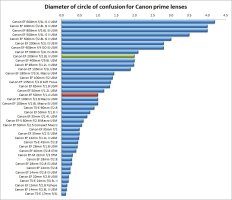
I created a quick excel sheet with the common canon prime lenses and calculated the numbers - as you can see I normalized the result to the 50mm f1.4 (this means the 50mm 1.4 delivers a coc radius of 1) since this is a very well known lens.
It seems that if you want really strong background blur you need to go with one of the big whites. I also marked the 200mm f2.8 II which is the black lens with maximum coc diameter (the 70-200 f2.8 II @200 would be the same).
Please note that these numbers are only valid at
subject distance >> focal length (--> "normal" distance - opposed to closeup)
so the mentioned macro lenses could deliver a much stronger blur at maximum magnification.
blur disk diameter =~ (focal length * subject magnification)/aperture number
If a constant magnification is used the lenses can be compared in regard to the strength of their background blur.
I created a quick excel sheet with the common canon prime lenses and calculated the numbers - as you can see I normalized the result to the 50mm f1.4 (this means the 50mm 1.4 delivers a coc radius of 1) since this is a very well known lens.
It seems that if you want really strong background blur you need to go with one of the big whites. I also marked the 200mm f2.8 II which is the black lens with maximum coc diameter (the 70-200 f2.8 II @200 would be the same).
Please note that these numbers are only valid at
subject distance >> focal length (--> "normal" distance - opposed to closeup)
so the mentioned macro lenses could deliver a much stronger blur at maximum magnification.


 .
.


