
What lens delivers the strongest background blur?

Status
Not open for further replies.
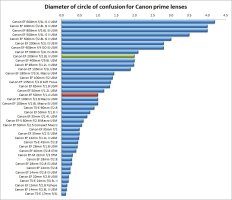
That is a question I recently asked myself. After some research on Wikipedia I found an easy formula which one can use to calculate the diameter of the circle of confusion at a given magnification:

blur disk diameter =~ (focal length * subject magnification)/aperture number

If a constant magnification is used the lenses can be compared in regard to the strength of their background blur.
I created a quick excel sheet with the common canon prime lenses and calculated the numbers - as you can see I normalized the result to the 50mm f1.4 (this means the 50mm 1.4 delivers a coc radius of 1) since this is a very well known lens.

It seems that if you want really strong background blur you need to go with one of the big whites. I also marked the 200mm f2.8 II which is the black lens with maximum coc diameter (the 70-200 f2.8 II @200 would be the same).

Please note that these numbers are only valid at
subject distance >> focal length (--> "normal" distance - opposed to closeup)
so the mentioned macro lenses could deliver a much stronger blur at maximum magnification.
 

Attachments

  • Fig1.jpg
    Fig1.jpg
    176.8 KB · Views: 2,360
J.R. said:
Sporgon said:
Shame the 50 f1.4 is unacceptable at 1.4. :(

??? How did you arrive at this conclusion?


Just from practical experience. I've always found it disappointing in the centre of the frame wide open when compared with other, admitably more expensive lenses. It just doesn't 'sing' until around f2.2.

So with regard to the OP's data, the curve might be more exaggerated if critical quality at max aperture were to bs applied; but of course that's subjective.

I still think the data is interesting: my half joking comment about the 85 f1.2 / 200 f2.8 was half serious !
 
Upvote 0
Note: I signed up to this forum just so that I could reply to this thread, because I need to clarify the technical issues being discussed.

The formula referred to applies only when the background object is located at infinity, and shows that it is proportional to the entrance pupil diameter. For a given fixed magnification, then, the compiled list is merely a list of lenses sorted by decreasing entrance pupil size. Unfortunately, this information frequently fails to capture the most interesting behavior of the background blur of a lens, which is its diameter as a function of the distance away from the subject in focus.

For instance, it is possible to have two lenses, say Lens A and Lens B, such that for a given subject magnification the blur circle for objects "close behind" the subject is larger for Lens A than for Lens B, but the reverse is true for objects at infinity. This occurs because (informally speaking) there are competing factors that contribute to the size of the blur disk. To complicate matters further, the background distance at which this "switch" occurs is itself a function of the subject magnification.

One such example of this phenomenon is an 85/1.2 versus a 300/2.8 lens. When both are shot around 1:10 magnification (which is near MFD for both real-world implementations), the former is predicted to have about 2x the blur circle diameter up to about 1 foot behind the subject, decreasing until the two have equal blur at about 11-12 feet behind the subject, after which the 300/2.8 will dominate. What is happening is that a faster f-number will increase the blur at distances close to the subject, but a longer focal length will increase the blur of very distant objects because of perspective.

To further illustrate, suppose we compare a 50/1.0 against a 200/4 lens. Both lenses have the same entrance pupil diameter at infinity focus (P = 50mm), so at the same subject magnification, a very distant background should have approximately the same amount of blur. But which lens should blur objects closer to the subject more? The answer to this question is one of the reasons why the (out of production) EF 50/1.0L is especially coveted for the way it images--it's not merely for the light-gathering ability of f/1.0. The combination of a relatively short focal length and a very fast aperture can result in images with a distinctive look, because it simultaneously delivers background blur while showing more of the background scene (owing to perspective), compared to a telephoto lens. By no means is this everyone's cup of tea, but there is a technical explanation for this behavior.

Of course, the entire complexity of the lens design itself must be taken into account for a more real-world understanding of its blur characteristics. Aberrations such as Petzval curvature, astigmatism, and spherical aberration, can significantly affect the way the blur looks off-axis. But for most well-corrected designs, the above holds true, especially for paraxial rays.
 
Upvote 0
I think the point about the 50mm 1.4 is fair generally, this calculation tells you about the theoretical, it doesn't tell you for example that although the 28mm f2.8 fares better than the 28mm f2.8 IS on paper, that the 28mm f2.8 IS has more diaphragm blades and so the quality of the blur is likely to be better.

I picked that as one example, as I am genuinely a fan of the original 28mm f2.8 (cheap, sharp wide open, compact)

Other variables are the issues that not all of the lenses are going to be used at the same FL, so for example the 50mm f2.5 which is rated relatively lowly will be used at much closer focus distance. A 600mm lens focused at infinity isn't going to be of much practical use, as at this focal length critical focusing becomes a must, and infinity isn't always infinity, either by lens markings or by through the lens manual focusing.

To use the old adage, it's like comparing an apple with a tractor.

To go back to the point about the aperture shape, will this affect the maths at all? Is the area of the diaphragm pupil exactly the same on a 200mm f2.8 lens with six blades as on one with nine?

It's interesting in a stats way, but I wouldn't pick a lens based on it.
 
Upvote 0
chromophore said:
Note: I signed up to this forum just so that I could reply to this thread, because I need to clarify the technical issues being discussed.

The formula referred to applies only when the background object is located at infinity, and shows that it is proportional to the entrance pupil diameter. For a given fixed magnification, then, the compiled list is merely a list of lenses sorted by decreasing entrance pupil size. Unfortunately, this information frequently fails to capture the most interesting behavior of the background blur of a lens, which is its diameter as a function of the distance away from the subject in focus.

For instance, it is possible to have two lenses, say Lens A and Lens B, such that for a given subject magnification the blur circle for objects "close behind" the subject is larger for Lens A than for Lens B, but the reverse is true for objects at infinity. This occurs because (informally speaking) there are competing factors that contribute to the size of the blur disk. To complicate matters further, the background distance at which this "switch" occurs is itself a function of the subject magnification.

One such example of this phenomenon is an 85/1.2 versus a 300/2.8 lens. When both are shot around 1:10 magnification (which is near MFD for both real-world implementations), the former is predicted to have about 2x the blur circle diameter up to about 1 foot behind the subject, decreasing until the two have equal blur at about 11-12 feet behind the subject, after which the 300/2.8 will dominate. What is happening is that a faster f-number will increase the blur at distances close to the subject, but a longer focal length will increase the blur of very distant objects because of perspective.

To further illustrate, suppose we compare a 50/1.0 against a 200/4 lens. Both lenses have the same entrance pupil diameter at infinity focus (P = 50mm), so at the same subject magnification, a very distant background should have approximately the same amount of blur. But which lens should blur objects closer to the subject more? The answer to this question is one of the reasons why the (out of production) EF 50/1.0L is especially coveted for the way it images--it's not merely for the light-gathering ability of f/1.0. The combination of a relatively short focal length and a very fast aperture can result in images with a distinctive look, because it simultaneously delivers background blur while showing more of the background scene (owing to perspective), compared to a telephoto lens. By no means is this everyone's cup of tea, but there is a technical explanation for this behavior.

Of course, the entire complexity of the lens design itself must be taken into account for a more real-world understanding of its blur characteristics. Aberrations such as Petzval curvature, astigmatism, and spherical aberration, can significantly affect the way the blur looks off-axis. But for most well-corrected designs, the above holds true, especially for paraxial rays.

Well this is exactly the reason why i clearly stated:

Please note that these numbers are only valid at
subject distance >> focal length (--> "normal" distance - opposed to closeup)

These numbers are simply invalid in the case you mentioned where MM is about 1:10 BECAUSE it is near MFD as you mentioned.

Also there is no = in the equation but a =~ which means approximately. The formula would be exactly correct at infinity as you said but it is exact enough for most of the focal range but NOT for the region near MFD. So in my opinion there's nothing really to "clarify" here.
 
Upvote 0
cervantes said:
These numbers are simply invalid in the case you mentioned where MM is about 1:10 BECAUSE it is near MFD as you mentioned.

You would see from the content of my previous post that what is more interesting to many photographers who wish to get more background blur is that such blur is achieved for objects not infinitely far away from the subject in focus, and as a result, a list of entrance pupil diameters is an oversimplification that can mislead people as to which lenses perform in the way they might want.

Also there is no = in the equation but a =~ which means approximately. The formula would be exactly correct at infinity as you said but it is exact enough for most of the focal range but NOT for the region near MFD. So in my opinion there's nothing really to "clarify" here.

That is not correct; you are confusing focus distance with subject-background distance. The model for points at infinity is not a function of focus distance or subject magnification, which are uniquely determined by a fixed magnification. It is a function of the separation between the subject in focus and the background object. This is something that holds true even if the lens is not focused near MFD, and conversely, your approximation is GOOD if you focused at MFD but the background is at infinity.

And in my opinion, my use of the word "clarify" is intended in the sense of assisting others with their understanding of the phenomenon of background blur. If you don't want to acknowledge that, that's fine by me--I will let others decide for themselves whether what I have written is meaningful or useful for them.
 
Upvote 0
paul13walnut5 said:
I think the point about the 50mm 1.4 is fair generally, this calculation tells you about the theoretical, it doesn't tell you for example that although the 28mm f2.8 fares better than the 28mm f2.8 IS on paper, that the 28mm f2.8 IS has more diaphragm blades and so the quality of the blur is likely to be better.

I wasn't talking about the quality of the blur, but its strength.

paul13walnut5 said:
Other variables are the issues that not all of the lenses are going to be used at the same FL, so for example the 50mm f2.5 which is rated relatively lowly will be used at much closer focus distance. A 600mm lens focused at infinity isn't going to be of much practical use, as at this focal length critical focusing becomes a must, and infinity isn't always infinity, either by lens markings or by through the lens manual focusing.

This is already considered by using the same magnification for all the lenses which means the focus distance for a 50mm will be much closer than that of a 600mm lens to retain the same magnification (exactly as you would use them in the field).

paul13walnut5 said:
To use the old adage, it's like comparing an apple with a tractor.

Actually I was comparing Canon prime lenses to Canon prime lenses.

paul13walnut5 said:
To go back to the point about the aperture shape, will this affect the maths at all? Is the area of the diaphragm pupil exactly the same on a 200mm f2.8 lens with six blades as on one with nine?

Maximum blur is always achieved wide open - so in general there are no aperture blades.

paul13walnut5 said:
It's interesting in a stats way, but I wouldn't pick a lens based on it.

+1
 
Upvote 0
chromophore said:
One such example of this phenomenon is an 85/1.2 versus a 300/2.8 lens. When both are shot around 1:10 magnification (which is near MFD for both real-world implementations), the former is predicted to have about 2x the blur circle diameter up to about 1 foot behind the subject, decreasing until the two have equal blur at about 11-12 feet behind the subject, after which the 300/2.8 will dominate. What is happening is that a faster f-number will increase the blur at distances close to the subject, but a longer focal length will increase the blur of very distant objects because of perspective.

You are exactly right, this is the level of understanding regards to DoF and background blur that most of the newcomers find hard to grasp.

Larger entrance pupil gives shallower DoF, while longer focal length (tighter angle of view) gives more distance background blur.

It is those two factors together, along with subject/background distance relationship determine the lens's ability to "blur the background"

When you are comparing a fast wide angle with a slow telephoto, it becomes complicated since you can't flat out say which one is better at blurring background, it depends on how far the background is to say which one is better!
 
Upvote 0
BozillaNZ said:
It is those two factors together, along with subject/background distance relationship determine the lens's ability to "blur the background"

When you are comparing a fast wide angle with a slow telephoto, it becomes complicated since you can't flat out say which one is better at blurring background, it depends on how far the background is to say which one is better!

Correct.

While the plotted data are useful, our backgrounds are not often infinitely far away (or far enough to be treated as such).

For anyone who's interested, Bob Atkins wrote a calculator for background blur that accounts for lens properties (as in the plot above) as well as subject distance and foreground/background distances.

http://www.bobatkins.com/photography/technical/bokeh_background_blur.html
 
Upvote 0
cervantes said:
ecka said:
Just let me guess...
200/1.8? :)

200mm f/1.8 would score a value of 3.1 which means 5th place ( behind 500 f4 but better than 300 f2.8 ).

Good luck with that. The error of this comparison is in the "given magnification".
In reality, for background blur, I'd pick 35/1.4 over 500/4 any day of the week :)

P.S. You forgot 1200/5.6 ;).
 
Upvote 0
chromophore said:
cervantes said:
These numbers are simply invalid in the case you mentioned where MM is about 1:10 BECAUSE it is near MFD as you mentioned.

You would see from the content of my previous post that what is more interesting to many photographers who wish to get more background blur is that such blur is achieved for objects not infinitely far away from the subject in focus, and as a result, a list of entrance pupil diameters is an oversimplification that can mislead people as to which lenses perform in the way they might want.

Also there is no = in the equation but a =~ which means approximately. The formula would be exactly correct at infinity as you said but it is exact enough for most of the focal range but NOT for the region near MFD. So in my opinion there's nothing really to "clarify" here.

That is not correct; you are confusing focus distance with subject-background distance. The model for points at infinity is not a function of focus distance or subject magnification, which are uniquely determined by a fixed magnification. It is a function of the separation between the subject in focus and the background object. This is something that holds true even if the lens is not focused near MFD, and conversely, your approximation is GOOD if you focused at MFD but the background is at infinity.

And in my opinion, my use of the word "clarify" is intended in the sense of assisting others with their understanding of the phenomenon of background blur. If you don't want to acknowledge that, that's fine by me--I will let others decide for themselves whether what I have written is meaningful or useful for them.

Yes, I concur, an important aspect is how much another (background) object is blurred with respect to the object in focus.
The "holding tank" has a number of graphs that show how the circle of confusion changes in diameter (degree of out of focus blur) behind and in front of the plane of focus for different focal lengths:
http://www.zen20934.zen.co.uk/photography/dof/dof.htm

For people who don't want to be bothered with formulas, here is a simulator, that can simulate the DOF with objects at different distances (I did not check if the results are actually accurate):
http://kingfisher.in.coocan.jp/boke2/bokekeisan2e.html
 
Upvote 0
I'd like to share a photo shot by a pal on another forum:

He used 200mm f2 to do this shot: tell me if any shorter lens can ever achieve this effect:

hint: subject distance: 17.6m

8084227393_12067f877c_c.jpg


35 1.4? pfff, not even close

Contrary to popular belief, in order to get most background blur (isolation), you shoot head/shoulder with wide angle (35), half body with medium (50/85) and full body with telephoto (>200), not the other way around.

Wide for full body, tele for close up just gives you flat and boring snap shots.
 
Upvote 0
Status
Not open for further replies.