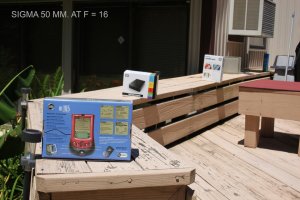
What lens delivers the strongest background blur?

Status
Not open for further replies.
cervantes said:
I wasn't talking about the quality of the blur, but its strength.

Yup. I did get that. Just making the point that it isn't the whole picture. Wide open bokeh from some lenses is just horrible.

cervantes said:
This is already considered by using the same magnification for all the lenses which means the focus distance for a 50mm will be much closer than that of a 600mm lens to retain the same magnification (exactly as you would use them in the field).

But the point of a lens like the 50mm is that it can do much greater magnification, up to 1:2, and so that messes with the perspective and blur even further. I'm making the general point that the tools you have compared are so different that this one criteria is no way to pick a lens. I'm not saying it's a worthless comparison, just that there are about a dozen other parameters to consider before I would get to this point. You wouldn't use a 50mm macro for distant wildlife in the same way as you wouldn't automatically use a 600mm for portraiture.

cervantes said:
paul13walnut5 said:
To use the old adage, it's like comparing an apple with a tractor.

Actually I was comparing Canon prime lenses to Canon prime lenses.

Ok a tractor to a lamborghini then. Other than for this theoretical test (done using maths rather than with any consideration of hands on, actual experience of individual lenses) these lenses are designed for tasks so far apart that you might as well be comparing an apple with a tractor. Your theory is seriously skewed and weighted as you cannot possibly be using something like a 50mm macro in the way that it was designed to perform best and is the way most folk will use it.


cervantes said:
paul13walnut5 said:
To go back to the point about the aperture shape, will this affect the maths at all? Is the area of the diaphragm pupil exactly the same on a 200mm f2.8 lens with six blades as on one with nine?

Maximum blur is always achieved wide open - so in general there are no aperture blades.

In general. Might want to check some of your zooms. For example my 17-40 used to shift aperture slightly as you zoomed, as did my ancient 28-70 f3.5-5.6 II. Again, how useful is this test in real life when with most of these lenses folk will probably shoot with the iris closed a stop or two. For example I own the 100 f2.0. Great fast lens. Hopeless wide open because of chromatic abberations that are gone by f2.8. So blur reduced and an iris shape introduced when the lens is set to be practically used.

paul13walnut5 said:
It's interesting in a stats way, but I wouldn't pick a lens based on it.

+1
[/quote]

Glad we agree on that at least.
 
Upvote 0
BozillaNZ said:
I'd like to share a photo shot by a pal on another forum:

He used 200mm f2 to do this shot: tell me if any shorter lens can ever achieve this effect:

hint: subject distance: 17.6m

8084227393_12067f877c_c.jpg


35 1.4? pfff, not even close

Well, my vote is for 200/1.8 (first page). What I meant with 35/1.4 is that 500/4 is very impractical for what we are discussing here.

Contrary to popular belief, in order to get most background blur (isolation), you shoot head/shoulder with wide angle (35), half body with medium (50/85) and full body with telephoto (>200), not the other way around.

Wide for full body, tele for close up just gives you flat and boring snap shots.

Yes, I agree :).
 
Upvote 0
BozillaNZ said:
I'd like to share a photo shot by a pal on another forum:

He used 200mm f2 to do this shot: tell me if any shorter lens can ever achieve this effect:

hint: subject distance: 17.6m

8084227393_12067f877c_c.jpg


35 1.4? pfff, not even close

Contrary to popular belief, in order to get most background blur (isolation), you shoot head/shoulder with wide angle (35), half body with medium (50/85) and full body with telephoto (>200), not the other way around.

Wide for full body, tele for close up just gives you flat and boring snap shots.

The OP asked a very general question. With your very nice posted image, taken with a 200mm lens, another focal length prime will not create an identical image. The background blur can be less or more depending on the working distance, focal length, aperture and subject distance from the background. If you hinge on a 200mm then the only way to create a simular isolation is to go closer with a wider lens or further back with a longer lens. If one goes wider, then a larger aperture will be needed to create a clean background.
A 35mm f1.4 and 85mm f1.2 are both perfectly capable of doing this, although the 35mm is better suited to "head and shoulders" portraits and not "head and toes" portraits. The wider lens will be a lot closer and cause a different look to the 200mm image. There will be a different look from the amount of compression difference between the 200mm and 35mm, but that's an entirely different subject.

I regularly use a 35mm f1.4 and 85mm f1.2 for my professional wedding work and it's very very easy to melt the background, but tricky to get a precise point of focus. That said, my 24-70L is very good at melting backgrounds too. At 70mm @ f2.8 it's min focus distance is very close and more than capable of making clean backgrounds.
 
Upvote 0
BozillaNZ said:
I'd like to share a photo shot by a pal on another forum:

He used 200mm f2 to do this shot: tell me if any shorter lens can ever achieve this effect:

hint: subject distance: 17.6m

8084227393_12067f877c_c.jpg


35 1.4? pfff, not even close

Contrary to popular belief, in order to get most background blur (isolation), you shoot head/shoulder with wide angle (35), half body with medium (50/85) and full body with telephoto (>200), not the other way around.

Wide for full body, tele for close up just gives you flat and boring snap shots.

One other thing to bear in mind when shooting head 'n shoulder portraits with 35mm is to keep out of slapping distance when you show the model the pictures.

With regard to the wonderful 200 f2, its ability of the focus point to be pin sharp at f2 adds to the differential between in and out of focus, and this exaggerates the effect. The 50 f1.4 on the other hand is very soft, and this spoils the differential between in and out of focus.
 
Upvote 0
GMCPhotographics said:
The OP asked a very general question. With your very nice posted image, taken with a 200mm lens, another focal length prime will not create an identical image. The background blur can be less or more depending on the working distance, focal length, aperture and subject distance from the background. If you hinge on a 200mm then the only way to create a simular isolation is to go closer with a wider lens or further back with a longer lens. If one goes wider, then a larger aperture will be needed to create a clean background.
A 35mm f1.4 and 85mm f1.2 are both perfectly capable of doing this, although the 35mm is better suited to "head and shoulders" portraits and not "head and toes" portraits. The wider lens will be a lot closer and cause a different look to the 200mm image. There will be a different look from the amount of compression difference between the 200mm and 35mm, but that's an entirely different subject.

I regularly use a 35mm f1.4 and 85mm f1.2 for my professional wedding work and it's very very easy to melt the background, but tricky to get a precise point of focus. That said, my 24-70L is very good at melting backgrounds too. At 70mm @ f2.8 it's min focus distance is very close and more than capable of making clean backgrounds.

That's some nice input. However if you try to take full body portrait using 35 1.4, it cannot achieve the same amount of background blur as a 200mm lens, because background compression plays a big factor on achieving this effect.

I don't deny the ability for 35 1.4 to achieve background blur, but it won't do much at this size of a subject. What I'm trying to get to is wide angle is good at blurring background when shooting small things close up, while telephone is good at blurring background when shooting big things (relatively) far away. So the chart in topic doesn't really tell you the whole picture.
 
Upvote 0
Sporgon said:
J.R. said:
Sporgon said:
Shame the 50 f1.4 is unacceptable at 1.4. :(

??? How did you arrive at this conclusion?


Just from practical experience. I've always found it disappointing in the centre of the frame wide open when compared with other, admitably more expensive lenses. It just doesn't 'sing' until around f2.2.

So with regard to the OP's data, the curve might be more exaggerated if critical quality at max aperture were to bs applied; but of course that's subjective.

I still think the data is interesting: my half joking comment about the 85 f1.2 / 200 f2.8 was half serious !

OK. I couldn't understand your comment in context of information in the original post. :)
 
Upvote 0
Well, Dear Friends
I love the Background Blur of my Canon FE 85 mm. F/ 1.2 L MK II = The First one, The Second Choice = Sigma 50 mm. F/ 1.4, And The Third one = Canon EF 20-200 F/ 2.8 L IS USM at 200mm at F= 2.8.
Just my 2 Cents Opinion.
Surapon
PS. All these Photos at. F= 1.2 by Canon 85 mm. F/ 1.2 L MK II
 

Attachments

  • 081X0032.JPG
    081X0032.JPG
    174 KB · Views: 667
  • 081X0035-2.jpg
    081X0035-2.jpg
    143.8 KB · Views: 640
  • SP4.jpg
    SP4.jpg
    106.5 KB · Views: 630
Upvote 0
chromophore said:
Note: I signed up to this forum just so that I could reply to this thread, because I need to clarify the technical issues being discussed.

The formula referred to applies only when the background object is located at infinity, and shows that it is proportional to the entrance pupil diameter. For a given fixed magnification, then, the compiled list is merely a list of lenses sorted by decreasing entrance pupil size. Unfortunately, this information frequently fails to capture the most interesting behavior of the background blur of a lens, which is its diameter as a function of the distance away from the subject in focus.

For instance, it is possible to have two lenses, say Lens A and Lens B, such that for a given subject magnification the blur circle for objects "close behind" the subject is larger for Lens A than for Lens B, but the reverse is true for objects at infinity. This occurs because (informally speaking) there are competing factors that contribute to the size of the blur disk. To complicate matters further, the background distance at which this "switch" occurs is itself a function of the subject magnification.

One such example of this phenomenon is an 85/1.2 versus a 300/2.8 lens. When both are shot around 1:10 magnification (which is near MFD for both real-world implementations), the former is predicted to have about 2x the blur circle diameter up to about 1 foot behind the subject, decreasing until the two have equal blur at about 11-12 feet behind the subject, after which the 300/2.8 will dominate. What is happening is that a faster f-number will increase the blur at distances close to the subject, but a longer focal length will increase the blur of very distant objects because of perspective.

To further illustrate, suppose we compare a 50/1.0 against a 200/4 lens. Both lenses have the same entrance pupil diameter at infinity focus (P = 50mm), so at the same subject magnification, a very distant background should have approximately the same amount of blur. But which lens should blur objects closer to the subject more? The answer to this question is one of the reasons why the (out of production) EF 50/1.0L is especially coveted for the way it images--it's not merely for the light-gathering ability of f/1.0. The combination of a relatively short focal length and a very fast aperture can result in images with a distinctive look, because it simultaneously delivers background blur while showing more of the background scene (owing to perspective), compared to a telephoto lens. By no means is this everyone's cup of tea, but there is a technical explanation for this behavior.

Of course, the entire complexity of the lens design itself must be taken into account for a more real-world understanding of its blur characteristics. Aberrations such as Petzval curvature, astigmatism, and spherical aberration, can significantly affect the way the blur looks off-axis. But for most well-corrected designs, the above holds true, especially for paraxial rays.

+1

This is a very clear and necessary addition to the conversation.
 
Upvote 0
I have enjoyed reading this discussion ...and learned a lot...thanks


.......Ok [comparing] a tractor to a lamborghini then.


lamborghini makes a very nice 4WD tractor

just sayin'

////////////////
those long lenses are nice..... that 200mm f2 shot was especially lovely...


but
I think there is a lot to be said for a moderate wide angle (35mm) FAST(f1.4) lens that can include
a prime subject ....close up... and yet blur out - but leave recognizable - a nearby secondary background subject

choose your fav brand.....

I like that compositional effect

this needs - I think a close focus ability and a secondary subject not-too-far-away
I think some of the discussion covered this issue


TOM


sigma 35mm @ f1.4
 

Attachments

  • 35mm - two.jpg
    35mm - two.jpg
    231.1 KB · Views: 817
Upvote 0
TommyLee said:
I have enjoyed reading this discussion ...and learned a lot...thanks


.......Ok [comparing] a tractor to a lamborghini then.


lamborghini makes a very nice 4WD tractor

just sayin'

////////////////
those long lenses are nice..... that 200mm f2 shot was especially lovely...


but
I think there is a lot to be said for a moderate wide angle (35mm) FAST(f1.4) lens that can include
a prime subject ....close up... and yet blur out - but leave recognizable - a nearby secondary background subject

choose your fav brand.....

I like that compositional effect

this needs - I think a close focus ability and a secondary subject not-too-far-away
I think some of the discussion covered this issue


TOM


sigma 35mm @ f1.4

Wait till you try the 24mm @ f1.4, get closer with stronger perspective distortion, yet still provides tons of blur. That is why 24 1.4 is special, it offers this effect at widest angle of view in 135 system. :P
 
Upvote 0
BozillaNZ said:
Wait till you try the 24mm @ f1.4, get closer with stronger perspective distortion, yet still provides tons of blur. That is why 24 1.4 is special, it offers this effect at widest angle of view in 135 system. :P

yes...it is a fun lens for sure....
I also like flower shots on it.... and when I first got it I went off in that direction for while...

this is my 24 L mk I .... mine is a sharp copy...but the mk II is sharper and less CA/fringing...
I didn't upgrade my 24L because I didnt use it enough...and the improvements not enough to justify the $$....but mk II is pretty nice

a 24 1.4 (wideopen) in a club or cafe or the street... in the evening... is very fun.

I find the 35 sigma giving canon a run for the money...
I would like to see them beat sigma with their 35L II...
 

Attachments

  • 5D3_3673s.jpg
    5D3_3673s.jpg
    283.2 KB · Views: 518
  • 24mm at  f1.4 from 12 inches - crop.jpg
    24mm at f1.4 from 12 inches - crop.jpg
    328.7 KB · Views: 532
Upvote 0
Status
Not open for further replies.