P
paul13walnut5
Guest
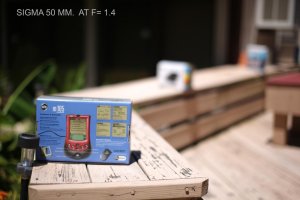
cervantes said:I wasn't talking about the quality of the blur, but its strength.
Yup. I did get that. Just making the point that it isn't the whole picture. Wide open bokeh from some lenses is just horrible.
cervantes said:This is already considered by using the same magnification for all the lenses which means the focus distance for a 50mm will be much closer than that of a 600mm lens to retain the same magnification (exactly as you would use them in the field).
But the point of a lens like the 50mm is that it can do much greater magnification, up to 1:2, and so that messes with the perspective and blur even further. I'm making the general point that the tools you have compared are so different that this one criteria is no way to pick a lens. I'm not saying it's a worthless comparison, just that there are about a dozen other parameters to consider before I would get to this point. You wouldn't use a 50mm macro for distant wildlife in the same way as you wouldn't automatically use a 600mm for portraiture.
cervantes said:paul13walnut5 said:To use the old adage, it's like comparing an apple with a tractor.
Actually I was comparing Canon prime lenses to Canon prime lenses.
Ok a tractor to a lamborghini then. Other than for this theoretical test (done using maths rather than with any consideration of hands on, actual experience of individual lenses) these lenses are designed for tasks so far apart that you might as well be comparing an apple with a tractor. Your theory is seriously skewed and weighted as you cannot possibly be using something like a 50mm macro in the way that it was designed to perform best and is the way most folk will use it.
cervantes said:paul13walnut5 said:To go back to the point about the aperture shape, will this affect the maths at all? Is the area of the diaphragm pupil exactly the same on a 200mm f2.8 lens with six blades as on one with nine?
Maximum blur is always achieved wide open - so in general there are no aperture blades.
In general. Might want to check some of your zooms. For example my 17-40 used to shift aperture slightly as you zoomed, as did my ancient 28-70 f3.5-5.6 II. Again, how useful is this test in real life when with most of these lenses folk will probably shoot with the iris closed a stop or two. For example I own the 100 f2.0. Great fast lens. Hopeless wide open because of chromatic abberations that are gone by f2.8. So blur reduced and an iris shape introduced when the lens is set to be practically used.
paul13walnut5 said:It's interesting in a stats way, but I wouldn't pick a lens based on it.
+1
[/quote]
Glad we agree on that at least.
Upvote
0


 .
.