Why run after cameras with high Noise/ISO performances?

When you see the power of IA noise reduction systems like the ON1 Denoise, you wonder why we're looking for cameras with high NOISE/ ISO performances

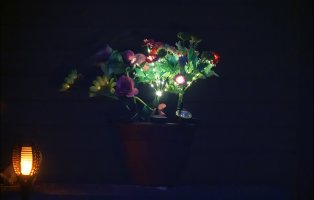
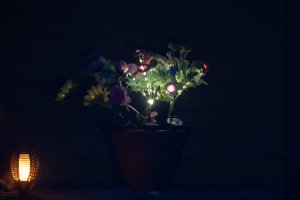
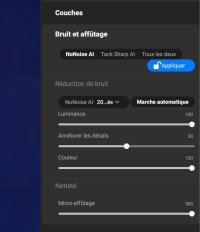
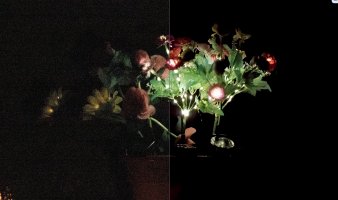
Here's an example of a picture take with my R3 at 25.600 iso .. it's very noised but ON1 Denoise made miracles

Maybe I should have bought an R5 with its 45 megapixels?

Capture d’écran 2025-05-26 à 17.04.34.jpg
 
Last edited:
  • Like
Reactions: 1 user
For me the limit of my R5 denoised with DXO Deep Prime (and the XD variants) is ISO 12800. Maybe people more competent push it even more.
So it is expected that R3 will be just fine at ISO 25600 with the proper denoise program. But as I mentioned I would not use R5 at the same ISO.
YMMV.
 
Upvote 0
If retention of detail along with complete banishment of grain is a goal, there is NO question DXO Photolab 8 or the stand alone they make for just noise reduction is without question the finest there is out there currently. Don't get me wrong, I love ON1 for some things. But higher ISO noise reduction in my experience thus far has NOT been it's particular strength in the above ISO6400 range. I've shot with a Sony A6700 cropped sensor camera at 51000 ISO and run it through DXO and the resulting image not only had great detail, NO noise whatsoever but also the color were dead on accurate. One of the things you don't see happen too often with very high ISO NR. I've done a number of test shots with the R5MkII so far at ISO12,800 and no one would dare say it wasn't shot at ISO200. NO loss of detail and great color rendition. So higher ISO's don't scare me in the least. Although my typical ISO's are between 100-6400ISO.
 
Upvote 0
So far, I've only compared the following noise reducers on the same picture at ISO 25600:
- ON1-IA (latest version)
- TopazDenoise-IA (latest version)
- ImageNomic

The best result, although they are all very close, is the ON1
The fastest is the ImageNomic
For non-professionals, you should also consider the price.

I'm currently downloading the trial version of DXO-PureRaw-V5, which is expensive, and I'll compare the results on the same photo as the other tests

this night i will take a picture at 102400 iso and try to denoise it with ON1 and DXO
 
Upvote 0
I come back after tested DXO-PureRaw-V5 on the same picture that i tested with the last ON1 NONOISE AI 2024.5
Sincerely the result with ON1 seem better

Here's the 2 results :
With ON1
With DXO

Remark I passed by phosotshop before to pass at ON1 in plug-in mode ... the contrast and color is perhaps different for this reason


ON1.jpgDXO.jpg
 
Last edited:
Upvote 0
Who thinks Lightroom produces more artificial-looking noise reduction?
It depends on the subject, it does reasonably well with family snapshots, but high detail wildlife shots tend to come out mushy. Of the 3 options I use , DxO, LR and Topaz, Topaz likes to turn everything into a wax sculpture the most. It has tons of sliders and checkboxes to stop it from doing that, but in my experience it takes per-image adjustments to make it look 'good'. DxO might deliver results that aren't as good, but it has less variance per picture. So I can batch process in DxO and have the resulting pictures look good or I can one-by-one run them through Topaz.

I've been using LR NR a lot these days (the R50V isn't supported by DxO) and it isn't as bad as I remember, but comparing it to R8+DxO pictures, it does like a bit more artificial if you go beyond '50'. Not cartoonish like Topaz' defaults, though. A well tuned Topaz and DxO can give you a clean picture where it isn't immediately obvious that NR was used, LR has a more 'classical' NR look, if you know what to look for.
 
Upvote 0
It depends on the subject, it does reasonably well with family snapshots, but high detail wildlife shots tend to come out mushy. Of the 3 options I use , DxO, LR and Topaz, Topaz likes to turn everything into a wax sculpture the most. It has tons of sliders and checkboxes to stop it from doing that, but in my experience it takes per-image adjustments to make it look 'good'. DxO might deliver results that aren't as good, but it has less variance per picture. So I can batch process in DxO and have the resulting pictures look good or I can one-by-one run them through Topaz.

I've been using LR NR a lot these days (the R50V isn't supported by DxO) and it isn't as bad as I remember, but comparing it to R8+DxO pictures, it does like a bit more artificial if you go beyond '50'. Not cartoonish like Topaz' defaults, though. A well tuned Topaz and DxO can give you a clean picture where it isn't immediately obvious that NR was used, LR has a more 'classical' NR look, if you know what to look for.
Try the ON1 NONOISE AI 2024.5 .. it's free for 30 days
 
Upvote 0
Maybe I should have bought an R5 with its 45 megapixels?
The noise reduction is impressive. As for this specific inquiry, I mean, maybe. I own the R5 and R1. R5 is a great camera. I will say I believe the R1 handles high ISO better. But with software improving all the time, that could change.

My point being if high ISO noise performance is your only criteria then I think the R3, at this time, was still a good choice. The R5 or R5II may not have been bad choices, but I'd still rank the R1 and R3 above the two in high noise performance. Some might argue.

I've provided this link before, but I'll do it again.


Ron, IMO, does a good job comparing images. It has been noted he did a lot of work in software. But he also concludes, these are all good cameras. R5, R3, R5 II, R1....all of them are very good cameras.

If you have one of these cameras, you are doing well. One being "better" than the other really depends on your preferences.
 
Upvote 0
Try the ON1 NONOISE AI 2024.5 .. it's free for 30 days
I've given that a spin. It doesn't seem to support the R5II (pink!), but it does support the R50V. Results are better than LR, but I find it smooths the skin a bit too much. Comparing shots from my R8, its noise reduction seems on-par with DxO, but DxO has better sharpening. I can't find a setting in ON1 where I can get an improvement in sharpness than doesn't scream OVERSHARPENED. DxO really wants to oversharpen things as well, but it has a sweet spot in the very low end of the settings where it looks natural enough.

I wish the marketing examples wouldn't look like they were done by someone that just discovered unsharp mask and clarity sliders :(
 
Upvote 0
I've given that a spin. It doesn't seem to support the R5II (pink!), but it does support the R50V. Results are better than LR, but I find it smooths the skin a bit too much. Comparing shots from my R8, its noise reduction seems on-par with DxO, but DxO has better sharpening. I can't find a setting in ON1 where I can get an improvement in sharpness than doesn't scream OVERSHARPENED. DxO really wants to oversharpen things as well, but it has a sweet spot in the very low end of the settings where it looks natural enough.

I wish the marketing examples wouldn't look like they were done by someone that just discovered unsharp mask and clarity sliders :(
The noise reduction is impressive. As for this specific inquiry, I mean, maybe. I own the R5 and R1. R5 is a great camera. I will say I believe the R1 handles high ISO better. But with software improving all the time, that could change.

My point being if high ISO noise performance is your only criteria then I think the R3, at this time, was still a good choice. The R5 or R5II may not have been bad choices, but I'd still rank the R1 and R3 above the two in high noise performance. Some might argue.

I've provided this link before, but I'll do it again.


Ron, IMO, does a good job comparing images. It has been noted he did a lot of work in software. But he also concludes, these are all good cameras. R5, R3, R5 II, R1....all of them are very good cameras.

If you have one of these cameras, you are doing well. One being "better" than the other really depends on your preferences.
Let's forget about noise for a moment and talk about resolution.
With the same lens, there's no comparison between a crop taken with an R5 and one taken with an R3... while artifacts appear in the R3 crop, they won't on the R5.

You'll need to upgrade to a focal length extender on the R3 lens to achieve the same cropping level as the R5
 
Upvote 0
I've given that a spin. It doesn't seem to support the R5II (pink!), but it does support the R50V. Results are better than LR, but I find it smooths the skin a bit too much. Comparing shots from my R8, its noise reduction seems on-par with DxO, but DxO has better sharpening. I can't find a setting in ON1 where I can get an improvement in sharpness than doesn't scream OVERSHARPENED. DxO really wants to oversharpen things as well, but it has a sweet spot in the very low end of the settings where it looks natural enough.

I wish the marketing examples wouldn't look like they were done by someone that just discovered unsharp mask and clarity sliders :(
 
Upvote 0
If retention of detail along with complete banishment of grain is a goal, there is NO question DXO Photolab 8 or the stand alone they make for just noise reduction is without question the finest there is out there currently. Don't get me wrong, I love ON1 for some things. But higher ISO noise reduction in my experience thus far has NOT been it's particular strength in the above ISO6400 range. I've shot with a Sony A6700 cropped sensor camera at 51000 ISO and run it through DXO and the resulting image not only had great detail, NO noise whatsoever but also the color were dead on accurate. One of the things you don't see happen too often with very high ISO NR. I've done a number of test shots with the R5MkII so far at ISO12,800 and no one would dare say it wasn't shot at ISO200. NO loss of detail and great color rendition. So higher ISO's don't scare me in the least. Although my typical ISO's are between 100-6400ISO.
I agree with what you say about DxO. But, here are a few facts. The dynamic range of the R5ii, for example, is 10.46 at iao 200 and only 5.15 at iso 12,800. You have lost over 5 stops of DR, and no amount of perfect noise reduction will get them back. You also do lose detail, and you will see it when you have an image that has very fine detail. So, if you are shooting a fighter jet flying overhead, the detail is very coarse and the image has little DR requirement and so iso 12,800 may be virtually indistinguishable from iso 200. However, if you are shooting a bird that has fine feather detail you can lose it. Or, if your image needs lots of DR, you will lose that at iso 12,800. I've gone up to iso 20-32k on occasion!.
 
  • Like
Reactions: 7 users
Upvote 0
Let's forget about noise for a moment and talk about resolution.
With the same lens, there's no comparison between a crop taken with an R5 and one taken with an R3... while artifacts appear in the R3 crop, they won't on the R5.

You'll need to upgrade to a focal length extender on the R3 lens to achieve the same cropping level as the R5
Based on? And before you answer, please watch the video I linked. "No comparison?" You have been provided a comparison
 
Upvote 0
I agree with what you say about DxO. But, here are a few facts. The dynamic range of the R5ii, for example, is 10.46 at iao 200 and only 5.15 at iso 12,800. You have lost over 5 stops of DR, and no amount of perfect noise reduction will get them back. You also do lose detail, and you will see it when you have an image that has very fine detail. So, if you are shooting a fighter jet flying overhead, the detail is very coarse and the image has little DR requirement and so iso 12,800 may be virtually indistinguishable from iso 200. However, if you are shooting a bird that has fine feather detail you can lose it. Or, if your image needs lots of DR, you will lose that at iso 12,800. I've gone up to iso 20-32k on occasion!.
^^^This

So many of the high ISO "tests" I see are where the scene has minimal DR, such as a poorly lit nightclub.
 
Upvote 0
Nothing makes me feel out of touch like these discussions! I'm pretty satisfied with editing the OOC jpegs on my phone. I know I can't get the best out of fine detail low light situations but most of the time the output is fine. I respect everyone here pushing the limits but it all sounds so involved (and expensive!).
 
  • Like
Reactions: 1 user
Upvote 0
It is not my intention to offend anyone here, BUT that said I've been at this for over 25 years when digital began. Had many a top line camera along the way. I've used every bit of competent software you can name as well. At one point some years ago indeed Adobe ruled the roost. That day has come and gone. As far as top tier RAW processing software is concerned having used them all extensively I don't hesitate to say that if one becomes familiar with proper application of DXO (and I do mean proper application because it's easy to not maximize it's capacity) it will deliver the most accurate profiles for demosaicing, noise reduction, retaining original resolution and color accuracy. You folks can post all the examples you want. In the end as I said, IF one does it right the results should without a doubt render what I'm saying. This is after all the internet and I can't account for all the possible moves outside of what is needed to make it happen right.
 
  • Like
Reactions: 1 users
Upvote 0
Nothing makes me feel out of touch like these discussions! I'm pretty satisfied with editing the OOC jpegs on my phone. I know I can't get the best out of fine detail low light situations but most of the time the output is fine. I respect everyone here pushing the limits but it all sounds so involved (and expensive!).
It's not bad in my opinion, it's similar to the difference between choosing a company to develop film or doing it yourself.
 
Upvote 0