100 said:
jrista said:
High ISO...I'd call that ISO 800 or above. ISO 100, 200, and 400 I consider low ISO, although ISO 400 is kind of in the middle there, and others might have a different opinion.
I don't have a specific study. It's a simple observation, however on that I have been making over the last four years or so. (FYI, I've moderated photo.stackexchange.com since 2010, and have encountered and chatted with quite a number of photographers over the last four years from a wide range of photographic endeavors.) How many white Canon lenses do you see at pretty much every sporting event around the globe? Hundreds to thousands at each and every event. Canon dominates sports, hands down, no question. They really dominate action, not just sports. I spend a lot of time out in nature, and meet a fair number of nature photographers. The very vast majority of the people I've met out in the wilderness, including both wildlife and bird photographers as well as landscape photographers, overwhelmingly have Canon equipment. Canon 1D IV, Canon 5D III, and Canon 1D X are becoming almost ubiquitous in the wildlife and bird world. Canon great white lenses, 300s, 500s, and 600s, are extremely common (particularly the 500 Mark Is...lot of wildlifers and birders use that lens, guess it's at a sweet spot of weight and cost). I've met a few who have Nikon equipment, two of whom use D800's for bird photography. I know of one (now a good friend) who uses Pentax and Nikon. I also know and have encountered/chatted with a decent number of wedding & portrait photographers. Most use the Canon 5D II. A few still use the 5DC (they don't seem to care about resolution). Some use the 5D III (and all of the 5D line wedding photographers had one consistent complaint before the 5D III: Sucky AF.) I know of several wedding photographers who use Nikon and other brands (some have gone to mirrorless as of late, with a variety of brands.) I know two wedding and portrait photographers who use Nikon exclusively. One uses a D800 and D3, the other uses a D7000, with a D800 planned for very soon. I would say that Nikon seems to have a growing following in the strait portraiture arena...not so much for DR, but for the sheer amount of detail the D800 or D600 bring to the table...seems that ridiculous, razor-sharp detail that brings out every single pore is really "in" right now, and there is no question that the D800 offers that in spades.
So, sorry, I don't have an official study for you, but it really isn't a difficult observation to make. Just look around. It's a very well-educated guess. The number of cameras and lenses that you can spot in the world that say "Canon" on them vastly outnumber any other brand. Of those, the biggest group that uses the most cohesive set of camera features are the action shooters. Sports/Olympics, Wildlife, Birds...and you can throw in car racing, air shows (know a few guys who do this, damn good at it too), kayaking, boat racing, pretty much anything you could remotely call a sport, or has moving subjects...the camera is going to be at a higher ISO setting, and is probably a 5D III or a 1D X. The next two biggest groups would be Wedding & Portrait, and Landscapes. Not sure which is bigger...seems pretty evenly split here in Colorado, but if you hit larger metropolitan areas, I would make the educated guess that Wedding and Portrait photographers would end up significantly out-pacing the Landscape photographers (and I mean real landscape photographers...I know more people than I can count who use entry level cameras, Canon, Nikon, Sony, Pentax, everything...and call themselves landscape photographers, but their work wouldn't land on anyones walls (no offense to anyone like this, but)...blown clouds, random people in the frame, lack of interesting composition, effectively point-and-shoot mountain peaks and a few scattered rocks or stubby evergreen trees here and there, never any post processing, thrown up on Imgur, PhotoBucket, or Facebook.)
I honestly don't have all that much knowledge about studio photographers. I can't really say how big a customer segment studio photographers might be for Canon...but I guess big enough for them to create the 1Ds line in the past. What I DO know about studio photography, it seems to lean medium format (or maybe Leica S-system) a lot more than it leans Canon, Nikon or Sony. Phase One also seems to be the brand I hear about most from the studio photogs I do know or have crossed paths with.
If you present something like some sort of statistical fact, you need to prove it. If it’s just an educated guess based on personal observation, it’s not a very strong base to build an argument on because it has no more value than any other personal observation claiming the opposite unless you have some proven authority on the subject. I have no way of knowing how well-educated your guess is. Please point me to your scientific publications in this particular field of research because moderating a website about photography doesn’t make someone a statistical expert. Ask yourself if the people visiting the website you moderate are even close to a cross section of camera users worldwide (that needs to be true if you want to extrapolate).
Alright, fair enough.
100 said:
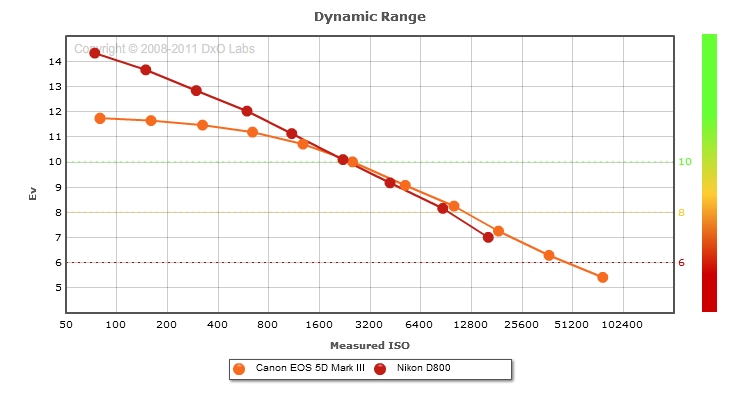
Anyway, if iso 800 and above is high iso, just look at the facts as they are presented by DxO mark. I’m not looking for (yet another) debate about DxO sensor scores. Just look at their measurement.
ISO 800 (high iso by your standard) on the Nikon D800 is as good as ISO 100 on the 5D3 (that’s a 3 stop ISO difference).
At ISO 3200 and above the 5D3 gets me marginally better results.
The reason I think “playing catchup” in the DR department is true for Canon is because they are not purposely crippling the 5D3. It’s not like the autofocus or fps on the 5D2. Canon doesn’t have a senor in production with the low iso DR capabilities of other manufacturers and at some point they need to catchup.
But don’t get me wrong, I’m not arguing the D800 is a better camera or Nikon has better camera systems. I know there is more to photography than dynamic range and sensor resolution. I’m happy with my 5D3 and my Canon TS-E 24mm f/3.5L II is much better than the Nikon 24mm PC-E but as Canon users we probably will be better off if we encourage Canon to catchup in the DR department.
Sure, I don't disagree that Canon lags behind in the low ISO arena. I just don't think having that extra two stops of dynamic range is actually quite as important as may photographers thing. It improves editing latitude, that's all it really does. One way or another, the things we view our photographs on...screen and print...have considerably less dynamic range. Screens average 8 stops, print averages 6-7 stops (or even as little as 5 stops). If anyone has tried to print on a low dMax paper with a natural white L*, they would understand how difficult it can be to compress even 11 stops of dynamic range into less than half that. It is not an easy task, and one has to be careful to avoid posterization and color fidelity issues in the shadows, where the available data (even after you remove noise and recover DR in the case of Canon sensors) is "sparse" compared to the midtones and highlights.
Compressing 13 stops of native dynamic range into 8 stops of screen DR is similar. You can lift the shadows, but beyond a certain point (around 3-4 stops) you run into the same issues...information in those low signal strength areas is sparse...discrete level transitions are often harsh, and ironically, the addition of noise is often the only way to combat posterization. Don't get me wrong, having more DR is useful, but until we have more available dynamic range on screen and in print (both of which I think are coming), being able to push shadows around by 4-6 stops doesn't buy you as much as you might think.
Pushing around exposure with more dynamic range than your screen is like tonemapping a 32-bit HDR image into 16-bit. You have twice the dynamic range (really, more than that, since 32-bit is floating point...so you have MANY times the dynamic range) as your output target. If you have a lot of shadow tones bunched up at the left end of your histogram, and have done much HDR, you would know how difficult it can be to tonemap all that extra dynamic range into the mere few shadow stops you have in a 16-bit scalar image. It's DIFFICULT! The results usually end up having that "HDR Look", where you end up with funky noise issues, posterization, odd tonal gradients, poor color fidelity, and even tonal inversions in the shadows.
I totally agree, though. I am not saying Canon shouldn't continue to push the envelope with their sensors. I just think dynamic range gets FAR more importance put on it by photographers than it really deserves. I think other in-camera factors are more important for most forms of photography, particularly any form of action photography (hence my earlier arguments about my observations of Canon's distribution of customers...honestly, observe a little yourself, and I think you'll come to the same conclusion...sports/action shooters are Canon Photography's bread and butter!

) Autofocus is probably the most important factor for action shooters. After AF, I would say frame rate. If you don't capture the right frame in focus, it really doesn't matter a wit how much dynamic range you have...you either have the wrong frame where that basketball players arm is half out of the frame, or the image is miss-focused. You might have 14 stops of missfocused arm-clipping wonder...but it ain't usable!
Finally...
I do believe Canon will deliver more DR. How and when, and at what cost, I honestly don't know. However having been a Canon customer for almost five years now, I've only grown more fond of them. They make a good product, they put in the effort to ensure their product, whatever it is (even if it is perceptually inferior to the competitions) is solid, reliable, and always backed by the best customer support in the industry (and I speak from experience on a few occasions where I needed to send my lenses in for repair.) Canon, in my opinion, very carefully listened to the most important and broadly held demands of their customers with the designs of both the 1D X and 5D III. I mean, people here on CR and on many other forums like DPR seemed surprised that Canon chose to release the 1D X with "only" 18 megapixels, and were surprised that the 5D III "only" got a 1mp boost. Personally, I felt that Canon delivered exactly what their customers were asking for...as I'd heard, and even called for myself, the following on photo.stackexchange.com (that site I moderate...which actually has a very broad worldwide participation, so I think it is a decent source of information like this):
"I'm so sick and tired of the megapixel wars! I want better pixels, not more pixels!"
"I don't care about pixel count. I just wish Canon would make less noise at high ISO."
"Fewer megapixels! All I need is 10mp. I can print very large with just 10mp. Give me low noise ISO 204,800!! I want to photograph the aurora as I see them with my own eyes."
"The 1D III AF system really needs to be replaced with something much better. Something like Nikon's D3 AF system." (The guy was talking about a denser, reticular AF design, which Nikon actually had first.)
"The 5D II 9pt AF is horrible. I just don't have the points I need to focus where I need. I wish they would make the hidden AF assist points selectable." (That guy got a lot more than he asked for!)
I heard a lot of this kind of stuff from 2010 (and maybe late 2009) through 2012. It was only AFTER the release of the D800 and the 5D III that the things people complained about regarding Canon's equipment changed. Once they actually had fewer megapixels and better high ISO, they stopped complaining about it. Now, they complain about not having more DR (although I know for a fact that many of them are action shooters, and rarely use ISO settings below 800...so more DR wouldn't do them a bit of good. Fewer megapixls, bigger pixels, and less noise at high ISO, however, would do them a LOT of good!
)
Personally, I was one of those hoping the 5D III would get more DR and more megapixels. I wanted a landscape camera. I still do. Ironically, the 5D III will still fill a role as a bird and wildlife photography camera given its feature set, and it is one of the top two things on my list of camera gear to buy this year. So I still find the 5D III to be a great camera. Regardless, I still hope Canon releases a landscape camera with lots of megapixels and lots of DR at some point in the future, because that is the one area of my work where more megapixels and more DR are literally the most useful things (AF and frame rate don't matter for jack when it comes to landscapes...but I also admit that as a landscape photographer, I become part of a much smaller minority of Canon customers, so I don't expect them to release anything with tons of MP and more dynamic range in the price range I want...I suspect the camera will be a 1Ds X at $5000. :\)