Canon EOS R7 Mark II Rumored Specifications Round-up

- EOS Bodies
- 85 Replies
Yes, evidently. The concepts you are fixated on are applicable to pixels, not to pictures. Image noise is inversely proportional to total light gathered. Total light gathered is dependent on the area of the sensor, and independent of pixel size.I definetly don't understand
The R7 and R10 were released at the same time, according to your mistaken belief the 24 MP R10 has larger pixels so it should have lower noise and thus better dynamic range than the 32 MP R7.
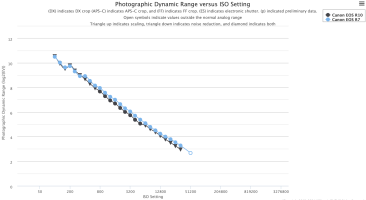
It doesn't. The two sensors are the same size, they gather the same total amount of light, and because of that the image noise is the same.
Yes. Each photosite collects less light. But there are more photosites, so for the sensor as a whole the same total amount of light is collected. Same image noise.I think we agree that for the same chip size, as you increase the number of pixels (or decrease the size of the individual collection sites), for each site as the density increases, the individual site collects less light. So, Canon in increasing pixel count, actually decreased the ability of each site to collect light and decreased the signal to noise (made the noise performance worse) of each site.
Each photosite would collect more light. But there would be fewer photosites, so for the sensor as a whole the same total amount of light is collected. Same image noise.If for example, Canon would conversely chose to go to 24MP, then each indiividual site would be larger and collect even more light than the smaller individual site on a 32MP chip;
At the level of the individual pixels. Not at the level of the whole sensor.and the signal to noise would increase (noise performance would improve at 24MP over 32MP).
I am not implying it, I am stating it explicitly. Going to a larger format is the way to get better noise performance.So it is incorrect to say that simply going to a larger format, is the only way to improve noise figure, if that is what you are implying.
No, it's not the only way...fundamental improvements in sensor technology can certainly decrease read noise and thus improve noise performance, at least at low ISOs where that matters. At high ISO, shot noise is the main driver and that's dependent on the amount of light not the read noise of the sensor. But you're not talking about a fundamentally different sensor (BSI doesn't count in this case, as discussed already). So yes, if you compare an sensor from 15 years ago to a sensor from today, there will be be an improvement; on-die ADC, for example, is one such fundamental improvement that has happened.
No. The whole point is that the size of the pixel is irrelevant. Only the area of the sensor matters.I do also agree that as you increase the size of a photo site by going to a larger chip size or format you should also improve signal to noise but the discussion within a specific chip size and the fundamental underlying physics is the same. Increase site size, better noise performance, decrease cell size, worse noise performance. There are design choices that can be made to make the signal to noise better on an APC-S chip.
As already discussed, that is not true for the pixel sizes relevant here. But if you want to drink the marketing Koolaid, go right ahead.If the rumour is true and Canon has decided to go to newer sensor technology as in BSI, then that technology actually improves each sites ability to collect light. BSI technology moves the collection site higher and closer to the lens actually improving light collection and increasing (making better) the signal to noise
If Canon stays at the original 32MP density and improved the sensor technology by evolving to a BSI sensor, then the noise figure could have actually improved on the new R7 APC-S chip.

Upvote
0


 )
)