Upvote
0
I use Prograde cards (and a Prograde reader), they are nearly as fast with a 3400 MB/s read speed.I’ve been looking for that very card, and I don’t really understand why, since it seems to be one of the fastest card on the market, I can’t find it in stores, but only on Amazon (I’m in Québec).
I see plenty of really slower cards for higher prices, thaugh. Any reason for that?
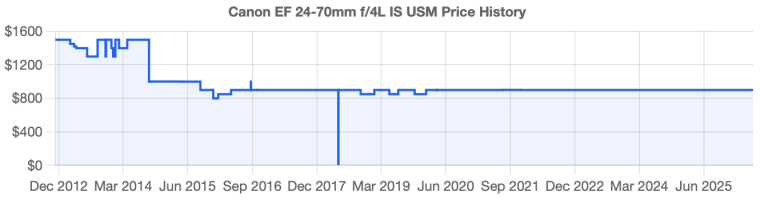
I bought them in March 2025 when they were in the 'Deal Zone' and I paid $594 the pair of 1 TB cards linked above that are currently sell for $627, and it was probably about that list price (maybe it was a little higher) when I bought them 'on sale'.But the price? Wow, it's almost doubled. It's currently for sale for around €555 (including 21% VAT).
I’ve been looking for that very card, and I don’t really understand why, since it seems to be one of the fastest card on the market, I can’t find it in stores, but only on Amazon (I’m in Québec).
I see plenty of really slower cards for higher prices, thaugh. Any reason for that?
Yes, that will definitely help. I recently downloaded some more photos:
LEXAR 512 GB PRO Type B Gold 4.0 series 512GB - R3600/W3300MB/s
CFexpress Type B memory card reader ProGrade Digital | USB 4.0
About 100GB
3004 files in C-raw
Less than 5 minutes (did not clock it exactly)
Just for completeness, there are 5 fast primes, all F1.4: 12mm, 16mm, 23mm, 30mm and 56mm.Depends how you look at it. As it stands Canon essentially outsources its APSC line of lenses to Sigma, which offer 4 fast primes (14, 23, 30, 56mm f1.4) and 4 zoomes (10-18mm f2.8, 18-50mm f2.8, 17-40mm f1.8, and 16-300mm) for Canon RF-S. And they are good quality. That covers the general use pretty good, such as family, travel, portrait, etc.. For wildlife people like me would be pleased to use my full frame lenses such as the RF 100-500mm. I have an R5. The R7ii would provide better reach with the same lens and would add to my kit, but not replace a full frame body. But it is true Canon has no high quality APS-C long lens. Many will be happy to use full frame lenses in those scenarios. Maybe sigma will introduce a long fast lens to RF-S.
In addition to the small F2.8 zoom you mention, I'd be really interested in an RF upgrade to the EF 50-100mm F1.8, especially if they can acheive the same weight and focal length improvements they did when upgrading the EF 18-35mm F1.8 to the 17-40mm F1.8. Say they could get a 45-115mm F1.8 lens that weighs less than the EF 50-100mm. That would be fantastic!I own seven of those Sigma lenses in RF mount so I mostly agree with you. Disagreements: (1) It's 17-40 f/1.8 (2) Sigma needs to add a small 50-135 or 140 f/2.8 and (3) Sigma needs to redesign their 16 f/1.4 to make it much smaller and add a control ring and maybe add a control ring to their other older APS-C primes as well.
Very handy lens, that 100-400 even if it is f/8Absolutely true. And, the Canon RF 100-400mm f/8 (which fits FF) is much lighter than the OM 100-400 f/6.3 to prove your point about lighter by being slower.
Still not a reason to make an APS-c specific 500mm lens, which was the original point. Besides, the main reason many of us use the R7 is to get the extra reach with that 800mm lens which now looks like 1240mm from a framing perspective, or more like 1120mm from a pixel density perspective when comparing to an R5. So an R7 with an 800mm gives almost identical pixels on the bird as an R5 with the same 800mm and a 1.4 extender. The R7 rig is lighter and avoids the optical losses in the extender.Sure, makes sense. For the same focal length FF and APS-C size is the same regardless of the image circle. But not for the same effective FL. So a wildlife shooter on APS-C can shoot his 800mm equivalent using a 500mm lens. It is thus much smaller but because of the focal length, not so much the size of the image circle.
A "Laika" from "Vetslar"? LOL. That would be an attractive offer to less well informed "collectors", I guessJust as you wrote, there are users, and there are collectors.
And never the twain shall meet!
PS: For Euro 1000, I could sell you a genuine Laika "Luxus" with the corresponding binoculars and bag, everything in lizard skin and gold-plated. Guaranteed made in Vetslar...
What me bothers more is the fact, that, if these rumors turn out to be true, 40 MP comes with a stacked sensor. That means an additional loss of dynamic range, and because these pixels are already quite small, I guess that this could be a huge trade-off. If it will be a BSI sensor like rumored, then the trade-off wouldn't be that dramatic, because it can use at least the maximum photo-active pixel area possible. So let's hope for BSI coming true.40Mpx is only 11% more linear resolution than 32.5Mpx, and each 40Mpx pixel is only 10% narrower so it's not going to make much difference in the DLA, the demands on lens resolution etc. It will make no difference to the S/N and high iso when you look at the whole image, because they are independent of pixel size. And if you pixel peep and look at the engineering S/N, each pixel will have only 10% less S/N, ie, less than 1/6th stop.
johnchio, I am with you. Overall my R7 surprised me with a much better IQ than I expected for such a 30+ MP sensor. But, like you say, above 3200 noise kicks in very visibly (fortunately, todays photo apps with good RAW converters such as DxO can "restore" noisy images surprisingly well, but there are limits). 40 MP on an APS-C sensor means in particular for birders/wildlife shooters that if you want to freeze action with a long tele lens on the pixel level (what you want if you have such a camera), you need to go to very high shutter speeds (or you just have to forget about 40 MP and render all images down to, say, 20 MP). That means that you have to accept high ISOs in many settings if you go for maximum resolution. If such a sensor is stacked, the photo-active pixel area is even smaller than on a conventional sensor, so this boosts noise in addition - and shrinks the dynamic range again. Plus, diffraction blur kicks in at very low f-stop numbers already with such small pixels.I'm still a bit concerned because the original R7's noise performance was quite bad above 3200, and with the greater pixel density it could be even worse if they don't do something else. Also, is this the highest density pixel sensor that Canon has(or will) released?
A green light in a red-light district?But hey, that's a free pass!
I'm a resolutionwhore and ppl look at me like a weirdo for having a 4K 13" notebook and complaining why the r5m2 is not 60MP.
So as long as one is a *whore, it's green light from me!![]()
I hope this is true! I got an R7 to use with the RF-S7.8MM F4 STM Dual but when it comes to video recording, because EOS VR Utility has to crop two eyes out of the 4K footage, the 3D footage ends up being worse than 1080p after processing. If they come out with an 8K60 APS-C camera, then that will be a huge leap in quality for stereoscopic recording.
Sure, a 500mm lens on Canon APS-C gives you the same field of view as 800mm on FF. But, pixel size is a crucial factor. If the FF is about 50 Mpx and the APS-C is about 20 Mpx, then a 500mm on FF has the same reach for resolving wild-life as does a 500mm on APS-C. Problem is that once you get to 50 Mpx on FF and 20 Mpx on APS-C, then there is diminishing returns because of diffraction requiring wide aperture lenses. Don't get me wrong, I am not knocking APS-C as I frequently use an RF 100-400mm on an R7. But, to get the best out of it, I would need to go back to my old 400mm f/4.Sure, makes sense. For the same focal length FF and APS-C size is the same regardless of the image circle. But not for the same effective FL. So a wildlife shooter on APS-C can shoot his 800mm equivalent using a 500mm lens. It is thus much smaller but because of the focal length, not so much the size of the image circle.
It sparks joy to know that there are people out there who still believe in fairies, wizards and the magic of the crop factor.Sure, makes sense. For the same focal length FF and APS-C size is the same regardless of the image circle. But not for the same effective FL. So a wildlife shooter on APS-C can shoot his 800mm equivalent using a 500mm lens. It is thus much smaller but because of the focal length, not so much the size of the image circle.

Sure, makes sense. For the same focal length FF and APS-C size is the same regardless of the image circle. But not for the same effective FL. So a wildlife shooter on APS-C can shoot his 800mm equivalent using a 500mm lens. It is thus much smaller but because of the focal length, not so much the size of the image circle.The reason they have no APS-c long lenses is because such lenses don't make any sense as they would be just as big as FF lenses of the same focal length. The most obvious example is the OM System 100-400, which is virtually the same size and weight as the RF 100-500 and we are talking 1/4th the image size with the Oly. The Oly tops out at f/6.3 and the Canon at f/7 but 100mm longer, so all things being equal, the Canon should be a bit bigger. The only way you can make a telephoto smaller is to make it slower. DO or mirrors might make it lighter, but won't reduce the diameter of the entrance pupil (i.e. the objective lens). Rest assured, Sigma won't go there either, although rumor has it that the make the OM Systems 100-400, but that would have been a contract deal to round out the M43 line. If you look at the specs of the Fuji x-mount 100-400 and 150-600, you will see that they are the same size as equivalent FF lenses as well.
Absolutely true. And, the Canon RF 100-400mm f/8 (which fits FF) is much lighter than the OM 100-400 f/6.3 to prove your point about lighter by being slower.The reason they have no APS-c long lenses is because such lenses don't make any sense as they would be just as big as FF lenses of the same focal length. The most obvious example is the OM System 100-400, which is virtually the same size and weight as the RF 100-500 and we are talking 1/4th the image size with the Oly. The Oly tops out at f/6.3 and the Canon at f/7 but 100mm longer, so all things being equal, the Canon should be a bit bigger. The only way you can make a telephoto smaller is to make it slower. DO or mirrors might make it lighter, but won't reduce the diameter of the entrance pupil (i.e. the objective lens). Rest assured, Sigma won't go there either, although rumor has it that the make the OM Systems 100-400, but that would have been a contract deal to round out the M43 line. If you look at the specs of the Fuji x-mount 100-400 and 150-600, you will see that they are the same size as equivalent FF lenses as well.
Then you shouldn't present your opinion as a fact!I'm not sure if I get you right. This was my comment on a forum. Do I need to explain, it represents my opinion?
If you said, you've seen several ppl choose 1.2 over 1.4 and you also own the 1.2 and not considering changing to 1.4, or anything similar, I'd get it and might even say it's a considerable comment and you have reflected to the subject. But like this, I feel you just basically said "meh, I don't like your comment".
I know of 3 people selling their 1.2 and buying the 1.4 instead. Which is 100% of the 1.2 owners I know.
And no, me saying that 1.2 has a very thin market (especially when a lens also has a 1.4 edition) and saying that there are many 1.2 owners out there who simply bought 1.2 because that was the only fast L available and things changed a lot with 1.4 vs vendors actually making 35/1.2 lenses - these do not contradict.
But hey, that's a free pass!I care, but I'm a bokewhore