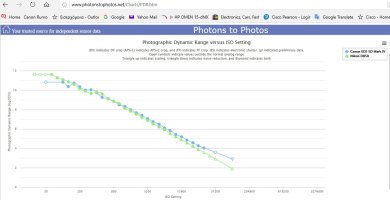
First downloadable RAW R5 and R6 files

That light behaves in a discrete way, like a particle, when coming in contact with surfaces is something that was briefly covered in school physics. If you want to call that professional study. I don't think that matters though, if you want to read up on the physics of light there is a ton of material out there. What we're talking about here is the noise inherent to the light itself, a property that is completly unaffacted by how good your sensor. Wikipedia has a small explanation for it: Shot noise.

As understanding and dealing with noise is a key aspect of astro photography, that's a good place to get information about it in the context of photography. Jon Rista has very detailed articles with example images and lots of math on his page (along some amazing deep sky images): Astrophotography Basics: Signal, Noise and Histograms & Astrophotography Basics: SNR. I believe he was also active on this forum under the account jrista, but haven't seen him post anything under the deep sky thread for a long while.

As for your second point, I though we were particularly concerned with the physical aspects of low light performance. That's why the focus was on RAW, not JPEG, or was it? Of course post processing techniques are continuing to improve. Slapping AI on something is no magical cure to any problem, but it can deliver impressive results for sure. Though, I personally think there's a pretty fine line between actually restoring details you would have gotten in an image by gathering more light, or just making the noise less apparent by smoothing it or replacing it with artificial detail.

As for animal eyes, not sure where you are going with this. As I said, the noise is in the light itself.


You are right, that would be cool. I'll see if I can put something together.

Just to clarify though, I am not saying that we have hit a plateau. I am saying that there is a physical limit for how noisy a low light image can look without further processing or techniques to improve it. That's what I consider to be meant when we talk about RAW file low light performance. And as progress is made, we approach that limit. As is generally the case when approaching these limits, it get's harder to make improvements as you get closer. I do think we are seeing that in recent releases, so hoping for really big steps forward appears to be futile to me. But for this last point, I don't have a proper source to point out at the moment. I'll get back to you if I can present the chart you mentioned, which I would also find very interesting myself.

That light behaves in a discrete way, like a particle, when coming in contact with surfaces is something that was briefly covered in school physics. If you want to call that professional study. I don't think that matters though, if you want to read up on the physics of light there is a ton of material out there. What we're talking about here is the noise inherent to the light itself, a property that is completly unaffacted by how good your sensor. Wikipedia has a small explanation for it: Shot noise.

As understanding and dealing with noise is a key aspect of astro photography, that's a good place to get information about it in the context of photography. Jon Rista has very detailed articles with example images and lots of math on his page (along some amazing deep sky images): Astrophotography Basics: Signal, Noise and Histograms & Astrophotography Basics: SNR. I believe he was also active on this forum under the account jrista, but haven't seen him post anything under the deep sky thread for a long while.

As for your second point, I though we were particularly concerned with the physical aspects of low light performance. That's why the focus was on RAW, not JPEG, or was it? Of course post processing techniques are continuing to improve. Slapping AI on something is no magical cure to any problem, but it can deliver impressive results for sure. Though, I personally think there's a pretty fine line between actually restoring details you would have gotten in an image by gathering more light, or just making the noise less apparent by smoothing it or replacing it with artificial detail.

As for animal eyes, not sure where you are going with this. As I said, the noise is in the light itself.


You are right, that would be cool. I'll see if I can put something together.

Just to clarify though, I am not saying that we have hit a plateau. I am saying that there is a physical limit for how noisy a low light image can look without further processing or techniques to improve it. That's what I consider to be meant when we talk about RAW file low light performance. And as progress is made, we approach that limit. As is generally the case when approaching these limits, it get's harder to make improvements as you get closer. I do think we are seeing that in recent releases, so hoping for really big steps forward appears to be futile to me. But for this last point, I don't have a proper source to point out at the moment. I'll get back to you if I can present the chart you mentioned, which I would also find very interesting myself.

Appreciate the thoughtful replies. Always nice when the harsh conversation turns more friendly.

If the R5 is one stop better than the R, can we not say I was half right and half wrong? :ROFLMAO:

One example of the kind of tech I was thinking Canon would bring to the R5 stills is illustrated by the 4K oversampled video that downsamples from 8K. From what I've read, it supposedly allows for full (I forget what the right word is) saturation(?) of each color channel, much like a still image from a Foveon sensor, plus producing higher dynamic range and sharpness. Not sure how I expected something like that to work for stills – perhaps processed the same way as the 4K oversampled video and delivered as S/MRAW.
Upvote 0

ZY Optics releases the Mitakon Speedmaster 50mm f/0.95, specially designed for Canon EF cameras.

Owned a couple of the 0.95 50mm speedmasters - one on Sony, one on RF.

I sold both.

That said: they're a little soft wide open when focusing close (but acceptable sharpness at medium to far focus), with noticeable CA. Bokeh is usually good, but due to CA, if you have a background with alternating dark and light (like tree branches against bright sky), it can look pretty 'busy' and unpleasant. They might be 0.95 from the bokeh perspective, but let a little less light in than you'd expect with comparatively poor transmission and wide incidence angle on the sensor.

Build quality felt sturdy and solid in both cases, with all metal construction. they were also surprisingly heavy for the size because of this.

The manual focus at .95 made focusing pretty hard, but that's a lot better on cameras like the r/rp, which pretty good manual focus aids.
I found them useful on wider scenes to isolate the subject from the background in busy environments; creating a few unique shots. Still, even then, focus was tough, but those shots where I got it right I really liked. The problem was there were a lot more shots that I missed where I got it wrong :)

In the end, the last one I owned on RF I traded in to get the RF 50mm 1.2 instead. Half a stop less bokeh, but an autofocus that nailed it every time. Of course, 3 times as expensive, soooo.....

I'm not sure how different the optics are on this one though, since it's for EF mount, rather than mirrorless.

Short version: If you like manual focus lenses, then this is actually a pretty decent option, though a little tricky. Otherwise if you're more like me, stick to something with autofocus where you'll end up with a LOT more keepers rather than mostly 'man, this shot would have been SO good if I hadn't missed the focus by half an inch'
exactly what i intend to do with my rf version, it is great but to use for work is tough, i love it but the 1.2 is more sensible and its only economics that stop me moving up, but for casual ust its great, the ef version is a no no seems they messed up the fitting
  • Like
Reactions: 1 user
Upvote 0

The Laowa 100mm f/2.8 2X Ultra Macro for the Canon RF mount is now available

It's more than a little disingenuous of people to knock a lens company for being in China when literally half the products in their homes were made there. Just flip your keyboards over and look at where they were made. People have known that there were slave labor camps at some places in China for decades. Me thinks many complaining about Laowa being in China were never going to buy the product in the first place, no matter where it is from. Saying, "I'll never buy anything from China again!" just isn't going to happen. It's a futile statement. People have no idea where the thousands of parts in their electronics or other products are sourced from. No doubt, Canon also sources parts from China. Gonna give up your cameras and lenses because they might have parts from China? Never gonna buy another flat screen television? Never a new computer? What about that much needed prescription drug you take? This is all silliness. In your zeal you could very well be hurting companies that are doing the right thing, and hurting people who are just trying to scratch out a living. If anyone here has proof that Laowa is using slave labor, then fine. I wouldn't buy THAT product. Otherwise, boycotting literally everything from China is nothing more than political or racist stupidity and ignorance that's gained traction only due to the politicization of a virus. The vast population of China has benefited immensely from China's relaxing of hard line communist thought to participate in the world economy. We've ALL benefited. Isolating China does nothing more than hurt the very people you claim need your help. Maybe it makes you feel good to say it, but we all know it's B.S. Self righteous verbal posturing with absolutely no intent at actually following through. It's sick.
  • Like
Reactions: 1 users
Upvote 0

Canon EF 400mm f/5.6L going away?

I love my 100-400 Mk II, but for raptors in flight I still prefer my 400mm f/5.6. I wish the zoom had a second 10m MFD so it wouldn't lose focus in the sky so often. I tried a 1.4X III on my 5DsR with the 400mm, but CA wasn't good, so I just crop as necessary. I don't know that IS is very useful when an eagle or hawk is on the move around my home. For perched raptors I would prefer IS, or the the zoom, no question. Here is an Alaskan Eagle with the 400mm on a 6D.0173-Eagle-Nest-c1s.jpg
  • Like
Reactions: 1 user
Upvote 0

1.3 crop in R5

I think the size of the files would be a lot better. Its starting to look like we may not see a 7d ii but I would be happy with 26mp for stuff that moves. I have got to the point where I don't take out the 7d ii unless things are far away and also moving. If they are far away and not fast I just use one of the crop modes on the 5ds. I also don't have any ef-s lens now. Not sure I want anything more than 50mp either because the files could be too big for even a new computer. I have an i9 10900k and notice some slow down with 50mp some times. The 45mp of the r5 is what I would use for landscape etc.
Upvote 0

Canon releases an official statement about the EOS R5 and EOS R6 heat concerns

Of course people buy high resolution systems specifically so that they can enlarge more. But nobody is expecting to make large prints from very high ISOs.

I think we're talking about the same thing but using different semantics.
What I meant was, if you have technical differences between sensors such as noise, you can't equalise them. As in my example, if sensor A is noisier than sensor B, you can't just apply noise reduction to A and tell 'now the sensors are the same'. They're not the same because postprocessing makes comparison meaningless: you can apply the same noise reduction to B and make it better again, or apply even more NR to A and make it even 'better' than B.

The same applies to downsampling (no matter from high ISO or low ISO images). Trading off resolution for NR doesn't actually make sensors 'equal'.

But in the narrow practical sense, when you need files/prints of the same size - absolutely. Yes, within some limits and by using digital manipulation, you can produce images of the same resolution and IQ from different sensors.
But equalisation will always come at a cost of information loss (from one sensor or both). If you consider information loss, it's evident that digital manipulation can't really make one poor sensor on par with a better sensor.
Upvote 0

Here are the specifications for the Canon RF 100-500mm f/4.5-7.1L IS USM

The more I think of it, the more I like this lens vs the DO's (if I had to choose between them).

This by itself gets you to 'close' to the 600mm DO at a much better fstop.
This with a 1.4 TC gets you past the 600mm DO and 'close' to the 800mm DO at a better fstop.
This with the 2.0 TC gets you past the 800mm at a slightly worse fstop but it would cover the range of the DO's (w/o TC of course) w/ less bag room.
This plus an R5 with just running in crop mode for 160-800 w/o the fstop penalty... but at a resolution just under the R (but over a R6).

I could see carrying the 100-500 for the versatility paired with a 2x TC for the optional 600-1000mm reach... and foregoing the DO's... and if running crop could get you up to 1600.

Guess it all depends on the TC IQ.
Upvote 0

5 unreleased RF lenses show up again for certification

Wow.

$2,699.00
Thanks for reminding me!
Apparently my guess wasn't that far off ($1), after all.
Now, what do I win? :ROFLMAO:

I do remember so many thinking it would be more like half that!
  • Like
Reactions: 1 user
Upvote 0

What will you do with your EOS R6?

There are many things I like about the R6, but, I'm concerned that just like my R, I'd keep touching the lcd screen with my thumb while holding it, and moving the AF point. I've messed up a lot of images that way. The R5 has a space for my thumb well away from the lcd.
I reverse the screen and fold it into the body to protect it. I cracked my 5DsR screen first time in the field.
I have set the middle button on the 4 way controller to centre the AF point. This makes it much quicker to recover the AF point if accidentally shifted. COmbined with excellent face/eye tracking I don't use the drag AF point function anymore.
Upvote 0

EF to RF adaptor - third party Chinese versions ...any good ?

...which is why, when the NON control ring adapter is in a kit (and the price is basically such that it is free with the camera and lens), I'd love to have the option to pay another hundred bucks and upgrade, but no, I must pay full boat for it. Or, likewise pay 200 or 300 to get the drop-in filter adapters.
That would be so nice indeed. :|
Upvote 0

RF 24-105mm F4 L IS USM Build Quality?

I had three copies of the RF 24-105 I tested them on a tripod and one copy had better corner resolution with less play at the barrel then others.
What was most interesting is that one lens (not the best one) was ever so slightly wider than the rest (at all focal markings).

I think my best copy was very good an all fronts, it's an L lens but also a kit lens produced in big numbers, so I don't expect quality control at the level of the RF 28-70.
Upvote 0

Filter

Forum statistics

Threads
37,282
Messages
967,190
Members
24,637
Latest member
Alter8

Gallery statistics

Categories
1
Albums
29
Uploaded media
353
Embedded media
1
Comments
25
Disk usage
982.4 MB