"In hell, where I sent her." - Po Campo, the potential new cook in Lonesome Dove, when asked in San Antonio if he had a wife he'd miss and want to go back to when the cattle drive was halfway from Texas to Montana.
The 6K2 has amazing menu and overlay. The Canon has good menu that work well for the amount of options that a photo camera has, but very very poor overlay placement. The items are not even aligned, and sometimes they get on top of the image for no reason. Why? I have no clue. It's really something that they should work on because it looks so stupid besides the fact that it can impact operations.
- Aspect ratio
There is a lot to unpack here. The origin of this whole issue is not Canon side, but you would be right to hate on them anyway because they only give this option. So, the digital specifications for video are bonkers. With digital, if you change the aspect ratio, the height stays the same. With 35mm, it is the opposite. Why? I don't know, and for me it doesn't make any sense. So for Canon you start from a 4K full DCI weird aspect ratio that is not even 1.85. You don't get any other aspect ratio in camera. You want something else? You have to crop in post. Basically giving a crop factor to your lens. It is so so bad. On the 6KG2 you also get a single aspect ratio, but at least it is a higher 16/9. You get so much more image. Standard digital specifications do not make any sense, and it's the whole reason why today everybody is looking forward to open gate. It's not to take out tiktok videos from a normal video. It's because the default and only aspect ratio sucks. The solution is pretty straightforward. Since most people are not delivering for cinema, manufacturers should just give us more aspect ratios that do not conform to standards but have higher pixel counts on the vertical side. Imho it is vastly better to resize than to have a crop factor. The non conform 6KG2 feels much better.
- Sound
XLR vs jack connector. Obviously one is better than the other. But is it a significant difference? I am not an audio expert, and it sound like I can get a very similar audio with jack. XLR is locked, but I don't think that you are going to pull the cables by chance that often, if ever. The truly good mics are all XLR obviously, but are you going to want to connect those to a camera instead of an external recorder? I don't think so. And I love the low profile of the Sennheiser MKE 440. What Canon could do on the next camera is implementing 32bit float audio recordings to avoid clipping at any cost, which a lot of manufacturers have already done. It shouldn't be that hard. But the 6KG2 doesn't do that either, so for the sake of this comparison for me they are equal. I do not miss XLR at all
- Stabilisation
I didn't test this much on either camera. The 28mm I am using right now is stabilised so that's already great for me. The 6KG2 has data that Resolve can use, and pixel size to crop in. The R52 has IBIS. They both have their strength, but it is nice to have a baked in IBIS stabilisation available.
- Screen
While the 6KG2 is way bigger, and the overlays are better positioned and drawn, the extra brightness on the R52 was significant. But i could have gone confused with the settings. I should look back at it.
-Overheating, camera noises, battery life
Battery life seemed pretty similar. My test didn't focus on this specifically so don't take my word for it, but at the end of it I had almost finished one battery on both. You clearly have to buy multiple spares for both. Since it was still a cold day, I didn't get to overheat warnings on the R52, but it will happen on a hot day as reported on multiple reviews. For me this is a crucial hybrid tradeoff: if you want a real fan, don't look at photo cameras. Then there are camera noises, in my case those all come from the 28mm doing tracking autofocus. There is no lens at a decent price on RF. On a 6KFF I would probably get the new Sigma 28-70 which is fully quiet. This matters to me since I have the mic on top of the camera, but there is no solution given Canon policy that connects silent focusing to high quality and high price. Which I don't want to spend.
After all this testing I had a clearer picture in mind.
R52: very compact form factor and decent color quality that needs grading but cannot retain highlights.
6KG2: bulkier form factor with impressive dynamic range, ease of use, and color workflow.
So I have decided to try and sell the 6KG2. While I do not think that there is anything else that matches the value of what this camera can give, for my current usage, form factor is everything. I want to be able to go around with a camera and not care about focusing that much. I'll get by the awful aspect ratio and the clipped highlight. I hope that Canon will implement open gate on the Mark II and seriously improve the dynamic range on the Mark III. I beg people to stop writing that "current cameras are all great", because they are not! But the portability of them is irresistible. And while I am selling the 6KG2, I am still very interested in their new full frame model. Like I said previously in this review it has many significant upgrades: brighter screen (already present on 6K Pro), cfexpress, tracking autofocus, tighter l mount, open gate. For now I am satisfied with Canon hybrid. But if I'll ever shoot on less so run and gun scenarios, I'll definitely consider coming back to Blackmagic. Or maybe I'll not manage to sell the 6KG2 at a decent price, so I'll just keep it on a shelf most of the time and use it in those rare situations where I am sure I don't want autofocus and can tollerate the bigger profile.
Have a couple of them and they have preformed real well in both my R6MkIII and R5 MkII for half the price of OEM. And the USB charging has worked great when I'm out and about, plug them into the cars USB and the charge fairly quick.
I've used a variety of Blackmagics over the years. Under controlled conditions, with good lighting, they make a very nice image. I personally find their form factor though to be less-than-desirable for most field situations, and in uncontrolled settings the image can sometimes be not great.
Carrying it around the sidelines attached to my monopod (I had to upgrade the tilt head from a Manfrotto 234 to an Oben VH-A30 to support the lens) and a gripped 7D Mark II attached to the lens was like carrying a bowling ball on the end of a stick. I typically held the monopod with my left hand with the lens facing rearward resting over my left shoulder while moving around. I had two other bodies on a dual harness with a 70-200/2.8 on one and either a 24-70/2.8 or 24-105/4 on the other.
No. The latest version is 1.9.0 from 2024. Given that the R6 is now two models out of date, I would not expect any more firmware updates (and if there is one, it will be to fix a glaring problem, not to add any features).
Well, I shoot cRAW as well.
The CRAW file is 34 mb. The DNG uncompressed is 163 mb. The compressed DNG file is 31 mb !
Albeit, with one test. Don't have the time now to do more tests.
I have processed 11100 CRAW files from my EOS R7 with PureRaw 6 and DeepPRIME XD3, exporting as compressed DNG! Results:
CRAW: 197.72GB (17.8MB/file on average)
Compressed DNG output: 190.63GB (17.2MB/file on average)
For comparison, out-of-camera JPEG cumulative size: 108.16GB (AdobeRGB, non-HDR; 9.7MB/file on average)
So my numbers are very similar to your findings, in that the compressed DNG output is slightly smaller than the CRAW file on average. My settings were "luminance" 40%, "force details" 5%. Just for reference, processing took around 21 hours.
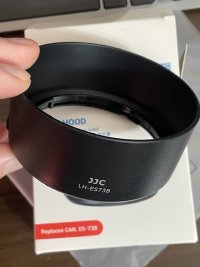
I have to say, I think JJC is building them better and better.
This is my fourth or fifth JJC lens hood and it’s the best so far. The plastic is thicker than ever, and it has the same textured finish as the petal-shaped version for the RF 35mm f/1.8 (similar to some Canon EF lenses).
It’s really good, I can see why they’ve been increasing their prices.
Friendly reminder: Canon’s RF lens hoods do not have velvet on the inside either.
Still here, lol. Both were shot with the 24 MP EOS R3. The football kickoff was shot from the stands, around 50 m / 160' away from the kicker, and the image is cropped to ~6 MP. The violinists were shot from my seat in the auditorium, probably about 18 m / 60' away from the front subject, and cropped to ~8 MP.Thanks
Keep in mind that the 'crop factor' does not just apply to focal length. Image noise is inversely proportional to sensor size. So while the 'brighter' f/2.8 lens on the iPhone seems like it would be better than the f/4 lens on your R6, in fact your iPhone video will have about the same amount of noise as if you were shooting the scene at f/10 on your R6.
This is a big improvement. Once they added the 3:2 and 1:1 crops to EOS VR Utility, it was really annoying to be having to use the 16:9 or 8:9 guides on the camera to just guess at what your shot's framing was going to be.
Canon has released a minor firmware update for the EOS R50. Canon has released a firmware update for the EOS R7 as well. Firmware v1.5.0 for the R50 is a minor update that adds improvements when using the RF-S7.8mm F4 STM DUAL along with stability improvements. This firmware update will make it to other global […]
Using a very complicated yet powerful algorithm called "average", I can state that an intermediate lens between the RF 85mm F/1.2 and the RF 135mm F/1.8 could be a RF 110mm F/1.6.
Or F/1.5.
This apparently weird focal length and aperture would make sense IMO, considering that
1) it could weight less than a 100mm F/1.4, and that
2) Canon RF lenses ofter offer something different from old EF lenses and from other brands' ones.
But any "RF 100-105mm F/1.something" would be interesting.
I enjoyed that 40mm lens. It made my Hexanon 52mm f/1.8 feel slightly claustrophobic.
While irrational, I'd like to see Canon make an RF f/1.8 40mm. I can't bring myself to get the 2.8.
I'm still kicking myself for not picking up an EF 40mm f/2.8 STM pancake from the Canon USA refurb store before that lens was discontinued. It's one of those things I always meant to do but never quite got around to it. I do use the EF 35mm f/2 IS quite a bit, so I really have no need for the 40mm.
I think the loss of mechanical linking is more about giving the platform greater control over computer-controlled AF for very fast or erratic subjects, such as athletes and bats (as in the mammal). I strongly suspect that the people who tend to talk directly to Canon are more in these situations, and they can reasonably purchase (personally or via a company) multiple big white lenses, or beasts like the 28-70.
And the fact that EF lenses still reasonably exist. So if you're weird like me and like that kind of feel or universal MTF then that stockpile satisfies the need, in one way of thinking.
I just re-read your statement and I think I replied after misreading what you wrote. I agree, it probably is impractical. In which case if mechanical linking were reintroduced it might well need to be with older EF technology such as ring USM.
This does bother me because we saw what happened with some of the older Canon lenses that were also entirely electronic for focusing. The 200/1.8L. The 50/1L. Many more. Once parts availability ends, the lens is completely useless if the AF motor dies.
I think that if the following were achieved by Canon then mechanical linking could die a full death for my purpose and feel:
Universal FTM focus during one-short and servo, regardless of lens (including older RF lenses)
No need to push AF-on or shutter button
Tactile feedback in the focus ring with resistance and placement stickiness (use a quality, modern L EF lens to understand this)
No damage potential if the focus ring is spun with or without power
No need for menu option or camera switch to engage, or default to engaged
Identical approach to FTM on all Canon R cameras going forward — again, no on-body switches on some but not on others, etc.
My EF USM lenses all achieve: 1, 2, 3, 4, 5, & 6. My 40mm STM is focus by wire.
I understand that many L series RF lenses support: 4, and 1 can now be achieved for most using firmware updates for the lens and sometimes the camera. Probably all except 3 and 6 can be solved with firmware. 3 would probably require some hardware, and 6 is more of a camera design thing.

Everyone upset about interpolation is gonna flip when they found out what “debayering” is.
As we all know, lens design is about tradeoffs. If y’all want to pay for and carry around all the extra glass elements that these “optically perfect” lenses would require, be my guest. But I welcome smaller, lighter, fewer glass element lenses using digital rather than optical corrections as long as the performance is up to snuff. And I think any rigorous lens testing methodology shows that most of the L-series lenses have the performance we all expect, regardless of the correction type used.