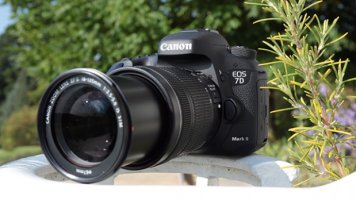
Canon Powershot Smartphone

With Panasonic finally coming to market with the Lumix CM1 with 20MP 1" sensor, 10.2mm fixed lens, 4K video, 16GB on-board storage and slot for additional storage plus the ability to mount a filter holder like the Lee Seven5 system with an Android smart phone to boot to load to Facebook, Flickr etc instantly and apps. should Canon use say the 1" sensor it has in the G7X to do something similar and address the lost point & shoot market.

Magic Lantern on a 5D3 for stills?

Hey gang,

my 5D3 enters its third year of service. It's been terrific.

I was curious to see who out there is running ML on theirs, and specifically what the experience / upside has been for stills. I (perhaps mistakenly) think of ML as a tool for video folks, but I never shoot any and didn't give ML much thought.

But rather than pour through an exhaustive list of ML features at their site, are there any specific stills features you've used and would recommend? Any slick tools to assist focusing with MF lenses? Any upsides to general IQ, DR, etc.? Does the menu system offer the ability to tune more parts of the camera, or unlock any 1DX goodness (like spot-metering at any AF point?)

Besides the warranty considerations, are there any drawbacks to using it? I assume the risk of bricking the camera is small this far post-release, right? Does it chew through battery life faster?

If it helps peg what I might value in ML, I'm principally an available light shooter from 16-200mm: landscapes, travel, macro, candids, street, events and some very infrequent sports/wildlife opportunities. I typically don't do video, timelapse, astro or dedicated portraiture.

Just curious for your thoughts, thanks!

- A

Official: Samyang 100mm T3.1 VDSLR ED UMC MACRO

HTML:
<p class="r1"><strong>Free Your Action</strong></p>
<p class="r2">Telephotos and close-ups for cinematography</p>
<ul class="r3">
<li>Macro Telephoto Manual Focus Lens</li>
<li>Bright T3.1 aperture</li>
<li>High refractive (HR) and extra low dispersion lens (ED)</li>
<li>Uncoupled aperture and focus gear ring</li>
<li>Ultra Multi Coating (UMC) technology of Samyang Optics</li>
<li>Circular aperture with 9 blades</li>
<li>VDSLR II CINE LENS</li>
</ul>
<p class="r5"><strong>Macro Telephoto Manual Focus Lens</strong>

Samyang Optics 100mm T3.1 VDSLR ED UMC MACRO is a macro telephoto manual focus cine lens designed for full frame sensor sizes. The maximum close-up magnification is 1:1. This macro lens with vivid color and soft out-focusing is the best lens for close-up images of flower and insects. It also can be used as a 100mm telephoto lens for landscapes and portraits.</p>
<p><strong>VDSLR Cine Lens Features</strong>

Samyang 100mm T3.1 VDSLR ED UMC MACRO allows more delicate video work with T number marks. The focus gear ring is installed for follow focus system. You may change the aperture quietly and smoothly with the uncoupled aperture gear rings. Also, distance scale and T numbers are marked on both sides of the lens for convenience.</p>
<p class="r5"><!--more--></p>
<p class="r5"><strong>Optical Features</strong>

Samyang 100mm T3.1 has a low F number of T3.1. You may control the lens precisely when shooting under various exposure environment including relatively dark or too bright situations

This lens features 15 lenses in 12 groups especially including a high refractive lens (HR) and extra low dispersion lens (ED) to minimize color aberration and unnecessary light dispersion in order to offer high resolution throughout the image. Ultra Multi Coating (UMC) of Samyang Optics is used to optimize the light penetration and minimizes flare and ghost. With such optical construction, it has 0.307m of minimum focal length to film subjects in a very near distance.</p>
<p><strong>Hardware Features</strong>

There are 9 aperture blades designed to be almost as a full circle when aperture is closed which expresses starlike ray clearly and beautifully. The frame of the lens is compact and solid since it is made of high-strength aluminum alloy so you can create trustworthy images. Also, detachable petal-shaped lens hood minimizes flare and ghost by sheltering lens from unnecessary lights.

Available for 10 camera mounts: Canon EOS, Nikon AE, Pentax K, Sony ∝, Canon M, Fujifilm X, Samsung NX, Sony E, FT, MFT.</p>
<p><strong>Samyang Optics VDSLR II Cine Lens Line Up</strong>

Samyang 100mm T3.1 VDSLR ED UMC MACRO is one of Samyang Optics VDSLR II Cine Lens Line Up for full frame image sensor sizes. The lenses produce the same image color and have a united location of aperture and focus gear ring to maximize the convenience when filming.</p>
<p class="r5"><a href="http://www.syopt.com/en/camera/cine-lenses-100mm-T3.1-VDSLR-ED-UMC-MACRO.php" target="_blank">Visit Samyang for more information</a></p>

Official: Samyang 100mm f/2.8 ED UMC Macro

HTML:
<p>Samyang has made the 100mm f/2.8 ED UMC Macro lens official.</p>
<p class="r1"><strong>Focusing on the Essence of Nature</strong></p>
<p class="r2">The real art designed for ultimate close-ups</p>
<ul class="r3">
<li>Macro Telephoto Manual Focus Lens</li>
<li>Bright F2.8 aperture</li>
<li>High refractive (HR) and extra low dispersion lens (ED)</li>
<li>Ultra Multi Coating (UMC) technology of Samyang Optics</li>
<li>Circular aperture with 9 blades</li>
</ul>
<p class="r5"><strong>Macro Telephoto Manual Focus Lens</strong>

Samyang Optics 100mm F2.8 ED UMC MACRO is a macro telephoto manual focus lens designed for full frame sensor sizes. The maximum close-up magnification is 1:1. This macro lens with vivid color and soft out-focusing is the best lens for close-up images of flower and insects. It also can be used as a 100mm telephoto lens for landscapes and portraits.</p>
<p class="r5"><!--more--></p>
<p><strong>Optical Features</strong>

Samyang 100mm F2.8 ED UMC MACRO has a low F number of F2.8. You may control the lens precisely when shooting under various exposure environment including relatively dark or too bright situations.

This lens features 15 lenses in 12 groups especially including a high refractive lens (HR) and extra low dispersion lens (ED) to minimize color aberration and unnecessary light dispersion in order to offer high resolution throughout the image. Ultra Multi Coating (UMC) of Samyang Optics is used to optimize the light penetration and minimizes flare and ghost. With such optical construction, it has 0.307m of minimum focal length to film subjects in a very near distance.</p>
<p><strong>Hardware Features</strong>

There are 9 aperture blades designed to be almost as a full circle when aperture is closed which expresses starlike ray clearly and beautifully. The frame of the lens is compact and solid since it is made of high-strength aluminum alloy so you can create trustworthy images. Also, detachable petal-shaped lens hood minimizes flare and ghost by sheltering lens from unnecessary lights.

Available for 10 camera mounts: Canon EOS, Nikon AE, Pentax K, Sony ∝, Canon M, Fujifilm X, Samsung NX, Sony E, FT, MFT.</p>
<p><a href="http://www.syopt.com/en/camera/photo-lenses-100mm-F2.8-ED-UMC-MACRO.php" target="_blank">Visit Samyang for more information</a></p>

Canon Announces Full-Frame Digital SLR Camera 6D Mark II

The EOS 6D Mark II Digital SLR Camera Includes a New Full-Frame Sensor, Built-in Wireless and GPS, Intervalometer, Articulating Touch-Screen, Dual-Pixel AutoFocus, 8K video recording, and 16-Bit sensor yielding 15.8 stops of Dynamic Range

LAKE SUCCESS, N.Y., April 1, 2015 – Canon U.S.A., Inc., a leader in digital imaging solutions, today introduced the EOS 6D Mark II Digital SLR Camera, a versatile mid-range full-frame camera with the durability and performance professionals require and the creative imaging options serious photographers crave. Canon has coupled the incredible image quality of a newly designed 39.3-megapixel full-frame CMOS sensor capable of 8K video with no line skipping and Dual DIGIC 6+ Image Processor with the creative potential of built-in Wireless and GPS features. The camera also includes a 31-point AF array and the EOS Scene Detection system features the 150,000-pixel RGB+IR 252-zone metering sensor for enhanced precision originally introduced on the 7D Mark II, all in an affordable camera body. Building upon the qualities that made the EOS 5D Mark III camera so successful, the EOS 6D Mark II bridges the gap for budget-minded photographers, videographers and cinematographers who are eager to step up into the world of full-frame imaging.

"The introduction of this camera completes a well-rounded ecosystem from input through output for Canon, allowing us to provide the right combination of features for every level of photographer. We believe the EOS 6D Mark II Digital SLR Camera along with our new PIXMA Pro printers will help unlock the creative vision of so many who aspire to capture and display their artistic abilities," stated Yuichi Ishizuka, executive vice president and general manager, Imaging Technologies & Communications Group, Canon U.S.A.

Designed for advanced amateurs and videographers making the move to a full-frame Digital SLR, the EOS 6D Mark II fits neatly into Canon's professional imaging system with an advanced feature set including full manual options for creative control in addition to new and intuitive automatic settings to help even novice photographers capture great images. The camera's construction helps meet the needs of professionals with a 150,000-cycle shutter durability and EOS Integrated Cleaning System for high-quality vibration-based dust removal. Among the many advancements in Canon's new EOS 6D Mark II is the Company's proprietary Dual DIGIC 6+ Image Processor that powers the camera's fast 16-bit analog-to-digital conversion for exceptionally smooth color tones and gradation. The camera offers a full-frame, 39.3-megapixel CMOS sensor and continuous shooting up to 7.5 frames per second (fps).

Thanks to the combination of its new CMOS image sensor and the powerful Dual DIGIC 6+ image processor, the EOS 6D Mark II provides a wide ISO range from 50-51200 two high settings, H1: 102400 and H2: 204800. These outstanding low-light capabilities allow the EOS 6D to easily capture dimly lit scenes such as wedding ceremonies, indoor corporate events, or landscapes at dusk. To support the ample sensitivity of the new camera's sensor, the EOS 6D Mark II camera's Auto Focus (AF) system includes a newly-developed 31-point AF sensor featuring 11 high-precision dual cross-type points with an exceptional EV -4 sensitivity rating and 20 cross-type points with EV -2 for accurate focusing even in extremely low-light conditions and compositions.

The EOS 6D Mark II has a 7.7cm (3.0”) Vari-angle Clear View LCD II Touch screen with a sharp 1,040k dot resolution and is ideal for video shooting, or composing images from unusual and creative angles. The screen is a capacitive type, which supports a series of multi-touch gestures including swiping and pinch-zooming – perfect for navigating menus, amending settings or flicking through images.

Full-Frame 8K Ultra HD Video

Videographers, student filmmakers, and creative independent spirits will appreciate the full-frame video capabilities of the EOS 6D Mark II in an affordable and compact body. Borrowing from the best of the entire EOS series and breaking new ground in the DSLR world, the EOS 6D Mark II provides full manual control over exposure and audio levels while recording video. The camera features NTSC and PAL video modes at multiple frame rates, recording 8K at 30 (29.97), 24 (23.976) and 25 fps, 4K at 60 (59.94) and 50 fps and standard video at 30 (29.97) and 25 fps. The camera provides up to 29 minutes and 59 seconds of continuous recording (with 4GB automatic file partitioning) in selectable All i-framei or IPB compressions with embedded timecode. Especially when used with large aperture lenses, the EOS 6D Mark II camera's full-frame sensor offers a tremendous degree of creative control over depth-of-field, helping users to achieve pro-quality cinematic effects in Ultra HD video recordings.

Built-in Wireless and GPS

For the ultimate in DSLR connectivity and control, the EOS 6D Mark II features a built-in wireless transmitter which allows the camera to share images and video with the user's choice of wireless devices such as select PowerShot cameras, smartphones, or tablets, as well as cloud-based destinations including social networking sites through the Canon iMAGE GATEWAYii. A very intuitive and useful wireless feature is the new, free Canon EOS Remote app available for iOS and Android systems which will allow a smartphone or wireless device such as a tablet to remotely connect, control and operate the connected EOS 6D Mark II, even when shooting 8K video. This seamless connection and control will open new opportunities for professional photographers shooting weddings or remote wildlife, without the need for tethered operation or accessories.

For on-location shooters, landscape photographers or enthusiast photo travelers, the EOS 6D Mark II features a built-in GPS receiver to record longitude, latitude, elevation and Coordinated Universal Time (UTC) as EXIF data for seamless geo-tagging while shooting. The GPS coordinates are appended to each image and easily syncs with Canon software or mapping apps on social network sites to show image locations. Use of UTC data allows images to be chronologically mapped and trails plotted and recorded.

A built-in GPSiv Receiver provides a digital compass and can record location information including longitude, latitude, elevation, camera direction and universal coordinated time (UTC) as EXIF data for geotagging both images and movie files in real time. The built-in pop-up flash is convenient for many applications and can also act as an optical controller with compatible off-camera EX-series Speedlites for enhanced pro-quality lighting effects.

Boundless Creativity

To help photographers unlock their full creative potential and explore all the different avenues of digital photography, the EOS 6D Mark II includes several creative modes for image capture. First is the HDR (High Dynamic Range) mode allowing the camera to capture three separate exposures and combine them in-camera for a stunning image capturing both enhanced shadow detail and bright highlights. Next is the camera's Multiple Exposure mode where users can combine up to nine individual images into a single composite image, with no need for later computer post-processing. Two different compositing methods are provided, Additive and Average. Compositing results can be viewed in real time on the camera's LCD monitor, and there is a one-step Undo command that allows photographers to delete an image and try again if desired. The EOS 6D Mark II will even allow photographers to specify a previously captured RAW image as the starting point for a new Multiple Exposure composite image. In addition to HDR and Multiple Exposure modes are Canon's standard Scene Intelligent Auto and special scene modes to capture great images with ease. The EOS 6D Mark II camera features dual card slots for SD/SDHC/SDXC, including Ultra High Speed (UHS-1) SD cards. Data transfer speeds from the camera to a personal computer are enhanced with the addition of a SuperSpeed USB 3.0 port.
Pricing and Availability

The EOS 6D Mark II Digital SLR Camera will be sold in a body-only configuration at an estimated retail price of $2,399.00 and it will additionally be offered in a kit version with Canon's EF 24-105mm f/4-5.6 IS STM zoom lens at an estimated retail price of $2,799.00. Both configurations are expected to be available in August 2015.

About Canon U.S.A., Inc.

Canon U.S.A., Inc., is a leading provider of consumer, business-to-business, and industrial digital imaging solutions. With approximately $45.6 billion in global revenue, its parent company, Canon Inc. (NYSE:CAJ), ranks third overall in U.S. patents registered in 2014† and is one of Fortune Magazine's World’s Most Admired Companies in 2014. In 2014, for the eleventh consecutive year, Canon U.S.A. has received the PCMag.com Readers' Choice Award for Service and Reliability. Committed to the highest level of customer satisfaction and loyalty, Canon U.S.A. provides 100 percent U.S.-based consumer service and support for all of the products it distributes. Canon U.S.A. is dedicated to its Kyosei philosophy of social and environmental responsibility. To keep apprised of the latest news from Canon U.S.A., sign up for the Company's RSS news feed by visiting www.usa.canon.com/rss.

Should I place pre-order for 5DSr or wait?

I am ready to push the button at B and H but I am wondering if the first copies of a new camera is a smart move? Anyone heard of bad first copies of Canon Bodies. I am thinking that I will probably get a firmware update pretty quick which I can live with. I am just chomping at the bit to get my hands on this camera.

FYI, I bought my 5dM2 about a year before the 5dm3 and just couldn't justify buying the next model since I do scenery and shoot tripod and manual focus most of the time. This is a big enough change and I am ready to move up. All my friends have switch to the Nikon 810 or the Sony's. I have too much high end glass to switch.

Sigma 150-600mm C Reviews

The first reviews of the C have appeared in the last day. slrgear gives it a good review

http://slrgear.com/reviews/showproduct.php?product=1736

as does ePhotozine

http://www.ephotozine.com/article/sigma-150-600mm-f-5-6-3-dg-os-hsm-contemporary-review-27247

It's very, very good at short focal lengths, better than the Tamron. However, it is weakest at 600mm, where it seems to be weaker than the Tammy. At 403mm, it appears to have dropped to f/6.3.

New Canon Tilt-Shift Lenses Finally Coming? [CR1]

HTML:
<p>A new report at Northlight suggests that Canon has prioritized the replacement of their “old” tilt-shift lenses, the TS-E 45mm and TS-E 90mm. These upgrades could match up wellwith the EOS 5DS & EOS 5DS R.</p>
<p>It’s also suggested that higher end glass supplies is limiting the introduction of more top end lenses being added to the Canon lineup. Canon does have new manufacturing capabilities, but the increase in production is a gradual one.</p>
<p>I agree with Northlight, and don’t think we’ll see these redone this year, but an advanced announcement is always possible.</p>
<p>Source: [<a href="http://www.northlight-images.co.uk/Canon_new_lenses.html" target="_blank">Northlight</a>]</p>

EF 11-24mm f/4L: Our First Impressions

HTML:
I’ve been in Scotland for the last 10 days or so and doing a lot of shooting with Canon’s brand new EF 11-24mm f/4L. The main purpose of the trip was for landscape photography, which I figured was a good place to start for our review.</p>
<p>There are a lot of things that make the EF 11-24mm f/4L a challenging lens to use for landscape. First and foremost is not being able to use filters. A lot of the time, especially scenes with wet rocks and water, a polarizer is sorely missed. In Scotland, with the ever changing skies and varied foregrounds, the inability to use graduated neutral density filters is also difficult. A lot of people are fine to do exposure blending, which is not something I’m all that keen on. I prefer one frame for exposure. Currently there is no filter holder available for this lens, but hopefully the folks at Lee Filters are working on a solution for grads and stoppers.</p>
<p><!--more--></p>
<p>11mm is wide, and in a lot of cases too wide for landscape photography if you don’t have a bold object in the foreground. You really do get the whole world in the frame, and the difference between 11mm and 15mm is quite substantial, as that is what I’m used to shooting at with the Zeiss 15mm f/2.8.</p>
<p>The build quality and optics are top notch, everyone that has used this lens says the same thing. I have found the distortion to be very well controlled and I haven’t done any correction in post. There’s currently no profile for the lens in Lightroom, but I haven’t felt I needed one either.</p>
<p>I return home this week, so I’ll be going through all the images captured with the lens and we’ll get a review up soon after.</p>
<p>Canon EF 11-24mm f/4L USM $2999: <a href="http://adorama.evyy.net/c/60085/51926/1036?u=http://www.adorama.com/CA11244.html" target="_blank">Adorama</a> | <a href="http://www.bhphotovideo.com/c/product/1119028-REG/canon_9520b002_ef_11_24mm_f_4l_usm.html/bi/2466/kbid/3296" target="_blank">B&H Photo</a> | <a href="http://www.amazon.com/gp/product/B00T3ERXKE/ref=as_li_tl?ie=UTF8&camp=1789&creative=390957&creativeASIN=B00T3ERXKE&linkCode=as2&tag=canorumo-20&linkId=SKIW33AKPAGADHBN" target="_blank">Amazon</a></p>

The Great 200mm Shootout

HTML:
Roger and Aaron at LensRentals.com decided it was time to test all the 200mm options for Canon and Nikon to find out which ones are the best.</p>
<p>It shouldn’t come as a surprise that the more you spend on a 200mm lens, the better it gets. Especially in the case of the <a href="http://www.bhphotovideo.com/c/product/542292-REG/Canon_2297B002_Telephoto_EF_200mm_f_2L.html/bi/2466/kbid/3296" target="_blank">EF 200mm f/2L IS</a> and <a href="http://www.bhphotovideo.com/c/product/680103-USA/Canon_2751B002_EF_70_200mm_f_2_8L_IS.html/bi/2466/kbid/3296" target="_blank">EF 70-200 f/2.8L IS II</a>.</p>
<blockquote><p>My opinion, though, is that the extra cost involved in getting the brand-name zoom lens in this category is probably worth it if you can possibly manage it. The Canon and Nikon f2.8 stabilized zooms are amazing optics. The f/2.0 primes, while wonderful lenses and even better optically than the zooms, are priced like the specialty items they are. The third-party lenses and Canon Non IS are cheaper, and probably good enough for many uses. But don’t kid yourself; they aren’t as good.</p></blockquote>
<p><a href="http://www.lensrentals.com/blog/2015/03/just-the-lenses-the-great-200mm-shoot-out" target="_blank">Head to LensRentals.com for the shootout</a></p>

Filter

Forum statistics

Threads
37,442
Messages
973,747
Members
24,808
Latest member
Djiran

Gallery statistics

Categories
1
Albums
29
Uploaded media
372
Embedded media
1
Comments
25
Disk usage
1 GB