Canon Looking At a Canon 18mm f/1.4 VCM?

Well, technically Canon did make an 18mm prime, the legendary Canon K35 18mm cinema lens. 18mm is a well liked focal length in cinema, and these vcm lenses are well liked on the c70/ c80 / r50v & r5c as gimbal flyers. I would absolutely love an 18mm vcm lens. More useful in cinema than the 14mm, a touch wider where you need it than the 20mm. I would love seeing a 28mm vcm lenses, and a prime in the 60-75 mm range, and the 100mm. Would give the widest array of options for cinematographers looking for lightweight versatility and range.
 
Last edited:
Upvote 0
And when will Canon start again to make proper lenses for photographers?
To be honest; I'm sick of these hyped VCM lenses for videographers - so called 'creators'. All I need are just excellent optical lenses without much 'digital correction' and also without this strict size and weight limits as for VCM lenses.
Canon already has an extended line of these light and good video lenses, so what about the very good lenses for photographers?

we've been through this.
 
Upvote 0
I'd go for mechanically linked focus with full time manual override and an external distance / depth of field gauge. Everything else can remain the same that would be compatible with those requirements.

Larger optics on the exit would also be nice. If you take the 24mm f/1.4 ii USM lens and compare it to, say, the EF 24-70 f/4 IS USM lens you'll notice something interesting at 24mm for each when digital corrections are applied: more scene is displayed in the final TIFF or JPEG with the prime than with the zoom. The pixel dimensions are the same, but more scene is presented. If you turn off corrections the scene is the same. The correction for zoom requires some crop, apparently, to gets things right — but the prime, with its huge exit optics, gets by with less adjustment. I suspect that for the VCMs either Canon has oversized the intake glass or made the real mm count a tag shorter (23 vs 24, 13 vs 14) to compensate for the small exit glass or there truly is less scene captured with the VCM for the stated length and with a lack of good comparisons no one is the wiser — and hey, "good enough" is "good enough."

Now I'm not saying people shouldn't buy the VCM lenses — I think they're a great idea and serve multiple audiences at once. I have no doubt that a collection of VCMs will make someone smile for years to come.

But mechanically linked focus (no power required) and external aids (no need to chimp in the EVF or back screen) with big exit optics covering the sensor are worth something. Apparently they cost less, too, given the price of a 24mm EF prime and a 24mm VCM prime:

EF 24mm f/1.4 II USM at BH Photo - $1,549 regular price

RF 24mm f/1.4 VCM - $1,649 regular price

So I don't think it's in the realm of crazy for Canon to do the best of both for many people at a reasonable price. Canon's made "big glass and fast" for years before RF with world winning results.

Not that I think Canon is under any pressure to do so at this time. The EF lens stock for the most recent generation of quality EF glass remains large, as is the installed base. Canon has the luxury at this time of pushing as hard in innovation as they can on the RF mount without insulting too many people in this regard, and later they can bring forward some classic elements or let a third party do so. Right now solutions like VCM make good sense, with small optics and digital corrections achieving size and weight reductions; as do sports lenses that can auto-AF track with superman like ability — even if at the cost of no-mechanical linking, power-on-only, etc.

you aren't seriously comparing the EF 24mm f1.4 vs the RF 24mm f1.4 and completely ignoring the fact that the RF 24mm takes the EF version out to the woodshed in terms of image quality?


mechnical linking with no power on is a weird hill to die on when the entire view finder optical path for mirrorless.. requires power.
 
  • Like
Reactions: 2 users
Upvote 0
Richard -- WHY would Canon release an 18mm when they already have the 20mm ?
You must have SOME idea, but I couldn't understand it from your post.

as the lenses get wider, the difference between 1 or 2mm become quite a bit more significant.

hardly a difference between say, 50 and 52mm, but there's a world of difference between 20 and 18.
 
  • Like
Reactions: 2 users
Upvote 0
Haha — I was just thinking that this morning in the shower.

Building on what you said...

While acknowledging that lenses can be used in many ways, let's look at this from the concept of matched perspective:

Let's say I have a 45mm or 50mm lens equivalent and I find my friend standing.

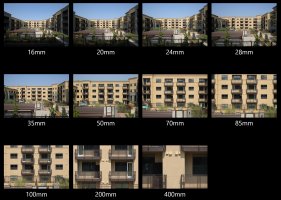
First, I decide to plant my tripod, mount my camera, and then take a 2/3rds body photo that nicely captures my friend, with a very minimal hint of where they are or what they are up to. I then swap my 50mm for a 100mm and, without moving the tripod, take a tight shot of their face: great eyes, nice hair, good looking person all-around. I then, again without moving my tripod, place my 24mm lens and take another photo — now we see they're at a park with trees and path. I repeat with my 20mm to emphasize the context a little more. I've now told a small story about my friend. Interestingly, because I didn't move at all, my lenses simply served to crop the scene to focus on one aspect or the other; the relative position of everything remains the same as they come into the picture. If I digitally crop my 20mm to be like the 24, or the 24 to be like the 50 then the placement of trees relative to the person and any other object remains generally the same but the amount of scene included does change. My perspective never changed from where my tripod was planted relative to the person — I simply showed more less of the world relative to that person.

Second, I instead decide to zoom with my feet and whether the 24mm or 50mm or 100mm I frame my friend to fill the sensor approximately the same: how the person looked and how objects around them appeared in relative position would change significantly. Trees would seem very close or very far away, as an example, regardless of how I might digitally crop the photos later.

So for people who shoot with primes the options matter if they are attempting to tell a story with the same perspective but different amounts of the world included in the scene. And approximately doubling the mm's from one prime to the next allows for meaningful jumps in scene crop factor to allow for different meaningful reflections on the subject without distorting the scene or subject from one photo to the next.

The Milky Way is a great extreme example because no matter where you walk to on your chosen continent your relative position to the galactic core is effectively the same: choose a 14mm, 20mm, 24mm, 35mm, etc. and you can digitally crop from wider to longer and achieve the same relative content with less scene.

You can reproduce this example with a zoom, such as 16-35 or 24-105: plant a tripod, choose a subject, take photos at different lengths, and then crop the widest to match something tighter and observe that the relative position of objects in the scene does not change.
"The Milky Way is a great extreme example because no matter where you walk to on your chosen continent your relative position to the galactic core is effectively the same: choose a 14mm, 20mm, 24mm, 35mm, etc. and you can digitally crop from wider to longer and achieve the same relative content with less scene."

yeah not that simple
 
  • Like
Reactions: 1 user
Upvote 0
If you mean the wide selection of different lenses as in the 'EF-era' I agree. But I strongly disagree with any narrowing of the discussion to video OR photography. What we have is a video AND photography! What I see is that new lenses are a little bit heavy-sided for video at the moment.

Concerning the lens market: Canon knows that much better than us. I can only speak for myself.
how does that make VCM lenses less capable for photography?
 
Upvote 0
And when will Canon start again to make proper lenses for photographers?
To be honest; I'm sick of these hyped VCM lenses for videographers - so called 'creators'. All I need are just excellent optical lenses without much 'digital correction' and also without this strict size and weight limits as for VCM lenses.
Canon already has an extended line of these light and good video lenses, so what about the very good lenses for photographers?
Same here - I hoped for an 18mm f/1.4 with very good optical correction but image height shows that this lens is meant to be used with digital correction.
So I will use my older EF glass if required which is IMO often overall well corrected and has the convenience factor of the use of variable ND filter adapters for both, video and photo and is ... available. Thankfully the IBIS of modern Canon cameras does a good job for photo with old lenses incl. the 180mm LAOWA which is great!
 
  • Like
Reactions: 1 users
Upvote 0
I'd go for mechanically linked focus with full time manual override and an external distance / depth of field gauge. Everything else can remain the same that would be compatible with those requirements.
AFAIK there are no FF AF mirrorless lenses with mechanically linked manual focus. Everything is fly by wire. With many of the modern linear AF systems I don't think it's possible (or maybe it's just impractical) to have mechanically linked MF.

This does bother me because we saw what happened with some of the older Canon lenses that were also entirely electronic for focusing. The 200/1.8L. The 50/1L. Many more. Once parts availability ends, the lens is completely useless if the AF motor dies.
 
  • Like
Reactions: 1 user
Upvote 0
Haha — I was just thinking that this morning in the shower.

Building on what you said...

While acknowledging that lenses can be used in many ways, let's look at this from the concept of matched perspective:

Let's say I have a 45mm or 50mm lens equivalent and I find my friend standing.

First, I decide to plant my tripod, mount my camera, and then take a 2/3rds body photo that nicely captures my friend, with a very minimal hint of where they are or what they are up to. I then swap my 50mm for a 100mm and, without moving the tripod, take a tight shot of their face: great eyes, nice hair, good looking person all-around. I then, again without moving my tripod, place my 24mm lens and take another photo — now we see they're at a park with trees and path. I repeat with my 20mm to emphasize the context a little more. I've now told a small story about my friend. Interestingly, because I didn't move at all, my lenses simply served to crop the scene to focus on one aspect or the other; the relative position of everything remains the same as they come into the picture. If I digitally crop my 20mm to be like the 24, or the 24 to be like the 50 then the placement of trees relative to the person and any other object remains generally the same but the amount of scene included does change. My perspective never changed from where my tripod was planted relative to the person — I simply showed more less of the world relative to that person.

Second, I instead decide to zoom with my feet and whether the 24mm or 50mm or 100mm I frame my friend to fill the sensor approximately the same: how the person looked and how objects around them appeared in relative position would change significantly. Trees would seem very close or very far away, as an example, regardless of how I might digitally crop the photos later.

So for people who shoot with primes the options matter if they are attempting to tell a story with the same perspective but different amounts of the world included in the scene. And approximately doubling the mm's from one prime to the next allows for meaningful jumps in scene crop factor to allow for different meaningful reflections on the subject without distorting the scene or subject from one photo to the next.

The Milky Way is a great extreme example because no matter where you walk to on your chosen continent your relative position to the galactic core is effectively the same: choose a 14mm, 20mm, 24mm, 35mm, etc. and you can digitally crop from wider to longer and achieve the same relative content with less scene.

You can reproduce this example with a zoom, such as 16-35 or 24-105: plant a tripod, choose a subject, take photos at different lengths, and then crop the widest to match something tighter and observe that the relative position of objects in the scene does not change.
1773415035709.jpeg
 
  • Like
Reactions: 3 users
Upvote 0
you aren't seriously comparing the EF 24mm f1.4 vs the RF 24mm f1.4 and completely ignoring the fact that the RF 24mm takes the EF version out to the woodshed in terms of image quality?


mechnical linking with no power on is a weird hill to die on when the entire view finder optical path for mirrorless.. requires power.
I have yet to see the slaughter with my own eyes, but I'll compare when I get the chance to properly play with the RF 24 based on your comment! Not that I have ever — I mean ever — complained about my 24mm quality outside of astro. But I believe you when you suggest you have.

To be fair, I was comparing the EF 24mm 1.4 ii with the EF 24-70 4 IS and noting the effect on scene inclusion due to the digital corrections. I have assumed that the larger exit on the prime has much to do with this outcome. Physics being what it is, I assume the same issues in the RF line when optics are compared. I suspect that the RF "glass" performance is really more about other factors such as the shorter distance from exit to sensor, improved IS, etc. and had the EF lines continued the glass would otherwise have been as good anyhow. I mean, look at where the big whites landed, or the 11-24 — it seems "glass" of itself had been figured out.

By the way, have you compared the amount of scene included in the final images between the EF 24 and the RF 24? Just curious. Is the same amount of view captured after digital corrections, or is one getting shorted? If the EF is getting shorted then that would be astounding and say a lot about the progress of Canon's lens element engineering capabilities in a short period of time.

It also occurs to me that if Canon makes the exit optics in such a way that the projected image covers the sensor then the same effect as the larger glass in previous iterations is probably achieved. I don't recall anyone looking at and remarking the projected image size. I'm curious.

I think I was simply turned off to the RF way of MTF by the initial one-shot limited MTF, or the need for a switch, or the need for a menu config, or the fact that still not all RF lenses can yet MTF with servo on a whim. The power thing just makes it all the more obvious. MTF in my approach is important, and I really like servo. I'm aware from an earlier discussion that I need to rent / borrow some modern RF lenses and try again.

I do also like the tactile feel of the mechanical linking. As a person who sometimes has the luxury of enjoying the experience that includes focusing just right it's nice to have the slight resistance, give, etc. when focusing. My EF 40 STM just feels... disconnected... when focusing; the exact focus achieved doesn't totally line up with the human input. It's subtle, but it is there. So it has been thus for the earlier RF lenses that I tried. It's a meh feel. Cheap even, which is ironic. Perhaps Canon has made it much better? I just haven't been bothered to check lately.
 
Upvote 0
AFAIK there are no FF AF mirrorless lenses with mechanically linked manual focus. Everything is fly by wire.
That does seem to be the trend.

With many of the modern linear AF systems I don't think it's possible (or maybe it's just impractical) to have mechanically linked MF.
I doubt it, or the EF lenses wouldn't work.

I think the loss of mechanical linking is more about giving the platform greater control over computer-controlled AF for very fast or erratic subjects, such as athletes and bats (as in the mammal). I strongly suspect that the people who tend to talk directly to Canon are more in these situations, and they can reasonably purchase (personally or via a company) multiple big white lenses, or beasts like the 28-70.

And the fact that EF lenses still reasonably exist. So if you're weird like me and like that kind of feel or universal MTF then that stockpile satisfies the need, in one way of thinking.


I just re-read your statement and I think I replied after misreading what you wrote. I agree, it probably is impractical. In which case if mechanical linking were reintroduced it might well need to be with older EF technology such as ring USM.

This does bother me because we saw what happened with some of the older Canon lenses that were also entirely electronic for focusing. The 200/1.8L. The 50/1L. Many more. Once parts availability ends, the lens is completely useless if the AF motor dies.
Bingo.


I think that if the following were achieved by Canon then mechanical linking could die a full death for my purpose and feel:
  1. Universal FTM focus during one-short and servo, regardless of lens (including older RF lenses)
  2. No need to push AF-on or shutter button
  3. Tactile feedback in the focus ring with resistance and placement stickiness (use a quality, modern L EF lens to understand this)
  4. No damage potential if the focus ring is spun with or without power
  5. No need for menu option or camera switch to engage, or default to engaged
  6. Identical approach to FTM on all Canon R cameras going forward — again, no on-body switches on some but not on others, etc.
My EF USM lenses all achieve: 1, 2, 3, 4, 5, & 6. My 40mm STM is focus by wire.

I understand that many L series RF lenses support: 4, and 1 can now be achieved for most using firmware updates for the lens and sometimes the camera. Probably all except 3 and 6 can be solved with firmware. 3 would probably require some hardware, and 6 is more of a camera design thing.
 
Last edited:
Upvote 0