photonius said:
privatebydesign said:
photonius said:
privatebydesign said:
photonius said:
privatebydesign said:
ajfotofilmagem said:
mackguyver said:
ajfotofilmagem said:
Phil Lowe said:
Just curious about something...Is there any older Canon lens - like the EF100-400L - that will be able to resolve anything close to what a 50.6mp sensor can resolve, or will buying a 50.6mp camera require all new glass?
There are several old Canon lenses able to show much more detail with a 50 megapixel camera. A brief list:
<snip>
TS-E24mm F3.5L
TS-E17mm F4L
<snip>
The TS-E lenses will be key for those wanting maximum resolution
and extended DOF. The diffraction limited aperture (DLA) is projected to be f/6.7, so f/16 or even f/11 won't be as usable at 50.6 as it is on the 5DII et al. Shooting with a T/S lens at f/5.6 or f/8 with tilt will be the way to give your image more DOF with a single exposure while keeping the aperture set for maximum sharpness.
I know some may chime in to explain all the technical details and limits here, but in practice, this is going to be the case. Hopefully this will push Canon to upgrade the non-L TS-E lenses (esp. the 45mm).
EDIT: Here's a good example from The-Digital-Picture:
300 f/2.8 IS II on the 1DsIII vs 7DII @ f/16
While not the most ideal example, the effect of diffraction on one of the sharpest lenses Canon makes is shocking on the 7DII (roughly same pixel pitch as 5Ds), even at f/11.
Good point.
I reprimanded often by people who say:
"more megapixel will never be worse" :-X
It depends if you are comparing apples to oranges, or not.
The 7DII crop is enlarged over twice as much so is an effective ff equivalent to f22. Change the crop camera aperture down 1 stop and you are looking at the same actual image qualities, or, dial f11 into the comparometer and keep the FF at f16, then you will see the true effects of diffraction at the same magnification and subject output, not so very different after all.
http://www.the-digital-picture.com/Reviews/ISO-12233-Sample-Crops.aspx?Lens=739&Camera=453&Sample=0&FLI=0&API=6&LensComp=739&CameraComp=963&SampleComp=0&FLIComp=0&APIComp=5
More MP are never worse, but look at more MP at 100% and they appear worse because you are magnifying them more. Magnify things the same and the more MP will always return more detail, even after DFA's. How much more is a test I am interested to carry out when I can come across a 5DSR, but that won't be soon and I don't expect to see much difference.
the crop should not be enlarged over 2x. the test chart should be shot at 1.6x distance, if tdp does it correctly.
Er, if you shoot something from 1.6 times the distance with the same lens and then reproduce it the same size you are enlarging it, and any IQ issues, diffraction, aberrations etc, more!
It is a 1.6 times linear enlargement, or a 1.6 x 1.6 area enlargement, which is 256% the area.
But that's not what should be happening with the test images at tdp. you have a standard test target. you use the same lens (e.g. 300mm). In one case on a FF body, let's say you are 3.5 meter away from the target to cover the test chart. With the maps-c body, you are 5.6 m away to cover the test chart. Now you zoom in 10x to show only the central circle of the test chart in both cases, the circle will be the same size. That's what you post on the web site. So, there is no extra enlargement.
Seriously?
Look, a 300mm lens has x magnification at x distance irrespective of what sensor is behind it, if you increase the distance the magnification gets less, if you reduce the distance the magnification gets higher.
How then can two cameras shot from different distances have the same size output? You enlarge the more distant shot more, that is what is being done in the linked tests. The only way you are comparing like for like with regards, in this instance, diffraction, is to shoot both cameras from the same distance with the same settings and enlarge them the same. But that is not what the first comparison does, my linked second comparison more closely emulates that from the results we have, but it still isn't quite the same.
well magnification is also Height-image divided height-object
And the two cameras have different sensor heights.
So, let's say, chart 1 meter high. M = 24/1000 for FF, for crop M = 15/1000
For tdp let's say we need to blow it up to 5 meters (and take then a 1/100 center crop).
FF: 5000/24 Total magnification from test chart to sensor to web site: 5000/24 * 24 / 1000 = 5
crop: 5000/15 total magnification 5000/15 * 15 /1000 = 5
You keep making the same mistake, but this time you have confused yourself with maths in doing it.
Think if it like this. A lens projects an image onto the sensor plane, from any distance it does this the same size irrespective of what sensor size is behind it. If you change the distance the magnification changes.
If I use a ff camera and take a frame filling image of a test target (or anything) and then want the same framing from a Canon crop camera with the same lens I have to move back 1.6 times as far, in doing so that subject is projected onto the sensor 1.6 times linear smaller, or 40% the area. If I then want to reproduce those images the same size I have to magnify the crop camera image 1.6 times linear more, or 256% the area.
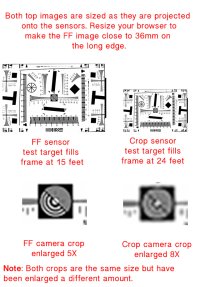
So I have made this little collage to help us along. The first two images are life sized FF and crop sensor images of a test target shot so the target fills the frame for both cameras, resize your browser window to make the FF image 36mm (or close to it) long.
These are what your sensor sees, and to make it so you need to be 1.6 times further away for the crop camera.
The second two images are enlargements of the first two such that we see a section of the test target the same size for both sensors. The FF crop is enlarged 5X, the crop camera crop has to be enlarged 8X (5x1.6=8) doing this makes the features in the two crops the same size.
The bottom two images are exactly what we are seeing in the linked tests. We can draw several conclusions from this:-[list type=decimal]
[*]The crop camera crop is enlarged more.
[*]The crop camera IQ is worse because it is enlarged more.
[*]Any aberrations are magnified more in the crop camera image.
[*]This is not a fair comparison of IQ.
[/list]