
You are using an out of date browser. It may not display this or other websites correctly.
You should upgrade or use an alternative browser.
You should upgrade or use an alternative browser.
Canon EOS 7D Mark II in Q2? [CR1]
- Thread starter Canon Rumors
- Start date
I am going to stay out of the 7d v 6d argument since both have their advantages/faults and I am waiting patiently (hard at my advanced age) to see what the 7d Mk II (or whatever) has to offer. But this picture is really impressive. Great post-processing on it. You have some serious talents and patience.jrista said:
Taken well after sunset (I could barely see the bird with my eyes, almost pitch dark):
ISO 3200, 1/6th second f/4. Lifted ~ +1 1/3rd stop in post including shadow lifts.
Effective ISO: ~8500
The latter shot was quite a feat, however both were pretty dark scenes to my own eyes. I already had the camera set on ISO 3200 and forgot to adjust it for the bird shot, because I was more concerned about keeping everything stable. Even with a tripod, a 1/6th second shot of a bird without getting motion blur required a very careful hand. ISO 6400 would have only gotten me 1/10th of a second, which wouldn't have changed the other factors. The bird, a heron, thankfully stood entirely motionless the entire time. For an effective ISO 8500 shot, it is pretty darn good for the 7D and shows its metal. Given the shutter speed, and the fact that it really was NIGHT...you could see the faintest glow of deep red on the clouds over the mountains (which were behind me), but other than that, there wasn't any real available light that I could see...this easily compares to your ISO 12800 shot.
Upvote
0
Nice shots, Jrista. Those deer are pretty cute. You definitely know how to put your 7D to good use. But (and you knew this was coming) those were all in fantastic light.
There's no question that wildlife can be out in the middle of the day. However, wildlife tends to be farther away in these situations, and usually it's harder to catch the sort of specialized behavioral activities that happen around crepuscular times, such as sparring, fighting, and hunting.
That's not what I said, though. I said most wildlife comes out at dusk and dawn, which is true.
I agree with you that FPS is nice. But it's almost irrelevant when you can't stop the action. If a grizzly comes out of the brush at dawn, and you can't freeze the bear, all the FPS and buffer in the world is worthless. That's my problem with the 7D.
Full frame will take you into another category of "light sucking". Even more so if you can slap on an F4 of F2.8 lens. You can be shooting well after the 7D is retired for the evening. Now, some may say you really should only shoot in the best light, but these people have never traveled 2,000 miles to film rare grizzly bears. The grizzlies choose the light, not you. So you take what you can get. And in this situation, the full frame sensitivity will buy you more chances than a few extra FPS.
In Montana, during the white-tail rut and bighorn rut, it gets dark at 4:30 p.m. and light at 8: a.m. The sky is often cloudy. The 7D does a mediocre job in these conditions, which is why the people I shoot with have migrated to full frame.
Anyway, cool shots. Thanks for sharing. I would be rude not to share my own now. Here's one from last December in the Montana wilderness with the 6D, at dusk and very poor light. Wild bighorn can be quite tricky.

There's no question that wildlife can be out in the middle of the day. However, wildlife tends to be farther away in these situations, and usually it's harder to catch the sort of specialized behavioral activities that happen around crepuscular times, such as sparring, fighting, and hunting.
I stand by my assertion that wildlife never being out, about, and active during daylight hours is a myth. It's harder to find your "prey" for sure, but it is very far from impossible. It just takes a little practice and skill, like any other aspect of photography.
That's not what I said, though.
I said most wildlife comes out at dusk and dawn, which is true.I agree with you that FPS is nice. But it's almost irrelevant when you can't stop the action. If a grizzly comes out of the brush at dawn, and you can't freeze the bear, all the FPS and buffer in the world is worthless. That's my problem with the 7D.
Full frame will take you into another category of "light sucking". Even more so if you can slap on an F4 of F2.8 lens. You can be shooting well after the 7D is retired for the evening. Now, some may say you really should only shoot in the best light, but these people have never traveled 2,000 miles to film rare grizzly bears. The grizzlies choose the light, not you. So you take what you can get. And in this situation, the full frame sensitivity will buy you more chances than a few extra FPS.
In Montana, during the white-tail rut and bighorn rut, it gets dark at 4:30 p.m. and light at 8: a.m. The sky is often cloudy. The 7D does a mediocre job in these conditions, which is why the people I shoot with have migrated to full frame.
Anyway, cool shots. Thanks for sharing. I would be rude not to share my own now.
Here's one from last December in the Montana wilderness with the 6D, at dusk and very poor light. Wild bighorn can be quite tricky.
Upvote
0

I work on a site that includes a military firing range.... As a result, the area is closed to the public and there are great numbers of wildlife, including deer. The deer are most active in the morning and evening. They are harder to spot in the middle of the day as they tend to stay out of the "heat of the midday sun". At night the bed down in the tall grass.
So yes, they are more likely to be spotted with the sun lower in the sky, but I've never had a problem shooting them with a crop camera..... It only rifles that you con't shoot these deer with
So yes, they are more likely to be spotted with the sun lower in the sky, but I've never had a problem shooting them with a crop camera..... It only rifles that you con't shoot these deer with
Upvote
0

MichaelHodges said:Nice shots, Jrista. Those deer are pretty cute. You definitely know how to put your 7D to good use. But (and you knew this was coming) those were all in fantastic light.
Thanks! I am pretty good with a 7D...but a lot of it is post processing. The 7D is definitely noisier...it takes some technique to make the results look good (even in good light).
You seem to have missed the last two. Go re-read...they were after sunset and literally at night. I also wouldn't say that all of the samples were in fantastic light. The first two were in pretty poor light...heavily overcast day (and they were actually fairly noisy). The last one was also taken in...odd light. I am pretty picky about my light. I generally refuse to shoot during the middle of the day unless there are just the right amount of clouds in the sky to diffuse it properly. I generally prefer morning or afternoon light, where the sun is at an angle. I also strictly try to keep myself on the sun-side of my subjects...so they get properly shaded. Sun has to be over one shoulder or the other at all times...I don't like it when the sun is directly behind me.
The last sample photo I shared was in some rather weird light. There weren't exactly clouds per-se, more like a very thin sheet of water vapor high up. It messed with the light...didn't diffuse it right, but enough that everything felt really flat. The color was weird as well. I finally gave up trying to correct it in post, because I needed a 0.5 notch on the tint slider in LR to really get it right.

So, not all were in fantastic light. Some were in ok light and the one was just in weird light...

MichaelHodges said:There's no question that wildlife can be out in the middle of the day. However, wildlife tends to be farther away in these situations, and usually it's harder to catch the sort of specialized behavioral activities that happen around crepuscular times, such as sparring, fighting, and hunting.
I've captured coyotes hunting in the afternoon on several occasions (I even shared a shot of a coyote trotting about in the afternoon light in my last post, as well as hunting before sunset in fine light). I've also caught them playing with each other before and after sunset, when there is and is not light. It's too restrictive to say sunset is the only time you can capture such activity...that's my point. And, even in the case of animals come out at dusk and dawn...they are usually out BEFORE the sun actually sets and AFTER the sun has risen for a time, so you have time (even if it is only about an hour) to photograph them in good light. I think my other low-light shot of the yearling buck after sunset in poor light also demonstrates that it isn't impossible to use the 7D in those conditions either...at least, it isn't as bad as you've made it sound.
MichaelHodges said:I stand by my assertion that wildlife never being out, about, and active during daylight hours is a myth. It's harder to find your "prey" for sure, but it is very far from impossible. It just takes a little practice and skill, like any other aspect of photography.
That's not what I said, though.
I agree with you that FPS is nice. But it's almost irrelevant when you can't stop the action. If a grizzly comes out of the brush at dawn, and you can't freeze the bear, all the FPS and buffer in the world is worthless. That's my problem with the 7D.
I guess it depends on how you use your equipment. In the case of Canon sensors, once you reach high ISO settings, read noise is 3e- or less. At ISO 3200, the 7D read noise is 2.8e-, which is actually a little better than at ISO 6400. With so little read noise, you have a lot more freedom to push exposure around in post, and you don't run the risk of encountering any banding noise, as that usually disappears entirely by ISO 1600. If I want to shoot at higher ISO settings with the 7D, all I really need to do is increase shutter speed, and increase exposure by however many stops in post. The outcome is effectively the same thing as using a higher ISO setting...visually, noise isn't any different. (In fact, this was pretty much the case with my Night Heron at Night shot.)
So if I need it, I still have both FPS and and high ISO...it's just that the ISO in camera is 3200, my shutter is faster so the images look underexposed without further processing, and I have to boost exposure in post by a stop or two to actually achieve ISO 6400 or 12800 (or even 25600 if I REALLY needed it...although by that level, the 7D's small pixels are going to be true IQ-killing factors...even with my post-processing techniques...
)MichaelHodges said:Full frame will take you into another category of "light sucking". Even more so if you can slap on an F4 of F2.8 lens. You can be shooting well after the 7D is retired for the evening. Now, some may say you really should only shoot in the best light, but these people have never traveled 2,000 miles to film rare grizzly bears. The grizzlies choose the light, not you. So you take what you can get. And in this situation, the full frame sensitivity will buy you more chances than a few extra FPS.
In the case of traveling 2000 miles to film rare grizzly bears, I honestly have to say the 6D wouldn't be my choice. It would be a 5D III at least. If I was traveling that far to film and photograph bears, I'd probably be renting a 1D X. But I certainly wouldn't be using a 6D. So yes, I agree FF has the low-light touch, not denying that at all.
If we are talking about making legitimate arguments, I am specifically saying the 6D, even with it's light sensitivity, doesn't offer me anything even remotely compelling enough to use it as a wildlife camera. I would certainly take what I can get...with a rented 1D X if the only options were buy a 6D or rent a 1D X.
MichaelHodges said:In Montana, during the white-tail rut and bighorn rut, it gets dark at 4:30 p.m. and light at 8: a.m. The sky is often cloudy. The 7D does a mediocre job in these conditions, which is why the people I shoot with have migrated to full frame.
If I lived in Montana, I'd be using FF as well. Still, it would be a 5D III or 1D X...not a 6D. The argument I'm making is quite specifically in regards to the use of the 6D as a wildlifers body...it isn't. It may have good high ISO performance...but it just isn't an action body. Maybe I've been spoiled by a high frame rate. It's possible. I would probably still want to be stuck with my 7D, and most certainly a 7D II, and employ my underexposure+virtual ISO tricks with ISO 3200 and post-process exposure boosting, than take a 6D along with me on any wildlife trip (even if it's just to my "backyard" here in Colorado).
MichaelHodges said:Anyway, cool shots. Thanks for sharing. I would be rude not to share my own now.
The ram is a beauty! Love how he's bleeting.
 I've tried to photograph bighorn on a couple occasions up Waterton Canyon. I've never captured anything I felt was a keeper. People always tell me they come down to the trail level from higher up in the mountains and that you can sometimes even give em a pet, but every time I am up there, they are way up the slope, jumping about amongst the rocks and brambles...they never really "show" themselves. At some point I'll head up there again...it's a long way, though...6.5 miles one way, so a 13 mile round trip...and you can only hike in or ride a bike...bleh.
Upvote
0
Don Haines said:I work on a site that includes a military firing range.... As a result, the area is closed to the public and there are great numbers of wildlife, including deer. The deer are most active in the morning and evening. They are harder to spot in the middle of the day as they tend to stay out of the "heat of the midday sun". At night the bed down in the tall grass.
So yes, they are more likely to be spotted with the sun lower in the sky, but I've never had a problem shooting them with a crop camera..... It only rifles that you con't shoot these deer with
Sure, animals are active around the extremes of the day. My point was that you don't have to wait for them to come to you...you can go to them as well. That's usually what I do with my 7D...I hike about and find the wildlife, wherever they are. At the right times of year, they tend not to be too dangerous or afraid either. The second photo I shared, of the yearling buck...he was incredibly curious about me, and would creep in slowly until he was about 7 feet away, then his fear would take over for just a moment and he would bound away, then go frolicking in circles around me for a while, before finally settling down again and giving me that ridiculously cute "OOOhhh, what is it! I'm SOOO CURIOUUUS!! I...just...have....to....get....a little closer.....nooooo! Hahaha!!" look. ;D ;D ;D Those shots were about 3pm in the afternoon in a meadow off the road hidden by a stand of treed during summer...so many hours before sunset (which was almost 9pm at that time.) I find deer like that all the time, and usually within 10 minutes of hiking into the woods to find a meadow somewhere.
During the rut, there is usually a period of time that starts about an hour before sunset and lasts until maybe 45 minutes after sunset where you are most likely to see two deer fighting. But earlier in the day, they kind of distance spar with each other, especially the younger bucks that don't have full racks. At least in Colorado here with the deer herds at Cherry Creek and Chatfield, the big bucks will usually have a following of yearling and two year bucks with them and their harem. These younger guys will frequently try their luck with a doe, and you can watch them chase a doe around for hours until the bull finally decides he doesn't like it, and chases the two-years off. By late afternoon, the bulls are starting to get into it...and that settles the younger bucks down. I have yet to actually photograph a fight, but I've captured sequences of big bulls corralling and controlling their does, sometimes chasing down the random stray girl.
So, at least given my experience tromping around the local state parks that I have easy access to, interesting wildlife activity is far from being restricted to just right at sunset or just right at dawn. You just have to spend the time finding it.
Upvote
0
jrista said:Don Haines said:I work on a site that includes a military firing range.... As a result, the area is closed to the public and there are great numbers of wildlife, including deer. The deer are most active in the morning and evening. They are harder to spot in the middle of the day as they tend to stay out of the "heat of the midday sun". At night the bed down in the tall grass.
So yes, they are more likely to be spotted with the sun lower in the sky, but I've never had a problem shooting them with a crop camera..... It only rifles that you con't shoot these deer with
Sure, animals are active around the extremes of the day. My point was that you don't have to wait for them to come to you...you can go to them as well. That's usually what I do with my 7D...I hike about and find the wildlife, wherever they are. At the right times of year, they tend not to be too dangerous or afraid either. The second photo I shared, of the yearling buck...he was incredibly curious about me, and would creep in slowly until he was about 7 feet away, then his fear would take over for just a moment and he would bound away, then go frolicking in circles around me for a while, before finally settling down again and giving me that ridiculously cute "OOOhhh, what is it! I'm SOOO CURIOUUUS!! I...just...have....to....get....a little closer.....nooooo! Hahaha!!" look. ;D ;D ;D Those shots were about 3pm in the afternoon in a meadow off the road hidden by a stand of treed during summer...so many hours before sunset (which was almost 9pm at that time.) I find deer like that all the time, and usually within 10 minutes of hiking into the woods to find a meadow somewhere.
During the rut, there is usually a period of time that starts about an hour before sunset and lasts until maybe 45 minutes after sunset where you are most likely to see two deer fighting. But earlier in the day, they kind of distance spar with each other, especially the younger bucks that don't have full racks. At least in Colorado here with the deer herds at Cherry Creek and Chatfield, the big bucks will usually have a following of yearling and two year bucks with them and their harem. These younger guys will frequently try their luck with a doe, and you can watch them chase a doe around for hours until the bull finally decides he doesn't like it, and chases the two-years off. By late afternoon, the bulls are starting to get into it...and that settles the younger bucks down. I have yet to actually photograph a fight, but I've captured sequences of big bulls corralling and controlling their does, sometimes chasing down the random stray girl.
So, at least given my experience tromping around the local state parks that I have easy access to, interesting wildlife activity is far from being restricted to just right at sunset or just right at dawn. You just have to spend the time finding it.
100% agreement...
I've been working outside putting a feed on a satellite dish and had the deer wander right up to me with several of them lying down in the shade of the dish.... Animals can be very easy to spot in the middle of the day if you are quiet and don't make loud noises.
The best one was the wild turkeys attacking thier reflection in the door of the building..... or the geese standing on the hood of the car....
Upvote
0
I've captured coyotes hunting in the afternoon on several occasions (I even shared a shot of a coyote trotting about in the afternoon light in my last post, as well as hunting before sunset in fine light). I've also caught them playing with each other before and after sunset, when there is and is not light. It's too restrictive to say sunset is the only time you can capture such activity...that's my point. And, even in the case of animals come out at dusk and dawn...they are usually out BEFORE the sun actually sets and AFTER the sun has risen for a time, so you have time (even if it is only about an hour) to photograph them in good light. I think my other low-light shot of the yearling buck after sunset in poor light also demonstrates that it isn't impossible to use the 7D in those conditions either...at least, it isn't as bad as you've made it sound.
Your deer shots were all in very nice light. I've gotten plenty of coyotes in the day, too. Bottom line is almost all behavior is affected by food source. But, the science is very clear. The animals we are talking about are primarily crepuscular, meaning their highest activity levels are at dusk and dawn. Anyone who's taken a road trip knows this quite well. The anxiety levels tick up a notch at dusk and in the early mornings.
The fact that I see deer and coyotes in the daytime does not mean the animals aren't crepuscular. ;
In the case of traveling 2000 miles to film rare grizzly bears, I honestly have to say the 6D wouldn't be my choice. It would be a 5D III at least. If I was traveling that far to film and photograph bears, I'd probably be renting a 1D X. But I certainly wouldn't be using a 6D. So yes, I agree FF has the low-light touch, not denying that at all.
I spend weeks with grizzlies using a 6D and 7D. I probably should just get the 1DX, but I'm waiting to see how Canon responds to the dynamic range issue. The 5D III is a slight downgrade in sensor, so I haven't gone there although it's a nice package.
If we are talking about making legitimate arguments, I am specifically saying the 6D, even with it's light sensitivity, doesn't offer me anything even remotely compelling enough to use it as a wildlife camera.
You really should shoot it alongside the 7D. The IQ is just on another level, and the usability extends into prime wildlife times. My original point was that for $1999, don't get yesterdays sensor tech. Get the FF.
If I lived in Montana, I'd be using FF as well. Still, it would be a 5D III or 1D X...not a 6D. The argument I'm making is quite specifically in regards to the use of the 6D as a wildlifers body...it isn't. It may have good high ISO performance...but it just isn't an action body.
Ovis canadensis, wild, Montana's northwest rainforest region. Full speed, full extension.
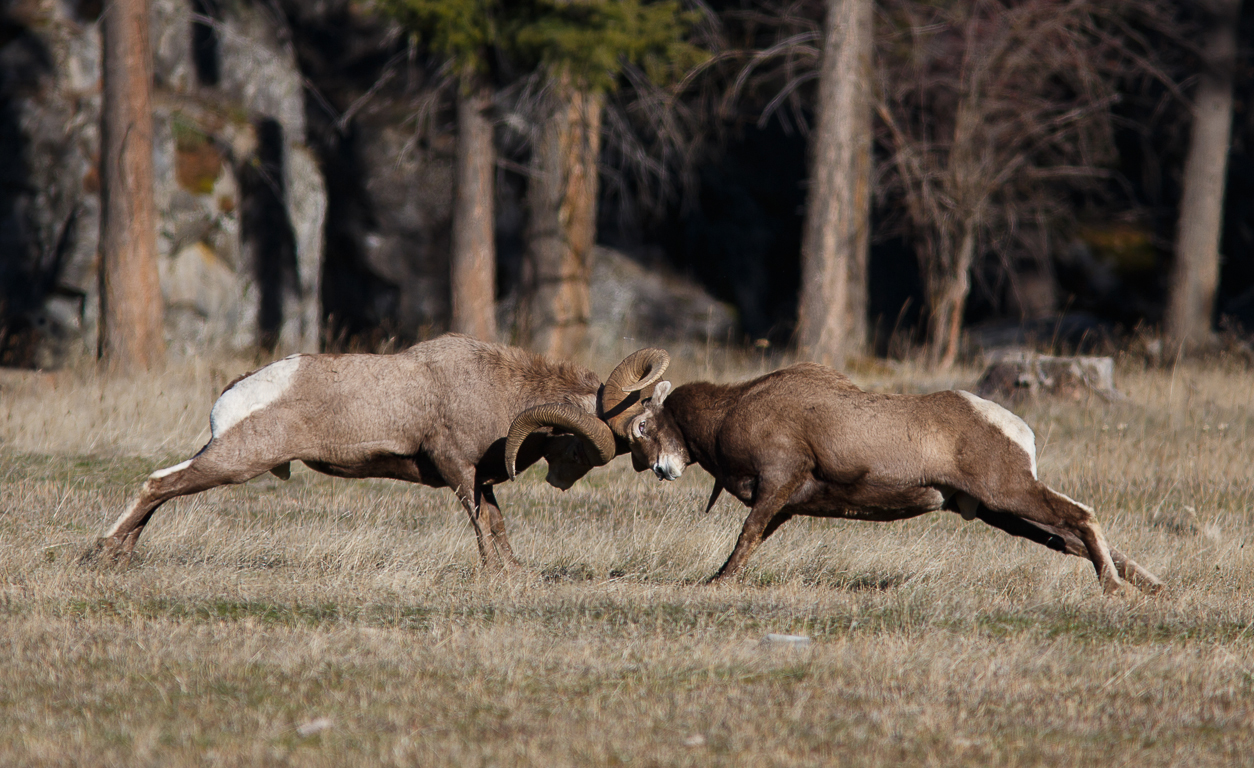
It took me six days of single digits temps to get them to do that, lol. Throughout the sessions, I basically gave up on the 7D. It was too noisy, and had more trouble focusing in the worse light...even light that wasn't necessarily bad, but one shade such as dusk or sunrise light. It also wasn't as consistent as the 6D in burst mode, making the extra FPS seem irrelevant. This is about a 65% crop.
As someone who owns a 7D and a 6D, I can't recommend the 7D over the FF camera for wildlife (especially for ungulates and bears). Again, the point I made was not 6D versus 5D III or 1DX, It was "what do you tell a wildlife photog to get when he has $1999 and is choosing between a 7D, 7D II, and a 6D". For me, after using both side by side in wilderness conditions, the choice is pretty obvious. Go with the better sensor every time.
Upvote
0
MichaelHodges said:If we are talking about making legitimate arguments, I am specifically saying the 6D, even with it's light sensitivity, doesn't offer me anything even remotely compelling enough to use it as a wildlife camera.
You really should shoot it alongside the 7D. The IQ is just on another level, and the usability extends into prime wildlife times. My original point was that for $1999, don't get yesterdays sensor tech. Get the FF.
I think this statement is radically premature: "don't get yesterdays sensor tech." The 7D II isn't even out yet. Regardless of what it ultimately is, it certainly won't be "yesterdays sensor tech". If it fuly lives up to the few things Canon has said about it, it should be a pretty amazing sensor. You can't write it off before it's even arrived!
Upvote
0
I'm a bit perplexed at the excitement for a 7D II at $1999. At that price point, you could have a 6D, which IMHO, is a superior wildlife camera.
I don't get this statement unless you know something you're not telling us. You're making a decision on the 7d II based on performance of the 7D. This is just faulty logic. No one seems to know what the 7D II will be or if/when it will actually exist. You're comparing 4 yr old tech to current tech. I would hope the current tech would be better.
I'll assume you expect the 7d II to be an incremental improvement, similar to how Canon manages the x0D line.
If this is the case there will be a lot of very disappointed people. The 7D was a huge improvement over the 50D and I expect the 7d II to be a huge improvement over the 70D.
The only thing that seems to be certain is that either you'll be surprised by the 7d II or I'll be disappointed.
Upvote
0
I have no intentions to get yesterday's sensor tech.... That's why I am waiting for the 7D2.MichaelHodges said:You really should shoot it alongside the 7D. The IQ is just on another level, and the usability extends into prime wildlife times. My original point was that for $1999, don't get yesterdays sensor tech. Get the FF.
And there is a lot more to a camera than just the sensor.... That's why the 1DX is so much nicer than a 6D and that's why, despite being more than 4 years old, the 7D is king of the crop cameras and is only now being challenged by the 70D.
The 7D2 is still speculation..... the rumours indicate a fine camera, but until it comes out, who knows what it will be.
We don't even know if the rumoured prototypes to be tested in Sochi are developemental prototypes or pre-production models.... NOTHING has been nailed down, not even the name... until it is on the market and in peoples hands, everything is pure speculation.
BTW... Remember Tamron and the 150-600? The collective wisdom before release was that it would be a terrible lens and very soft.... Then the collective wisdom was that it would not focus properly... yet as people get thier hands on them they seem to be praising the lens, and the reviewers with borrowed copies are ordering thier own... Pre-judgement is not a precise science
Upvote
0
jrista said:I think this statement is radically premature: "don't get yesterdays sensor tech." The 7D II isn't even out yet. Regardless of what it ultimately is, it certainly won't be "yesterdays sensor tech". If it fuly lives up to the few things Canon has said about it, it should be a pretty amazing sensor. You can't write it off before it's even arrived!
Basing a statement on proven physics isn't premature. There are a couple guide posts here as well: Canon continuing to lose the sensor IQ race, and the work they did on the 70D.
I hope the 7D II sensor is an improvement on the 70D sensor (which isn't impressive at all).
Upvote
0
Lurker said:I'll assume you expect the 7d II to be an incremental improvement, similar to how Canon manages the x0D line.
If this is the case there will be a lot of very disappointed people. The 7D was a huge improvement over the 50D and I expect the 7d II to be a huge improvement over the 70D.
No, I don't expect an improvement. I don't see each new camera in the 1.6x line as automatically better than the last in terms of IQ.
I owned the 50D and upgraded to the 7D. The 50D, IMHO was a better camera. It seemed to lack the waxy-looking AA filter the 7D has, and the keeper rate was better, including lowlight focusing and cropping. It also wasn't hit with AF issues. Hand-holding was superior too, and I didn't have the problems with noisy shadows and blue skies at ISO 100 that the 7D has. The 7D does have sightly better high ISO handling, though.
Sure, the 7D has superior specs (including supposedly improved AF), but I never saw those results in the field. The one feature I really loved was the video.
Even better than the 50D, IMHO, was the 40D. This was the "sweet spot" for 1.6X. Low ISO quality was very nice, and the 40D just seemed to have better color. Very nice images from this camera, highly crop-able in ISO 100-800. Clean, crisp images.
I do hope the 7D II is fantastic so everyone can enjoy it. But my days with 18+MP 1.6x sensors are over.
Upvote
0

Lurker said:I'm a bit perplexed at the excitement for a 7D II at $1999. At that price point, you could have a 6D, which IMHO, is a superior wildlife camera.
I don't get this statement unless you know something you're not telling us. You're making a decision on the 7d II based on performance of the 7D. This is just faulty logic. No one seems to know what the 7D II will be or if/when it will actually exist. You're comparing 4 yr old tech to current tech. I would hope the current tech would be better.
I'll assume you expect the 7d II to be an incremental improvement, similar to how Canon manages the x0D line.
If this is the case there will be a lot of very disappointed people. The 7D was a huge improvement over the 50D and I expect the 7d II to be a huge improvement over the 70D.
The only thing that seems to be certain is that either you'll be surprised by the 7d II or I'll be disappointed.
True... 7D was a huge improvement over the 50D, but... 7D was a new line altogether from the x0D line....
7DII is not a new line... its a improvement from the 7D... an existing line.
From past behavior...
50D to 60D to 70D - modest improvements, some down-scaling like the magnesium alloy body.
5DII to 5DIII - modest improvements
I'm not saying that there wasn't huge leaps and bounds in the past, look at the difference between 5D classic and the 5DII. http://en.wikipedia.org/wiki/Canon_EOS_5D
I'm just saying that you shouldn't expect too much... yeah Nikon and Sony are doing great things, but they are hurting in sales... I mean aren't we still getting through the after effects of the recession?
And really... we should give the Japanese a break, including Sony and Nikon...
Aren't they still getting over the after effects of the 2011 Tsunami... its like a double blow for them. Recession + Tsunami... what the hell?
Upvote
0
Don Haines said:BTW... Remember Tamron and the 150-600? The collective wisdom before release was that it would be a terrible lens and very soft.... Then the collective wisdom was that it would not focus properly... yet as people get thier hands on them they seem to be praising the lens, and the reviewers with borrowed copies are ordering thier own... Pre-judgement is not a precise science
Exactly my point, down play it.
It will suck, it will suck ass, it will suck so bad that it will feel like [insert a past nightmare].
And then when it releases... huh... not bad after all.
Upvote
0
MichaelHodges said:jrista said:I think this statement is radically premature: "don't get yesterdays sensor tech." The 7D II isn't even out yet. Regardless of what it ultimately is, it certainly won't be "yesterdays sensor tech". If it fuly lives up to the few things Canon has said about it, it should be a pretty amazing sensor. You can't write it off before it's even arrived!
Basing a statement on proven physics isn't premature. There are a couple guide posts here as well: Canon continuing to lose the sensor IQ race, and the work they did on the 70D.
I hope the 7D II sensor is an improvement on the 70D sensor (which isn't impressive at all).
Hmm, your not giving Canon enough credit. The 70D has a 32% larger full well capacity than Canon's prior 18mp sensor. That is actually quite impressive, given the age of Canon's fabrication technology! Quantum efficiency jumped about 5%, which further helps higher ISO settings. The 70D is a quarter to a third of a stop better at all higher ISO settings than the 7D, thanks to lower read noise. The DPAF is certainly quite impressive! Even if you don't care for video, DPAF is still an impressive innovation.
The 70D, however, was never going to be the APS-C sensor that Canon used to introduce a whole bunch impressive new technology with. The 7D II is the most likely camera that Canon will introduce impressive new technology with, given that the 7D was the first to bring the (at the time "new", now much loathed so many years on and overused) 18mp APS-C sensor, the new-at-the-time 19pt AF system, and the new-at-the-time 63-zone iFCL metering sensor. The 7D was packed with new technology from Canon. Canon's customers put the 7D line on a pedestal, and expect great things from it. If Canon misses that ball, it'll hurt them.
Given the historical facts, and the position the 7D holds among Canon fans who don't have the near seven grand to shell out for a 1D X, but want the extra reach and need the higher frame rate and better AF system, it is very much premature to call the 7D II sensor "old technology". It can't just be some mediocre evolution of the old 7D sensor...that would cost Canon some customers for sure.
As for physics...there is still plenty of room to push things without necessarily innovating radical new technology. And, there is plenty of radical new technology to apply to the 7D sensor. Canon could use new silicon fabrication techniques to double or triple quantum efficiency using black silicon, which effectively eliminates photon loss due to reflection off the silicon itself. They could employ light pipes to reduce reflection off the wire etching around each photodioe. They could move to BSI. They could layer photodiodes to increase FWC. They could use color splitting rather than CFA to capture nearly 100% of the incident light at every pixel.
Sorry, but proven physics have achieved a hell of a lot more than you seem to be aware of. All of these technologies exist. Most of them have been employed in high sensitivity video sensor technology for a few years now. Some of them have been prototyped and proven to work (i.e. color splitting has doubled or more the low light performance of Panasonic prototype sensors, black silicon has reduced read noise to less than 2e- at room temperature and increased quantum efficiency several fold over standard silicon fabrication.) It's a long way to go before physics stops progress, ESPECIALLY at the relatively huge pixel sizes of the 7D or as proposed for the 7D II. Were still in the 3-4 micron range...researchers and small form factor manufacturers are doing amazing things at 1.1 micron, and are now moving into the 0.95µm scale.
The 7D II, if it employed even some of these technologies, could be really amazing as far as APS-C sensors go. It could close the gap quite a bit with the 5D III. Sometimes noise doesn't matter if eliminating it costs you too much in overall detail. The key strength of the 7D line is its higher pixel count, smaller pixels, and higher spatial resolution. That's where the true reach factor comes into play...and a lot of people put more value on reach and frame rate than they do on noise levels. (Not to mention the fact that noise is pretty easy to clean up in post once you know how...as my example images can attest to.)
Upvote
0
mkabi said:Lurker said:I'm a bit perplexed at the excitement for a 7D II at $1999. At that price point, you could have a 6D, which IMHO, is a superior wildlife camera.
I don't get this statement unless you know something you're not telling us. You're making a decision on the 7d II based on performance of the 7D. This is just faulty logic. No one seems to know what the 7D II will be or if/when it will actually exist. You're comparing 4 yr old tech to current tech. I would hope the current tech would be better.
I'll assume you expect the 7d II to be an incremental improvement, similar to how Canon manages the x0D line.
If this is the case there will be a lot of very disappointed people. The 7D was a huge improvement over the 50D and I expect the 7d II to be a huge improvement over the 70D.
The only thing that seems to be certain is that either you'll be surprised by the 7d II or I'll be disappointed.
True... 7D was a huge improvement over the 50D, but... 7D was a new line altogether from the x0D line....
7DII is not a new line... its a improvement from the 7D... an existing line.
...
5DII to 5DIII - modest improvements
What the? The 5D III was a MASSIVE improvement over the 5D II!!!! What are you people smoking??!?...this thread has gotten really weird. The 5D III was such a significant improvement across the board over the 5D II, so much so that it still sells like hotcakes. 6ave sold 60 copies in less than two days just two days ago! Even for a sale, that is some serious product movement...
Wow...some of the comments on this forum lately are just out of wackjob field...

If we assume the 7D II is similarly upgraded as the 5D III was, and given that sensor IQ is the single most requested improvement with the 7D II, regardless of whether that means more megapixels or fewer megapixels, and given Canon's propensity to deliver on their customers key requests...I expect the 7D II to get a better sensor. A meaningfully better sensor.
Upvote
0
There's always room to push things and improve them. The question is how long is a photog wiling to wait? By the time theoretical wish-lists come to fruition, full frame sensors will be cheaper and the point will be moot.
As far as closing the gap with the 5D III anytime soon, that's a very unrealistic "if".
Noise matters. It will always matter. In the future, IQ is what's going to keep DLSR's alive amidst the smart phone horde.
As far as closing the gap with the 5D III anytime soon, that's a very unrealistic "if".
Noise matters. It will always matter. In the future, IQ is what's going to keep DLSR's alive amidst the smart phone horde.
Upvote
0
MichaelHodges said:If I lived in Montana, I'd be using FF as well. Still, it would be a 5D III or 1D X...not a 6D. The argument I'm making is quite specifically in regards to the use of the 6D as a wildlifers body...it isn't. It may have good high ISO performance...but it just isn't an action body.
Ovis canadensis, wild, Montana's northwest rainforest region. Full speed, full extension.
It took me six days of single digits temps to get them to do that, lol. Throughout the sessions, I basically gave up on the 7D. It was too noisy, and had more trouble focusing in the worse light...even light that wasn't necessarily bad, but one shade such as dusk or sunrise light. It also wasn't as consistent as the 6D in burst mode, making the extra FPS seem irrelevant. This is about a 65% crop.
BTW, Jrista, you sort of forgot about this.
Upvote
0
Yes, but you can not make comparisons across generations. It is possible that when the 7D2 comes out that the noise levels and ISO performance will approach the 5DIII, but that comparison is as unfair as comparing a 6D to a 7D. We could compare the 70D to a 5D2... they are close, but that's also an unfair comparison....MichaelHodges said:There's always room to push things and improve them. The question is how long is a photog wiling to wait? By the time theoretical wish-lists come to fruition, full frame sensors will be cheaper and the point will be moot.
As far as closing the gap with the 5D III anytime soon, that's a very unrealistic "if".
Noise matters. It will always matter. In the future, IQ is what's going to keep DLSR's alive amidst the smart phone horde.
The fact remains that because of the difference in pixel sizes, USING THE SAME TECHNOLOGY a FF camera should be about a stop to 1 1/3 stops better than a crop camera. If new technology emerges on a crop camera that closes the gap, then as soon as it comes out on the FF camera, this gap will be restored. The cost of the actual sensor has become moot. I read somewhere that it costs 5 times as much to fabricate a FF sensor as a crop sensor... that's a pretty big disparity, but we are talking a $25 sensor against a $5 sensor... $20 difference in a thousand dollar cameras is not a big thing... What makes a 7D2 more expensive than a 6D is everything else... AF, Frame rate, weather sealing, improved controls, possible high speed storage, etc
And far far more important that sensors, we have AF. As I never tire saying, who cares what the IQ is on a blurry picture?
Upvote
0
Similar threads

- Replies
- 393
- Views
- 130K

- Replies
- 210
- Views
- 83K
- Replies
- 27
- Views
- 9K

- Replies
- 41
- Views
- 22K
- Replies
- 21
- Views
- 10K