Canon EOS 7D Mark II in Q2? [CR1]

hampai said:
Its time to get my Fony soon if Canon don't wake up.

Wrong thread. Look at the "Wake up Canon" thread or the "Switching Systems" thread or the multitude of threads of the Sony thread. No point in comparing a Sony A7/A7R to the 7DII, let me save you some time and tell you that the IQ of the 7DII will not be better than the Sony A7/A7R. Because the 7DII will be a an APS-C and the Sony will be a full frame.

Sabaki said:
Number one feature I want for the 7D II?

A friggin' release date!

With your gear list, can I recommend a 6D, a 5DIII, or even a 1DX(if you can afford it)? Reality is... No matter if they cram a few more MP into the 7D or not... Its still going to be underwhelming compared to a full frame camera.
 
Upvote 0
madmailman said:
Why would a pro want to use a test camera at something like the Olympics and/or the world cup. Surely they wouldn't be allowed to use/sell the images made with the test units due to the NDA's they would have signed. Canon or Nikon would have to compensate the photographers enough to cover the potential lost revenues from not being able to sell any pictures. In which case the photogs would just use the test units as teathered cameras and shoot as normal with their own kit so who really cares how reliable the test unit is. No?

Test models and prototypes are different things. A prototype is a tested model that needs to be put in the hands of a user to see how they like it. You don't "test" prototypes, you "test drive" prototypes! This is Canon getting the 7D II out into the field for some cuddle time with potential 7D II customers so they can get some real-world feedback about handling, ergonomics, performance, functionality...and any quirks that might pop up along the way.

We aren't talking about a beta test here where bugs are likely...were talking about a small set of potential models nearly ready for RTM. These bodies should have already been pretty thoroughly tested, so the chances of horrid failure out in the field should be pretty low. Its like a prototype of a new concept car...concept car companies don't hand out prototypes for people to go driving around on your average community streets if there is anything but a remote potential the car will fail, and as close to zero potential as possible that the car would fail in any hazardous manner.

I'd happily take a prototype 7D II to the Olympics...hell, I'd be ecstatic. I wouldn't want to take a preliminary test model 7D II to...well, anything.
 
Upvote 0
jrista said:
I'd happily take a prototype 7D II to the Olympics...hell, I'd be ecstatic. I wouldn't want to take a preliminary test model 7D II to...well, anything.

Only if it were to be used for fun shots, or unimportant games that you aren't being paid to cover. Why? Simply because as a sport's journalist covering such important event you would want the best body for the job, and that would be a 1D X.

I am looking forward to the 7D Mark II but it will not be as good as the 1D X, it will give more reach, be useful in that regard but I would very much doubt it would be better than the 1D X.
 
Upvote 0
dolina said:
XQD and CFast are based on PCIe and SATA technologies. As such are restricted by the same limitations. Like SATA rev 3.0 peaks at 600MB/s and PCIe rev 3.0 peaks at 800MB/s.

You're being a little imprecise there. PCIe peaks at 985 MB/s of bidirectional bandwidth per lane. However, PCIe allows you to aggregate (bond) up to 32 lanes. An x32 PCIe bus, therefore, maxes out at almost 16 gigabytes per second in each direction. Mind you, XQD currently provides only a single lane, but you could trivially turn it into a much faster standard just by throwing enough additional pins at the problem (four extra pins per lane, ignoring any ground pins that might be required to prevent crosstalk).

For a data card standard, unless I'm missing something, you could easily do away with all but three of the first 22 pins in the PCIe standard (the two SMBUS pins and one 3.3V rail). The next 14 would probably be required, though perhaps not all of the grounds. So you're at about 17 pins for the first lane, and possibly fewer. If you then add more lanes using the same ground-opposite-data scheme that PCIe connectors use, add 8 pins per additional lane.

So if you used the same 50-pin connector that CF cards use, for example, you ought to be able to do 4x PCIe with nine pins to spare (assuming that you either require everything to do 4x or require the mode to be negotiated over the SMBUS instead of using detect pins). If you use those nine pins as detect pins in some particularly smart way, you might even be able to achieve backwards compatibility with CF in both directions....
 
Upvote 0
I account for overhead. SATA 6Gbps would be 768 MB/s but no SSD I know off can consistently hit 600MB/s whether read or write.

Serial ATA International Organization interpreted 16Gb/s of SATA Express to 2GB/s. I would more likely believe 1.6GB/s to cover overhead.

I am also speculating where future unannounced versions could lead to.

dgatwood said:
dolina said:
XQD and CFast are based on PCIe and SATA technologies. As such are restricted by the same limitations. Like SATA rev 3.0 peaks at 600MB/s and PCIe rev 3.0 peaks at 800MB/s.

You're being a little imprecise there. PCIe peaks at 985 MB/s of bidirectional bandwidth per lane. However, PCIe allows you to aggregate (bond) up to 32 lanes. An x32 PCIe bus, therefore, maxes out at almost 16 gigabytes per second in each direction. Mind you, XQD currently provides only a single lane, but you could trivially turn it into a much faster standard just by throwing enough additional pins at the problem (four extra pins per lane, ignoring any ground pins that might be required to prevent crosstalk).

For a data card standard, unless I'm missing something, you could easily do away with all but three of the first 22 pins in the PCIe standard (the two SMBUS pins and one 3.3V rail). The next 14 would probably be required, though perhaps not all of the grounds. So you're at about 17 pins for the first lane, and possibly fewer. If you then add more lanes using the same ground-opposite-data scheme that PCIe connectors use, add 8 pins per additional lane.

So if you used the same 50-pin connector that CF cards use, for example, you ought to be able to do 4x PCIe with nine pins to spare (assuming that you either require everything to do 4x or require the mode to be negotiated over the SMBUS instead of using detect pins). If you use those nine pins as detect pins in some particularly smart way, you might even be able to achieve backwards compatibility with CF in both directions....
 
Upvote 0
dolina said:
I account for overhead. SATA 6Gbps would be 768 MB/s but no SSD I know off can consistently hit 600MB/s whether read or write.

Serial ATA International Organization interpreted 16Gb/s of SATA Express to 2GB/s. I would more likely believe 1.6GB/s to cover overhead.

I am also speculating where future unannounced versions could lead to.

dgatwood said:
dolina said:
XQD and CFast are based on PCIe and SATA technologies. As such are restricted by the same limitations. Like SATA rev 3.0 peaks at 600MB/s and PCIe rev 3.0 peaks at 800MB/s.

You're being a little imprecise there. PCIe peaks at 985 MB/s of bidirectional bandwidth per lane. However, PCIe allows you to aggregate (bond) up to 32 lanes. An x32 PCIe bus, therefore, maxes out at almost 16 gigabytes per second in each direction. Mind you, XQD currently provides only a single lane, but you could trivially turn it into a much faster standard just by throwing enough additional pins at the problem (four extra pins per lane, ignoring any ground pins that might be required to prevent crosstalk).

For a data card standard, unless I'm missing something, you could easily do away with all but three of the first 22 pins in the PCIe standard (the two SMBUS pins and one 3.3V rail). The next 14 would probably be required, though perhaps not all of the grounds. So you're at about 17 pins for the first lane, and possibly fewer. If you then add more lanes using the same ground-opposite-data scheme that PCIe connectors use, add 8 pins per additional lane.

So if you used the same 50-pin connector that CF cards use, for example, you ought to be able to do 4x PCIe with nine pins to spare (assuming that you either require everything to do 4x or require the mode to be negotiated over the SMBUS instead of using detect pins). If you use those nine pins as detect pins in some particularly smart way, you might even be able to achieve backwards compatibility with CF in both directions....

Is the transfer synchronous (8 bits per byte and no framing) where 16Mbits/sec = 2Mbytes per second?
Is it asynchronous (8bits per byte plus 2 framing) where 16Mbits/sec = 1.6Mbytes per second?
Is it asynchronous block (256bytes of 8 bits per byte plus 8 bits framing) where 16Mbits/sec = 1.9998Mbytes per second?
 
Upvote 0
expatinasia said:
It is a brave photographer that would test a brand new body at such an important event.

A lens is different. I would not mind testing a new lens on my favourite top of the range body.

But if I was at either of those two events mentioned (Sochi and Brazil), I would want the 1D X and only the 1D X (in multiples).

Not really, I'm guessing they would be using it initially alongside other cameras (1Dx) and will start using it during the early heats to get accustomed to it. I seriously anyone would be using one for the finals or portfolio work.
 
Upvote 0
Don Haines said:
Is the transfer synchronous (8 bits per byte and no framing) where 16Mbits/sec = 2Mbytes per second?
Is it asynchronous (8bits per byte plus 2 framing) where 16Mbits/sec = 1.6Mbytes per second?
Is it asynchronous block (256bytes of 8 bits per byte plus 8 bits framing) where 16Mbits/sec = 1.9998Mbytes per second?
Based on industry practices it appears that they are quoting raw throughput.

See explanation contained http://www.tomshardware.com/forum/271146-32-since#6004346

790-800MB/s is achievable using a PCIe SSD but no one can hit 768MB/s with SATA 6Gb/s SSD.

That is how I came about 1.6GB/s ceiling for a 16Gb/s SATA Express SSD.

I do not expect SATA Express SSDs that are below $1/GB @ 1.6GB/s sequential read/writes in 2014 based on this 2008 headline. It took them more than 5 years to get a $1/GB @ faster than 500MB/s sequential read/writes out the door. I would expect mainstream SATA Express SSDs by 2020.

Maybe by then 4K resolution *IPS displays will cost less than $1,000. The ones being peddled now at below $2,000 are TN displays.
 
Upvote 0
I'm a bit perplexed at the excitement for a 7D II at $1999. At that price point, you could have a 6D, which IMHO, is a superior wildlife camera.

Most wildlife comes out in terrible light, with dark backgrounds (forest, brush, rock etc). The 6D has a far superior center point focus in low light, and it simply takes pictures at dawn and dusk that the 7D cannot.

Fifty extra AF points and nine extra FPS don't matter when you can't freeze a sauntering moose at dusk.

As an owner of both cameras, I often chuckle at the comments that the 7D is a "great wildlife camera in good light". The problem is, the light is crap more often than not. And a cell phone image looks good in perfect light. The true mark of a good camera is what it does when conditions are marginal to sub-marginal.
 
Upvote 0
dolina said:
Don Haines said:
Is the transfer synchronous (8 bits per byte and no framing) where 16Mbits/sec = 2Mbytes per second?
Is it asynchronous (8bits per byte plus 2 framing) where 16Mbits/sec = 1.6Mbytes per second?
Is it asynchronous block (256bytes of 8 bits per byte plus 8 bits framing) where 16Mbits/sec = 1.9998Mbytes per second?
Based on industry practices it appears that they are quoting raw throughput.

See explanation contained http://www.tomshardware.com/forum/271146-32-since#6004346

790-800MB/s is achievable using a PCIe SSD but no one can hit 768MB/s with SATA 6Gb/s SSD.

That is how I came about 1.6GB/s ceiling for a 16Gb/s SATA Express SSD.

I do not expect SATA Express SSDs that are below $1/GB @ 1.6GB/s sequential read/writes in 2014 based on this 2008 headline. It took them more than 5 years to get a $1/GB @ faster than 500MB/s sequential read/writes out the door. I would expect mainstream SATA Express SSDs by 2020.

Yes but the transfer rate and the throughput rates are different. If we assume that they are using block transfers, the transfer rate is 2GB/sec. That rate remains the same no matter what the read or write speed of the card is....

For example, if the read rate of the card is 200MB/sec, the data is transferred in pulses of 2GB/sec... the line is only active 10 percent of the time. Get a 500MB/sec card and the data is still transferred in pulses of 2GB/sec, but the pulses are more frequent and the line is now active for 25 percent of the time.
 
Upvote 0
MichaelHodges said:
I'm a bit perplexed at the excitement for a 7D II at $1999. At that price point, you could have a 6D, which IMHO, is a superior wildlife camera.

Most wildlife comes out in terrible light, with dark backgrounds (forest, brush, rock etc). The 6D has a far superior center point focus in low light, and it simply takes pictures at dawn and dusk that the 7D cannot.

Fifty extra AF points and nine extra FPS don't matter when you can't freeze a sauntering moose at dusk.

As an owner of both cameras, I often chuckle at the comments that the 7D is a "great wildlife camera in good light". The problem is, the light is crap more often than not. And a cell phone image looks good in perfect light. The true mark of a good camera is what it does when conditions are marginal to sub-marginal.

I shoot a lot of airshows in full sunlight, and I guarantee you the 7D will crush the 6D in these situations.
 
Upvote 0
Drizzt321 said:
I didn't think Canon manufactured memory cards. Maybe rebranded, sure.

From Canon's 2013 financial report.

In the industry and others sector, a rebound in capital investment for memory devices led to a pickup in demand for semiconductor lithography equipment in the latter half of the year, while demand for lithography equipment used in the production of flat panel displays (FPD) showed healthy market growth for mid- and small-size panels used mainly in smartphones and tablet PCs, and a modest recovery for large-size panels.

It's easy to forget how big Canon really is. They are one of the few big players producing the machines that make computer chips.
In an indirect way you could say that a percentage of all memory cards are made by Canon.

For a company so proud of producing camera components in house, I'm actually surprised that they don't have their own line of memory cards. They certainly have the capability. For example, they do make their own LCD panels, but it seems that is mostly for industrial applications.
 
Upvote 0
MichaelHodges said:
I'm a bit perplexed at the excitement for a 7D II at $1999. At that price point, you could have a 6D, which IMHO, is a superior wildlife camera.

Most wildlife comes out in terrible light, with dark backgrounds (forest, brush, rock etc). The 6D has a far superior center point focus in low light, and it simply takes pictures at dawn and dusk that the 7D cannot.

Fifty extra AF points and nine extra FPS don't matter when you can't freeze a sauntering moose at dusk.

As an owner of both cameras, I often chuckle at the comments that the 7D is a "great wildlife camera in good light". The problem is, the light is crap more often than not. And a cell phone image looks good in perfect light. The true mark of a good camera is what it does when conditions are marginal to sub-marginal.
As someone who shoots (or more accurately, attempts to shoot) small birds in flight, the speed of the burst mode is very important. Things are happening too fast to react to. An autofocus system that is more than the centre point is very important because they do not fly straight and level... you will NOT keep them centered in the frame.

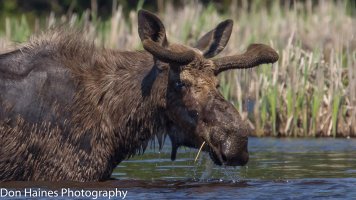
And I will defer to your knowledge of how animals only come out in poor light, although as a canoeist who can paddle silently and smoothly, my ears pick up a lot of wildlife in the daytime and my quiet calm nature lets me float and drift nearer, particularly with feeding moose.... like this one in bright sunlight at noon.
 

Attachments

  • IMG_7192.jpg
    IMG_7192.jpg
    528.9 KB · Views: 924
Upvote 0
Lee Jay said:
MichaelHodges said:
I'm a bit perplexed at the excitement for a 7D II at $1999. At that price point, you could have a 6D, which IMHO, is a superior wildlife camera.

Most wildlife comes out in terrible light, with dark backgrounds (forest, brush, rock etc). The 6D has a far superior center point focus in low light, and it simply takes pictures at dawn and dusk that the 7D cannot.

Fifty extra AF points and nine extra FPS don't matter when you can't freeze a sauntering moose at dusk.

As an owner of both cameras, I often chuckle at the comments that the 7D is a "great wildlife camera in good light". The problem is, the light is crap more often than not. And a cell phone image looks good in perfect light. The true mark of a good camera is what it does when conditions are marginal to sub-marginal.

I shoot a lot of airshows in full sunlight, and I guarantee you the 7D will crush the 6D in these situations.

That's not lowlight wildlife shooting, though, as conveyed in my post.

The 7D does have faster AI-Servo acquisition than the 6D, that's for sure. But this isn't as big of a problem for giant planes that you can predictably track versus ruffed grouse surprising the hell out of you and taking off through rays of sunlight in a dim forest.

The 7D is good at full sunlight sports, that's for sure. But so are a lot of cameras.
 
Upvote 0
Don Haines said:
As someone who shoots (or more accurately, attempts to shoot) small birds in flight, the speed of the burst mode is very important. Things are happening too fast to react to. An autofocus system that is more than the centre point is very important because they do not fly straight and level... you will NOT keep them centered in the frame.

I agree. The 7D, theoretically is better for birds in flight. The faster AI-servo acquisition and increased burst rate/FPS is a big advantage. But, where the 7D loses is in feather detail and noise in less than ideal conditions. Also, you can always tell what bird shots were taken with a 7D...the backgrounds are often blocky and noisy, especially in blue skies.


And I will defer to your knowledge of how animals only come out in poor light, although as a canoeist who can paddle silently and smoothly, my ears pick up a lot of wildlife in the daytime and my quiet calm nature lets me float and drift nearer, particularly with feeding moose.... like this one in bright sunlight at noon.

Nice shot.
 
Upvote 0
Lee Jay said:
MichaelHodges said:
I'm a bit perplexed at the excitement for a 7D II at $1999. At that price point, you could have a 6D, which IMHO, is a superior wildlife camera.

Most wildlife comes out in terrible light, with dark backgrounds (forest, brush, rock etc). The 6D has a far superior center point focus in low light, and it simply takes pictures at dawn and dusk that the 7D cannot.

Fifty extra AF points and nine extra FPS don't matter when you can't freeze a sauntering moose at dusk.

As an owner of both cameras, I often chuckle at the comments that the 7D is a "great wildlife camera in good light". The problem is, the light is crap more often than not. And a cell phone image looks good in perfect light. The true mark of a good camera is what it does when conditions are marginal to sub-marginal.

I shoot a lot of airshows in full sunlight, and I guarantee you the 7D will crush the 6D in these situations.

Additionally, I shoot the majority of my birds and wildlife during the day, when there is plenty of light. Even when the ungulates come out "late", that is still usually before sunset, and even around sunset, the current 7D is still a superior tool than the 6D. When it comes to low light, aperture is the only thing that REALLY gets you anywhere...ISO is only a stopgap measure. I use a 600mm f/4 Lens with the 7D right now...it would only be better paired with the 7D II.

I would offer that it is more myth than fact that animals only come out in poor light. If you are only willing to sit and wait in areas where animals are known to come out at dawn or dusk, then sure, that's true. But if you actually go hunting for deer, moose, elk, bear, coyote and whatever else it is your after, then it is not all that hard to find them. I actually prefer to find wildlife during the morning hours a little after the sun has risen, or in the afternoon hours a couple/few hours before the sun sets. You get not only good light but excellent light, you can use lower ISO settings and still have good frame rates, and often the animal behavior is more interesting (i.e. coyotes hunt most around sunset, however you can find them roughhousing and playing a couple hours before and a little after sunset...you actually have a higher chance of finding different, more interesting behavior if you look for them when there is still light!)
 
Upvote 0
jrista said:
Even when the ungulates come out "late", that is still usually before sunset, and even around sunset, the current 7D is still a superior tool than the 6D.

I'd disagree there. The 7D sat in my bag for my 6D for just that reason.

I would offer that it is more myth than fact that animals only come out in poor light. If you are only willing to sit and wait in areas where animals are known to come out at dawn or dusk, then sure, that's true. But if you actually go hunting for deer, moose, elk, bear, coyote and whatever else it is your after, then it is not all that hard to find them.


Moose - crepuscular
White-tailed deer - crepuscular
Elk - crepuscular
Mule deer - crepuscular
Black bears - crepuscular
Bighorn sheep - crepuscular
Coyote - crepuscular
Wolf - crepuscular

And if you are "hunting" wildlife, chances are you're just going to scare it away. They will hear and smell a clumsy human before you even know they are there. The best option it to hike into a spot and wait them out, making sure to stay downwind. This is also a good way to surprise an animal and get your tail kicked. ;)

It goes without saying that the noise characteristics and ISO bumping of a full frame sensor completely outweighs FPS and buffer in these crepuscular situations. Of course, the ideal option is the 1DX, but not everyone can justify such a purchase. I've used my 7D in these situations thousands upon thousands of times, and the images are just too destroyed with noise (I shoot in RAW). Going to full frame in this context opened up a whole new world of shooting.

Here's an example from a recent wilderness shoot in Montana. It was -5, and just about night. Taken at ISO 12,800 with no processing in RAW:

iso12800.jpg


Now, is it a great image? No. But the 7D couldn't do it in RAW, and that's the point.

If someone said to me, "I want to shoot ungulates and bears, should I get the $1999 7D II or the 6D?" I would absolutely steer them towards the 6D.
 
Upvote 0
MichaelHodges said:
jrista said:
Even when the ungulates come out "late", that is still usually before sunset, and even around sunset, the current 7D is still a superior tool than the 6D.

I'd disagree there. The 7D sat in my bag for my 6D for just that reason.

:D Well, disagree all you want. However, if we are going to go by empirical evidence, try this. All of these shots were taken during the day, in anywhere from bright daylight to evening sun to gloomy overcast:

summer-bucks-at-cherry-creek-1-of-5.jpg

prancer-the-yearling-buck-1-of-8.jpg

beautiful-does-2-of-5.jpg

deer-at-cottonwood-creek-6-of-6.jpg

coyotes-and-the-groundlings-8-of-15.jpg

beautiful-doe.jpg

christmas-collaboration-2.jpg

old-one-eye-20131214.jpg


Sorry for the number of images...but I wanted to make as strong a point as possible, and the more examples the better: I've never had trouble finding wildlife during the day! They far more frequently seem curious of me when I'm "hunting" than afraid, probably because I wear camo and know how to move. The only times they run away is when I get too close...however with a 600mm lens on a cropped sensor, you really can't even GET that close and still be able to get the shot. All of the images above were taken with the Canon 7D and either the 100-400mm f/4.5-5.6 lens (@ 400/5.6) or the 600mm f/4 L II lens. All were taken over the last 8 months.

I stand by my assertion that wildlife never being out, about, and active during daylight hours is a myth. It's harder to find your "prey" for sure, but it is very far from impossible. It just takes a little practice and skill, like any other aspect of photography.

Animals are always out and about, for one reason or another. Or, in many cases, they may not be "about"...but you can still find them in interesting settings. A year or so ago, during early summer, I found a large group of bucks in Cherry Creek chewing cud in the waist-deep grass of a meadow, only their antlers were visible. (Not sure where the images are right now...looks like I may have never published them.) I was able to get within about 10 feet for some great shots...not even one of them seemed concerned I was there. I actually ended up making a few clicking and kissing noises to get them to be a little more interesting after I'd sat there for 10 minutes. They weren't even phased by that, and it was over a half hour before they finally decided to get up. They were momentarily startled when they first noticed some "creature" only 10 feet away, but after that they were merely curious (especially the younger ones...older bucks tend to take a single yearling under their wing the first year after their birth during non-rut moths.) They meandered on without running away after a few minutes of curious observation of the photographer, and gave me a whole bunch more interesting shots.

I'd personally take a 7D or a 7D II any day over a 6D. Not because the 6D isn't a good camera, it's great. But when it comes to any kind of action, I want at least 6fps, no less. The 6Ds 4.5fps is only marginally faster than my 450D (first DSLR)...too many lost frames with such low frame rates. Even at 6fps, you just don't always get the best moment. And I can't stress enough the value of an all-cross type 19pt AF system. I frequently shoot with off-center AF points for composition. It works well enough, even in poor light with the 100-400, that it gives the 7D that extra leg up over the 6D. So it isn't just fps, it is both fps and AF that make the 7D the more useful camera.

If it came down to the 7D II and the 5D III, it would be a tougher call. The AF of the 5D III is so good that the loss in frame rate doesn't hurt as much. The 7D AF system is better than the 6D's no question, but under extended use it does reveal a "jitter" as I call it...an inability to maintain ideal focus frame-to-frame. That often eats away at printable keepers. For web keepers, the 8fps reigns supreme, and there is no way a 6D could compare. I'd buy a 1D X if I could afford it, however if I had to choose between the 7D, 6D, and 5D III, it would be a 5D III first, 7D a very close second (and probably as a backup body regardless), and a 6D third. I suspect a 7D II will make it that much harder to choose between a 5D III and a 7D II...in particular if it has a better AF system and a higher frame rate (61pt or 41pt and 10fps would be absolutely KILLER!)

Oh, and sorry for this, but here are a couple more examples. I just have to respond to this:

MichaelHodges said:
iso12800.jpg


Now, is it a great image? No. But the 7D couldn't do it in RAW, and that's the point.

If someone said to me, "I want to shoot ungulates and bears, should I get the $1999 7D II or the 6D?" I would absolutely steer them towards the 6D.

Actually, it's a pretty good image! I wouldn't discount it. Now, the 7D certainly can't do 12800, however it can do ISO 3200 and ISO 6400 and even beyond with post-process edits, and the results can be excellent:

yearling.jpg

Taken a short while after sunset (diffuse light due to patchy clouds):
ISO 3200, 1/100th f/5.6 Lifted +1/2 stop in post plus additional shadow lifts.
Effective ISO: ~5000

night-heron-at-night-1-of-1.jpg

Taken well after sunset (I could barely see the bird with my eyes, almost pitch dark):
ISO 3200, 1/6th second f/4. Lifted ~ +1 1/3rd stop in post including shadow lifts.
Effective ISO: ~8500

The latter shot was quite a feat, however both were pretty dark scenes to my own eyes. I already had the camera set on ISO 3200 and forgot to adjust it for the bird shot, because I was more concerned about keeping everything stable. Even with a tripod, a 1/6th second shot of a bird without getting motion blur required a very careful hand. ISO 6400 would have only gotten me 1/10th of a second, which wouldn't have changed the other factors. The bird, a heron, thankfully stood entirely motionless the entire time. For an effective ISO 8500 shot, it is pretty darn good for the 7D and shows its metal. Given the shutter speed, and the fact that it really was NIGHT...you could see the faintest glow of deep red on the clouds over the mountains (which were behind me), but other than that, there wasn't any real available light that I could see...this easily compares to your ISO 12800 shot.

 
Upvote 0