MichaelHodges said:
jrista said:
Even when the ungulates come out "late", that is still usually before sunset, and even around sunset, the current 7D is still a superior tool than the 6D.
I'd disagree there. The 7D sat in my bag for my 6D for just that reason.

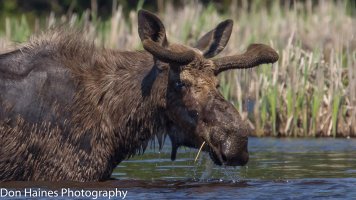
Well, disagree all you want. However, if we are going to go by empirical evidence, try this. All of these shots were taken during the day, in anywhere from bright daylight to evening sun to gloomy overcast:
Sorry for the number of images...but I wanted to make as strong a point as possible, and the more examples the better: I've never had trouble finding wildlife during the day! They far more frequently seem curious of me when I'm "hunting" than afraid, probably because I wear camo and know how to move. The only times they run away is when I get too close...however with a 600mm lens on a cropped sensor, you really can't even GET that close and still be able to get the shot. All of the images above were taken with the Canon 7D and either the 100-400mm f/4.5-5.6 lens (@ 400/5.6) or the 600mm f/4 L II lens. All were taken over the last 8 months.
I stand by my assertion that wildlife never being out, about, and active during daylight hours is a myth. It's harder to find your "prey" for sure, but it is very far from impossible. It just takes a little practice and skill, like any other aspect of photography.
Animals are always out and about, for one reason or another. Or, in many cases, they may not be "about"...but you can still find them in interesting settings. A year or so ago, during early summer, I found a large group of bucks in Cherry Creek chewing cud in the waist-deep grass of a meadow, only their antlers were visible. (Not sure where the images are right now...looks like I may have never published them.) I was able to get within about 10 feet for some great shots...not even one of them seemed concerned I was there. I actually ended up making a few clicking and kissing noises to get them to be a little more interesting after I'd sat there for 10 minutes. They weren't even phased by that, and it was over a half hour before they finally decided to get up. They were momentarily startled when they first noticed some "creature" only 10 feet away, but after that they were merely curious (especially the younger ones...older bucks tend to take a single yearling under their wing the first year after their birth during non-rut moths.) They meandered on without running away after a few minutes of curious observation of the photographer, and gave me a whole bunch more interesting shots.
I'd personally take a 7D or a 7D II any day over a 6D. Not because the 6D isn't a good camera, it's great. But when it comes to any kind of action, I want at least 6fps, no less. The 6Ds 4.5fps is only marginally faster than my 450D (first DSLR)...too many lost frames with such low frame rates. Even at 6fps, you just don't always get the best moment. And I can't stress enough the value of an all-cross type 19pt AF system. I frequently shoot with off-center AF points for composition. It works well enough, even in poor light with the 100-400, that it gives the 7D that extra leg up over the 6D. So it isn't just fps, it is both fps and AF that make the 7D the more useful camera.
If it came down to the 7D II and the 5D III, it would be a tougher call. The AF of the 5D III is so good that the loss in frame rate doesn't hurt as much. The 7D AF system is better than the 6D's no question, but under extended use it does reveal a "jitter" as I call it...an inability to maintain ideal focus frame-to-frame. That often eats away at printable keepers. For web keepers, the 8fps reigns supreme, and there is no way a 6D could compare. I'd buy a 1D X if I could afford it, however if I had to choose between the 7D, 6D, and 5D III, it would be a 5D III first, 7D a very close second (and probably as a backup body regardless), and a 6D third. I suspect a 7D II will make it that much harder to choose between a 5D III and a 7D II...in particular if it has a better AF system and a higher frame rate (61pt or 41pt and 10fps would be absolutely KILLER!)
Oh, and sorry for this, but here are a couple more examples. I just have to respond to this:
MichaelHodges said:
Now, is it a great image? No. But the 7D couldn't do it in RAW, and that's the point.
If someone said to me, "I want to shoot ungulates and bears, should I get the $1999 7D II or the 6D?" I would absolutely steer them towards the 6D.
Actually, it's a pretty good image! I wouldn't discount it. Now, the 7D certainly can't do 12800, however it can do ISO 3200 and ISO 6400 and even beyond with post-process edits, and the results can be excellent:
Taken a short while after sunset (diffuse light due to patchy clouds):
ISO 3200, 1/100th f/5.6 Lifted +1/2 stop in post plus additional shadow lifts.
Effective ISO: ~5000
Taken well after sunset (I could barely see the bird with my eyes, almost pitch dark):
ISO 3200, 1/6th second f/4. Lifted ~ +1 1/3rd stop in post including shadow lifts.
Effective ISO: ~8500
The latter shot was quite a feat, however both were pretty dark scenes to my own eyes. I already had the camera set on ISO 3200 and forgot to adjust it for the bird shot, because I was more concerned about keeping everything stable. Even with a tripod, a 1/6th second shot of a bird without getting motion blur required a very careful hand. ISO 6400 would have only gotten me 1/10th of a second, which wouldn't have changed the other factors. The bird, a heron, thankfully stood entirely motionless the entire time. For an effective ISO 8500 shot, it is pretty darn good for the 7D and shows its metal. Given the shutter speed, and the fact that it really was NIGHT...you could see the faintest glow of deep red on the clouds over the mountains (which were behind me), but other than that, there wasn't any real available light that I could see...this easily compares to your ISO 12800 shot.