Deep Sky Astrophotography (Gear Discussion)

Re: Deep Sky Astrophotography

jrista said:
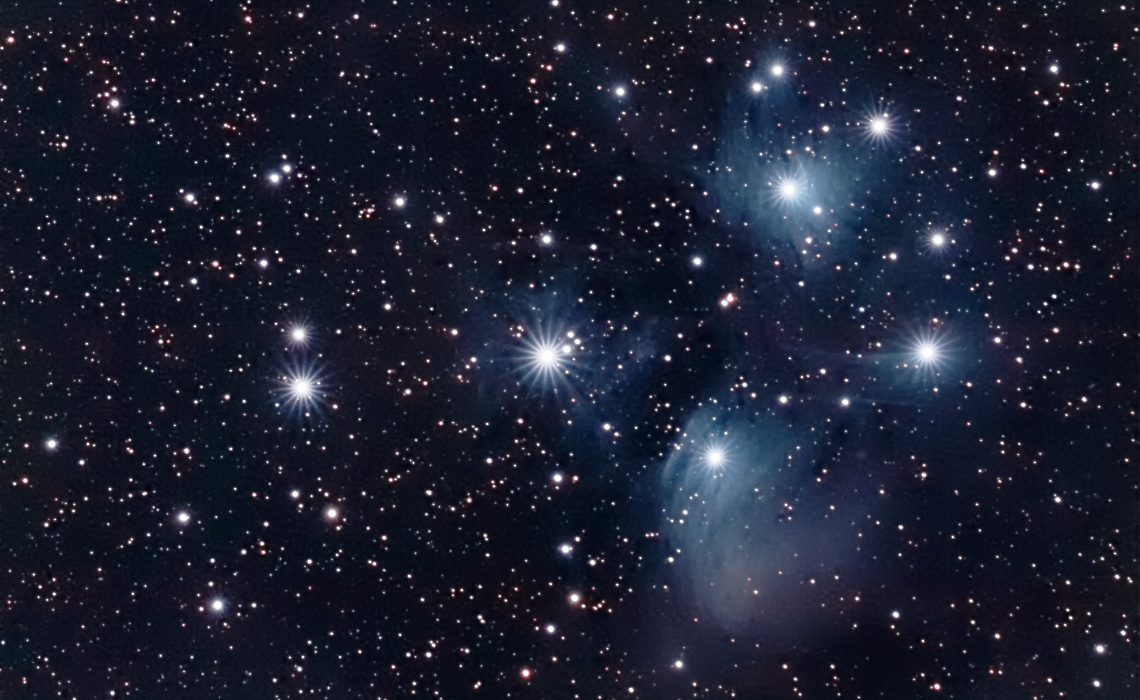
The Pleiades. The first few frames I managed to get on the first night I set up my telescope setup:

the-pleiades-first-light1.jpg


This was stacked from only a few frames, maybe 28. I had originally intended to take about 100 frames or so, but cloud cover and an accidental unplugging of my power cable ended up ending the night before it really got started.

Nice, so this was with the 600mm Canon lens and the 7D?
 
Upvote 0
Re: Deep Sky Astrophotography

This has all been very interesting and informative! But I'll stick with my plan - my budget just doesn't stretch that far! I think living in a country where the weather is unreliable, many nights ruined by cloud - and not having access to a very dark site - means it wouldn't be worth bothering with high end equipment. Mind you, it's amazing what can be done without telescopes, cooled sensors, etc.

Fwiw my roadmap goes: full frame in-body light pollution filter (just out, though not available yet) ~£130, better tracker ~£500 (minus what I can get back by selling my current one).

The latter should allow me to use the 500mm f/4 for tracked astro work at last, and that should keep me happy until midsummer, when the nights are too short here to be able to do any night sky photography. Come autumn, maybe there'll be room for another upgrade :)
 
Upvote 0
Re: Deep Sky Astrophotography

Oh, I forgot about planetarium software and plate solving. You will need that as well:

Planetarium Software:
Microsoft WorldWide Telescope
Stellarium
Cartes du Ciel
[others]

Planetarium software allows you to find things in the night sky to observe or image, and can be used to instruct the mount to go to (point the scope to) those objects. By far the easiest way to navigate the sky is with a planetarium.

I personally use Microsoft WWT. If offers a full color ultra high detail seamless map of the sky made from actual photographic images, and offers very fluid and smooth panning, zooming, tracking, etc. It has a very useful search tool. It can connect to your mount directly.

Largely a matter of taste, however.

Plate Solving:
AstroTortilla
Elbrus
Pinpoint
(SGP)*

Plate solving is a process by which an image of the sky is "solved", or where all the stars and other celestial objects are identified by matching it to an index of the sky. Plate solving allows the control software on your computer to know exactly where your mount is actually pointing. There is usually some amount of residual error in pointing, so when you tell the mount to point to "IC434" or "M45", it may not actually center that object in the view. When it comes to brighter objects, that isn't such a huge problem, you can "star hop" until you find the object visually.

For dimmer objects, it's impossible to see them unless you have a telescope with a HUGE aperture (i.e. 14" or more) and a large eyepiece...however with astrophotography, you generally don't have eyepieces and often don't have large apertures, and only computer control software with which to find things by. Accurate pointing is then quite important. By plate solving, you can automate the process of working out the error in your pointing. AstroTortilla is the simplest way to start plate solving. It's free, simple, and effective...once you get it configured right (you MUST learn how to set the min and max scaling, scale factor, and sigma values for your actual FoV of the sky with whatever lens or scope you are using in order for it to work.) AT will work with other control software like BackyardEOS, SGP, MaxIm DL to automatically take images of whatever the telescope is pointing at, solve the image, use the information about the exact region of the sky that image indicates the mount is pointing at to "sync" with the scope a new, more accurate model of the sky, and repoint. The process can automatically be repeated until your pointing accuracy is within a certain configurable precision...by default 1" (one arcsecond). After this, you should be able to point to anything on that side of the meridian (the imaginary line that goes directly overhead from north to south that divides the sky into eastern and western halves). After a meridian flip (the necessary action when an object starting in the east moves past the meridian, where the mount is reoriented in the opposite configuration to point at objects on the western side of the sky), you may need to plate solve again for pointing accuracy to be perfect again.

For fully automated imaging, you can use Sequence Generator Pro (SGP). SGP supports automatic meridian flipping and integrates plate solving to support highly accurate, fully automated all-night imaging. Without plate solving, due to the often inherent error in mount+telescope setup (called cone error, where the optical axis is not exactly at a 90° right angle to the declination axis), pointing accuracy is often off by a few minutes RA/degree or two Dec after a meridian flip. This requires meridian flips to be manual, and if you are not paying close attention to the imaging process, a meridian flip can cost you time. SGP can detect when the mount is in a "past meridian" point from the east, pause your imaging sequence, automatically do a meridian flip, plate solve and remodel the sky, repoint EXACTLY at your object (not just point, but frame it the same as well), and automatically resume your imaging sequence.

Drivers:
ASCOM

In order for you to be able to properly control your telescope and mount setup from a computer, you will need ASCOM. This is the standard component object model and driver platform that ALL telescope equipment and software use to communicate with each other. You will need ASCOM, and an ascom telescope driver. If you use an Orion Atlas and EQMOD, EQMOD includes an ASCOM compatible driver.
 
Upvote 0
Re: Deep Sky Astrophotography

scyrene said:
This has all been very interesting and informative! But I'll stick with my plan - my budget just doesn't stretch that far! I think living in a country where the weather is unreliable, many nights ruined by cloud - and not having access to a very dark site - means it wouldn't be worth bothering with high end equipment. Mind you, it's amazing what can be done without telescopes, cooled sensors, etc.

Fwiw my roadmap goes: full frame in-body light pollution filter (just out, though not available yet) ~£130, better tracker ~£500 (minus what I can get back by selling my current one).

The latter should allow me to use the 500mm f/4 for tracked astro work at last, and that should keep me happy until midsummer, when the nights are too short here to be able to do any night sky photography. Come autumn, maybe there'll be room for another upgrade :)

At 500mm, you are going to need guiding. You are also going to need a mount that can REALLY handle the load. That's an expensive lens, and relatively heavy. When you throw in the weight of the guider, the weight of the camera and lens, plus the weight of all the cables coming off them, your going to be around 20lb or so. For smooth tracking without any issues or the chance of toppling over, you want a mount that can handle twice the load. You might be able to get away with an Orion Sirius. The Sirius is $1100, and it can hold 30lb. You can usually find those used for $700, maybe a little less. I really wouldn't recommend anything smaller than that for use with your 500mm lens. If you must go cheaper, then the smallest thing I would recommend would be either the Orion SkyView Pro (which runs about $850 new), or the iOptron ZEQ25GT (also $850 new). You can find both for cheaper used (check cloudynights.com and astromart.com). The SkyView Pro can handle 20lb (your cutting it REALLY close with that), and the ZEQ25GT can handle 27lb (close, but probably acceptable.)

The iOptron mount won't support EQMOD, so it isn't at the top of my list of recommendations. I really highly recommend that you use an Orion mount...either the Sirius or the Atlas. You can find both used for pretty reasonable prices. I've even seen the Atlas mount used for as cheap as $750.
 
Upvote 0
Re: Deep Sky Astrophotography

CarlTN said:
Thank you for all the details, very interesting and impressive! I must say, the most interesting part from the perspective of photography and photo lenses, is the arrays of them you are talking about. How does that work? Do they each feed their own imager that is then digitally summed somehow, or is it mechanical, using prisms or some kind of mirrors to reflect it all into one imager?

They all have their own imagers. It's all stacked in post the same way, via an averaging algorithm. Median with Kappa-sigma clipping is a common one. Such arrays are usually mounted with custom adapters that allow multiple lenses to be attached to some kind of frame, and the frame itself is then attached to the mount. You can read about one of these, the Dragonfly Array, here: https://dl.dropboxusercontent.com/u/1727159/DFPapers/674875.pdf
 
Upvote 0
Re: Deep Sky Astrophotography

CarlTN said:
jrista said:
The Pleiades. The first few frames I managed to get on the first night I set up my telescope setup:

the-pleiades-first-light1.jpg


This was stacked from only a few frames, maybe 28. I had originally intended to take about 100 frames or so, but cloud cover and an accidental unplugging of my power cable ended up ending the night before it really got started.

Nice, so this was with the 600mm Canon lens and the 7D?

Yup!
 
Upvote 0
Re: Deep Sky Astrophotography

jrista said:
The Pleiades. The first few frames I managed to get on the first night I set up my telescope setup:

the-pleiades-first-light1.jpg


This was stacked from only a few frames, maybe 28. I had originally intended to take about 100 frames or so, but cloud cover and an accidental unplugging of my power cable ended up ending the night before it really got started.
Nice Pictures Jon and thanks for all the information.
 
Upvote 0
Re: Deep Sky Astrophotography

jrista said:
scyrene said:
This has all been very interesting and informative! But I'll stick with my plan - my budget just doesn't stretch that far! I think living in a country where the weather is unreliable, many nights ruined by cloud - and not having access to a very dark site - means it wouldn't be worth bothering with high end equipment. Mind you, it's amazing what can be done without telescopes, cooled sensors, etc.

Fwiw my roadmap goes: full frame in-body light pollution filter (just out, though not available yet) ~£130, better tracker ~£500 (minus what I can get back by selling my current one).

The latter should allow me to use the 500mm f/4 for tracked astro work at last, and that should keep me happy until midsummer, when the nights are too short here to be able to do any night sky photography. Come autumn, maybe there'll be room for another upgrade :)

At 500mm, you are going to need guiding. You are also going to need a mount that can REALLY handle the load. That's an expensive lens, and relatively heavy. When you throw in the weight of the guider, the weight of the camera and lens, plus the weight of all the cables coming off them, your going to be around 20lb or so. For smooth tracking without any issues or the chance of toppling over, you want a mount that can handle twice the load. You might be able to get away with an Orion Sirius. The Sirius is $1100, and it can hold 30lb. You can usually find those used for $700, maybe a little less. I really wouldn't recommend anything smaller than that for use with your 500mm lens. If you must go cheaper, then the smallest thing I would recommend would be either the Orion SkyView Pro (which runs about $850 new), or the iOptron ZEQ25GT (also $850 new). You can find both for cheaper used (check cloudynights.com and astromart.com). The SkyView Pro can handle 20lb (your cutting it REALLY close with that), and the ZEQ25GT can handle 27lb (close, but probably acceptable.)

The iOptron mount won't support EQMOD, so it isn't at the top of my list of recommendations. I really highly recommend that you use an Orion mount...either the Sirius or the Atlas. You can find both used for pretty reasonable prices. I've even seen the Atlas mount used for as cheap as $750.

I don't understand what you mean by a guider. There's a new iOptron tracker out this spring here, aimed at DSLRs just like my current one. It takes up to 5+3.5kg according to the specs, although I don't know precisely what they mean. I understand what you're saying about extra capacity, but 5kg is enough for my peace of mind. Here's a link: http://www.tringastro.co.uk/ioptron-sky-guider-portable-dslr-imaging-mount-3683-p.asp

As for the others you mention... are they aimed at telescopes? I found aligning my telescope so counterintuitive I gave up, but the mount I use at present seems straightforward.

To be honest, if it cost any more than that, I'd probably give up at this point. It's too niche an area, even though I enjoy it, for me to justify too much dedicated equipment.
 
Upvote 0
Re: Deep Sky Astrophotography

scyrene said:
jrista said:
scyrene said:
This has all been very interesting and informative! But I'll stick with my plan - my budget just doesn't stretch that far! I think living in a country where the weather is unreliable, many nights ruined by cloud - and not having access to a very dark site - means it wouldn't be worth bothering with high end equipment. Mind you, it's amazing what can be done without telescopes, cooled sensors, etc.

Fwiw my roadmap goes: full frame in-body light pollution filter (just out, though not available yet) ~£130, better tracker ~£500 (minus what I can get back by selling my current one).

The latter should allow me to use the 500mm f/4 for tracked astro work at last, and that should keep me happy until midsummer, when the nights are too short here to be able to do any night sky photography. Come autumn, maybe there'll be room for another upgrade :)

At 500mm, you are going to need guiding. You are also going to need a mount that can REALLY handle the load. That's an expensive lens, and relatively heavy. When you throw in the weight of the guider, the weight of the camera and lens, plus the weight of all the cables coming off them, your going to be around 20lb or so. For smooth tracking without any issues or the chance of toppling over, you want a mount that can handle twice the load. You might be able to get away with an Orion Sirius. The Sirius is $1100, and it can hold 30lb. You can usually find those used for $700, maybe a little less. I really wouldn't recommend anything smaller than that for use with your 500mm lens. If you must go cheaper, then the smallest thing I would recommend would be either the Orion SkyView Pro (which runs about $850 new), or the iOptron ZEQ25GT (also $850 new). You can find both for cheaper used (check cloudynights.com and astromart.com). The SkyView Pro can handle 20lb (your cutting it REALLY close with that), and the ZEQ25GT can handle 27lb (close, but probably acceptable.)

The iOptron mount won't support EQMOD, so it isn't at the top of my list of recommendations. I really highly recommend that you use an Orion mount...either the Sirius or the Atlas. You can find both used for pretty reasonable prices. I've even seen the Atlas mount used for as cheap as $750.

I don't understand what you mean by a guider. There's a new iOptron tracker out this spring here, aimed at DSLRs just like my current one. It takes up to 5+3.5kg according to the specs, although I don't know precisely what they mean. I understand what you're saying about extra capacity, but 5kg is enough for my peace of mind. Here's a link: http://www.tringastro.co.uk/ioptron-sky-guider-portable-dslr-imaging-mount-3683-p.asp

As for the others you mention... are they aimed at telescopes? I found aligning my telescope so counterintuitive I gave up, but the mount I use at present seems straightforward.

To be honest, if it cost any more than that, I'd probably give up at this point. It's too niche an area, even though I enjoy it, for me to justify too much dedicated equipment.

The sky guider might work. It aligns the same way as the other mounts I mentioned, however...you look through a scope built into the mounts RA axis. It really is not counterintuitive, and once you get the hang of it, it is pretty easy and very precise. It does take some time, though.

It does not look like the sky guider is computerized, however. At 500mm, which is like a small refracting telescope, you are going to have a tough time finding objects in the sky. For wider focal lengths, you'll be fine, but 400mm and 500mm, you'll have to spend some time hunting to find the objects you are interested in. Just be aware of that.
 
Upvote 0
Re: Deep Sky Astrophotography

Two more images. Two nights ago, we had a fluke clear sky...forecast showed cloudy at sunset, turned out to be clear from sunset until after midnight. I got some imaging done on a number of objects, including Pleiades again.

This shot of the Pleiades was much more deeply exposed than my first attempt, however I ended up having some problems with my guiding that consumed a lot of the detail present in the nebula. I worked on this image for two days, but because of the guiding issues, I think it's the best I can do without trying again with better subs:

the-pleiades-recaptured-and-redone2.jpg


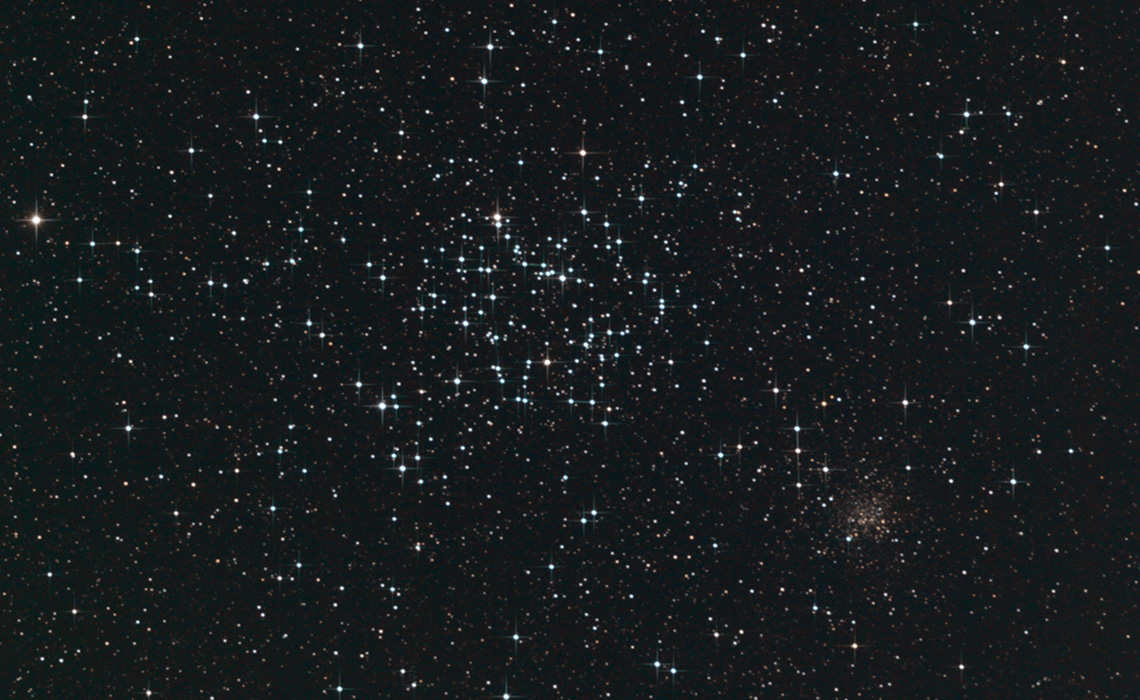
I also imaged two other regions of the sky. Orion slipped behind the trees before I had a change to get any exposure time on M78. So I looked a little higher in the sky, in Gemini. I was first looking for Jellyfish Nebula, but it is extremely dim, and I knew the mount was having problems guiding, which would have destroyed a lot of the nebula detail. So looking around the same area, I found M35 and NGC2158, two open clusters about too moon diameters above Jellyfish:

m35-and-ngc2158-open-clusters-in-gemini.jpg


The color is slightly false...the blue stars of M35 (the larger cluster) should be just a touch paler, and the red stars of NGC2158 should be a little more varied. I have to use a light pollution filter from my back yard, and it blocks out most of the greens, hence the skewed color.

I also started imaging one of the galaxy clusters in Leo, however by the time I managed to get that sequence started, the clouds had closed in, and I only managed to get 7 subs before Leo was clouded over.

I am hoping to solve my guiding issues next time there is a clear sky. I also have the option of programming PEC, or Periodic Error Correction, in my mount, which can improve tracking accuracy even further. It's complicated, though, so I haven't tried that yet. I think I'll need about five minute exposures to get good light on the galaxies (and "Galaxy Season" is coming up...once Orion sets, the Milky Way is generally out of sight for most of the night, and the constellations that are overhead, like Leo and the Big Dipper, have bunches of galaxies in them. Until late April, early May, about the only interesting things to image are galaxies.)

 
Upvote 0
Re: Deep Sky Astrophotography

CarlTN said:
Nice work. What keeps the stars from blowing out more than this, if the exposures are 5 minutes?

I use a relatively low ISO of 400. A lot of astrophotographers shoot at ISO 800 or 1600 on APS-C cameras (most often, the 18mp Canon APS-C), however that reduces the saturation point to half or one quarter what I usually get at ISO 400. It might make it a little more difficult for me to pull detail out of the shadows, but I prefer my stars not be blown.
 
Upvote 0
Re: Deep Sky Astrophotography

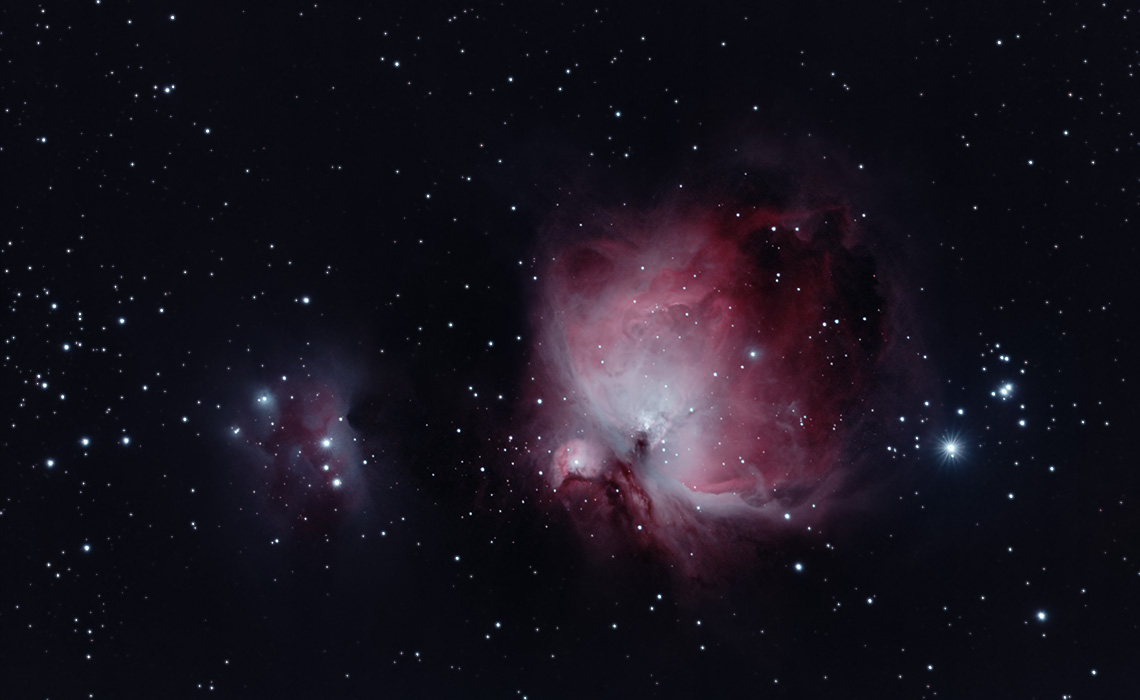
Here is an image of Orion Nebula and Running Man. This is effectively an HDR image, as this region has EXTREMELY high dynamic range. I used 30x120s + 20x60s + 20x30s exposures to capture the ultra bright core detail where the Trapezium open cluster is, (30s and 60s exposures) as well as the dimmer outer regions of the nebula (120s exposures). I'd have liked to get 240s exposures, but Orion had moved behind my trees before I was able to do that. I wasn't even able to capture all of the dimmer dust detail...and for the detail I did capture, there is probably about 20 stops of DR. I'd probably need about 24 stops of DR to capture it all, meaning I'd need several more sequeces at 240s and maybe 480s to really pull out the dark dusty detail (which fills the entire region):


Couple of close ups:

running-man.jpg

Running Man Nebula and Dark Dust Lane

m43-and-trapezium.jpg

M43 and Trapezium Core
 
Upvote 0
Re: Deep Sky Astrophotography

wearle said:
To all,

This is not quite deep-sky, but might be "landscape". :)

This is a composite image of the 2012 Perseid Meteor shower taken with a Canon 1DX and a rented Canon 8-15mm f/4.0L lens. The underlying background is a single image. I captured meteors throughout the night and picked the brightest ones to copy onto the background image. LightRoom and Photoshop CC were used to make the composite.

Thanks for looking,

Wade

Love this picture, congrats.
 
Upvote 0
Re: Deep Sky Astrophotography

jrista said:
scyrene said:
jrista said:
scyrene said:
This has all been very interesting and informative! But I'll stick with my plan - my budget just doesn't stretch that far! I think living in a country where the weather is unreliable, many nights ruined by cloud - and not having access to a very dark site - means it wouldn't be worth bothering with high end equipment. Mind you, it's amazing what can be done without telescopes, cooled sensors, etc.

Fwiw my roadmap goes: full frame in-body light pollution filter (just out, though not available yet) ~£130, better tracker ~£500 (minus what I can get back by selling my current one).

The latter should allow me to use the 500mm f/4 for tracked astro work at last, and that should keep me happy until midsummer, when the nights are too short here to be able to do any night sky photography. Come autumn, maybe there'll be room for another upgrade :)

At 500mm, you are going to need guiding. You are also going to need a mount that can REALLY handle the load. That's an expensive lens, and relatively heavy. When you throw in the weight of the guider, the weight of the camera and lens, plus the weight of all the cables coming off them, your going to be around 20lb or so. For smooth tracking without any issues or the chance of toppling over, you want a mount that can handle twice the load. You might be able to get away with an Orion Sirius. The Sirius is $1100, and it can hold 30lb. You can usually find those used for $700, maybe a little less. I really wouldn't recommend anything smaller than that for use with your 500mm lens. If you must go cheaper, then the smallest thing I would recommend would be either the Orion SkyView Pro (which runs about $850 new), or the iOptron ZEQ25GT (also $850 new). You can find both for cheaper used (check cloudynights.com and astromart.com). The SkyView Pro can handle 20lb (your cutting it REALLY close with that), and the ZEQ25GT can handle 27lb (close, but probably acceptable.)

The iOptron mount won't support EQMOD, so it isn't at the top of my list of recommendations. I really highly recommend that you use an Orion mount...either the Sirius or the Atlas. You can find both used for pretty reasonable prices. I've even seen the Atlas mount used for as cheap as $750.

I don't understand what you mean by a guider. There's a new iOptron tracker out this spring here, aimed at DSLRs just like my current one. It takes up to 5+3.5kg according to the specs, although I don't know precisely what they mean. I understand what you're saying about extra capacity, but 5kg is enough for my peace of mind. Here's a link: http://www.tringastro.co.uk/ioptron-sky-guider-portable-dslr-imaging-mount-3683-p.asp

As for the others you mention... are they aimed at telescopes? I found aligning my telescope so counterintuitive I gave up, but the mount I use at present seems straightforward.

To be honest, if it cost any more than that, I'd probably give up at this point. It's too niche an area, even though I enjoy it, for me to justify too much dedicated equipment.

The sky guider might work. It aligns the same way as the other mounts I mentioned, however...you look through a scope built into the mounts RA axis. It really is not counterintuitive, and once you get the hang of it, it is pretty easy and very precise. It does take some time, though.

It does not look like the sky guider is computerized, however. At 500mm, which is like a small refracting telescope, you are going to have a tough time finding objects in the sky. For wider focal lengths, you'll be fine, but 400mm and 500mm, you'll have to spend some time hunting to find the objects you are interested in. Just be aware of that.

You've been so kind, I hope my last replies didn't seem churlish. It is a pain finding stuff in the sky, but I have done some fixed tripod work with the 500mm lens. Some objects can be found (if they're near obvious asterisms), by hunting back and forth. A pain, but can be worth it - especially as this is a once in a quarter-year sort of endeavour. Actually, it's looking unlikely that I'll be able to devote any time to astro work this side of the summer now, so I can take stock at leisure. Maybe I'll change my mind again :)
 
Upvote 0
Re: Deep Sky Astrophotography

jrista said:
Here is an image of Orion Nebula and Running Man. This is effectively an HDR image, as this region has EXTREMELY high dynamic range. I used 30x120s + 20x60s + 20x30s exposures to capture the ultra bright core detail where the Trapezium open cluster is, (30s and 60s exposures) as well as the dimmer outer regions of the nebula (120s exposures). I'd have liked to get 240s exposures, but Orion had moved behind my trees before I was able to do that. I wasn't even able to capture all of the dimmer dust detail...and for the detail I did capture, there is probably about 20 stops of DR. I'd probably need about 24 stops of DR to capture it all, meaning I'd need several more sequeces at 240s and maybe 480s to really pull out the dark dusty detail (which fills the entire region):


Couple of close ups:

running-man.jpg

Running Man Nebula and Dark Dust Lane

m43-and-trapezium.jpg

M43 and Trapezium Core

Excellent work.
 
Upvote 0
Re: Deep Sky Astrophotography

Not sure I should even open my mouth here as I'm new to this and indeed very uneducated in the subject. I have modified my iOptron skytracker to add rigidity to the base and allow my gimbal head to be mounted on a horizonatal plane. I removed the gimbal swing arm and mounted my 300 X1.4 and was able to get quite good shots with pretty accurate focus. Aligning Polaris was not too much of an issue but it did need tweaking. With the now horizontal orientation of the iOptron base the gimbal worked really well in allowing smooth balanced movement of the lens.

However, last week I tried 300 X2 and found getting focus to be tricky becasue of lens movement due to lack of rigidity. I will try again and then perhaps have to accept that it's impractical. I'm not fully convinced, but obviously what I'm trying to do is not what anyone who is serious about the stars would be willing to accept.

An even bigger problem is my ignorance of where to aim. Also I have not yet tried stacking. I did post a shot in the other thread but I guess it's no longer active, so here's a sample at 420, 30 sec. My remote timer release is in the mail, so that'll help. Otherwise I'm all ears.

Jack
 

Attachments

  • StarSample420_14705.JPG
    StarSample420_14705.JPG
    653.3 KB · Views: 1,022
Upvote 0
Re: Deep Sky Astrophotography

jrista said:
Here is an image of Orion Nebula and Running Man. This is effectively an HDR image, as this region has EXTREMELY high dynamic range. I used 30x120s + 20x60s + 20x30s exposures to capture the ultra bright core detail where the Trapezium open cluster is, (30s and 60s exposures) as well as the dimmer outer regions of the nebula (120s exposures). I'd have liked to get 240s exposures, but Orion had moved behind my trees before I was able to do that. I wasn't even able to capture all of the dimmer dust detail...and for the detail I did capture, there is probably about 20 stops of DR. I'd probably need about 24 stops of DR to capture it all, meaning I'd need several more sequeces at 240s and maybe 480s to really pull out the dark dusty detail (which fills the entire region):


Couple of close ups:

running-man.jpg

Running Man Nebula and Dark Dust Lane

m43-and-trapezium.jpg

M43 and Trapezium Core
Truly MAGNIFICENT!
 
Upvote 0
Re: Deep Sky Astrophotography

jrista said:
Here is an image of Orion Nebula and Running Man. This is effectively an HDR image, as this region has EXTREMELY high dynamic range. I used 30x120s + 20x60s + 20x30s exposures to capture the ultra bright core detail where the Trapezium open cluster is, (30s and 60s exposures) as well as the dimmer outer regions of the nebula (120s exposures). I'd have liked to get 240s exposures, but Orion had moved behind my trees before I was able to do that. I wasn't even able to capture all of the dimmer dust detail...and for the detail I did capture, there is probably about 20 stops of DR. I'd probably need about 24 stops of DR to capture it all, meaning I'd need several more sequeces at 240s and maybe 480s to really pull out the dark dusty detail (which fills the entire region):


Couple of close ups:

running-man.jpg

Running Man Nebula and Dark Dust Lane

m43-and-trapezium.jpg

M43 and Trapezium Core

You did very well on Orion, the other two are less compelling...especially the bottom one. Scaled too large, or otherwise too soft. I'll post the one I got of Orion with just my 135 f/2 in a few days. It doesn't compare of course, haha.

Well, 5 minutes at ISO 400 on a stationary star, seems like it would still blow it out. You're wide open at f/4, correct? (Maybe you're closed down for some of the esposures in the series, and open for others?) The Pleiades primary stars would be so blown that they would appear twice as large as they do, so I'm not sure how you're doing that. It seems like the way to do it, would be to expose for only a few seconds at ISO 100 for the brighter stars...then combine that with longer exposures at ISO 400 for the Nebulae and the fainter stars.
 
Upvote 0