
That's the whole point! While what is acceptable may be very subjective, if you know what works for you, you can use MTF as a guide to decide which lens-camera combination is better suited for the job (provided there are no other real world variable). While MTF comparison of f/11/22 vs f/1.2 is not so relevant for someone who wants to shoot at f11/22 most of the time, it is valuable to know how various lens perform at this f stop.Mt Spokane Photography said:Acceptable for what?? The resolution is given on the chart, and no matter what it is, it might not be acceptable to some photographers.comsense said:I think the more relevant question to ask from these MTF charts is whether it still has an acceptable levels of sharpness at f/16 or f/22. %ages matter less in 'bigger picture' even after assuming linear correlation between variables and final pictures....Mt Spokane Photography said:There are some actual examples at Photozone. Most lenses are find at f/16, the resolution is highest at F/5.6 but drops 21% in the center by f/16. It would drop a little more at F/22.
This is a 17mm TS-E on a 5D MK II
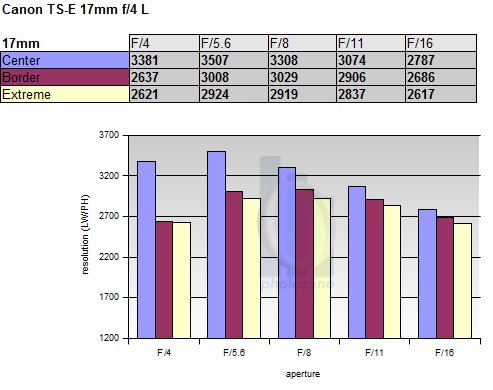
Photozone used to put a vague term like excellent, very good, good, fair, and poor on the charts. but that was another undefined term. The photographer needs to decide what is acceptable to him for his use.
Is 2700 LW/PH on a 5D MK II good enough? 2200?? Note, those values only pertain to the one camera model.
It is interesting to note that the resolution at f/16 is pretty much the same for all lenses on a 5D MK II. The diffraction appears to be the limiting factor, not the lens resolution. Since many landscape shooters use f/16, it is acceptable to most, but I'm certain its not for all..
Upvote
0


