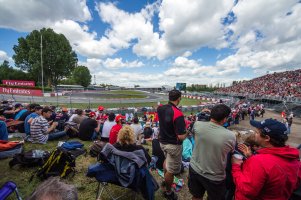
As a long time F1 fan and occasional race antendee, I agree with a lot of the points that have been made. I think the most important one is to enjoy the race first and worry about photographing it second, especially if it is your first race. Soak up the atmosphere and marvel at the astonishing, visceral sound the engines make. My wife still talks about the first time she heard an F1 engine fire up, which happened when we were a couple blocks away from the Indianapolis circuit - normally she has little interest in cars, but that really got her attention!
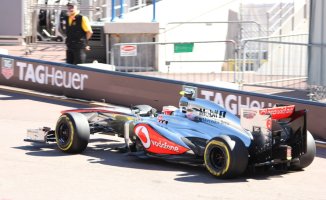
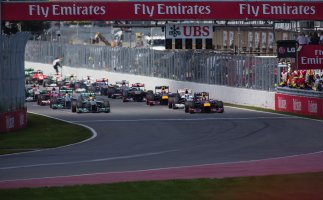
The pit straight location will be good for shots of the start, finish (especially if Vettel ignores the officials and does a few donuts!), and pit stops. Malaysia is a modern track and is very wide, with large runoff areas. Getting close to the action will probably be difficult, so a lens with reach is likely to be a good idea. That will be especially true of the pit stops, where you want to zoom in on the action. F1 pit stops are crazy fast, often around 2.5 seconds, and it is just amazing to watch 15 or more crew swarm around the car in a carefully choreographed dance of pinpoint precision. You'll have to be quick to catch it though.
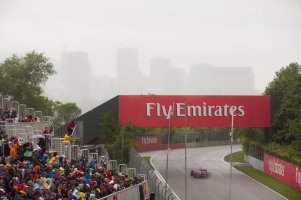
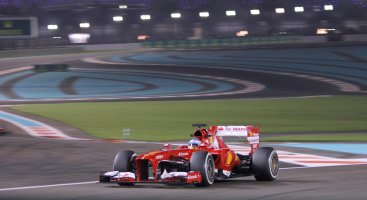
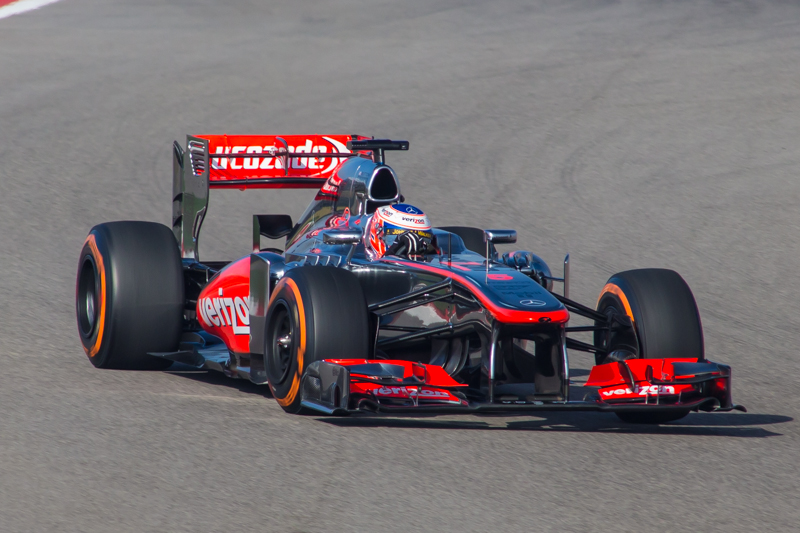
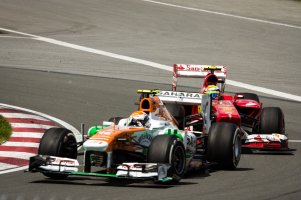
After my couple of F1 races I realized that the best place to watch is in the braking zone at the end of one of the really long straights. F1 cars can slow from 200 to 50 mph in just a few yards, and if you get it right you can get great shots of the front brake discs glowing red inside the wheels as they approach the corner (the discs are carbon, and it takes a lot of heat to do that...). This is also where most of the passing moves are completed, as a few others mentioned, so you can get shots of the cars fighting for the racing line. Collisions tend to be the rule rather than the exception on the first lap.
If your race day seats are already set, you may still be able to get some good photos from the braking zone. I'm not sure if it is the same at all the tracks, but sometimes there are no assigned seats on practice and qualifying days which means you can scoop a prime position if you get there early. Use the practice sessions to scope out different locations and find one that works best for you, then occupy it during qualifying if you can. The qualifying laps are the most extreme since the drivers have only one or two chances to get the perfect lap, and they are pushing everything to the limit. Although they won't be aggressively passing other cars, you can definitely tell the difference between a race lap and a qualifying lap. And with the freedom to change seats, you should be able to find a place with a decent, unobstructed view. Malaysia doesn't have the huge crowds and rabid fans that you see at Monza or Silverstone, which should make things a bit easier.
So from what you said about your trip, I think you'll get the best shots of the cars during practice and qualifying, and on race day you can focus on just grabbing a few photos of the start, finish and pit stops and spend most of the time enjoying the race. Do scope out the podium location well in advance - it is not always obvious where to go at the end of the race, and if you want good pics of the ceremonies you might need to leave your seat before the race is over. I've always preferred to see the finish and watch the awards on the big screens, but your preference may be different.
I can't say too much about equipment because I still had my old EOS 10S and a crappy 100-300 zoom when I last attended an F1 race. My best F1 shots came from my first race, which was in Phoenix, and I was at the start/finish. Back then the stand actually overhung the track by a few feet, and during qualifying I could lean over the edge and shoot the cars going past a few yards below. I was constantly getting hit by pieces of hot rubber coming off the tires! The coolest pics were shot with a 28mm manually focused to a spot on the track, and panning like mad whenever a car came past. Most of the time I didn't get the timing right, but when I did I got a really neat effect with different blurring on various parts of the car due to the differential speeds. Unfortunately (or fortunately, depending on how you look at it) they are now very safety concious, so this sort of thing is no longer possible.
Personally I think the panning technique with a slowish shutter speed works best when the cars are in motion, as otherwise it tends to look like they were parked on the track. But unless you can get relatively close when the crowds are smaller prior to race day, I'm not sure it will be very effective. With the exception of the above Phoenix experience, my successul panning shots have all come from lesser race series like Japan F4 or were taken at private club track days, at small tracks where it is easier to get close. There is no substitute for having your gear with you when you volunteer as a corner worker, but sadly the FIA doesn't think I am qualified to marshall an F1 race. :
:
The pit straight location will be good for shots of the start, finish (especially if Vettel ignores the officials and does a few donuts!), and pit stops. Malaysia is a modern track and is very wide, with large runoff areas. Getting close to the action will probably be difficult, so a lens with reach is likely to be a good idea. That will be especially true of the pit stops, where you want to zoom in on the action. F1 pit stops are crazy fast, often around 2.5 seconds, and it is just amazing to watch 15 or more crew swarm around the car in a carefully choreographed dance of pinpoint precision. You'll have to be quick to catch it though.
After my couple of F1 races I realized that the best place to watch is in the braking zone at the end of one of the really long straights. F1 cars can slow from 200 to 50 mph in just a few yards, and if you get it right you can get great shots of the front brake discs glowing red inside the wheels as they approach the corner (the discs are carbon, and it takes a lot of heat to do that...). This is also where most of the passing moves are completed, as a few others mentioned, so you can get shots of the cars fighting for the racing line. Collisions tend to be the rule rather than the exception on the first lap.
If your race day seats are already set, you may still be able to get some good photos from the braking zone. I'm not sure if it is the same at all the tracks, but sometimes there are no assigned seats on practice and qualifying days which means you can scoop a prime position if you get there early. Use the practice sessions to scope out different locations and find one that works best for you, then occupy it during qualifying if you can. The qualifying laps are the most extreme since the drivers have only one or two chances to get the perfect lap, and they are pushing everything to the limit. Although they won't be aggressively passing other cars, you can definitely tell the difference between a race lap and a qualifying lap. And with the freedom to change seats, you should be able to find a place with a decent, unobstructed view. Malaysia doesn't have the huge crowds and rabid fans that you see at Monza or Silverstone, which should make things a bit easier.
So from what you said about your trip, I think you'll get the best shots of the cars during practice and qualifying, and on race day you can focus on just grabbing a few photos of the start, finish and pit stops and spend most of the time enjoying the race. Do scope out the podium location well in advance - it is not always obvious where to go at the end of the race, and if you want good pics of the ceremonies you might need to leave your seat before the race is over. I've always preferred to see the finish and watch the awards on the big screens, but your preference may be different.
I can't say too much about equipment because I still had my old EOS 10S and a crappy 100-300 zoom when I last attended an F1 race. My best F1 shots came from my first race, which was in Phoenix, and I was at the start/finish. Back then the stand actually overhung the track by a few feet, and during qualifying I could lean over the edge and shoot the cars going past a few yards below. I was constantly getting hit by pieces of hot rubber coming off the tires! The coolest pics were shot with a 28mm manually focused to a spot on the track, and panning like mad whenever a car came past. Most of the time I didn't get the timing right, but when I did I got a really neat effect with different blurring on various parts of the car due to the differential speeds. Unfortunately (or fortunately, depending on how you look at it) they are now very safety concious, so this sort of thing is no longer possible.
Personally I think the panning technique with a slowish shutter speed works best when the cars are in motion, as otherwise it tends to look like they were parked on the track. But unless you can get relatively close when the crowds are smaller prior to race day, I'm not sure it will be very effective. With the exception of the above Phoenix experience, my successul panning shots have all come from lesser race series like Japan F4 or were taken at private club track days, at small tracks where it is easier to get close. There is no substitute for having your gear with you when you volunteer as a corner worker, but sadly the FIA doesn't think I am qualified to marshall an F1 race.
:
Upvote
0