
High Megapixel Camera Coming in 2015 [CR3]

NancyP said:
What ahsanford said. I would LOVE to see a high-resolution, high-dynamic-range FF body for landscape shooting. I don't care about video, high stills frame rate, fancy autofocus. Right now I am very happy with my 6D, but would like the additional DR and resolution offered by the Nikon D810 sensor. Some of the MF MA film era legacy (literally) lenses I use would have to be upgraded, no doubt, but I am in the process of doing so anyway. AIS Nikkor 50 f/1.2 and 55 f/3.5 1:2 macro and 105 f/2.5 would become Sigma Art 50 and maybe the Canon 100 2.8L IS macro (I have and really like the 180 f/3.5L macro, but it is heavy on a long hike with a bag of other lenses).

Canon landscapers almost exclusively have an 'out' to get a D8_0 sensor without waiting or converting. Since you don't need AF and can use Liveview, you can get an a7R, adapt your Canon glass to it with a fairly inexpensive adaptor ring and go to town.

No need to convert. No need to wait. Just $2200 will get you the IQ you want as a temporizing 'fix' until Canon delivers the sensor you need. I've not done this myself, and I'm not calling it a perfect solution by any stretch, but others have tried this successfully.

- A
 
Upvote 0
Lee Jay said:
pdirestajr said:
When does diffraction kick in on a 50mp 35mm sensor?! How would this be good for landscapes or studio shots where you stop down? Wouldn't scaling up a lower mp shot probably look the same?

Diffraction is always present. So I don't know what "kicks in" means.

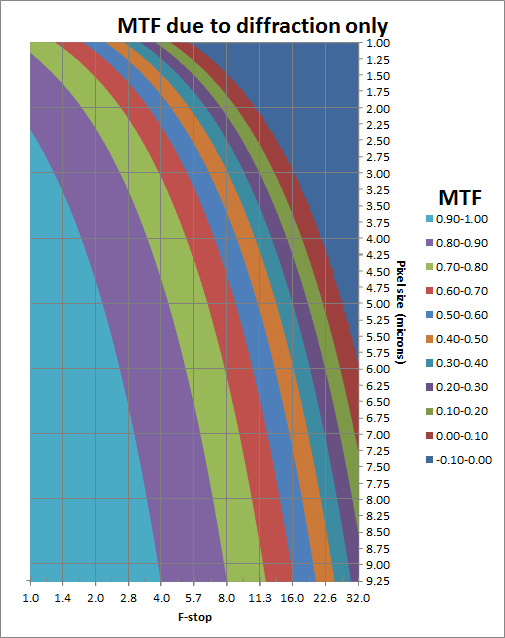
These would be about 4 micron pixels. Here's a chart for how diffraction affects MTF.

MTF%20from%20diffraction.JPG

I meant "kick-in" like when does diffraction softening become so much that we hit the point of diminishing returns? There has to be a point where just cramming more pixels on a sensor is not going to help right?

I would love a higher res 35mm digital camera from Canon as I shoot small products (like makeup), and need to blow them up to poster sizes, so I'm all for it.

I'm not a tech guy, so I'm truly asking.
 
Upvote 0
I see no point in the 'Do we need so many megapixels?' debate.
It is the future , along with more FPS, faster AF, improved video and new features yet to be invented.
It all has to start somewhere, however meaningless it may seem today ( i bet most of us can remember the early high end DSLRs and their lack of performance compared to the best film cameras.)
I say, 'Bring it on Canon' . I am a Canon system user and whatever they produce will be good ( even if their DR is somewhat lacking with respect to competitors) and I will find use for it. :)
 
Upvote 0
There are many articles about the AA filter out there, so it's use is no mystery. It is there to reduce moire, but it's drawbacks are less detail, sharpness and lower resolution. That is why the newer high MP cameras have no filter. Put the AA filter back on, and you lose the advantages of the higher MP count. Pretty simple really.
 
Upvote 0
dak723 said:
There are many articles about the AA filter out there, so it's use is no mystery. It is there to reduce moire, but it's drawbacks are less detail, sharpness and lower resolution. That is why the newer high MP cameras have no filter. Put the AA filter back on, and you lose the advantages of the higher MP count. Pretty simple really.

I'm sorry, but NO.
 
Upvote 0
dak723 said:
There are many articles about the AA filter out there, so it's use is no mystery. It is there to reduce moire, but it's drawbacks are less detail, sharpness and lower resolution. That is why the newer high MP cameras have no filter. Put the AA filter back on, and you lose the advantages of the higher MP count. Pretty simple really.

Yeah...that's pretty much all BS. There's just a hint of truth in there, barely.

An quality AA filter, with modern processing, reduces resolving power by just under 10%. However, removing the AA filter pollutes the entire spectrum with false information from beyond the spacial resolution of the sampled system.

So, which do you want? Do you want slightly lower resolution (10% is basically undetectable by eye) or a total inability to trust any of the image information you do get?

Most of the supposed increased detail from a camera that lacks an AA filter is just false detail being mistaken as actual detail by the viewer.

Ask yourself this question. If an AA filter did nothing but decrease image quality, why would camera makes put it into a camera thereby costing themselves money and buying nothing but lower image quality rankings?

The answer is simple - they don't. An expensive camera like the 7DII (which has the same size pixels as a hypothetical 50MP full-frame camera) has an AA filter because it is necessary to get the best possible image quality.
 
Upvote 0
bdunbar79 said:
dak723 said:
There are many articles about the AA filter out there, so it's use is no mystery. It is there to reduce moire, but it's drawbacks are less detail, sharpness and lower resolution. That is why the newer high MP cameras have no filter. Put the AA filter back on, and you lose the advantages of the higher MP count. Pretty simple really.

I'm sorry, but NO.

[Disclaimer to everyone: I am not of an opinion on AA, so save the daggers for someone who is... If you're a jerk, that is. (Didn't mean to presume)]

Doesn't the Nikon D800 / D800E / D810 give us a canary in the mine to suss out how real / not real the upside of pulling the AA filter is?

I thought -- again, not well read on this -- that:

The D800 had an AA filter
The D800E 'bypassed' the AA filter but it was still there? (Did I get that right?)
The D810 does not have an AA filter

Three sensors, all 36 MP, that take the same lenses on the same mount. Has anyone stacked these up head to head to sort out what the real value is? Did sharpness improve? Did moire get worse?

- A
 
Upvote 0
pdirestajr said:
Lee Jay said:
pdirestajr said:
When does diffraction kick in on a 50mp 35mm sensor?! How would this be good for landscapes or studio shots where you stop down? Wouldn't scaling up a lower mp shot probably look the same?

Diffraction is always present. So I don't know what "kicks in" means.

These would be about 4 micron pixels. Here's a chart for how diffraction affects MTF.

MTF%20from%20diffraction.JPG

I meant "kick-in" like when does diffraction softening become so much that we hit the point of diminishing returns? There has to be a point where just cramming more pixels on a sensor is not going to help right?

Yes. That point, for the original 7D, is at about f/18-f/20. In other words, if you are shooting at f/18 to f/20, the 7D's sensor is extracting all the detail available and smaller pixels would do nothing.

I'm ignoring "diminishing returns" because the returns are diminishing all the way up (see the chart - it's a curve). So, you can draw any point you want to and call it "the point of diminishing returns".
 
Upvote 0
Lee Jay said:
Ask yourself this question. If an AA filter did nothing but decrease image quality, why would camera makes put it into a camera thereby costing themselves money and buying nothing but lower image quality rankings?

The answer is simple - they don't. An expensive camera like the 7DII (which has the same size pixels as a hypothetical 50MP full-frame camera) has an AA filter because it is necessary to get the best possible image quality.

OK Lee..... this is your last warning about using common sense and logic in an emotional argument :)

and seriously, I agree!
 
Upvote 0
DarkKnightNine said:
HurtinMinorKey said:
DarkKnightNine said:
The last time I remember them doing anything that significant was adding radio to the 600EX-RT Flashes, but even that was half-assed because they took away optical IR for no particular reason.

I think the 600EX has both radio and IR.


I'm pretty sure they DO NOT and I know for a fact that the ST-E3-RT Transmitter DOES NOT. They can be fired optically with another 600EX-RT but not optically with anything else. Normally this isn't a problem, but I sometimes mix my Profoto strobes with Speedlites on location and it presents it's challenges. Fortunately Profotos do fire optically when they see my Speedlites fire, but it would be nice to fire everything from my Profoto remote rather than relying on my Speedlites to fire my studio strobes. However at this point we are getting off subject, so let's get back to that new 50MP goodie shall we?

I'm no flash expert, but I've fired a remote 600EX-RT with a camera-mounted 90EX. I assume that's optically?
 
Upvote 0
The Flasher said:
In practical terms the a7r wipes the floor with any Canon sensor on the market today. This is from resolution and perceived point of view.

Well, it has more pixels so, duh?

My point was that if the a7R looks as good as it does next to my 6D resolution and sharpness-wise then it gets my money. I don't give a S___ about Nyquist–Shannon_sampling_theorem lol.

You should - it's the basis of the entire digital world.

Both the d810 and A7r and now the d750 have the AA blur removed, look clearer and sharper without moiree. That's where my money will go, Canon failing to match that benchmark.

And they're filled with jaggies, false detail, and false resolution.

A 50MP with an AA filter will wipe the floor with a 36MP with no AA filter, and that's the right way to do it - more pixels with proper sampling rather than fewer pixels with lousy sampling.
 
Upvote 0
scyrene said:
I'm no flash expert, but I've fired a remote 600EX-RT with a camera-mounted 90EX. I assume that's optically?

Yup, Canon was kind enough to have the 90ex work as optical master, just as the pop-up flashes ... while the much more expensive 430ex2 and similar, well, kind of miss it.

Lee Jay said:
No AA filter = not positive for anything but the company making the camera (AA filters are very expensive optical devices). Removing it does not help image quality, and it does hurt image quality of still images.

Not exactly, but you should really know what you're going to shoot and if you can make use of the (tiny) difference. See the Internet photog review authority on that on the d810, "missing" both the aa filter *and* the optical low pass filter: http://www.kenrockwell.com/nikon/d810.htm
 
Upvote 0
pdirestajr said:
When does diffraction kick in on a 50mp 35mm sensor?! How would this be good for landscapes or studio shots where you stop down? Wouldn't scaling up a lower mp shot probably look the same?

There is exactly the same amount of diffraction in a print of a given size from a 12 MP camera and a 50 MP camera with the same size sensor. Higher photo site density does not create any diffraction problem whatsoever. Diffraction is an optical phenomenon, not a sensor phenomenon. The news is entirely good news.

At the same smaller apertures you might shoot on your current camera, you will get equal resolution from the higher MP body to the extent that it affected by things related to diffraction. At some larger apertures, depending on what lens you use, you might get a bit better resolution on the higher MP body.

In addition, there is that potential for smoother gradients, smaller "grain" and pixelation, etc.
 
Upvote 0
And they're filled with jaggies, false detail, and false resolution.

I see it better shadow detail, sharper images, better colour rendition.

A 50MP with an AA filter will wipe the floor with a 36MP with no AA filter, and that's the right way to do it - more pixels with proper sampling rather than fewer pixels with lousy sampling.

Fantastic. Until then the sensor with jaggies and false detail wins.
 
Upvote 0
The Flasher said:
And they're filled with jaggies, false detail, and false resolution.

I see it better shadow detail, sharper images, better colour rendition.

A 50MP with an AA filter will wipe the floor with a 36MP with no AA filter, and that's the right way to do it - more pixels with proper sampling rather than fewer pixels with lousy sampling.

Fantastic. Until then the sensor with jaggies and false detail wins.

So the ONLY reason, the ONLY single factor to your "better shadow detail, sharper images, better colour rendition", is because of the AA filter or lack of one?

By the way, "colour rendition" in digital photography doesn't mean anything at all in RAW.

Nothing personal at all, I just don't understand your statement. That's all.
 
Upvote 0
gdanmitchell said:
pdirestajr said:
When does diffraction kick in on a 50mp 35mm sensor?! How would this be good for landscapes or studio shots where you stop down? Wouldn't scaling up a lower mp shot probably look the same?

There is exactly the same amount of diffraction in a print of a given size from a 12 MP camera and a 50 MP camera with the same size sensor. Higher photo site density does not create any diffraction problem whatsoever. Diffraction is an optical phenomenon, not a sensor phenomenon. The news is entirely good news.

At the same smaller apertures you might shoot on your current camera, you will get equal resolution from the higher MP body to the extent that it affected by things related to diffraction. At some larger apertures, depending on what lens you use, you might get a bit better resolution on the higher MP body.

In addition, there is that potential for smoother gradients, smaller "grain" and pixelation, etc.


There are many who do not understand what diffraction is and that more sensor resolution is never a bad thing.
If Canon would increased the resolution it will also lead to better dynamic range.
 
Upvote 0
Giovanni said:
gdanmitchell said:
pdirestajr said:
When does diffraction kick in on a 50mp 35mm sensor?! How would this be good for landscapes or studio shots where you stop down? Wouldn't scaling up a lower mp shot probably look the same?

There is exactly the same amount of diffraction in a print of a given size from a 12 MP camera and a 50 MP camera with the same size sensor. Higher photo site density does not create any diffraction problem whatsoever. Diffraction is an optical phenomenon, not a sensor phenomenon. The news is entirely good news.

At the same smaller apertures you might shoot on your current camera, you will get equal resolution from the higher MP body to the extent that it affected by things related to diffraction. At some larger apertures, depending on what lens you use, you might get a bit better resolution on the higher MP body.

In addition, there is that potential for smoother gradients, smaller "grain" and pixelation, etc.


There are many who do not understand what is diffraction is and that more sensor resolution is never a bad thing.
If Canon would increased the resolution it will also lead to better dynamic range.

Increased resolution causes increased DR? ???
 
Upvote 0