How (and why) does sensor size change DOF?

Status
Not open for further replies.
privatebydesign said:
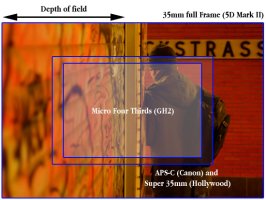
Here is a comparison I did a while ago for another thread much like this one. It is a comparison based on the above criteria. The three images are identical in dof, noise, perspective, angle of view, etc etc.

Admit it, since you knew they'd be the same you were lazy and they're all from the same camera :-p ... ok, just kidding.

Knut Skywalker said:
Why does the sensor size affect the DOF and why do FF cameras have a smaller DOF?

In addition to the good explanations from privatebydesign above, here's what I personally tell myself: To get the same shot (i.e. field of view) on a ff camera in comparison to a crop, you have to walk towards the object with a ff, resulting in a thinner dof @same aperture.

This also means that in real life, camera-object range is equaly important for the resulting dof than your sensor size, you can get very thin dof shots out of a longer lens even @medium aperture like the 70-300L@f4 which is able to focus very near objects. Play around here: http://www.dofmaster.com/dofjs.html

Last not least, note that if people rave about thin dof they often mean "strong background blur" except if you like the "only the nose in focus" type shots, and same thing here: bokeh also strongly depends on focal length and object/background distance relationship.

PS: The phrase "ff has thinner dof" indeed confusing at first, /me also German :-p and I also had to refer to this site to get a proper explanation :-)
 
Upvote 0
Or you can mostly keep discussing it whilst completely ignoring the linked articles that explain it far better then any of us. :)

What is dof? It is the distance at which a point is no longer a point but a circle (where something sharp is no longer sharp). The size of the circle or point is determined by the physical aperture (not the f stop value) and the subject magnification (not distance). Alone.

Depending on how you draw your comparison the sensor size can make a difference, or not.

Typical photo situations.
[list type=decimal]
[*]Where you have different sensors and want to take exactly the same image from the same place. To do that you use a shorter focal length lens on a crop camera, this has a smaller physical aperture for the same framing and f stop value, if you use a 160mm @ f2.8 on your FF camera you are shooting through a 57mm aperture . Whereas for your same framed shot with a crop camera a 100mm @ f2.8 gives you an aperture of 35mm (to get the same dof you need the same 57mm aperture, with your crop sensor and 100mm lens that would be f1.8 ). The smaller the aperture, in absolute terms, the greater the dof. Think pinhole cameras where everything is sharp.
[*]Where you are focal length limited. If you are shooting :) taking a picture of a bird with your two cameras, but you don't have a lens long enough to fill the frame even with the crop camera. If you crop both images to the same size, the dof is the same in both images. The physical aperture you shot through was the same, and the subject magnification is the same, so you get the same depth of field.
[/list]

If you change either the physical aperture, not necessarily the f stop value (50mm f2 is the same as 100mm f4, they both equal 25mm), or the subject magnification, you change the dof characteristics.

Subject magnification is not limited to the size it is reproduced on the sensor, it continues through to final output size. Take a slightly blurry image and down size it to a thumbnail, it will look sharp, if you make something smaller the dof increases, conversely enlarging something more makes those points and circles easier to differentiate. Take a razor sharp image and enlarge it 400%, it will look blurry from the same place, step back and it will regain its apparent sharpness. Look at a billboard from across the street, it looks sharp, now walk up to it and the "pixels" can each be two inches large.

You have to determine your specific image and comparison criteria to determine dof.
 
Upvote 0
Marsu42 said:
Last not least, note that if people rave about thin dof they often mean "strong background blur" except if you like the "only the nose in focus" type shots, and same thing here: bokeh also strongly depends on focal length and object/background distance relationship.

Except that bokeh really refers to the quality of the OOF blur, independent of quantity. But maybe that's a story for another day. ;)
 
Upvote 0
Marsu42 said:
privatebydesign said:
Here is a comparison I did a while ago for another thread much like this one. It is a comparison based on the above criteria. The three images are identical in dof, noise, perspective, angle of view, etc etc.

Admit it, since you knew they'd be the same you were lazy and they're all from the same camera :-p ... ok, just kidding.

:) No I promise they were from three different cameras. Having said that you could mimic the test with one camera and a zoom lens, just crop the zoomed in images.

I actually did the original for a talk I did on sensors, dof and other related camera stuff. Somebody said they were the same image until I pointed out some of the greenery moves between them!
 
Upvote 0
This has been confusing for me for a long time thank you everyone for clarifying it.

Here's my new understanding.
• Physically the DOF does not change because your not changing the lens (ie. set up a shot, switch a crop to a FF, and you'll just get a wider field of view but same DOF).
• But in practice it essentially does change (ie set up a shot, switch bodies, now move the came to have the same field of view, now the DOF of the crop camera photo will be larger. Same goes for not moving the camera and changing focal length).
 
Upvote 0
randerson5726 said:
This has been confusing for me for a long time thank you everyone for clarifying it.

Here's my new understanding.
• Physically the DOF does not change because your not changing the lens (ie. set up a shot, switch a crop to a FF, and you'll just get a wider field of view but same DOF).
• But in practice it essentially does change (ie set up a shot, switch bodies, now move the came to have the same field of view, now the DOF of the crop camera photo will be larger. Same goes for not moving the camera and changing focal length).

If you change your physical aperture you change dof. If you change your subject magnification you change your dof. If you don't change either you don't change dof.

So both your points are valid.
 
Upvote 0
randerson5726 said:
This has been confusing for me for a long time thank you everyone for clarifying it.

Here's my new understanding.
• Physically the DOF does not change because your not changing the lens (ie. set up a shot, switch a crop to a FF, and you'll just get a wider field of view but same DOF).
• But in practice it essentially does change (ie set up a shot, switch bodies, now move the came to have the same field of view, now the DOF of the crop camera photo will be larger. Same goes for not moving the camera and changing focal length).

Bingo! :)
 
Upvote 0
Well, thank you guys for the great explanation! I got confused because so many people stated that the DoF for a lens will be different when you use it on FF. The thing that changes the DoF is the distance to the subject to get the same framing. Basic answer to a basic question. :)
 
Upvote 0
Excellent comparison!

privatebydesign said:
Oh dear,

Anybody that wants to argue the point really needs to read my two links, and get a background understanding on the CoC, circle of confusion.

The first thing you have to do when trying to understand this dof stuff is set a standard for your comparison. If we are going to assume a same sized reproduction, ie 8"x10" print or "fill screen" on the same monitor, and frame the image the same while shooting from the same place, you have to take everything into consideration.

Here is a comparison I did a while ago for another thread much like this one. It is a comparison based on the above criteria. The three images are identical in dof, noise, perspective, angle of view, etc etc.

If you read and understand the quote from Wikipedia I posted you will understand if you change your comparison criteria you will change the dof characteristics.
 
Upvote 0
ecka said:
DoF ~ focal length * aperture * subject distance
If you want to shoot the same picture using the same lens with both FF and crop sensor cameras, you need to be closer to the subject with FF camera to get the same framing and that's the only difference.

Good concise explanation!

I think of it like this:
A photographer must frame a shot. To get the same shot as a FF using the same lens on a crop camera, the photographer has to move backwards (by a factor of 1.6). Instead of 10 feet away, he must be 16 feet away. This increased focal distance increases the DOF of the shot. Do the calculation here: http://dofmaster.com/dofjs.html
 
Upvote 0
randerson5726 said:
This has been confusing for me for a long time thank you everyone for clarifying it.

Here's my new understanding.
• Physically the DOF does not change because your not changing the lens (ie. set up a shot, switch a crop to a FF, and you'll just get a wider field of view but same DOF).
• But in practice it essentially does change (ie set up a shot, switch bodies, now move the came to have the same field of view, now the DOF of the crop camera photo will be larger. Same goes for not moving the camera and changing focal length).

Yes.

Photographers frame shots. None of the ultra-technical mumbo-jumbo about "circle of confusion" and "DOF is a function of the lens" is helpful.

Using a 50mm lens:

Framing on a FF cam at 10 feet = Framing on a crop at 16 feet

BUT the extra focal distance necessary to frame the same shot on a crop camera causes the DOF to increase. In order to get the same shallow depth of field on the crop camera, the aperture has to be opened by 1.3 stops in comparison to the FF camera.

Prove it for yourself. Go to http://dofmaster.com/dofjs.html and calculate the DOF for ( these two examples will give the same fov framing of the scene):

Crop camera with 50mm lens at f=1.8 and distance 16 feet
FF camera with 50mm lens at f=2.8 and distance of 10 feet

These two examples result in the same DOF (2.1 feet total). The crop camera needs to increase the aperture by 1.3 stops in order to get the same DOF as the FF camera.

PS ... the effect of "circle of confusion" calculations for different sensors is completely swamped by the overwhelming effect of the need to stand further back to compose with a crop camera.
 
Upvote 0
Etienne said:
ecka said:
DoF ~ focal length * aperture * subject distance
If you want to shoot the same picture using the same lens with both FF and crop sensor cameras, you need to be closer to the subject with FF camera to get the same framing and that's the only difference.

Good concise explanation!

I think of it like this:
A photographer must frame a shot. To get the same shot as a FF using the same lens on a crop camera, the photographer has to move backwards (by a factor of 1.6). Instead of 10 feet away, he must be 16 feet away. This increased focal distance increases the DOF of the shot. Do the calculation here: http://dofmaster.com/dofjs.html

It might be a concise explanation, but it is not good or accurate.

DOF, or CoC (they are entirely interchangeable), is a function of apparent aperture and subject magnification. Just those two. You can work out dof figures from just those two numbers. Subject magnification is a function of focal length and subject distance, as well as viewing distance and reproduction (print or screen) size.

When you put focal length and subject distance into a dof calculator all it is working out is the subject magnification on the sensor; it then needs the sensor size to work out the CoC for a given standard output, often an 8"x10" print viewed at 12".
 
Upvote 0
privatebydesign said:
Etienne said:
ecka said:
DoF ~ focal length * aperture * subject distance
If you want to shoot the same picture using the same lens with both FF and crop sensor cameras, you need to be closer to the subject with FF camera to get the same framing and that's the only difference.

Good concise explanation!

I think of it like this:
A photographer must frame a shot. To get the same shot as a FF using the same lens on a crop camera, the photographer has to move backwards (by a factor of 1.6). Instead of 10 feet away, he must be 16 feet away. This increased focal distance increases the DOF of the shot. Do the calculation here: http://dofmaster.com/dofjs.html

It might be a concise explanation, but it is not good or accurate.

DOF, or CoC (they are entirely interchangeable), is a function of apparent aperture and subject magnification. Just those two. You can work out dof figures from just those two numbers. Subject magnification is a function of focal length and subject distance, as well as viewing distance and reproduction (print or screen) size.

When you put focal length and subject distance into a dof calculator all it is working out is the subject magnification on the sensor; it then needs the sensor size to work out the CoC for a given standard output, often an 8"x10" print viewed at 12".

Wrong: the dof calculator also calculates the circle of confusion. http://dofmaster.com/dofjs.html

The technical mumbo-jumbo can be ignored. Crop factor cameras used to collect the same image as a FF camera will need to open the aperture by 1.3 stops in order to get the same DOF in the final image.

This is true regardless of whether you achieve the same field of view by moving the camera back by a factor of 1.6, or whether you use a shorter focal length (by a factor of 1.6, for Canon APS-C).

Circle of Confusion calculations won't make any difference at all. Partly because the effect is so small when comparing one real-world camera to another.
 
Upvote 0
Etienne said:
Wrong: the dof calculator also calculates the circle of confusion. http://dofmaster.com/dofjs.html

The technical mumbo-jumbo can be ignored.

Sorry, but then I suggest that you just ignore it, instead of calling others' correct statements wrong based on your misunderstanding.

FYI, DoFMaster doesn't calculate CoC, it assigns a standard value based on sensor size. It uses that assigned value to calculate DoF.
 
Upvote 0
neuroanatomist said:
Marsu42 said:
Last not least, note that if people rave about thin dof they often mean "strong background blur" except if you like the "only the nose in focus" type shots, and same thing here: bokeh also strongly depends on focal length and object/background distance relationship.
Except that bokeh really refers to the quality of the OOF blur, independent of quantity. But maybe that's a story for another day. ;)

Thanks for the hint, you are correct, even trusty Wikipedia says so (though you've probably written the article there :-)).
 
Upvote 0
Etienne said:
The technical mumbo-jumbo can be ignored. ..................

Circle of Confusion calculations won't make any difference at all. Partly because the effect is so small when comparing one real-world camera to another.

A common CoC figure for 135 format sensor is 0.029mm, divide that by 1.6 and you get? Voila, 0.018mm, the CoC for APS-C. if you wanted to ignore the difference in CoC, that is the same magnitude as focal length, aperture and noise, then you might as well ignore all of it!

You can't ignore the "technical mumbo-jumbo" in answering a technical question.

Now if you did want to ignore CoC differences you could, but your crop camera print (or on screen) could only be 40% as big as the ff print. If you were looking at an 8"x10" ff print you could only compare that to a 5"x6.25" crop print. Or a 12"x16" crop print would have the same CoC characteristics as a ff print 19"x26", quite a difference to my mind.
 
Upvote 0
I was hoping this thread would answer the question for me too, but I would have been better off not reading it. Now I am in the circle of confusion.

If I am understanding the consensus, the only difference is due to the need to back up or use a wider angle lens in APS-C to get the same coverage. If you have a FF and APS-C camera at the same position and same lens and aperture, the depth of field will be the same (even though the APS-C shot will be cropped tighter).

I am not sure I agree with this (but I very well could be wrong). My experience is based on shooting through zoo fences with my cousin on APS-C and me on full frame. I could swear there were times we had the same lens length and aperture and yet I could blur out the fence and he could not. I have heard that full frame cameras have a shallower depth of field and this experience seems to confirm that. Am I just imaging things?
 
Upvote 0
MrFotoFool said:
I am not sure I agree with this (but I very well could be wrong). My experience is based on shooting through zoo fences with my cousin on APS-C and me on full frame. I could swear there were times we had the same lens length and aperture and yet I could blur out the fence and he could not. I have heard that full frame cameras have a shallower depth of field and this experience seems to confirm that. Am I just imaging things?

Sorry, but probably, yes. If you were, in fact, using the same lens and aperture and not changing magnification (distance), and were the same distance from the fence, the blur would be equivalent.
 
Upvote 0
Etienne said:
privatebydesign said:
Etienne said:
ecka said:
DoF ~ focal length * aperture * subject distance
If you want to shoot the same picture using the same lens with both FF and crop sensor cameras, you need to be closer to the subject with FF camera to get the same framing and that's the only difference.

Good concise explanation!

I think of it like this:
A photographer must frame a shot. To get the same shot as a FF using the same lens on a crop camera, the photographer has to move backwards (by a factor of 1.6). Instead of 10 feet away, he must be 16 feet away. This increased focal distance increases the DOF of the shot. Do the calculation here: http://dofmaster.com/dofjs.html

It might be a concise explanation, but it is not good or accurate.

DOF, or CoC (they are entirely interchangeable), is a function of apparent aperture and subject magnification. Just those two. You can work out dof figures from just those two numbers. Subject magnification is a function of focal length and subject distance, as well as viewing distance and reproduction (print or screen) size.

When you put focal length and subject distance into a dof calculator all it is working out is the subject magnification on the sensor; it then needs the sensor size to work out the CoC for a given standard output, often an 8"x10" print viewed at 12".

Wrong: the dof calculator also calculates the circle of confusion. http://dofmaster.com/dofjs.html

The technical mumbo-jumbo can be ignored. Crop factor cameras used to collect the same image as a FF camera will need to open the aperture by 1.3 stops in order to get the same DOF in the final image.

This is true regardless of whether you achieve the same field of view by moving the camera back by a factor of 1.6, or whether you use a shorter focal length (by a factor of 1.6, for Canon APS-C).

Circle of Confusion calculations won't make any difference at all. Partly because the effect is so small when comparing one real-world camera to another.
 

Attachments

  • Dave_Patch_Meme.jpg
    Dave_Patch_Meme.jpg
    14.6 KB · Views: 730
Upvote 0
Status
Not open for further replies.