In-Depth Review: Tamron 150-600 f/5-6.3 VC

TWI by Dustin Abbott said:
For all of you birders, here is a pretty amazing review of the lens by a guy comparing it to the 600mm f/4L IS (original version):

http://theamazingimage.com/wildlife/field-test-new-tamron-150-600mm-super-telephoto-zoom/#prettyPhoto

The comparison images of the Red-Tailed Hawk have the bird occupying half the height of the frame. At that size, the image should be extremely sharp with fine details of the plumage visible. You can see that the head of the hawk from the Tamron is soft. All of the images I have seen at 600mm f/6.3 are soft to varying degrees, as you would expect from the measured MTF charts published by different reviewers. However, the lens gets significantly sharper at f/8-f/11 and the lens should be very sharp. So would someone please post some shots at f/8-f/11 so we can see what the lens is really capable of doing. How about it Don?
 
Upvote 0
AlanF said:
TWI by Dustin Abbott said:
For all of you birders, here is a pretty amazing review of the lens by a guy comparing it to the 600mm f/4L IS (original version):

http://theamazingimage.com/wildlife/field-test-new-tamron-150-600mm-super-telephoto-zoom/#prettyPhoto

The comparison images of the Red-Tailed Hawk have the bird occupying half the height of the frame. At that size, the image should be extremely sharp with fine details of the plumage visible. You can see that the head of the hawk from the Tamron is soft. All of the images I have seen at 600mm f/6.3 are soft to varying degrees, as you would expect from the measured MTF charts published by different reviewers. However, the lens gets significantly sharper at f/8-f/11 and the lens should be very sharp. So would someone please post some shots at f/8-f/11 so we can see what the lens is really capable of doing. How about it Don?

Alan, I get what you are saying, but as Roger rightly pointed out in his comparison, it is the lighting and conditions that are going to make the biggest difference. I know what you want to see, but for many of us that have had the chance to use the lens, we simply don't have the kind of lighting conditions that are going to produce the most optimum photos. It's January, not exactly a month cherished by photographers around the world.

The takeaway for me is that here the lens was compared to a high end 600mm and wasn't trounced and that he got a great shot tracking with the lens.
 
Upvote 0
dilbert said:
How many folks that are dissing the 150-600 own the 600 or have the ability to buy the 600 tomorrow with cash, I wonder?
My only diss on the lens is that they didn't release it many years ago before I bought and sold my 70-300 IS, 70-200 4IS+1.4xII, 400 5.6, and then bought 1.4xIII, 70-200 2.8 IS II, 2xIII, and then 300mm 2.8 IS II. Now I have the same focal lengths covered at a FAR higher price. I'm very happy with my gear, and this would be a duplicate (albeit more convenient) lens for me, but it sure would have been nice if it had been around in 2008 or so :)
 
Upvote 0
The question is whether someone has the $12K -- plus the cost of support equipment -- to get the better quality. Most don't and I don't think that we're talking about some Bower/Vivitar/Pro Optic lens.

However I found this comment interesting and even a good selling point. A softer image is better than none at all:
With the Tamron 150-600mm, I had complete freedom of movement and could track the owl easily as he flew past me. The key is that it can be hand-held.

In fact, had I been using the gimbal-mounted Canon 600mm instead of the hand-held Tamron, I’m really not sure that I would have captured that Snowy Owl shot.
 
Upvote 0
I am certainly not dissing the lens, and am thinking of buying one. What I want is for someone to show off the lens at its best with birds shot at f/8-f/11 where it looks from MTFs as if it could be really great.
 
Upvote 0
Most if not all the foregoing discussion centres around the softness beyond 400mm on a F/F body. Using the lens on a F/F camera, one's going to have to stop down to f8 or f11 to maximise sharpness beyond the 400mm focal length. I'm probably going to buy one, and currently have a 7D, (was waiting for a 7DII), and if I've any reservations after trying it will probably buy a 5DIII instead, - but in the meantime it seems to me that in using the 7D, I'll have an equivalent focal length of up to 960mm, the central sharpness inherent in a crop frame, and the ability to use the 150-400mm focal length equainting to 240-640mm. The softer long end may rarely be needed. What I really want to know now, (will find out next week), is how this lens will perform on a crop frame.
 
Upvote 0
I live in an area that rarely keeps snow. Most of the year I feel lucky to get a shutter speed of 1600 which I think is about the minimum for getting tack sharp shots of moving birds. Even the tweety birds are active enough to benefit from a high shutter speed. If you get the aperture to f8-11, the ISO often needs to be at least 2000, for me that is not 7D territory.

I'm going to wait to see some art Morris types try this lens to see how the whole package performs- autofocus low light etc.
 
Upvote 0
Thank you everyone who has braved the Winter temps and conditions to give us some excellent examples of what the lens can do.

Based on the discussion by people who are experienced with long lenses, I've decided to pull the trigger on this lens as my first long lens. I know I'm down in the queue and will have to wait for the lens. But even if I don't receive it until March (when the weather warms and lets me get outside to begin using it), I'll have a lot more information from these forums by then. And if some drastic flaw rears it's head, I can cancel my order.

As Dustin, and a few others have pointed out, the compromises this lens makes don't have a dramatic impact on the long end as compared to high $$ competition. And I'm certainly not in a position to spend $3000 or more to buy even larger lenses that will yield 'similar' results. As 2 experienced reviewers have pointed out: 'better' lenses, with the tele-externders and cropping, yield similar results in the 500-600mm range.

Thanks again for your work and dedication.
 
Upvote 0
dilbert said:
Kiboko said:
Most if not all the foregoing discussion centres around the softness beyond 400mm on a F/F body. Using the lens on a F/F camera, one's going to have to stop down to f8 or f11 to maximise sharpness beyond the 400mm focal length.

This is the same for many many other lenses, including those made by Canon.

SO what's the point here?

Dilbert.... Dilbert... Dilbert..... Don't you know that common sense and logic has no place in an emotional argument :)

And seriously, is there ANY lens that is sharpest wide open?
 
Upvote 0
Like most of us I was interested as soon as I saw the introduction of this lens on CR and dpreview. I searched for sample images and reviews. The images provided by Tamron looked promising and finally the first review came out from Frank Wong which was positive. I then waited to see the price and as soon as this was announced I ordered one from my local camera store.
I tried it out at the Arizona-Sonora Desert Museum and their Raptor Free Flight program and was impressed with the results and have attached thumbnail (reduced resolution) full frame images plus cropped full resolution images to show the sharpness. These were all taken hand held with my Canon 5D Mk III at ISO 1600. The great horned owl closeup was at 600mm at f14, the bobcats at 600mm at f9 and the hummingbird wide open at 600mm and f6.3 and is a little soft compared to the others.

JR5A4197t.jpg

JR5A4197c.jpg

JR5A4046t.jpg

JR5A4046c.jpg

JR5A3979t.jpg

JR5A3979c.jpg


I just registered to be able to show these photos so I am not sure how to add my equipment list automatically below my posts so here is a sampler.
Canon D30, D60, 1D Mk II, 20D, 5D Mk II, 7D, 5D Mk III, SL-1, 24-105 L, 70-200 L f2.8 IS, 100-400 L IS, 28 - 300 IS L, 70 - 300 IS, Tamron 150-600
 
Upvote 0
naturephotographer said:
Like most of us I was interested as soon as I saw the introduction of this lens on CR and dpreview. I searched for sample images and reviews. The images provided by Tamron looked promising and finally the first review came out from Frank Wong which was positive. I then waited to see the price and as soon as this was announced I ordered one from my local camera store.
I tried it out at the Arizona-Sonora Desert Museum and their Raptor Free Flight program and was impressed with the results and have attached thumbnail (reduced resolution) full frame images plus cropped full resolution images to show the sharpness. These were all taken hand held with my Canon 5D Mk III at ISO 1600. The great horned owl closeup was at 600mm at f14, the bobcats at 600mm at f9 and the hummingbird wide open at 600mm and f6.3 and is a little soft compared to the others.

[ just registered to be able to show these photos so I am not sure how to add my equipment list automatically below my posts so here is a sampler.
Canon D30, D60, 1D Mk II, 20D, 5D Mk II, 7D, 5D Mk III, SL-1, 24-105 L, 70-200 L f2.8 IS, 100-400 L IS, 28 - 300 IS L, 70 - 300 IS, Tamron 150-600
Wonderful pictures!
Welcome to the Forum....
 
Upvote 0
Thanks nature photographer, and welcome to the forum. I have the canon 600II but like to backpack and it is too heavy when I'm also carrying a tent, food, etc…. I have been carrying the canon 300 2.8II w 1.4 and 2X TC's as my hiking wildlife combo. Your shots make this a more interesting option than I thought. This plus the 24-70 2.8II, 70-200 2.8II and the 24 TS II w a tripod and 5DMKIII might be a nice set of hiking gear. I need to add up the weights and think about size as well but I might just rent this lens to get some hands on experience. With the lower noise on the 5D III and 1Dx, I think I could often shoot at one stop down.
 
Upvote 0
naturephotographer said:
Like most of us I was interested as soon as I saw the introduction of this lens on CR and dpreview. I searched for sample images and reviews. The images provided by Tamron looked promising and finally the first review came out from Frank Wong which was positive. I then waited to see the price and as soon as this was announced I ordered one from my local camera store.
I tried it out at the Arizona-Sonora Desert Museum and their Raptor Free Flight program and was impressed with the results and have attached thumbnail (reduced resolution) full frame images plus cropped full resolution images to show the sharpness. These were all taken hand held with my Canon 5D Mk III at ISO 1600. The great horned owl closeup was at 600mm at f14, the bobcats at 600mm at f9 and the hummingbird wide open at 600mm and f6.3 and is a little soft compared to the others.


I just registered to be able to show these photos so I am not sure how to add my equipment list automatically below my posts so here is a sampler.
Canon D30, D60, 1D Mk II, 20D, 5D Mk II, 7D, 5D Mk III, SL-1, 24-105 L, 70-200 L f2.8 IS, 100-400 L IS, 28 - 300 IS L, 70 - 300 IS, Tamron 150-600

Thank you! Thank you! Just what I wanted to see. It is really very good stopped down.
 
Upvote 0
Don Haines said:
dilbert said:
Kiboko said:
Most if not all the foregoing discussion centres around the softness beyond 400mm on a F/F body. Using the lens on a F/F camera, one's going to have to stop down to f8 or f11 to maximise sharpness beyond the 400mm focal length.

This is the same for many many other lenses, including those made by Canon.

SO what's the point here?

Dilbert.... Dilbert... Dilbert..... Don't you know that common sense and logic has no place in an emotional argument :)

And seriously, is there ANY lens that is sharpest wide open?

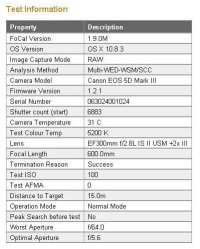
Yes. For example, my 300mm f/2.8 II + 2xTC III analysed by FoCal is sharpest wide open - see chart. The new big whites are often sharpest wide open. However, the Tamron when stopped down is giving the Canon a run for its money, which makes it very attractive. You have to pay a hell of a lot extra to get the sharpest at f/5.6.
 

Attachments

  • 300+2xOptimum.jpg
    300+2xOptimum.jpg
    46.3 KB · Views: 1,886
Upvote 0
Update,

I looked at my hummingbird photo I posted taken at 600mm f6.3 and found signs of motion blur so it is not the best sample to show what this lens can do. That one was taken at 1/160 sec which is just a little slow at least for me to hand hold this lens at 600mm.

Here is another one without motion blur at 600mm, f6.3 and 1/200 sec showing this lens is still rather sharp wide open.

JR5A4009t.jpg


JR5A4009c.jpg
 
Upvote 0
Don Haines said:
dilbert said:
Kiboko said:
Most if not all the foregoing discussion centres around the softness beyond 400mm on a F/F body. Using the lens on a F/F camera, one's going to have to stop down to f8 or f11 to maximise sharpness beyond the 400mm focal length.

This is the same for many many other lenses, including those made by Canon.

SO what's the point here?

Dilbert.... Dilbert... Dilbert..... Don't you know that common sense and logic has no place in an emotional argument :)

And seriously, is there ANY lens that is sharpest wide open?


As mentioned above, it seems like all of the Big Whites (at least MkII) fit that description.

http://slrgear.com/reviews/zproducts/canon500f4is2/ff/tloader.htm


TWI by Dustin Abbott said:
For all of you birders, here is a pretty amazing review of the lens by a guy comparing it to the 600mm f/4L IS (original version):

http://theamazingimage.com/wildlife/field-test-new-tamron-150-600mm-super-telephoto-zoom/#prettyPhoto

That's just what I was looking for, a benchmark vs. a known lens.
The 400f5.6 with a 1.4xTC is probably still optically better (maybe with more CA, and yes, I also suspect it's better than the version 1 600f4IS), but the Tamron still has AF and it zooms. Again, I'll still keep my 400f5.6, it's an easy lens to love.
 
Upvote 0