No EOS 5DS & EOS 5DS R Replacements in 2017 [CR2]

LonelyBoy said:
Canon Rumors said:
I'm not under NDA, but this is for fun, not to get people in trouble. An EF 85mm f/1.4L IS is coming this year, pricing hasn't been set and we don't have an exact announcement date. I'm not sure what other information people want beyond that.

Everybody, it's very much this - my wife used to work at AMD on the Xbox1 chip, and I absolutely knew things about the development of it that, if I had leaked on the gaming websites, would have been traceable to a small group of people. You just don't do it (if you're smart).

we just learned: you are smart!
 
Upvote 0
ahsanford said:
tr573 said:
You wouldn't be throwing out more resolution than you're gaining by having a 100mp sensor. Just like how if your lens performs best at f/11 but your DLA is 5.6, you're still going to get more resolution at f/11 on a higher MP rig than at 5.6 on a lower MP rig

Would you get even more if you focus stscked? Sure. But even a single frame is still going to give you more than a lower res camera

Just clarifying your comment above (see in red) -- did I get that right?

- A

No, both on the high res rig for that example (although it would be higher than the low res rig also). If the imaginary lens keeps increasing in resolution until f/11 , then that increase means you're resolving more there even with diffraction then you would where the lens is weaker. (Of course, no modern lens peaks at f/11 just an imaginary example)

I'm just saying that if you are getting increases in resolution from the lens still or from a higher resolution sensor, it's outweighing the effects of diffraction which are minor in comparison.

So you're never going to do worse with a high resolution sensor - you can go to extremes to eke out every ounce of performance , but even if you don't you're still going to get more resolution out of it.
 
Upvote 0
Sony has rumored to be announcing two pro A9 bodies. One is rumored to be 20MP and shoot around 20FPS. The other is rumored to be around 70MP?

Now the thing is with cramming more pixels into the same 35mm wafer is that there is a point with current CMOS tech is that it starts to hinder performance more then it helps. (Just to keep things simple and not get into SNR, diffraction and so on)

But Canon could easily make a 62MP sensor using the same pixel pitch as the 80D (24MP x 1.6 + 24MP = 62.4) and it would perform in every way the same as the 80D just on a larger wafer. Even a 70MP isn't to far fetched in the next two years.
But something like 250MP would be horridness and not usable due to camera shake and diffraction cause by the atmosphere its self. This is why even Med Format does not go above 100MP at the moment. It becomes a point where more is not helping and its better for focus on quality other then quantity.

That said. There is no reason to release a new 5DSR this year or even next year unless Sony forces Canon's hand marketing wise. But it would be nice if they did in announce an update...
 
Upvote 0
Re: EOS 5DS & EOS 5DS R Replacements - 60 MP

entoman said:
I would also expect just a single model, with a cancellable AA filter. This tech is already being tested in the 5DMkiv, which has a user-selectable "Digital Lens Optimiser" which, among other things, cancels the effect of the AA filter.

This is the first time i hear this.

I thought an AA filter was a physical mesh in front of the sensor. Does the "Digital Lens Optimiser" do a software edit to the photos and emulate the lack of an AA filter?
 
Upvote 0
Re: EOS 5DS & EOS 5DS R Replacements - 60 MP

Joakim said:
entoman said:
I would also expect just a single model, with a cancellable AA filter. This tech is already being tested in the 5DMkiv, which has a user-selectable "Digital Lens Optimiser" which, among other things, cancels the effect of the AA filter.

This is the first time i hear this.

I thought an AA filter was a physical mesh in front of the sensor. Does the "Digital Lens Optimiser" do a software edit to the photos and emulate the lack of an AA filter?

Yes it is, in that the AA filter is physically in front of the sensor, and no amount of software can remove it. All DLO does is add some sharpening to counter the AA filter softness.
 
Upvote 0
Re: EOS 5DS & EOS 5DS R Replacements - 60 MP

IglooEater said:
Yes it is, in that the AA filter is physically in front of the sensor, and no amount of software can remove it. All DLO does is add some sharpening to counter the AA filter softness.

Thanks for the explanation.

Will the same and/or better results be had from just sharpening in Lightroom instead?
 
Upvote 0
Re: EOS 5DS & EOS 5DS R Replacements - 60 MP

Joakim said:
IglooEater said:
Yes it is, in that the AA filter is physically in front of the sensor, and no amount of software can remove it. All DLO does is add some sharpening to counter the AA filter softness.

Thanks for the explanation.

Will the same and/or better results be had from just sharpening in Lightroom instead?

Depends if you're asking a DPP fan or not. ACR offers deconvolution, but DLO is more lens-customized instead of generic. That's what a DPP fan will tell you.

ACR lets you mask it so you don't add nine tons of sharp noise to Oof areas of your photo is what ACR fans will tell you.

Use what you like best
 
Upvote 0
Re: EOS 5DS & EOS 5DS R Replacements - 60 MP

IglooEater said:
Joakim said:
entoman said:
I would also expect just a single model, with a cancellable AA filter. This tech is already being tested in the 5DMkiv, which has a user-selectable "Digital Lens Optimiser" which, among other things, cancels the effect of the AA filter.

This is the first time i hear this.

I thought an AA filter was a physical mesh in front of the sensor. Does the "Digital Lens Optimiser" do a software edit to the photos and emulate the lack of an AA filter?

Yes it is, in that the AA filter is physically in front of the sensor, and no amount of software can remove it. All DLO does is add some sharpening to counter the AA filter softness.

that's not true at all.

an AA filter's effect can be mathematically removed via iteration via deconvolution while not perfect, it is certainly not just "sharpening".
 
Upvote 0
ahsanford said:
I'm only passingly well read on diffraction, but I had a question.

I'm just curious as sensor resolution climbs and the diffraction limited aperture more and more approaches a wide-open aperture, how would landscapes work? It would seem very difficult to obtain peak sharpness given the larger DOF needs of most landscape compositions.

This is true of landscape work in general -- even on my 5D3 my lens might be sharpest at f/5.6 but I don't hesitate to stop down to f/11 or f/14 as needed. But on a massive 100+ MP canvas, I imagine you'd be throwing out a lot more detail to make a similar decision to stop down. So what is one to do in that case? Are people going to need to focus-stack their landscapes like a product/macro photographer would?

Please educate me here, this is not my wheelhouse at all. Thx.

- A

landscape is never all about sharpness, but also more accuracy. a 100mp image is more accurate than a 30mp image, regardless of aperture.

the judgement of sharpness and the effect of diffraction depends on the magnification of sensor to image size. in other words, how big of a print you can print, before diffraction airy disc is larger than the airy disc of confusion of an out of focus zone.

in other words, diffraction is only an issue when we perceive it to show "out of focus". however, as one prints larger, or views larger, their observer distance also increases. it makes f/8 shooting and even f/16 shooting extremely resilient to diffraction, because the bigger you display, the greater the observer distance, and the greater the observer distance the bigger the airy disc of diffraction can be.

there's alot of false myths surrounding diffraction and images that sound quite impressive, but per line pair diffraction is hardly ever that important unless all you do is view your images magnified 100% on the monitor and it's usually false sharpness, as a carry over from square pixels demosaiced from a bayer sensor pattern.

as far as "full benefit of the resolution" you ALWAYS get the full effect of the resolution regardless of diffraction - as you increase resolution, you decrease false pixel sharpness and increase image acutance. two different things.
 
Upvote 0
jeffa4444 said:
3. The weakest atribute is dynamic range, its not a good low light camera
4. File sizes are way larger and you need to upgrade your PC or Mac
5. Lightroom and Photoshop even with newer PC / Mac is slower

a. Im not sure I would want a 120MP camera without some new compression algorithm the files sizes would be a killer
b. Dynamic range needs to be significantly better certainly at a minimum 14 stops
c. Nyquist would suggest at 120MP defraction would limit the benefits particularly for landscape shooters


4/5 .. i regularly edit and process 1.2GB TIFF's with out any issuses on a fairly modern platform. if someone gets a new camera, without conversly updating their "image processing" pipeline, than that's their own priorites, however the two always should be lock step. I think your mac has a problem if it can't process normal raws more than fast enough today.

a. that would go right against 4/5 .. and make editing,etc slower...
b. lol minimum 14EV? yeah. okay.
c. not really. nyquist has little involvement in landscape photography. if it did, we may as well shoot with smartphones that are f/16 and nothing else. image sharpness and per pixel sharpness (usually false sharpness) are two different things. people confuse the two.
 
Upvote 0
jolyonralph said:
If you ever do see 120Mpx I think you'll only see that in a specialist non-DSLR body as they did with the ME20F-SH. Hardly any lenses will resolve anywhere near well enough to be of use.

Jumping to 60mpx with dpaf makes all the sense in the world though.

except they already stated it will be a DSLR.....
 
Upvote 0
ahsanford said:
  • Those willing to change their shooting method (MLU, shutter delay, diffraction considerations, etc.) to make the most of those 100 MP

there's hardly any difference in shooting conditions necessary to jump from 50 to 120MP. it's 1.54x the linear resolution, which is less than one 1EV shutter speed difference. also any lens, any apeture will always show the benefit of 120mp over 50.
 
Upvote 0
ahsanford said:
Regarding the next 5DS having 120 MP:

I would not hold your breath on that. Even if Canon holds off the 5DS / R follow up to 2019+ timeframe (as we'd expect from the 4-5 year cycles we've seen of late on FF SLRs), consider what a 120 MP rig would drive...

  • When the 5DS / 5DS R came out, Canon only recommended certain lenses for it. They didn't purge large chunks of the EF portfolio from it, but the message was clear -- only certain lenses would let you make the most of the added resolving power of the sensor. Now imagine how short a lens list we'd see for a 120 MP canvas.

  • 120 MP would have a ridiculously low frame rate -- say 2.1 fps on the current 5DS's data handling ability. Even projecting to 2019, two DIGIC chips might only get you 3 fps, which is (to some) below a floor of usability for many realms of photography. (Can Canon put 3 DIGIC chips in a body?)

I'm not saying a 120 will never happen -- I'm arguing 120 is not the logical next step for high resolution FF for Canon. I expect the 5DS2 to have far less than 120 MP.

- A

this is simply not true at all. there's so much wrong with this.

a) canon doesn't have to hold to any timeline, it all depends on whether or not canon has a updated sensor and appropriate DIGIC. they've stated this many times. they upgrade when they can provide an upgrade. the sensor is out, the DIGIC is done. they stated it was a) in development in 2015. a DSLR takes 3 years to develop. Do the math.

b) canon already stated 60 lenses are compatible with the upcoming 120MP camera. any lens will work on a 120mp camera that works on a lower resolving sensor.

c) DIGIC 7 is already north of 210MP / sec on a single chip on a power / heat enveloped restrained EOS-M5. The current 5Ds is a generation of digic old - this is just ridiculous fearmongering or assumptions that canon can't increase the bitrate 2.5 times. especially considering they stated that DIGIC 7 was 17 times faster than DIGIC 6.
 
Upvote 0
rrcphoto said:
a) canon doesn't have to hold to any timeline, it all depends on whether or not canon has a updated sensor and appropriate DIGIC. they've stated this many times. they upgrade when they can provide an upgrade. the sensor is out, the DIGIC is done. they stated it was a) in development in 2015. a DSLR takes 3 years to develop. Do the math.

b) canon already stated 60 lenses are compatible with the upcoming 120MP camera. any lens will work on a 120mp camera that works on a lower resolving sensor.

c) DIGIC 7 is already north of 210MP / sec on a single chip on a power / heat enveloped restrained EOS-M5. The current 5Ds is a generation of digic old - this is just ridiculous fearmongering or assumptions that canon can't increase the bitrate 2.5 times. especially considering they stated that DIGIC 7 was 17 times faster than DIGIC 6.

a) Yes, because Canon is famous for releasing bleeding edge tech as soon as it can be commercialized. ::)

b) I've seen that statement, yes, but even looking at 50 MP vs. 22 MP comparisons of Canon's current lineup (check PZ, DXO) shows that the EF portfolio is certainly rewarded by more resolving power behind the lens, but few (if any) lenses sail over a 50 MP bar and ask "Is that all you've got?". I think a claim of 60 lenses being compatible -- even from Canon directly -- is wishful thinking, clever marketing, etc.

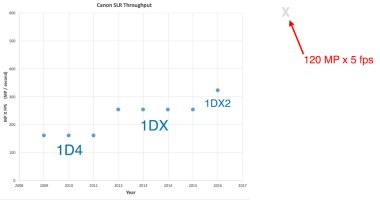
c) Let's step past component performance and jump to overall camera throughput. I've plotted the highest throughput rigs Canon sells over time, and the trend is hardly consistent with a 600 MP/s future needed to get back to the 5 fps 5DS users enjoy today.

Again -- I'm not doubting they are working on a 120 MP rig. I just don't think it's the 5DS2. I believe a > 100 MP rig will be later down the road.

- A

 

Attachments

  • Throughput.jpg
    Throughput.jpg
    96.8 KB · Views: 127
Upvote 0
ahsanford said:
rrcphoto said:
a) canon doesn't have to hold to any timeline, it all depends on whether or not canon has a updated sensor and appropriate DIGIC. they've stated this many times. they upgrade when they can provide an upgrade. the sensor is out, the DIGIC is done. they stated it was a) in development in 2015. a DSLR takes 3 years to develop. Do the math.

b) canon already stated 60 lenses are compatible with the upcoming 120MP camera. any lens will work on a 120mp camera that works on a lower resolving sensor.

c) DIGIC 7 is already north of 210MP / sec on a single chip on a power / heat enveloped restrained EOS-M5. The current 5Ds is a generation of digic old - this is just ridiculous fearmongering or assumptions that canon can't increase the bitrate 2.5 times. especially considering they stated that DIGIC 7 was 17 times faster than DIGIC 6.

a) Yes, because Canon is famous for releasing bleeding edge tech as soon as it can be commercialized. ::)

b) I've seen that statement, yes, but even looking at 50 MP vs. 22 MP comparisons of Canon's current lineup (check PZ, DXO) shows that the EF portfolio is certainly rewarded by more resolving power behind the lens, but few (if any) lenses sail over a 50 MP bar and ask "Is that all you've got?". I think a claim of 60 lenses being compatible -- even from Canon directly -- is wishful thinking, clever marketing, etc.

c) Let's step past component performance and jump to overall camera throughput. I've plotted the highest throughput rigs Canon sells over time, and the trend is hardly consistent with a 600 MP/s future needed to get back to the 5 fps 5DS users enjoy today.

Again -- I'm not doubting they are working on a 120 MP rig. I just don't think it's the 5DS2. I believe a > 100 MP rig will be later down the road.

- A

a) that's an official and legally binding statement from Canon. you simply don't spout that off and not do it. it was VERY specific that it was active IN development, not GOING to be in development.

b) you don't comprehend that ANY lens will show a benefit. lens performance such as with diffraction depends on your sensor to image magnification, not your pixel density.

c) dual digic 7's should be able to hit around 400+ MP/second with the same heat envelope of the M5 - which takes it over your 2.1fps handily. Canon has stated that DIGIC 7 is 17 times faster than DIGIC 6. Dual DIGIC 6's are able to achieve 252MP/sec. Also we dont' know the top end of the DIGIC 6+ - we can assume it's somewhere around 210MP, of which the DIGIC 7 (normal) has already surpassed that. We dont' know the top end of DIGIC 7 yet.

again, if they are working on it, if it's in development then it's coming out in 3 years time or so from Sept 2015. Do the math.
 
Upvote 0
ahsanford said:
b) I've seen that statement, yes, but even looking at 50 MP vs. 22 MP comparisons of Canon's current lineup (check PZ, DXO) shows that the EF portfolio is certainly rewarded by more resolving power behind the lens, but few (if any) lenses sail over a 50 MP bar and ask "Is that all you've got?". I think a claim of 60 lenses being compatible -- even from Canon directly -- is wishful thinking, clever marketing, etc.

I don't think this is a valid way to look at it because (hear me out) - even the lenses which come the closest (new sigma 85mm art score a 40 "pmpix" score on DXO) still also fall short of the total megapixel count of much lower resolution cameras for the same score. So I think there's more to it than just saying "this lens can't handle 50mpix as it is" , because it also can't handle 30, or 22, or 20, on a 5DIV,3,etc. Despite handling 40 on a 5DSR
 
Upvote 0