Where has the post with the complaint about the 80D's IQ gone?

Hi YuengLinger.
Thank you for today's quote that gave me a laugh.
I did wonder when you were being given all the lighting advice (move to change the angle of the shot) if any of them once thought that perhaps you were unable to change your location for whatever reason. Most if not all of us know that back lighting a subject is the least desirable situation, but we still need (really really want) to be able to get good photos in this situation.
Also I thank you for your most candid responses to the questions posed to you here, it seems that you have been very open about the situation.

Cheers, Graham.

YuengLinger said:
Being an imperfect photographer who will not wade into gator and moccasin infested swamps to get a shot of a heron with the sun behind my shoulder, I like a sensor that is a little more forgiving!
 
Upvote 0
Valvebounce said:
Hi YuengLinger.
Thank you for today's quote that gave me a laugh.
I did wonder when you were being given all the lighting advice (move to change the angle of the shot) if any of them once thought that perhaps you were unable to change your location for whatever reason. Most if not all of us know that back lighting a subject is the least desirable situation, but we still need (really really want) to be able to get good photos in this situation.
Also I thank you for your most candid responses to the questions posed to you here, it seems that you have been very open about the situation.

Cheers, Graham.

YuengLinger said:
Being an imperfect photographer who will not wade into gator and moccasin infested swamps to get a shot of a heron with the sun behind my shoulder, I like a sensor that is a little more forgiving!

Well...I'm the type who would wade into gator and moccasin infested swamps to get proper sunlit a shot of a Heron! :P
 
Upvote 0
Hi Jon.
We all know that there are some willing to play the odds for that perfect shot but I'm with YuengLinger on this one, in fact I'm not wading in to any water to get the shot unless it is crystal clear and preferably not cold either! ;D

Cheers, Graham.

jrista said:
Valvebounce said:
Hi YuengLinger.
Thank you for today's quote that gave me a laugh.
I did wonder when you were being given all the lighting advice (move to change the angle of the shot) if any of them once thought that perhaps you were unable to change your location for whatever reason. Most if not all of us know that back lighting a subject is the least desirable situation, but we still need (really really want) to be able to get good photos in this situation.
Also I thank you for your most candid responses to the questions posed to you here, it seems that you have been very open about the situation.

Cheers, Graham.

YuengLinger said:
Being an imperfect photographer who will not wade into gator and moccasin infested swamps to get a shot of a heron with the sun behind my shoulder, I like a sensor that is a little more forgiving!

Well...I'm the type who would wade into gator and moccasin infested swamps to get proper sunlit a shot of a Heron! :P
 
Upvote 0
Valvebounce said:
Hi Jon.
We all know that there are some willing to play the odds for that perfect shot but I'm with YuengLinger on this one, in fact I'm not wading in to any water to get the shot unless it is crystal clear and preferably not cold either! ;D

Cheers, Graham.

jrista said:
Valvebounce said:
Hi YuengLinger.
Thank you for today's quote that gave me a laugh.
I did wonder when you were being given all the lighting advice (move to change the angle of the shot) if any of them once thought that perhaps you were unable to change your location for whatever reason. Most if not all of us know that back lighting a subject is the least desirable situation, but we still need (really really want) to be able to get good photos in this situation.
Also I thank you for your most candid responses to the questions posed to you here, it seems that you have been very open about the situation.

Cheers, Graham.

YuengLinger said:
Being an imperfect photographer who will not wade into gator and moccasin infested swamps to get a shot of a heron with the sun behind my shoulder, I like a sensor that is a little more forgiving!

Well...I'm the type who would wade into gator and moccasin infested swamps to get proper sunlit a shot of a Heron! :P

Sure. That doesn't change the facts though. The distribution of the signal can change dramatically depending on the angle of light on the subject, as well as the surrounding scene. If you do not take that fact into account, you'll be constantly perplexed when one shot looks great and the next looks terrible. Even if you cannot actually change your position to subject enough, you should always try to get the best angle possible (and there is certainly more to it than just sunlight angle...there is also bird angle, head angle, relative position to background objects some of which you may not want in the scene, etc.) Getting good bird and wildlife shots requires a fairly expansive presence of mind so you can take into account all the factors...including light.
 
Upvote 0
Hi Jon.
I hope you have not misunderstood my post, I was not in any way intending to question your advice or information, I find your in depth technical information very interesting though I will confess a great deal of it goes clear over my head. My only intention was to raise the point that it is not always possible to reposition for a better shot.
Goodnight gents.

Cheers, Graham.

jrista said:
Valvebounce said:
Hi Jon.
We all know that there are some willing to play the odds for that perfect shot but I'm with YuengLinger on this one, in fact I'm not wading in to any water to get the shot unless it is crystal clear and preferably not cold either! ;D

Cheers, Graham.

jrista said:
Valvebounce said:
Hi YuengLinger.
Thank you for today's quote that gave me a laugh.
I did wonder when you were being given all the lighting advice (move to change the angle of the shot) if any of them once thought that perhaps you were unable to change your location for whatever reason. Most if not all of us know that back lighting a subject is the least desirable situation, but we still need (really really want) to be able to get good photos in this situation.
Also I thank you for your most candid responses to the questions posed to you here, it seems that you have been very open about the situation.

Cheers, Graham.

YuengLinger said:
Being an imperfect photographer who will not wade into gator and moccasin infested swamps to get a shot of a heron with the sun behind my shoulder, I like a sensor that is a little more forgiving!

Well...I'm the type who would wade into gator and moccasin infested swamps to get proper sunlit a shot of a Heron! :P

Sure. That doesn't change the facts though. The distribution of the signal can change dramatically depending on the angle of light on the subject, as well as the surrounding scene. If you do not take that fact into account, you'll be constantly perplexed when one shot looks great and the next looks terrible. Even if you cannot actually change your position to subject enough, you should always try to get the best angle possible (and there is certainly more to it than just sunlight angle...there is also bird angle, head angle, relative position to background objects some of which you may not want in the scene, etc.) Getting good bird and wildlife shots requires a fairly expansive presence of mind so you can take into account all the factors...including light.
 
Upvote 0
BIB

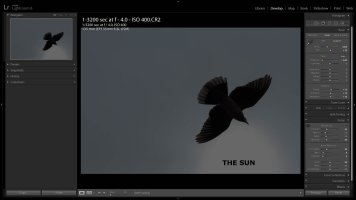
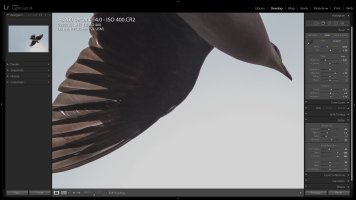
Stands for Birds in Backlight, sure recipe to cause most of the photographers to hit Delete button repeatedly. And if the backlit edge is made of thin, translucent feathers it will behave as a brightest object in the frame. Compare the neck to lower beak... Oh, and if this is not enough troubling, try postprocessing photo of a backlit crow taken at noon, on a lightly overcast day, straight up... :'( >:( :-[
 
Upvote 0
I want to thank jrista for his very informative replies in this thread, that I expect will (have to) affect my way of shooting with my 80D (without having to enter swamps, that is...... ;) ).

What I read in the technical description of jrista's replies, I can follow and understand (I have a technical background in electronics). The thing is, that I do not have 'the whole picture' and therefore have difficulty making my own decisions based on this extremely relevant information about the possibilities and limitations that inevitably come with the technology of camera sensors.

Therfore I hope I do not act against the forum rules, but I would like to pose these 2 questions to jrista for further information.

1. Can you point me in the direction of more (technical) information about sensors (beit Canon's or in general) that describe their workings and the mechanisms, limitations and tradeoffs involved - thus leading to understanding the parameters you mentioned (and perhaps other parameters too)?

2. Can you point me in the direction of relating this to the consequences of these technical (scientific) description of camera sensors for photography, like the influence on the performance of these parameters from (micro) contrast, the amount of light, the type of lighting or whatever proves to be relevant?

I am aware these are quite 'heavy' questions and I appologise if I ask too much here.
I think this is the background I need to better results, both at the moment I press the shutter and in post-processing.

Thanks in advance. ::)
 
Upvote 0
haggie said:
I can remember a photo added with a post of some time ago (it was of an F-35 flying by on a rainy day) where this phenomenon was visible (I looked for it, but cannot find it…..).
I did not pay too much attention to it then. Only now I own the 80D I see its relevance.

That post was mine - it's here: http://www.canonrumors.com/forum/index.php?topic=30410.msg613233#msg613233

I'm embarassed to say that I've not used the 80D since then (tending to use my 6D as my 'main' camera & the 80D more for telephoto shots - airshows etc)

The reason I noticed the noise on the photos from the shoot that I posted may have been because a) It was the 1st time I'd shot RAW only at an airshow & b) being a 25 MP sensor, at 100% the noise would be more noticeable than that of my other crop cameras - 18MP EOS 100d (SL1) & the 8MP 350D that I've also use at airshows.

I like to think I know what I'm doing (!) so I don't think it's my technique at fault & I don't believe my 80D is faulty and I don't have a problem getting rid of it in post production so I'm hoping my results were just due to the conditions at the time/expecting to much/previously shooting only jpeg at airshows. Or a combination of all three.

I really need to take some test shots under identical conditions to compare but I still have a nagging doubt that the 80D is not as good under dull conditions as some have reported.

However, looking at the noise show at 400iso for RAW files on the uniform grey areas on DP Reviews charts here: https://www.dpreview.com/reviews/canon-eos-80d-review/11 does show quite a bit of noise. Considering these were shot in a studio so presumably under optimum lighting conditions, perhaps my results under poorer conditions were par for the course.
 
Upvote 0
Here is another image from the 80D at moderate ISO but shot under more severe back-lighting. Also note that the 135L is prone to veiling flare.
 

Attachments

  • 80D Extreme backlight.jpg
    80D Extreme backlight.jpg
    107.4 KB · Views: 142
  • 80D Extreme backlight 2.jpg
    80D Extreme backlight 2.jpg
    539.4 KB · Views: 150
Upvote 0
StudentOfLight said:
Here is another image from the 80D at moderate ISO but shot under more severe back-lighting. Also note that the 135L is prone to veiling flare.

All things considered, that is the best backlit performance I think I've seen from a Canon camera thus far. OF COURSE there is going to be noise in the bird in such a situation...but i can tell you this. My 5D III performs significantly worse in the same situation. I get both horizontal and vertical banding, lots of color blotch, etc. in scenarios like that.

Canon has definitely made improvements here. There is no question about that. This is a situation that was well out of the realm of capability for Canon cameras not that long ago. It now seems that current generation Canon cameras, well at least the 80D and 5D IV (and probably 1D X II, although I've not processed any data from that yet), are capable of performing well in much more challenging situations.
 
Upvote 0
Valvebounce said:
Hi Jon.
I hope you have not misunderstood my post, I was not in any way intending to question your advice or information, I find your in depth technical information very interesting though I will confess a great deal of it goes clear over my head. My only intention was to raise the point that it is not always possible to reposition for a better shot.
Goodnight gents.

Cheers, Graham.

I understood. I just thought it was important to note that having presence of mind about your light sources relative to subject and scene is an important aspect of photography. I just don't want people to think if they can't control the light, then it doesn't matter. There is almost always something you can do, even if you can't go wading into a deadly creature-infested swamp to nail the lighting perfectly.

Bird and wildlife photography is in large part about having the presence of mind to quickly evaluate the setting and calculate whether you need to adjust your position or not (because of lighting, or any of the reasons I stated before). Sometimes it is not possible, but that shouldn't be license to ignore it all the time. It should never be ignored, even if you can't do anything about it. Sometimes the better option is to turn around and take a photo of the other Heron right behind you...already in perfect light. ;)
 
Upvote 0
ajfotofilmagem said:
YuengLinger said:
More subjectively, I was finding during post processing that, in the more contrasty lighting, edges and fine detail did not have the typical photographic appearance of a print or older sensors. Attempting to sharpen and enhance the images sometimes is producing an almost illustrated look, as if edges were inked or penciled in. Yes, subjective, and at a 100% view (which is what many of us zoom into for sharpening, right?).
I remember when I had my old Rebel XT (8 megapixel), and how the contours of the objects seemed natural to me, not looking like oversharp.

I think the "per pixel" sharpness on the 24 megapixel cameras will inevitably be lower, and it causes the temptation to process the images with too much sharpness, generating nasty artifacts.

Would not that be the reason for your disappointment with 80D? The desire for a very high sharpness, when one has much more megapixel, can cause frustration.

First of all, I think most of these images where people are dissatisfied look fine. I think people tend to be far too picky and forget to look at photos as a whole rather than zoom in and find things to be dissatisfied with.

Secondly, I agree completely with ajfotofilmagem. As pixels have become smaller, there have been sacrifices. I have no technical knowledge of this, but am often surprised that photos taken with my old 6 MP Canon (300D) look more natural than those I took with my SL1. While marketing - and the constant clamor from the gear heads - leads us to smaller and smaller pixels, our photos WILL look different as a result, it seems to me. When I upgraded from my 300D, I went to a 6D - not because I really wanted to go FF (I was quite satisfied with Crop) but because I wanted to keep the larger pixels. While other constantly clamor for more, more and more, I would really like to see an APS-C camera with about 12 MP. I think photographers would be quite happy with the IQ. Alas, it will never happen as long as the need for more MPs continues to dominate - despite the shortcomings of smaller and smaller pixels.
 
Upvote 0
dak723 said:
ajfotofilmagem said:
YuengLinger said:
More subjectively, I was finding during post processing that, in the more contrasty lighting, edges and fine detail did not have the typical photographic appearance of a print or older sensors. Attempting to sharpen and enhance the images sometimes is producing an almost illustrated look, as if edges were inked or penciled in. Yes, subjective, and at a 100% view (which is what many of us zoom into for sharpening, right?).
I remember when I had my old Rebel XT (8 megapixel), and how the contours of the objects seemed natural to me, not looking like oversharp.

I think the "per pixel" sharpness on the 24 megapixel cameras will inevitably be lower, and it causes the temptation to process the images with too much sharpness, generating nasty artifacts.

Would not that be the reason for your disappointment with 80D? The desire for a very high sharpness, when one has much more megapixel, can cause frustration.

First of all, I think most of these images where people are dissatisfied look fine. I think people tend to be far too picky and forget to look at photos as a whole rather than zoom in and find things to be dissatisfied with.

Secondly, I agree completely with ajfotofilmagem. As pixels have become smaller, there have been sacrifices. I have no technical knowledge of this, but am often surprised that photos taken with my old 6 MP Canon (300D) look more natural than those I took with my SL1. While marketing - and the constant clamor from the gear heads - leads us to smaller and smaller pixels, our photos WILL look different as a result, it seems to me. When I upgraded from my 300D, I went to a 6D - not because I really wanted to go FF (I was quite satisfied with Crop) but because I wanted to keep the larger pixels. While other constantly clamor for more, more and more, I would really like to see an APS-C camera with about 12 MP. I think photographers would be quite happy with the IQ. Alas, it will never happen as long as the need for more MPs continues to dominate - despite the shortcomings of smaller and smaller pixels.

Pixel size doesn't really have anything to do with it. The small pixels of today are vastly superior to the large pixels of a decade or so ago. VASTLY superior. Read noise levels are becoming vanishingly small, in some cases dropping below 1 electron. Well capacities of pixels smaller than 4 microns are becoming larger than those of pixels larger than 4 microns from cameras only in the last five years. Dynamic range has expanded from 8-9 stops over a decade ago, to 14 stops or more today. Color accuracy has improved from 22 bits to 24, 24, 26 bits.

There is absolutely nothing about a 30D that is superior to any camera today, even the worst performing Canon camera. Color is a highly subjective thing, and it's mostly been due to math anyway since before the 30D. It is easy enough to achieve any kind of color you want with just a little bit of fiddling with a RAW editor, and color preferences are easy to save as user profiles with modern RAW editors. Every other IQ factor has grown considerably in modern cameras. It's not even a contest. Canon has lagged behind the times, but they are finally catching up, and I am regularly amazed at the quality I see from the 5Ds. Especially in colors that Canon used to be a bit weak with before, such as yellows and oranges (Nikon always seemed to perform best for those colors in the past).
 
Upvote 0
jrista said:
StudentOfLight said:
Here is another image from the 80D at moderate ISO but shot under more severe back-lighting. Also note that the 135L is prone to veiling flare.

All things considered, that is the best backlit performance I think I've seen from a Canon camera thus far. OF COURSE there is going to be noise in the bird in such a situation...but i can tell you this. My 5D III performs significantly worse in the same situation. I get both horizontal and vertical banding, lots of color blotch, etc. in scenarios like that.

Canon has definitely made improvements here. There is no question about that. This is a situation that was well out of the realm of capability for Canon cameras not that long ago. It now seems that current generation Canon cameras, well at least the 80D and 5D IV (and probably 1D X II, although I've not processed any data from that yet), are capable of performing well in much more challenging situations.
My example(s) were meant to challenge the notion that the 80D struggles/utterly-fails in difficult lighting conditions. I find that images out of my 80D are just fine when appropriate post processing techniques are applied.

My only issue with the 80D is the clunky in-field image review options (which I detail here:
http://www.canonrumors.com/forum/index.php?topic=31325.msg636284#msg636284) that can hopefully be addressed in a firmware update.
 
Upvote 0
StudentOfLight said:
jrista said:
StudentOfLight said:
Here is another image from the 80D at moderate ISO but shot under more severe back-lighting. Also note that the 135L is prone to veiling flare.

All things considered, that is the best backlit performance I think I've seen from a Canon camera thus far. OF COURSE there is going to be noise in the bird in such a situation...but i can tell you this. My 5D III performs significantly worse in the same situation. I get both horizontal and vertical banding, lots of color blotch, etc. in scenarios like that.

Canon has definitely made improvements here. There is no question about that. This is a situation that was well out of the realm of capability for Canon cameras not that long ago. It now seems that current generation Canon cameras, well at least the 80D and 5D IV (and probably 1D X II, although I've not processed any data from that yet), are capable of performing well in much more challenging situations.
My example(s) were meant to challenge the notion that the 80D struggles/utterly-fails in difficult lighting conditions. I find that images out of my 80D are just fine when appropriate post processing techniques are applied.

My only issue with the 80D is the clunky in-field image review options (which I detail here:
http://www.canonrumors.com/forum/index.php?topic=31325.msg636284#msg636284) that can hopefully be addressed in a firmware update.

I think you succeeded with your challenge. Not a chance I could get that shot with my 5D III without rabid banding or blotchy red noise in the bird. I really need to sell that and pick up the 5D IV.
 
Upvote 0
jrista said:
Color is a highly subjective thing, and it's mostly been due to math anyway since before the 30D. It is easy enough to achieve any kind of color you want with just a little bit of fiddling with a RAW editor, and color preferences are easy to save as user profiles with modern RAW editors.

Not to mention that when looking at OOC jpegs, you can create your own picture styles in DPP and save them into the DSLR as a jpeg alternative to Canon's own 'Landscape', 'Portrait' etc
 
Upvote 0
jrista said:
dak723 said:
ajfotofilmagem said:
YuengLinger said:
More subjectively, I was finding during post processing that, in the more contrasty lighting, edges and fine detail did not have the typical photographic appearance of a print or older sensors. Attempting to sharpen and enhance the images sometimes is producing an almost illustrated look, as if edges were inked or penciled in. Yes, subjective, and at a 100% view (which is what many of us zoom into for sharpening, right?).
I remember when I had my old Rebel XT (8 megapixel), and how the contours of the objects seemed natural to me, not looking like oversharp.

I think the "per pixel" sharpness on the 24 megapixel cameras will inevitably be lower, and it causes the temptation to process the images with too much sharpness, generating nasty artifacts.

Would not that be the reason for your disappointment with 80D? The desire for a very high sharpness, when one has much more megapixel, can cause frustration.

First of all, I think most of these images where people are dissatisfied look fine. I think people tend to be far too picky and forget to look at photos as a whole rather than zoom in and find things to be dissatisfied with.

Secondly, I agree completely with ajfotofilmagem. As pixels have become smaller, there have been sacrifices. I have no technical knowledge of this, but am often surprised that photos taken with my old 6 MP Canon (300D) look more natural than those I took with my SL1. While marketing - and the constant clamor from the gear heads - leads us to smaller and smaller pixels, our photos WILL look different as a result, it seems to me. When I upgraded from my 300D, I went to a 6D - not because I really wanted to go FF (I was quite satisfied with Crop) but because I wanted to keep the larger pixels. While other constantly clamor for more, more and more, I would really like to see an APS-C camera with about 12 MP. I think photographers would be quite happy with the IQ. Alas, it will never happen as long as the need for more MPs continues to dominate - despite the shortcomings of smaller and smaller pixels.

Pixel size doesn't really have anything to do with it. The small pixels of today are vastly superior to the large pixels of a decade or so ago. VASTLY superior. Read noise levels are becoming vanishingly small, in some cases dropping below 1 electron. Well capacities of pixels smaller than 4 microns are becoming larger than those of pixels larger than 4 microns from cameras only in the last five years. Dynamic range has expanded from 8-9 stops over a decade ago, to 14 stops or more today. Color accuracy has improved from 22 bits to 24, 24, 26 bits.

There is absolutely nothing about a 30D that is superior to any camera today, even the worst performing Canon camera. Color is a highly subjective thing, and it's mostly been due to math anyway since before the 30D. It is easy enough to achieve any kind of color you want with just a little bit of fiddling with a RAW editor, and color preferences are easy to save as user profiles with modern RAW editors. Every other IQ factor has grown considerably in modern cameras. It's not even a contest. Canon has lagged behind the times, but they are finally catching up, and I am regularly amazed at the quality I see from the 5Ds. Especially in colors that Canon used to be a bit weak with before, such as yellows and oranges (Nikon always seemed to perform best for those colors in the past).

No argument. Smaller pixels today have lower noise and more DR than the used to. Smaller pixels have definitely improved greatly over the years.

Unfortunately, your comments ignored the one issue that the above quotes are discussing. The question is: Do smaller pixels need more sharpening than larger pixels. That was the question - and my feeling is yes. But I don't know if this is true. If it is true, than it can indeed give photos a different look. If it is not true, than perhaps our perception of the difference between smaller and larger pixel photos is due to something else - or perhaps merely imagined.
 
Upvote 0
dak723 said:
jrista said:
dak723 said:
ajfotofilmagem said:
YuengLinger said:
More subjectively, I was finding during post processing that, in the more contrasty lighting, edges and fine detail did not have the typical photographic appearance of a print or older sensors. Attempting to sharpen and enhance the images sometimes is producing an almost illustrated look, as if edges were inked or penciled in. Yes, subjective, and at a 100% view (which is what many of us zoom into for sharpening, right?).
I remember when I had my old Rebel XT (8 megapixel), and how the contours of the objects seemed natural to me, not looking like oversharp.

I think the "per pixel" sharpness on the 24 megapixel cameras will inevitably be lower, and it causes the temptation to process the images with too much sharpness, generating nasty artifacts.

Would not that be the reason for your disappointment with 80D? The desire for a very high sharpness, when one has much more megapixel, can cause frustration.

First of all, I think most of these images where people are dissatisfied look fine. I think people tend to be far too picky and forget to look at photos as a whole rather than zoom in and find things to be dissatisfied with.

Secondly, I agree completely with ajfotofilmagem. As pixels have become smaller, there have been sacrifices. I have no technical knowledge of this, but am often surprised that photos taken with my old 6 MP Canon (300D) look more natural than those I took with my SL1. While marketing - and the constant clamor from the gear heads - leads us to smaller and smaller pixels, our photos WILL look different as a result, it seems to me. When I upgraded from my 300D, I went to a 6D - not because I really wanted to go FF (I was quite satisfied with Crop) but because I wanted to keep the larger pixels. While other constantly clamor for more, more and more, I would really like to see an APS-C camera with about 12 MP. I think photographers would be quite happy with the IQ. Alas, it will never happen as long as the need for more MPs continues to dominate - despite the shortcomings of smaller and smaller pixels.

Pixel size doesn't really have anything to do with it. The small pixels of today are vastly superior to the large pixels of a decade or so ago. VASTLY superior. Read noise levels are becoming vanishingly small, in some cases dropping below 1 electron. Well capacities of pixels smaller than 4 microns are becoming larger than those of pixels larger than 4 microns from cameras only in the last five years. Dynamic range has expanded from 8-9 stops over a decade ago, to 14 stops or more today. Color accuracy has improved from 22 bits to 24, 24, 26 bits.

There is absolutely nothing about a 30D that is superior to any camera today, even the worst performing Canon camera. Color is a highly subjective thing, and it's mostly been due to math anyway since before the 30D. It is easy enough to achieve any kind of color you want with just a little bit of fiddling with a RAW editor, and color preferences are easy to save as user profiles with modern RAW editors. Every other IQ factor has grown considerably in modern cameras. It's not even a contest. Canon has lagged behind the times, but they are finally catching up, and I am regularly amazed at the quality I see from the 5Ds. Especially in colors that Canon used to be a bit weak with before, such as yellows and oranges (Nikon always seemed to perform best for those colors in the past).

No argument. Smaller pixels today have lower noise and more DR than the used to. Smaller pixels have definitely improved greatly over the years.

Unfortunately, your comments ignored the one issue that the above quotes are discussing. The question is: Do smaller pixels need more sharpening than larger pixels. That was the question - and my feeling is yes. But I don't know if this is true. If it is true, than it can indeed give photos a different look. If it is not true, than perhaps our perception of the difference between smaller and larger pixel photos is due to something else - or perhaps merely imagined.

The answer according to photozone is yes they do.

"Why are the MTFs sometimes "better" on 21 megapixels compared to 50 megapixels ? There are two reasons for this. Lateral CAs are lower in terms of pixel widths at 21mp simply because the pixel density is also lower. Extreme CAs that may exist at 50mp are therefore less affecting the measurements at 21mp. Generally we are also using a certain degree of sharpening during the image conversion (just like in real life images) and because the 21mp results are "sharper" on pixel level they are relatively more receptive to (mild base-) sharpening."

The reason (according to me, and I think correct) is that smaller pixels give better resolution, i.e. showing fine detail, but large pixels give better acutance, I.e. sharper transitions between light and dark, which is what Imatest, used for MTFs, measures. I noticed this some time ago comparing lenses on a 5DIII with crop that the same degree of sharpening made the 5DIII images really pop compared with the crop. My own feeling comparing the 5DIII, 5DIV and 5DSR is that on FF 30 mpix is an excellent compromise.
 
Upvote 0
AlanF said:
dak723 said:
No argument. Smaller pixels today have lower noise and more DR than the used to. Smaller pixels have definitely improved greatly over the years.

Unfortunately, your comments ignored the one issue that the above quotes are discussing. The question is: Do smaller pixels need more sharpening than larger pixels. That was the question - and my feeling is yes. But I don't know if this is true. If it is true, than it can indeed give photos a different look. If it is not true, than perhaps our perception of the difference between smaller and larger pixel photos is due to something else - or perhaps merely imagined.

The answer according to photozone is yes they do.

"Why are the MTFs sometimes "better" on 21 megapixels compared to 50 megapixels ? There are two reasons for this. Lateral CAs are lower in terms of pixel widths at 21mp simply because the pixel density is also lower. Extreme CAs that may exist at 50mp are therefore less affecting the measurements at 21mp. Generally we are also using a certain degree of sharpening during the image conversion (just like in real life images) and because the 21mp results are "sharper" on pixel level they are relatively more receptive to (mild base-) sharpening."

The reason (according to me, and I think correct) is that smaller pixels give better resolution, i.e. showing fine detail, but large pixels give better acutance, I.e. sharper transitions between light and dark, which is what Imatest, used for MTFs, measures. I noticed this some time ago comparing lenses on a 5DIII with crop that the same degree of sharpening made the 5DIII images really pop compared with the crop. My own feeling comparing the 5DIII, 5DIV and 5DSR is that on FF 30 mpix is an excellent compromise.

This is only true in a non-normalized context. To properly compare a 50mp camera to a 21mp camera, you must first downsample the 50mp images to 21mp. At that point, I have little doubt the 50mp would stomp all over the 21mp...sharpness, detail, image quality in every respect.

There is nothing magical about pixel size. Larger pixels gather more light per-pixel and deliver less resolution. Smaller pixels gather less light per pixel an deliver more resolution. However, the TOTAL LIGHT gathered is THE SAME for a given SENSOR SIZE. You aren't gathering more or less light, not at all. You are simply divvying it up in different ways. Smaller pixels are always going to be better. You cannot gain resolution you never had when using larger pixels. However, you can effectively "bin" pixels and gain SNR by downsampling when using smaller pixels.

Throw in better pixel technology with each new generation of sensors, and its really no contest. I'd take the 50mp camera every day over the 21mp, with only one exception: When I need high FPS, and the 50mp simply cannot deliver the necessary frame rate.
 
Upvote 0
Jon
It is easy to argue and does appear to be logical that downsampling to the same megapixel size will give the same resolution, noise etc as on the less dense sensor. But, in practice, it does not appear to be as straightforward as that. I have done lots of comparisons of different lenses on a 5DS R, 5DIV, 5DIII and 7DII (plus some on 80D an 7D), and can write from experience.
1. Transitions on a 50 MP sensor are smoother, and when downsampled have a different quality from those taken directly on a 20 or 30 mp sensor, may be not as crisp. The downsampling algorithms do not give the same results as direct measurements.
2. The 50 MP sensor is more sensitive to diffraction effects and lens defects. For example, my 300/2.8 II + 2xTC and 400mm DO II f/4 + 2xTC do not perform that well on the 5DS R but give very crisp images on 5DIV and 5DIII. The 5DIV gives much better results than a downsampled 5DS R image.
 
Upvote 0