Why isn't Canon working on DSLRs with higher dynamic range?

Hi Folks.
I'm looking for an app to automatically mark any post with DR in the title as read! ;D

Cheers Graham.

mackguyver said:
awinphoto said:
And this is why I dont spend much time anymore on this forum... but is fun to watch the banter back and forth... let me get the popcorn warmed up... extra butter this time!
LOL, I spend too much time on the forum, but I'm usually a spectator anytime I see posts about DR or Megapixels. It's fun to watch 8).
 
Upvote 0
mackguyver said:
awinphoto said:
And this is why I dont spend much time anymore on this forum... but is fun to watch the banter back and forth... let me get the popcorn warmed up... extra butter this time!
LOL, I spend too much time on the forum, but I'm usually a spectator anytime I see posts about DR or Megapixels. It's fun to watch 8).

I wish I had your willpower. Sometimes I just can't help myself and respond to these stupid threads.
 
Upvote 0
Ah, you guys just don't like a good debate! :P Sometimes debate is healthy...

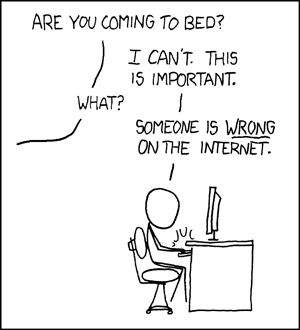
Although I'll grant it's less debate and more "Let's beat that last little bit of brain matter and bone of the dead horse over there...AGAIN" on these forums...but hey, that isn't my fault. :o Some people are just too thick to let the facts soak into their skulls. I'm just responding to the call:

duty_calls.png


;D
 
Upvote 0
jrista said:
Ah, you guys just don't like a good debate! :P Sometimes debate is healthy...

Although I'll grant it's less debate and more "Let's beat that last little bit of brain matter and bone of the dead horse over there...AGAIN" on these forums...but hey, that isn't my fault. :o Some people are just too thick to let the facts soak into their skulls. I'm just responding to the call:

;D

I, for one, am glad you are afflicted with this obsession. I have learned a lot from your posts. And, I mean that in all sincerity.
 
Upvote 0
jrista said:
Ah, you guys just don't like a good debate! :P Sometimes debate is healthy...

Although I'll grant it's less debate and more "Let's beat that last little bit of brain matter and bone of the dead horse over there...AGAIN" on these forums...but hey, that isn't my fault. :o Some people are just too thick to let the facts soak into their skulls. I'm just responding to the call:

duty_calls.png


;D
That cartoon is awesome and I'm all for debates, and even (gasp) recently replied to a megapixels post, but that and DR are two topics that generally seem to get out of control! Sometimes it's more fun to watch, but as unfocused says, you certainly know a lot and we always learn from you.
 
Upvote 0
Orangutan said:
As an example, back in 2004 there was that video tape of a purported Ivory-Billed Woodpecker. Subsequent analysis showed that it was almost certainly the rather common pileated woodpecker. The "eyewitnesses," however, recall seeing detail that would clearly distinguish it as an IBW. Even if it was a pileated, those witness may truthfully and genuinely believe they saw those distinguishing characteristics.

Actually a great many still hold that it is an IBW on the tape. And multiple people had multiple sightings, many better than the time on the tape. This reminds me of the time my 100% clear observation of something else was laughed off by the snobby, if we didn't see it first, forget it counting birders (just a year later dozens were replicating my 'absurd, ridiculous, impossible' sighting.
 
Upvote 0
jrista said:
dilbert said:
neuroanatomist said:
Let's turn this around. Can you provide a reference showing the a7S has a 16-bit ADC?

Nope. The specs for the a7s only quote the bit depth for the image files, not the ADC.

Since they are claiming >15 stops of DR

Note that at present the claim for 15.3 stops of DR comes from a 3rd party ... even I'm dubious on that. I'll wait and see what Sony says and more importantly, what DxO can measure.

it's certainly in their best interest to not make much of the fact that they're using a 14-bit ADC which cannot deliver the actual DR they claim, meaning they're merely cooking the RAW file to include fabricated data.

Or maybe they're using a spreading function (i.e applying a curve to the sensor feed) rather than doing a linear conversion?

Did you completely miss the post where I linked directly to Sony's site that SHOWS the sensor output (which CONTAINS the ADC) is 14-bit? How convenient...that you read my first post, and just magically didn't happen to see my second post. Sony's OWN SITE says the Sensor output is 14-bit. The sensor is an Exmor. Exmor uses CP-ADC ON-DIE. The last output of the sensor is FROM the ADC.

Therefor...the A7s IS 14-BIT! I love it how you DEMAND I PROVE things to you, then simply ignore the FACTS when I smack you upside the face with them.

There is absolutely ZERO question about it. The facts are the facts. The A7s is still "just" an Exmor, and Exmor's use 14-bit ADC. Here, I'll smack you upside the face with them again:

From the horses mouth: http://discover.store.sony.com/sony-technology-services-apps-NFC/tech_imaging.html#BIONZ

16-bit image processing and 14-bit RAW output
16-bit image processing and 14-bit RAW output help preserve maximum detail and produce images of the highest quality with rich tonal gradations. The 14-bit RAW (Sony ARW) format ensures optimal quality for later image adjustment (via Image Data Converter or other software).

e1-6col1-imaging-chart04-desktop.png

I'm guessing that by 15.3 stops they just mean in 8MP normalized terms as DxO does (however, that is kinda misleading, since it really leaves you guessing, I mean what if it is 15.3 normalized to 1MP? Then it's even worse than the current Sonys.)
 
Upvote 0
K-amps said:
Has any manufacturer implemented a dual scan or dual pixel single scan of a read whereby one scan reads the scene (as an example) +6 stops over and the second scan reads 6 stops under, then these scans are merged to output a file that is +12 stops more in DR than the one file.

If the dual scan will cause a blur for fast objects... perhaps have a dual pixel read out where each partner pixel offsets the recording of the image by +/- 6 stops, and either yield 2 raw files for manual processing, or do an in camera processing to compress the file into visible DR for output purposes...

Canon has a patent to not quite do that but to read it at two ISOs at once (so you get the shadow detail from an ISO3200 read and the brights and midtones and upper darks from an ISO100 read), similar to something E.M. proposed on DPR a few years ago.
 
Upvote 0
Oh, no. Jrista what happened?? About a year ago, you had finally gotten down with the concept of normalization, but now you are back to your old game of normalization doesn't make sense again. :(

jrista said:
Well, it's no surprise that you buy into DXO's bull. There are two values on DXO's site for DR. One is a measure, as in something actually MEASURED from a REAL RAW file. The other is an EXTRAPOLATION. It isn't even a real extrapolation, it is just a number spit out by a simple mathematical formula...they don't actually even do what they say they are doing.

And since the simple formula is simply it actually gives worse results if anything compared to fancy techniques, not better.

The first of these is Screen DR. Screen DR is the ONLY actual "measure" of dynamic range that DXO does. It is the SINGLE and SOLE value for DR that is actually based on the actual RAW data. In the case of the D800....do you know what Screen DR is? (My guess is not.)

The other of these is Print DR. Print DR is supposedly the dynamic range "taken" from a downsampled image. The image size is an 8x12 "print", or do DXO's charts say. As it actually happens to be, and this is even according to DXO themselves...Print DR is not a measure at all. It isn't a measurement taken from an actually downsampled image. You know what it is? It is an extremely simple MATHEMATICAL EXTRAPOLATION based on...what? Oh, yup...the only actual TRUE MEASURE of dynamic range that DXO has: Screen DR. Print DR is simply the formula DR+ log2 SQRT(N/N0). DR is ScreenDR. N is the actual image size, N0 is the supposed downsampled size. The formula is rigged to guarantee that "Print DR" is higher than Screen DR...not even equal to, always higher. And, as it so happens, potentially 100% unrelated to reality, since it is not actually measured.

Oh brother. It is not rigged! Why are you back to calling normalization rigged again???? Do you realize that 90% of modern tech and science wouldn't work out if what you say was true?

DXO doesn't even have the GUTS to ACTUALLY downsample real images and actually measure the dynamic range from those downsampled images. They just run a mathematical forumla against Screen DR and ASSUME that the dynamic range of an image, IF they had downsampled it, wouold be the same as what that mathematical value says it should be.

Print DR is about as bogus as "camera measurement 'science'" can possibly get. It's a joke. It's a lie. It's bullshit. The D800 does not have 14.4 stops of DR, as DXO's Print DR would indicate. The Screen DR measure of the D800? Oh, yeah...it's LESS than 14 stops, as one would expect with a 14-bit output. It's 13.2 stops, over ONE FULL STOP less than Print DR. The D600? Says Print DR 14.2, but Screen DR is 13.4. D610? Print DR 14.36, but Screen DR 13.55. D5300? Print DR 13.8, but Screen DR 13. A7? Print DR 14, but Screen DR 13.2. A7s? Print DR 14 but Screen DR 13. NOT ONE SINGLE SENSOR with 14-bit ADC output has EVER actually MEASURED more than 14 stops of dynamic range. That's because it's impossible for a 14-bit ADC to put put enough information to allow for more than 14 stops of dynamic range. There simply isn't enough room in the bit space to contain enough information to allow for more than 14 stops..not even 0.1 more stops. Every stop is a doubling. Just as every bit is a doubling. Bits and stops, in this context, are interchangeable terms. In the first bit you have two values. With the second bit, your "dynamic range" of number space doubles...you now have FOUR values. Third bit, eight values. Fourth bit, sixteen values. Fifth bit, thirty two values. To begin using numeric space beyond what the 14th bit allows, which would be necessary to start using up some of the 15th stop of dynamic range, you need at least 15 bits of information. It's theoretically, technologically, and logically impossible for any camera that uses a 14-bit ADC to have more than 14 stops of dynamic range.

no, no, no and no

comparing noise at different energy scales as if the scales were the same is what would be totally bogus!

Here is another fact about dynamic range. Dynamic range, as most photographers think about it these days, is the number of stops of editing latitude you have. While it also has connotations to the amount of noise in an image, the biggest thing that photographers think about when it comes to dynamic range is: How many stops can I lift this image? We get editing latitude by editing RAW images. RAW. Not downsampled TIFFs or JPEGs or any other format. RAW images. How do we edit RAW images? Well...as RAW images. There IS NO DOWNSAMPLING when we edit a RAW image. Even if there was...who says that we are all going to downsample our images to an 8x12" print size (3600x2400 pixels, or 8.6mp)? We edit RAW images at full size. It's the only possible way to edit a RAW image...otherwise, it simply wouldn't be RAW, it would be the output of downsampling a RAW to a smaller file size...which probably means TIFF. Have you ever tried to push the exposure of a TIFF image around the same way you push a RAW file around? You don't even get remotely close to the kind of shadow lifting or highlight recovery capabilities editing a TIFF as you do a RAW. Not even remotely close. And the editing latitude of JPEG? HAH! Don't even make me say it.

Therefor, the ONLY valid measure of dynamic range is the DIRECT measure, the measure from a RAW file itself, at original size, in the exact same form that photographers are going to be editing themselves. Screen DR is the sole valid measure of dynamic range from DXO. Print DR is 100% bogus, misleading, fake.

Please go the library and check out a book on normalization and mathematics.


Their sensors may be good, but how Sony themselves are using their sensors is crap.

sometimes they do do some annoying things, that is true at least
 
Upvote 0
LetTheRightLensIn said:
Oh, no. Jrista what happened?? About a year ago, you had finally gotten down with the concept of normalization, but now you are back to your old game of normalization doesn't make sense again. :(

jrista said:
Well, it's no surprise that you buy into DXO's bull. There are two values on DXO's site for DR. One is a measure, as in something actually MEASURED from a REAL RAW file. The other is an EXTRAPOLATION. It isn't even a real extrapolation, it is just a number spit out by a simple mathematical formula...they don't actually even do what they say they are doing.

And since the simple formula is simply it actually gives worse results if anything compared to fancy techniques, not better.

The first of these is Screen DR. Screen DR is the ONLY actual "measure" of dynamic range that DXO does. It is the SINGLE and SOLE value for DR that is actually based on the actual RAW data. In the case of the D800....do you know what Screen DR is? (My guess is not.)

The other of these is Print DR. Print DR is supposedly the dynamic range "taken" from a downsampled image. The image size is an 8x12 "print", or do DXO's charts say. As it actually happens to be, and this is even according to DXO themselves...Print DR is not a measure at all. It isn't a measurement taken from an actually downsampled image. You know what it is? It is an extremely simple MATHEMATICAL EXTRAPOLATION based on...what? Oh, yup...the only actual TRUE MEASURE of dynamic range that DXO has: Screen DR. Print DR is simply the formula DR+ log2 SQRT(N/N0). DR is ScreenDR. N is the actual image size, N0 is the supposed downsampled size. The formula is rigged to guarantee that "Print DR" is higher than Screen DR...not even equal to, always higher. And, as it so happens, potentially 100% unrelated to reality, since it is not actually measured.

Oh brother. It is not rigged! Why are you back to calling normalization rigged again???? Do you realize that 90% of modern tech and science wouldn't work out if what you say was true?

DXO doesn't even have the GUTS to ACTUALLY downsample real images and actually measure the dynamic range from those downsampled images. They just run a mathematical forumla against Screen DR and ASSUME that the dynamic range of an image, IF they had downsampled it, wouold be the same as what that mathematical value says it should be.

Print DR is about as bogus as "camera measurement 'science'" can possibly get. It's a joke. It's a lie. It's bullshit. The D800 does not have 14.4 stops of DR, as DXO's Print DR would indicate. The Screen DR measure of the D800? Oh, yeah...it's LESS than 14 stops, as one would expect with a 14-bit output. It's 13.2 stops, over ONE FULL STOP less than Print DR. The D600? Says Print DR 14.2, but Screen DR is 13.4. D610? Print DR 14.36, but Screen DR 13.55. D5300? Print DR 13.8, but Screen DR 13. A7? Print DR 14, but Screen DR 13.2. A7s? Print DR 14 but Screen DR 13. NOT ONE SINGLE SENSOR with 14-bit ADC output has EVER actually MEASURED more than 14 stops of dynamic range. That's because it's impossible for a 14-bit ADC to put put enough information to allow for more than 14 stops of dynamic range. There simply isn't enough room in the bit space to contain enough information to allow for more than 14 stops..not even 0.1 more stops. Every stop is a doubling. Just as every bit is a doubling. Bits and stops, in this context, are interchangeable terms. In the first bit you have two values. With the second bit, your "dynamic range" of number space doubles...you now have FOUR values. Third bit, eight values. Fourth bit, sixteen values. Fifth bit, thirty two values. To begin using numeric space beyond what the 14th bit allows, which would be necessary to start using up some of the 15th stop of dynamic range, you need at least 15 bits of information. It's theoretically, technologically, and logically impossible for any camera that uses a 14-bit ADC to have more than 14 stops of dynamic range.

no, no, no and no

comparing noise at different energy scales as if the scales were the same is what would be totally bogus!

Here is another fact about dynamic range. Dynamic range, as most photographers think about it these days, is the number of stops of editing latitude you have. While it also has connotations to the amount of noise in an image, the biggest thing that photographers think about when it comes to dynamic range is: How many stops can I lift this image? We get editing latitude by editing RAW images. RAW. Not downsampled TIFFs or JPEGs or any other format. RAW images. How do we edit RAW images? Well...as RAW images. There IS NO DOWNSAMPLING when we edit a RAW image. Even if there was...who says that we are all going to downsample our images to an 8x12" print size (3600x2400 pixels, or 8.6mp)? We edit RAW images at full size. It's the only possible way to edit a RAW image...otherwise, it simply wouldn't be RAW, it would be the output of downsampling a RAW to a smaller file size...which probably means TIFF. Have you ever tried to push the exposure of a TIFF image around the same way you push a RAW file around? You don't even get remotely close to the kind of shadow lifting or highlight recovery capabilities editing a TIFF as you do a RAW. Not even remotely close. And the editing latitude of JPEG? HAH! Don't even make me say it.

Therefor, the ONLY valid measure of dynamic range is the DIRECT measure, the measure from a RAW file itself, at original size, in the exact same form that photographers are going to be editing themselves. Screen DR is the sole valid measure of dynamic range from DXO. Print DR is 100% bogus, misleading, fake.

Please go the library and check out a book on normalization and mathematics.


Their sensors may be good, but how Sony themselves are using their sensors is crap.

sometimes they do do some annoying things, that is true at least

I don't disagree with you. But your missing my point. I tried to be clear about what I'm referring to. Noise is one thing. And noise in an image doesn't just come from read noise, it's the photon shot noise in the signal as well. And YES, downsampling normalizes results. I'm not debating that.

I'm specifically debating the notion that you actually have 14.4 stops worth of EDITING LATITUDE with a D800, or 14.2 with a D800, etc. Because that's what everyone things about. That's what everyone is referring to when they bring up the DR difference. It's not a bad thing, and there is no question that Sony Exmor has more DR than a Canon sensor. The problem I have is the missleading notion that DXO's Print DR "results" have created in the community.

We don't push the exposure of downsampled TIFF files around, so it makes no sense to refer to 14.4 stops of DR in the context of, say, discussing the benefit of DR when working with landscapes. It really doesn't make any sense to refer to 14.4 stops of 8mp image DR when discussing actual photographic editing in ANY context EXCEPT when directly comparing cameras, and then, only in a very neat and tidy context...such as when your actually on the DXO web site. In all other contexts, the only legitimate measure is that taken directly from the RAW...from the actual image we actually work with out in the actual world. In that context...the D800 has 13.2 stops of DR.

Does that make sense? As far as I'm concerned: Comparison Shmarison! :P I care about actual real-world editing latitude. Mathematically extrapolated imaginary downsampled fake "measurements" don't tell me jack about what I am ACTUALLY going to be able to do FOR REAL. Screen DR? It tells me exactly what I want to know. It tells every photographer what they want to know: How much can I lift my landscape photos? Print DR is lying...it tells you you could lift more than you actually can, because you don't edit RAW images downsampled, JPEGs don't even remotely cut it, and TIFF images, because they are RGB triples rather than RAW indepentent digital signal values, you can't lift the shadows nor compress the highlights the same way...not without significant artifacts after a push or pull of a couple stops. (i.e. you may be able to lift shadows by two, maybe three stops without artifacts with a TIFF at "14.4" stops DR, but you could easily lift a Nikon D800 RAW by six stops at 13.2 stops DR.)

So I don't disagree. I agree. I am just working within a different context. The context I believe most photographers approach the subject of DR (based on the things they reference when they approach it.) To you and me, dynamic range means signal cleanliness across the entire band. To most everyone else, it means: How much can I lift without banding in the shadows? :P
 
Upvote 0
OK I give up! - "Why isn't Canon working on DSLRs with higher dynamic range"??????
Am I missing something? I have yet to have problems with the Dynamic range capabilities of any Canon DSLR that I have owned.
I have used several Nikons (D800/800E + others) that are alleged to have increased Dynamic Range but, frankly, I was not too impressed wit the results, lenses perhaps? I read that they have higher DR at low ISO - perhaps they do - but I was not impressed by the overall IQ.
I am not saying that my cameras are perfect, but what I am saying is that they have yet to let me down in the DR department.
Am I just exposing properly?
 
Upvote 0
jrista said:
I'm specifically debating the notion that you actually have 14.4 stops worth of EDITING LATITUDE with a D800, or 14.2 with a D800, etc. Because that's what everyone things about. That's what everyone is referring to when they bring up the DR difference. It's not a bad thing, and there is no question that Sony Exmor has more DR than a Canon sensor. The problem I have is the missleading notion that DXO's Print DR "results" have created in the community.

Mostly it gets brought up when talking camera vs. camera though, so it's fine.

We don't push the exposure of downsampled TIFF files around, so it makes no sense to refer to 14.4 stops of DR in the context of, say, discussing the benefit of DR when working with landscapes. It really doesn't make any sense to refer to 14.4 stops of 8mp image DR when discussing actual photographic editing in ANY context EXCEPT when directly comparing cameras, and then, only in a very neat and tidy context...such as when your actually on the DXO web site.

Not a tiny context. People compare bodies all the time, that's a pretty large context. And the Print DR is a much better, fairer comparison than the Screen DR charts, when comparing body to body.


Does that make sense? As far as I'm concerned: Comparison Shmarison! :P I care about actual real-world editing latitude.

Most people seem to care how one does relative to another and whether they will have more or less lattitude than with what they currently own and the Print DR chart is what tells you that. The Screen DR chart is generally more misleading. If you want to know what you'll get using every MP and ignoring other cameras, the Screen DR chart tells you what to expect though.

Mathematically extrapolated imaginary downsampled fake "measurements" don't tell me jack about what I am ACTUALLY going to be able to do FOR REAL. Screen DR? It tells me exactly what I want to know. It tells every photographer what they want to know: How much can I lift my landscape photos?

Not so simple though. As looking at the Screen DR chart alone could still trick you. You just look at it and see that you can do with it say 10 stops but you have no way to relate that to what you are used to dealing with on your other cameras. Maybe they say 14 stops, but maybe the real world performance is the same between the two cameras. Yeah if you use all the MP and want 14 stops at a higher frequency of detail you won't get it and only get 10, but you actually might do just the same as your old camera if you compare them at the same detail scale.

Print DR is lying...it tells you you could lift more than you actually can, because you don't edit RAW images downsampled, JPEGs don't even remotely cut it, and TIFF images, because they are RGB triples rather than RAW indepentent digital signal values, you can't lift the shadows nor compress the highlights the same way...not without significant artifacts after a push or pull of a couple stops. (i.e. you may be able to lift shadows by two, maybe three stops without artifacts with a TIFF at "14.4" stops DR, but you could easily lift a Nikon D800 RAW by six stops at 13.2 stops DR.)

It's not lying it's just letting you know how you do between various cameras.

So I don't disagree. I agree. I am just working within a different context. The context I believe most photographers approach the subject of DR (based on the things they reference when they approach it.) To you and me, dynamic range means signal cleanliness across the entire band. To most everyone else, it means: How much can I lift without banding in the shadows? :P

yeah but that can easily lead one to trick oneself, you have to be very careful to realize that you can't use your past references as a basis (unless the cameras happened to have the same MP count)
 
Upvote 0
johnf3f said:
OK I give up! - "Why isn't Canon working on DSLRs with higher dynamic range"??????
Am I missing something? I have yet to have problems with the Dynamic range capabilities of any Canon DSLR that I have owned.
Am I just exposing properly?

You are simply just shooting scenes that don't have a lot of DR and avoiding all the ones that do.
 
Upvote 0
LetTheRightLensIn said:
johnf3f said:
OK I give up! - "Why isn't Canon working on DSLRs with higher dynamic range"??????
Am I missing something? I have yet to have problems with the Dynamic range capabilities of any Canon DSLR that I have owned.
Am I just exposing properly?
You are simply just shooting scenes that don't have a lot of DR and avoiding all the ones that do.

I've shot many scenes where the 11-12 stops of DR my Canon sensor could capture was insufficient. However, for the vast majority of those scenes, the 13-14 stops of DR from a SoNikon sensor would also have been insufficient.
 
Upvote 0
neuroanatomist said:
LetTheRightLensIn said:
johnf3f said:
OK I give up! - "Why isn't Canon working on DSLRs with higher dynamic range"??????
Am I missing something? I have yet to have problems with the Dynamic range capabilities of any Canon DSLR that I have owned.
Am I just exposing properly?
You are simply just shooting scenes that don't have a lot of DR and avoiding all the ones that do.

I've shot many scenes where the 11-12 stops of DR my Canon sensor could capture was insufficient. However, for the vast majority of those scenes, the 13-14 stops of DR from a SoNikon sensor would also have been insufficient.
Same here. If two extra stops were enough, I could bracket at +/-1 EV, but I typically bracket at 2 stops, which would theoretically give me 16 stops with the 5DIII / 1D X
 
Upvote 0
neuroanatomist said:
LetTheRightLensIn said:
johnf3f said:
OK I give up! - "Why isn't Canon working on DSLRs with higher dynamic range"??????
Am I missing something? I have yet to have problems with the Dynamic range capabilities of any Canon DSLR that I have owned.
Am I just exposing properly?
You are simply just shooting scenes that don't have a lot of DR and avoiding all the ones that do.

I've shot many scenes where the 11-12 stops of DR my Canon sensor could capture was insufficient. However, for the vast majority of those scenes, the 13-14 stops of DR from a SoNikon sensor would also have been insufficient.

Yes. In extreme situations no camera can provide details both in shadows and highlights. And I like this fact: It helps me create contrast vs muddy photos.
 
Upvote 0
johnf3f said:
OK I give up! - "Why isn't Canon working on DSLRs with higher dynamic range"??????
Am I missing something? I have yet to have problems with the Dynamic range capabilities of any Canon DSLR that I have owned.
I have used several Nikons (D800/800E + others) that are alleged to have increased Dynamic Range but, frankly, I was not too impressed wit the results, lenses perhaps? I read that they have higher DR at low ISO - perhaps they do - but I was not impressed by the overall IQ.
I am not saying that my cameras are perfect, but what I am saying is that they have yet to let me down in the DR department.
Am I just exposing properly?

Could be a different tone/gamma curve that makes things pop or look more appealing from your Canon compared to other bodies.

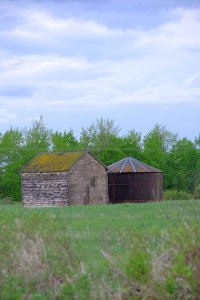
Here's an example from my D800E.

I was looking at backlit granaries in a grassy field last weekend, with a partly cloudy sky.
I was using my d800e with 70-200. As I framed the shot I was looking around at the 3 main elements in the scene and noting their relative brightness to each other, within the VF. Within the constraint of the optical VF, it's easy to do that.

I could clearly see all the cloud detail in the viewfinder
I could clearly see all the detail of the granaries' shadow sides simultaneously
I could clearly see the grass detail as well.
This scene did not, visually, appear to have a lot of DR. But it does have enough to make the camera's standard tone-curve/gamma interpretation for jpg appear flawed when shooting it.

If you expose to retain the cloud detail without clipping, the shadowed structures look too dark compared to how they look by eye.
If you expose a little more to bring up the structures' shadow area to look like it appeared in the viewfinder, the highlights get clipped.
After last week's discussion of how things look to the eye, I was suprised to see just how much my organic visual system was compressing the DR of this scene compared to the camera's (jpg) response.

There was no "correct exposure" for nailing this scene in one shot using the standard curves that produced the OOC jpg. It had to be exposed to retain highlight detail and the darker areas will have to be brought up in post in order that it should look at is appeared to my eyeball looking at the real scene at the time of the shot.
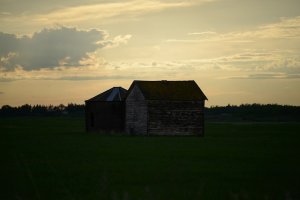
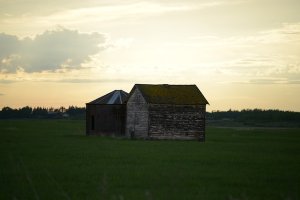
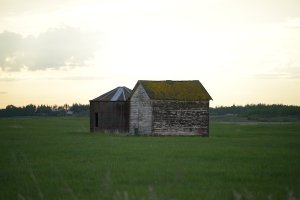
Just using the exif data from the jpgs I use to catalog a shoot, the granaries and grass were about 1.5 stops too dark compared to the sky. I manually bracketed 2 stops with 3 shots. I'll use the one without highlight clipping and tweak the shadows and midtones in post so it looks closer to how it did in reality

to my eye:
- 1154 was very close to how the sky looked in the VF, reality was a tad brighter, maybe 1/3 stop
- 1153 is still a little too dark for how the grass and granaries looked
- 1152 was is slightly brighter than how the granaries looked but very close for the grass

All are ISO 100, f/4
shutter :1154=1/1250, 1153-1/640, 1152=1/320

So, even without a very challenging scene to shoot, some manipulation in post is required to adjust the image to make it look close to reality by lifting shadows to the point of low-midtones. Most cameras can cope with this small amount of shadow push without any FPN issues.
if I wanted to push hard enough to see what's inside of the open door of the round granary, then the Exmor sensor gives a better chance but that would be merely experimental as I could see no detail, with my eye, beyond that doorframe.

 

Attachments

  • 1154.jpg
    1154.jpg
    47.7 KB · Views: 602
  • 1153.jpg
    1153.jpg
    50.3 KB · Views: 554
  • 1152.jpg
    1152.jpg
    49.1 KB · Views: 593
Upvote 0
From a different perspective, a change of less than 90 degrees shows how relatively flat the lighting was otherwise... Altho this was shot with a Fuji. EDIT - within about 1 minute of the last shot with the D800.
 

Attachments

  • 0393.jpg
    0393.jpg
    77.6 KB · Views: 579
Upvote 0
neuroanatomist said:
LetTheRightLensIn said:
johnf3f said:
OK I give up! - "Why isn't Canon working on DSLRs with higher dynamic range"??????
Am I missing something? I have yet to have problems with the Dynamic range capabilities of any Canon DSLR that I have owned.
Am I just exposing properly?
You are simply just shooting scenes that don't have a lot of DR and avoiding all the ones that do.

I've shot many scenes where the 11-12 stops of DR my Canon sensor could capture was insufficient. However, for the vast majority of those scenes, the 13-14 stops of DR from a SoNikon sensor would also have been insufficient.

Well I've encountered numerous where the extra 2-3 stops would help a lot.
 
Upvote 0
Ah, you guys and your 12-14 stops. :P Little ppls with their little bits of DR.

Here's a glimpse at the big leagues. Try this:

Original 50 frame integration of 270 second exposures, calibrated with a master bias (180 frames), master dark (50 frames), and master flat (30 frames) [grand total exposure time across all frames of ~8hrs):
L7zdemI.jpg


After stretching that totally BLACK image by some 20, 25 stops, and two days worth of post processing with the most advanced noise reduction and data extraction tools on the planet:
RYxS740.jpg


Fourteen stops. HAH! I fart in the general direction of your fourteen stops! And Laugh. MUHAHAHAHAHAAAA!
 
Upvote 0