johnf3f said:
OK I give up! - "Why isn't Canon working on DSLRs with higher dynamic range"??????
Am I missing something? I have yet to have problems with the Dynamic range capabilities of any Canon DSLR that I have owned.
I have used several Nikons (D800/800E + others) that are alleged to have increased Dynamic Range but, frankly, I was not too impressed wit the results, lenses perhaps? I read that they have higher DR at low ISO - perhaps they do - but I was not impressed by the overall IQ.
I am not saying that my cameras are perfect, but what I am saying is that they have yet to let me down in the DR department.
Am I just exposing properly?
Could be a different tone/gamma curve that makes things pop or look more appealing from your Canon compared to other bodies.
Here's an example from my D800E.
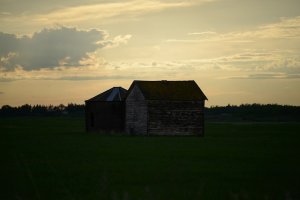
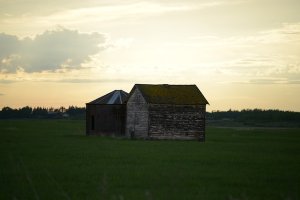
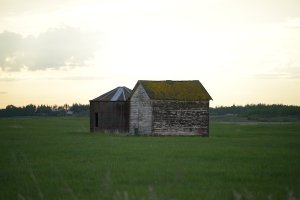
I was looking at backlit granaries in a grassy field last weekend, with a partly cloudy sky.
I was using my d800e with 70-200. As I framed the shot I was looking around at the 3 main elements in the scene and noting their relative brightness to each other, within the VF. Within the constraint of the optical VF, it's easy to do that.
I could clearly see all the cloud detail in the viewfinder
I could clearly see all the detail of the granaries' shadow sides simultaneously
I could clearly see the grass detail as well.
This scene did not, visually, appear to have a lot of DR. But it does have enough to make the camera's standard tone-curve/gamma interpretation for jpg appear flawed when shooting it.
If you expose to retain the cloud detail without clipping, the shadowed structures look too dark compared to how they look by eye.
If you expose a little more to bring up the structures' shadow area to look like it appeared in the viewfinder, the highlights get clipped.
After last week's discussion of how things look to the eye, I was suprised to see just how much my organic visual system was compressing the DR of this scene compared to the camera's (jpg) response.
There was no "correct exposure" for nailing this scene in one shot using the standard curves that produced the OOC jpg. It had to be exposed to retain highlight detail and the darker areas will have to be brought up in post in order that it should look at is appeared to my eyeball looking at the real scene at the time of the shot.
Just using the exif data from the jpgs I use to catalog a shoot, the granaries and grass were about 1.5 stops too dark compared to the sky. I manually bracketed 2 stops with 3 shots. I'll use the one without highlight clipping and tweak the shadows and midtones in post so it looks closer to how it did in reality
to my eye:
- 1154 was very close to how the sky looked in the VF, reality was a tad brighter, maybe 1/3 stop
- 1153 is still a little too dark for how the grass and granaries looked
- 1152 was is slightly brighter than how the granaries looked but very close for the grass
All are ISO 100, f/4
shutter :1154=1/1250, 1153-1/640, 1152=1/320
So, even without a very challenging scene to shoot, some manipulation in post is required to adjust the image to make it look close to reality by lifting shadows to the point of low-midtones. Most cameras can cope with this small amount of shadow push without any FPN issues.
if I wanted to push hard enough to see what's inside of the open door of the round granary, then the Exmor sensor gives a better chance but that would be merely experimental as I could see no detail, with my eye, beyond that doorframe.



 Sometimes debate is healthy...
 Some people are just too thick to let the facts soak into their skulls. I'm just responding to the call: